
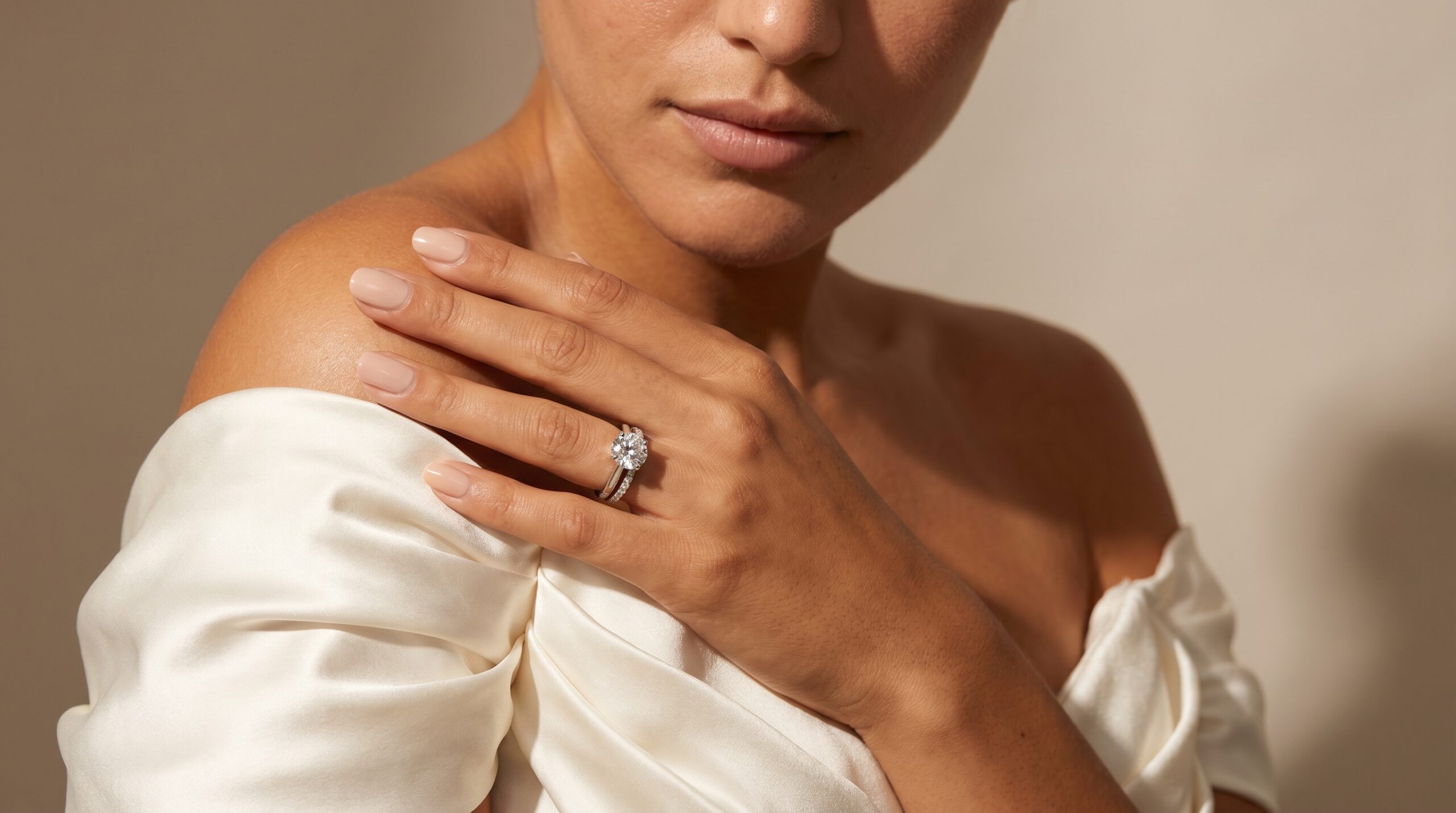
A wedding band can look perfect on its own and still sit wrong next to an engagement ring. The stone catches on the metal, a gap opens up along one side, or the two rings just look mismatched in scale. None of this means the band was a bad choice in isolation. It means the pairing wasn’t evaluated the way it needed to be: shape against shape, height against height, metal against metal.
There’s no single band that works with every engagement ring. The right match depends on the setting style, the profile height of the center stone, the metal, the width, and how the two rings will actually sit on the finger when worn together every day. This guide walks through each of those factors so you can make that decision with some confidence instead of guessing.
Why Matching Your Wedding Band Matters
The Goal Is a Balanced Bridal Set
When a wedding band and engagement ring are matched well, they read as one set rather than two separate rings that happen to be worn on the same finger. That means the metals look intentional together, the widths feel proportional, and the bands sit close enough that there’s no visible daylight between them. It also means the rings can be worn daily without one constantly pushing against the other.
What Can Go Wrong With a Poor Match
A few problems show up repeatedly when a band and ring aren’t matched carefully:
- A visible gap between the two rings, usually where a halo, cathedral setting, or large center stone raises the engagement ring off the finger
- Rotation, where the wedding band spins around the finger because nothing is holding it in place against the engagement ring
- Scratching or wear on the metal where the two bands rub against each other
- A wedding band that looks too thick or too thin next to the engagement ring
- Discomfort from stacking two rings that weren’t designed to sit next to each other
Good match: the bands sit flush, the metals and finishes align, and the width of the wedding band feels proportional to the engagement ring.
Poor match: there’s a gap under the center stone, the wedding band is noticeably wider or narrower than the engagement ring’s shank, or the two metals clash instead of complementing each other.
Start With Your Engagement Ring Setting
The setting on your engagement ring, more than any other factor, determines what kind of wedding band will actually sit well next to it.
Low-Profile Solitaire Rings
A solitaire with a simple prong or bezel setting and a low profile height usually pairs well with a straight band. There’s nothing underneath the setting for a straight edge to catch on, so the two rings can sit side by side without a gap.
Halo or Elevated Settings
A halo setting, or any setting that raises the center stone well above the finger, often leaves a gap when paired with a straight band. A curved, nesting, or contour band is usually the better fit because it’s shaped to follow the outline of the halo or the base of the setting instead of running straight across it.
Oval, Pear, and Marquise Rings
Fancy-shaped center stones, especially oval, pear, and marquise cuts, often sit in settings with curved or pointed baskets underneath. A straight band can leave a wedge-shaped gap on one or both sides. A contour band shaped to the specific silhouette of the stone closes that gap.
Vintage Engagement Rings
Vintage and vintage-inspired rings often include milgrain edging, filigree, or engraved detail. A wedding band that echoes one of those details, rather than a plain modern band, tends to look more intentional next to it, though this is a style preference rather than a fit requirement.
Engagement Ring Style and Recommended Wedding Band
| Engagement Ring Style | Typically Works With | Often Needs to Be Avoided | Why |
| Low-profile solitaire | Straight band | Heavily curved contour band | Nothing beneath the setting to nest around |
| Halo | Curved or contour band | Wide straight band | Straight edges leave a gap around the halo |
| Oval or pear | Shaped contour band | Generic straight band | Basket shape doesn’t match a straight edge |
| Cathedral setting | Notched or curved band | Flat straight band | Cathedral arms need a band that follows their curve |
| Vintage with milgrain | Band with matching detail | Plain modern minimalist band | Detail continuity, not a fit issue |
Straight Band vs Contour Band
What Is a Straight Band?
A straight band is a traditional ring with a consistent, unbroken shape all the way around, with no curve built in to accommodate another ring.
What Is a Contour Band?
A contour band is shaped with a notch, curve, or dip designed to follow the outline of a specific engagement ring so the two sit close together with minimal gap.
Which One Should You Choose?
This comes down to the setting height and the shape of the center stone. A low-profile solitaire rarely needs a contour band. A halo, a raised cathedral setting, or an unusually shaped stone usually does. If you’re not sure, try both rings on together before deciding. A gap that’s barely noticeable when the engagement ring is worn alone can look obvious once the wedding band is next to it.
| Best For | Fit Style | Visual Effect | Considerations | |
| Straight band | Low-profile solitaires, simple round or square settings | Runs alongside the engagement ring without shaping | Clean, classic line | May leave a gap under raised or fancy-shaped settings |
| Contour band | Halos, cathedral settings, oval or pear stones | Curves or notches to follow the engagement ring’s outline | Close, nested look | Usually needs to be matched to the specific engagement ring, sometimes custom |
How to Match Metals and Finishes
Should Your Wedding Band Metal Match Your Engagement Ring?
Matching the metal color and type of your wedding band to your engagement ring creates a consistent look and avoids the visual competition that can happen when two different metal tones sit side by side. It also means the two bands wear at a similar rate, since different metals have different hardness and different resistance to scratching. The GIA gem encyclopedia covers how metal composition affects durability and wear over time, which is worth understanding if you’re combining metals that age differently.
Can You Mix Metals?
Mixed metals can work, but it should be a deliberate choice rather than an accident of buying two rings separately without checking how they’d look together. A rose gold wedding band next to a platinum engagement ring can look intentional and layered, or it can look like the rings don’t belong together, depending on the design and how the two metals are balanced in weight and finish.
Match the Finish Too
Metal color is only part of the equation. A high-polish engagement ring next to a matte or brushed wedding band can look mismatched even if the underlying metal is identical. If you want the two rings to read as a set, check that the finish, whether polished, matte, brushed, hammered, or detailed with milgrain, is either matched or paired with intention.
Match Width, Height, and Proportion
Why Width Matters
A wedding band that’s much wider or much narrower than the engagement ring’s shank throws off the visual balance of the stack. A very thin engagement ring next to a wide statement wedding band can look like the wedding band is overpowering the piece it’s supposed to be complementing.
General Width Guidance
Keeping the width of the wedding band within roughly a millimeter of the engagement ring’s shank width tends to keep the stack looking proportional. This isn’t a strict rule. Some people prefer a deliberately wider or narrower band for a layered look, and that’s a design choice, not a mistake. But if you want the two rings to look like a matched pair, a close width match is the more reliable starting point.
Profile Height and Stack Comfort
Profile height refers to how far the ring rises off the finger. A high-profile engagement ring, meaning one where the setting sits noticeably elevated, needs a wedding band that either accounts for that height with a contour shape or is worn with the understanding that there may be some visible space underneath the setting. Checking profile height matters as much for comfort as for looks. According to GIA, understanding how a setting is constructed, including how high it sits, is part of evaluating how a ring will wear day to day.
Matching Diamond Bands to Engagement Rings
Pavé Bands
A pavé band, set with small diamonds close together along the surface, adds sparkle without competing with the engagement ring’s center stone. It’s a common choice because the scale of the diamonds is usually modest enough to complement rather than overpower.
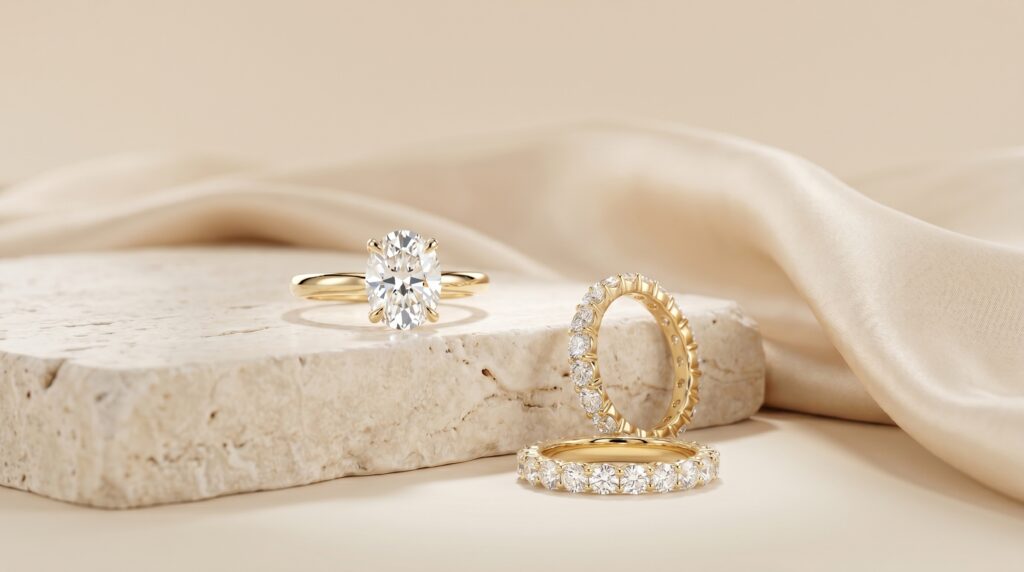
Eternity Bands
An eternity band, set with diamonds all the way around the shank, gives a fuller, more consistent line of sparkle. The tradeoff is practical: a band set with stones all the way around can be harder to resize later, since resizing typically requires cutting and altering the shank, which can affect stones set close to the cut point.
Half Eternity Bands
A half eternity band sets diamonds across the top half of the ring, leaving the bottom plain. This gives much of the visual effect of a full eternity band while keeping a plain section of metal available for resizing, which makes it a more practical option for many buyers.
Matching Diamond Size and Setting Style
The diamonds on a wedding band should feel proportional to the engagement ring’s center stone rather than competing with it. A large, bold engagement ring can usually handle a wedding band with more noticeable stones, while a smaller or more delicate engagement ring often looks better with a band set with smaller accent diamonds.
| Band Style | Sparkle Level | Resizing | Best For |
| Pavé | Moderate, evenly distributed | Generally straightforward | Classic pairing with most engagement ring styles |
| Full eternity | High, continuous around the band | More limited due to stones set all the way around | Buyers who don’t anticipate needing to resize |
| Half eternity | Moderate to high on the visible portion | Easier than full eternity, plain metal available at the back | Buyers who want the look with more practical flexibility |
How to Avoid Gaps Between Rings
What Causes Gaps?
Gaps most often show up under:
- Low basket settings, where the metal cradling the stone sits close to the finger and leaves little room for a straight band to tuck underneath
- Large center stones that widen the base of the setting
- Halo settings, where the ring of accent stones extends the footprint of the ring beyond the center stone itself
- Cathedral designs, where the metal arms rise up on either side of the stone
- Unusual stone shapes, like marquise or pear, that don’t follow a simple round or square outline
Solutions for a Better Fit
A contour band, shaped specifically to the engagement ring, is the most direct fix. An open band, which has a gap built into its own design to accommodate the engagement ring’s setting, is another option for certain styles. For engagement rings with unusual proportions, a custom nesting band, made to the exact measurements of that specific ring, closes gaps that no ready-made band could account for. In some cases, a slim spacer band placed between the two rings can also fill a small gap, though this adds a third ring to the stack rather than solving the fit between the original two.
Signs You May Need a Contour Band
- There’s a visible gap when you hold the wedding band up against the engagement ring
- The engagement ring has a halo, cathedral, or raised basket setting
- The center stone is oval, pear, marquise, or another non-round shape
- The wedding band shifts or rotates because nothing is holding it against the engagement ring
Ready-Made vs Custom Wedding Bands
When Ready-Made Works Well
A ready-made band is usually enough for a simple solitaire or a standard round or princess-cut setting with a low profile. These shapes are common enough that manufacturers design standard bands to pair with them.
When Custom Is Worth Considering
Custom contouring becomes more useful for halo settings, vintage rings with unusual proportions, elevated cathedral settings, or fancy-shaped stones where a ready-made band is unlikely to close the gap cleanly. This isn’t a rule that every unusual ring needs a custom band, but it’s the category of ring where custom work solves a problem that off-the-shelf options often can’t.
What Custom Contouring Should Achieve
A well-made custom band should sit close to the engagement ring without a visible gap, feel comfortable enough to wear daily without pinching or shifting, keep the proportions of the two rings balanced, and hold its position on the finger without needing to be readjusted throughout the day.
How to Buy a Matching Wedding Band Online
Product Details to Look For
Before buying a wedding band online, check that the listing includes the band width in millimeters, the profile height, the metal type, the finish, and ideally photos or video showing the band stacked next to an engagement ring similar in style to yours. Contour diagrams, if the retailer offers custom or shaped bands, help confirm the band will actually follow the shape of your specific setting.
Online Buying Red Flags
Be cautious of listings with only generic stock photography and no images of the band worn or stacked, no width or profile height measurements listed, no guidance on how the band is meant to fit against different engagement ring styles, and no clear resizing or return policy if the fit turns out to be wrong.
Online Buying Confidence Checklist
- Band width and profile height listed in millimeters
- Metal type and finish specified
- Photos or video showing the band stacked with an engagement ring
- Clear resizing and return policy
- Contour or custom options available if your engagement ring has an unusual shape
Care Tips for Wearing Rings Together
Clean Stacked Rings Regularly
Lotion, soap, and everyday dirt build up between two rings worn together more than they do on a single ring, since there’s less airflow and more surface contact between the bands. Regular cleaning keeps that buildup from dulling the metal or, in the case of diamond bands, blocking light from reaching the stones.
Schedule Professional Inspections
An annual inspection can catch prong wear, loosening settings, or contour alignment issues before they lead to a lost stone or a band that no longer sits flush. The American Gem Society is a professional organization that can help you find a qualified jeweler for this kind of inspection.
Store Rings Carefully
When you’re not wearing your rings, store them separately in soft, lined compartments rather than tossing them together in a single dish or drawer. Two rings resting against each other, especially if one has exposed prongs or a textured finish, can scratch the softer metal on the other.
Frequently Asked Questions
Do I need a contour wedding band?
It depends on your engagement ring’s setting. A low-profile solitaire usually pairs fine with a straight band. A halo, cathedral setting, or fancy-shaped stone like an oval or pear often leaves a visible gap with a straight band, which is where a contour band becomes useful. The only way to know for certain is to hold the two rings together before buying, or check whether the retailer offers a fit guarantee.
Should my wedding band sit flush with my engagement ring?
Flush fit, meaning the two rings sit closely together without a visible gap, is generally the goal for both appearance and comfort. A gap between the rings can catch on clothing, allow the wedding band to shift out of position, and create an uneven look. That said, a small amount of space isn’t a functional problem for everyone, and some people prioritize other design elements over a perfectly flush fit.
Can I wear a straight band with a halo engagement ring?
You can, but it’s more likely to leave a gap along the outer edge of the halo than a contour band would. Some people are fine with that gap, especially if the halo is small or the band is worn loosely as a stack rather than pushed directly against the engagement ring. If a close, gapless look matters to you, a contour or curved band designed for halo settings is the more reliable choice.
Should my wedding band metal match my engagement ring?
Matching metal color and type creates a more cohesive look and means the two rings wear at a similar rate over time, since different metals resist scratching and tarnishing differently. Matching isn’t mandatory, but it’s the more predictable choice if your goal is a set that reads as one unit rather than two separate rings.
Can I mix platinum and gold?
Yes, and it can look intentional and layered when done with some planning. The risk is that platinum and gold wear differently over time and can develop a visible contrast in finish that wasn’t part of the original design. If you mix metals, it helps to choose the combination deliberately rather than pairing two rings that happened to be bought separately without checking how they’d look and wear together.
What width should my wedding band be?
Keeping the wedding band within about a millimeter of your engagement ring’s shank width tends to keep the two rings looking proportional. This is a general guideline rather than a fixed rule. Some people choose a wider or narrower band on purpose for a layered or asymmetric look, which is a valid design choice as long as it’s intentional.
Are eternity bands hard to resize?
Often, yes. Because an eternity band is set with diamonds all the way around the shank, resizing usually requires cutting into a section that has stones close to the cut point, which limits how much the ring can be resized without risking the setting. A half eternity band, which leaves the bottom portion plain, is generally easier to resize because there’s unset metal available to work with.
Can a wedding band be custom-made to match my engagement ring?
Yes. A jeweler can measure your specific engagement ring and shape a wedding band to follow its exact contour, which is often the most reliable way to eliminate a gap around an unusual setting or fancy-shaped stone. Custom contouring is generally more relevant for halo, cathedral, or fancy-shaped rings than for simple low-profile solitaires, which usually pair well with a standard band.