
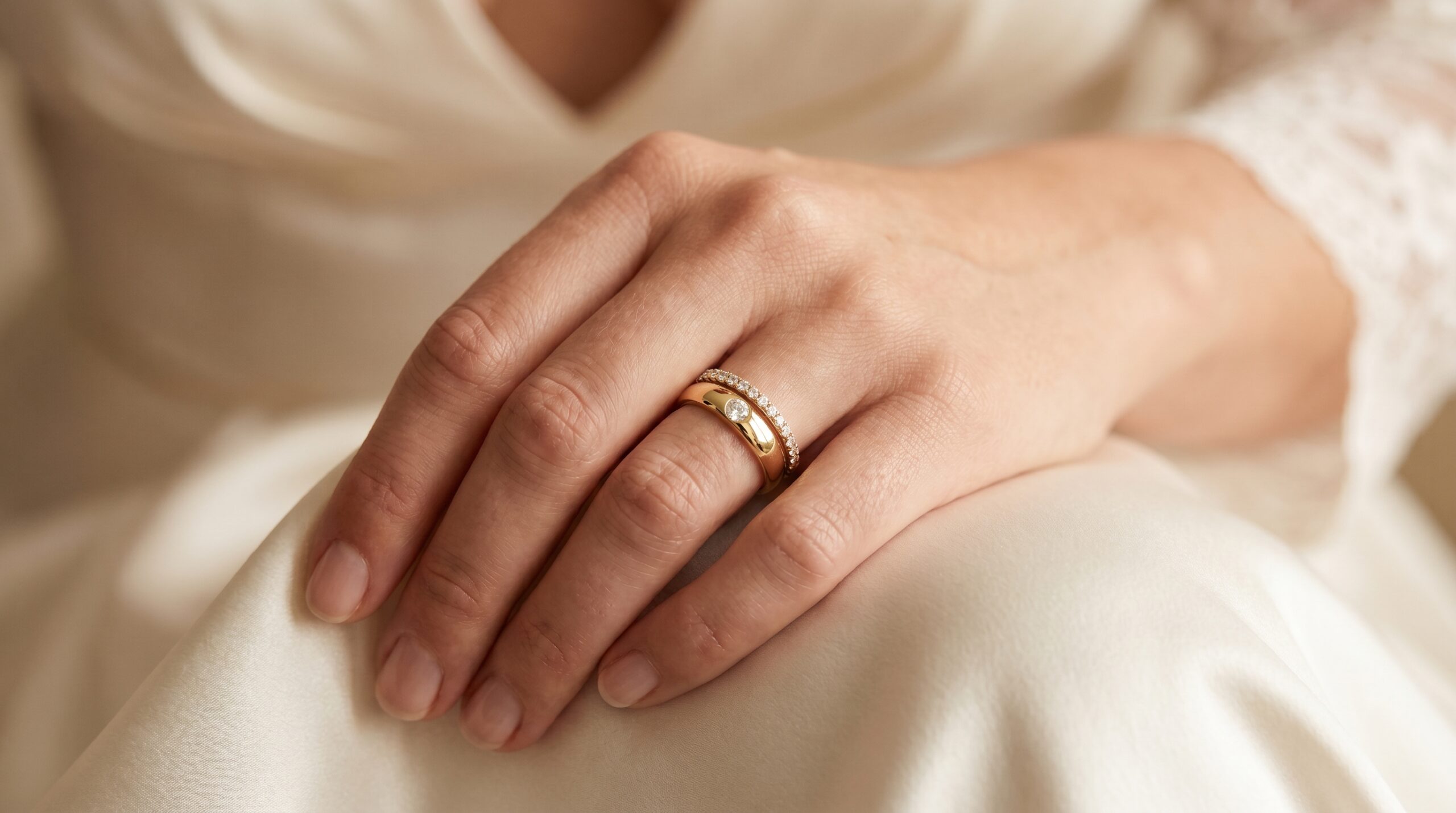
Choosing a wedding band comes down to one real question: which style will look right next to your engagement ring and still feel good on your hand every day for years? That’s a different problem than picking the prettiest ring in a display case. A band that photographs beautifully but rubs against your knuckle or catches on a prong won’t get worn for long.
The differences between plain, pavé, eternity, curved, and vintage-inspired bands aren’t just aesthetic. They affect how the ring fits with your engagement ring, how much upkeep it needs, and how it holds up against a decade of hand washing, gym sessions, and typing.
What Defines a Women’s Wedding Band Style?
More Than a Matching Ring
A wedding band isn’t just a smaller, simpler version of an engagement ring. Its style comes from a handful of specific choices: width, metal, surface finish, whether it carries stones, whether the profile is straight or curved, and how well it sits against the engagement ring it will be worn with.
Two bands can use the same metal and carat weight of diamonds and still wear completely differently, because the setting style and profile shape change how the ring sits on the finger and how it interacts with everyday movement.
Common Style Categories
Most women’s wedding bands fall into five broad categories: plain bands, eternity bands, pavé bands, curved or chevron bands, and vintage milgrain bands. Retailers sometimes combine these, such as a curved pavé band or a milgrain-edged plain band, but understanding each category on its own makes it easier to evaluate combinations.
Popular Women’s Wedding Band Styles
Plain Wedding Bands
A plain band is a continuous ring of metal with no stones, in a rounded, flat, or slightly domed profile. It’s the lowest-maintenance option because there are no prongs to check, no small stones to lose, and no channel to collect dirt.
Plain bands work well for people whose hands are in and out of water, gloves, or gym equipment throughout the day. The tradeoff is that they don’t add sparkle, so someone who wants the wedding band itself to carry visual weight may find a plain style too understated on its own.
Eternity Bands
Eternity bands set diamonds either around the full circumference of the ring (full eternity) or partway around, typically across the top half that faces outward (half eternity). Full eternity bands give a continuous line of sparkle from any angle, including when the hand is turned to face inward.
The tradeoff is resizing. Because the diamonds run the full circle, a jeweler can’t simply cut and stretch or shrink the shank the way they can with a plain band. Resizing a full eternity band often means removing and resetting stones, which is more expensive and not always possible without altering the design. A half eternity band, with plain metal on the underside, is easier to resize because that bottom portion has no stones to disturb.
Pavé and Micro-Pavé Bands
Pavé bands set small diamonds close together across the surface of the band, secured with tiny shared prongs, so the metal underneath is barely visible. Micro-pavé uses even smaller stones set with finer prongs for a denser, smoother look.
The visual effect is a soft, continuous shimmer rather than the more defined line of individual larger stones. Because the prongs holding pavé diamonds are small, they’re more prone to catching on fabric, hair, or tools, and any one prong wearing down can eventually let a stone loosen. The American Gem Society recommends periodic professional inspection for pavé and other prong-set jewelry to catch loose stones before they’re lost.
Curved and Chevron Bands
Curved bands, sometimes called contour or notched bands, are shaped to follow the outline of a specific engagement ring rather than sitting as a straight circle. Chevron bands use a V-shaped notch for a similar purpose. Both styles exist to solve one problem: an engagement ring with an elevated setting, a halo, or an asymmetric silhouette can leave a visible gap when paired with a straight wedding band.
A curved band works like a frame built for a specific shape. It won’t necessarily fit engagement rings other than the one it was designed or matched for, so buyers who plan to reset or replace their engagement ring later should factor that in.
Vintage Milgrain Bands
Milgrain refers to a fine row of tiny raised beads pressed along the edge of a band, a decorative technique associated with early 20th-century jewelry design. It adds texture and a handcrafted look without requiring extra stones.
Milgrain detailing is applied to the metal itself, not set with stones, so it doesn’t carry the same maintenance concerns as pavé. It can wear down with heavy daily friction over many years, though, and re-application isn’t always straightforward on softer metals.
Women’s Wedding Band Style Comparison
| Style | What It Offers | What to Watch For | Best For |
| Plain | Simple, durable, minimal upkeep | Less visual sparkle on its own | Daily wear, active lifestyles |
| Eternity | Continuous diamond coverage | Full eternity is harder to resize | Buyers who want maximum sparkle |
| Pavé | Soft shimmer across the band | Small prongs need regular checks | Buyers comfortable with routine inspection |
| Curved/Chevron | Nests closely with elevated or halo settings | Often matched to one specific engagement ring | Non-straight or elevated engagement ring designs |
| Vintage milgrain | Beaded, heirloom-style detail | Fine detail can wear down over decades | Buyers who want traditional detailing |
How to Match a Women’s Wedding Band to an Engagement Ring
Straight vs Curved Fit
A straight band works fine against most solitaire and low-profile engagement rings, where the setting sits close to the finger and doesn’t leave much of a gap. Engagement rings with a raised prong setting, a halo, or a curved gallery underneath the center stone are more likely to leave a visible space next to a straight band. That’s the situation curved bands are designed to solve.
Flush Fit and Nesting
Nesting describes how closely two rings sit together when worn side by side, ideally without a gap that catches on things or looks unintentional. A flush fit means the wedding band and engagement ring sit at the same height along the point where they touch, rather than one sitting noticeably higher or lower than the other.
Jewelers can often assess nesting from photos of the engagement ring’s profile, but trying the two rings on together, in person or through a return-eligible online purchase, is the more reliable way to confirm fit.
Matching Metal and Finish
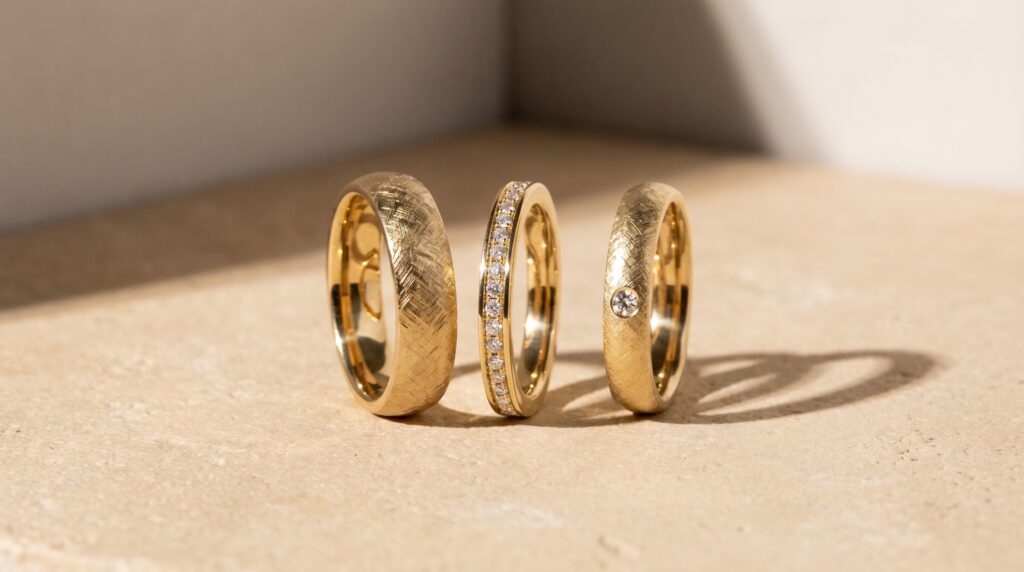
Metal color, karat, and surface finish don’t need to be identical, but noticeable mismatches, such as a high-polish yellow gold engagement ring paired with a brushed white gold band, tend to look unintentional rather than intentional. Karat differences also matter for wear: 14K gold contains a higher proportion of alloy metals than 18K, which generally makes it more scratch-resistant, while 18K gold is softer but has a richer color. Pairing rings of different karats won’t cause damage, but it’s worth knowing they may show wear at slightly different rates over time.
Choosing the Right Width
Common Widths for Women’s Wedding Bands
Women’s wedding bands are typically sold between 2mm and 6mm wide. Narrower widths, around 2mm to 3mm, read as delicate and are common for stacking with an engagement ring. Wider bands, 4mm and up, read as more substantial and are sometimes chosen to be worn alone.
Petite Hands and Narrow Bands
A narrower band, generally in the 2mm to 4mm range, tends to suit smaller hands and shorter fingers proportionally better than a wide band, which can look heavy on a petite hand. That said, going very narrow trades off some structural stability: a thinner shank has less metal to resist bending or warping over years of wear, particularly for people who do manual work or wear rings during exercise.
Stacking and Sizing
When a wedding band is worn stacked against an engagement ring, the combined width of both rings sits across the finger, which can feel tighter than either ring worn alone, even if each one fits correctly by itself. It’s common for jewelers to recommend trying on the full stack, not just the individual rings, before finalizing sizing.
Diamond Settings and Maintenance
Pavé Settings
Pavé settings use small shared prongs to hold closely spaced diamonds with minimal visible metal. The tradeoff for that density of sparkle is more contact points that can wear or catch over time, which is why pavé rings benefit from more frequent inspection than plain or channel-set bands.
Channel Settings
Channel settings secure stones, often baguette-cut, between two parallel metal rails rather than individual prongs. Because the stones are enclosed rather than exposed at the edges, channel-set bands tend to catch on fabric less than pavé or prong settings, which makes them a common choice for people who want visible diamonds with lower daily maintenance.
Eternity Settings
Full eternity settings extend stones around the entire band, while half eternity settings limit stones to the top portion. Beyond the resizing tradeoff already covered, full eternity rings also tend to sit slightly less comfortably against the inside of the finger for some wearers, since the stone settings run continuously rather than leaving a smooth plain section against the skin.
Prong Inspection
Any ring that holds stones with prongs, whether pavé, channel, or eternity, needs periodic inspection because prongs wear down gradually with contact against surfaces throughout the day. The American Gem Society recommends professional jewelry inspections roughly once a year, more often for rings worn daily, to catch loosening before a stone is lost.
Lifestyle and Daily Wear Considerations
Someone who works with their hands, exercises frequently, or simply prefers not to think about their ring day to day is usually better served by a plain band or a low-profile channel setting, both of which have fewer points that can catch or loosen. Someone prioritizing sparkle over low maintenance may prefer pavé or eternity styles and accept the tradeoff of more frequent checking. For engagement rings with elevated or halo settings, a curved or chevron band solves a fit problem that a straight band, no matter how well made, generally can’t.
None of these are universal rules. A pavé band can hold up fine for someone willing to have it checked twice a year, and a plain band can look underwhelming to someone who specifically wants visible diamonds. The right choice depends on how much upkeep someone is willing to do and how much sparkle they actually want, not on which style is objectively “better.”
Buying Women’s Wedding Bands Online
Product Details to Look For
Before buying a band online, confirm the width in millimeters (not just a size label like “thin” or “classic”), the metal type and karat, the finish (polished, brushed, or hammered), whether the band has a curved or straight profile, any resizing limitations, and, for eternity styles, whether the setting is full or half.
Visuals That Build Confidence
Photos that show the band nested against a comparable engagement ring, a side profile view, and real product photography rather than only rendered images make it easier to judge fit and finish before the ring arrives.
Red Flags
Listings without millimeter width measurements, without any resize information, or with only rendered stock imagery and no nesting photos make it harder to know what will actually arrive. For eternity bands specifically, a listing that doesn’t specify full or half eternity leaves out a detail that affects both appearance and future resizing options.
Care and Maintenance
Clean bands weekly with mild soap and warm water, using a soft brush to reach under stones and along the underside of the shank where oils and lotion residue build up. Avoid harsh chemicals, which can dull certain finishes or, in some cases, damage softer metals over time.
Have pavé, eternity, and other prong-set bands professionally inspected roughly once a year, or more often if worn daily, so a jeweler can catch a loosening prong before it results in a lost stone.
Store stacked rings separately, rather than piled together in one dish or pouch, to reduce the chance of diamonds scratching the metal of an adjacent ring. Diamonds are harder than gold, platinum, or silver, so contact between rings over time can leave visible scratches on softer surfaces.
Choosing between these styles isn’t about finding the objectively best option. It’s about matching the tradeoffs, sparkle versus upkeep, delicate versus sturdy, straight versus curved, to how the ring will actually be worn. A band that fits the engagement ring well, sits at a comfortable width, and matches how often someone is realistically willing to have it checked will hold up better than one chosen on looks alone.
Frequently Asked Questions
What is the most popular women’s wedding band style?
Plain and pavé bands are both common choices, though popularity varies by region and by how the engagement ring is set. Plain bands remain popular for their low maintenance and versatility, while pavé and eternity styles are common among buyers who want a wedding band that adds its own sparkle rather than acting purely as a complement to the engagement ring.
Should my wedding band sit flush with my engagement ring?
A flush, gap-free fit is generally preferred because it reduces the chance of the two rings shifting or catching on each other during daily wear, and it tends to look more intentional. It isn’t strictly required. Some engagement ring settings, particularly low-profile solitaires, sit close enough to the finger that a straight band pairs cleanly without needing a curved or notched profile.
Are eternity bands hard to resize?
Full eternity bands, which carry diamonds around the entire circumference, are more difficult and expensive to resize than plain bands because the shank can’t simply be cut and adjusted without disturbing the stones. Half eternity bands, which leave the bottom portion of the shank plain, are easier to resize since a jeweler can work with the stone-free section.
Is pavé suitable for everyday wear?
Pavé bands can hold up to daily wear, but they require more attention than plain bands. The small shared prongs holding each stone can wear down or catch on fabric over time, so pavé rings benefit from more frequent professional inspection to catch a loose stone before it’s lost.
What width should a women’s wedding band be?
Most women’s wedding bands range from 2mm to 6mm. Narrower widths, generally 2mm to 4mm, tend to suit smaller hands and stack more easily with an engagement ring, while wider bands offer more structural stability and are often chosen to be worn on their own. There’s no single correct width; it depends on hand size, whether the ring will be stacked, and personal preference.
Do I need a curved wedding band?
Not necessarily. A curved or chevron band solves a specific fit problem: an engagement ring with an elevated, halo, or asymmetric setting that would otherwise leave a visible gap next to a straight band. If the engagement ring sits low and close to the finger, a straight band typically pairs without issue.
Should my wedding band metal match my engagement ring?
Matching metal color and karat generally creates a more cohesive look, but it isn’t a requirement. Noticeable finish mismatches, such as pairing a high-polish surface with a heavily brushed one, tend to look more accidental than intentional, while similar karats also wear at similar rates over time.
Are vintage-style bands durable?
Vintage-inspired details like milgrain are applied to the metal itself rather than set with separate stones, so they don’t carry the same loose-stone risk as pavé or eternity settings. The fine beaded texture can gradually wear down with decades of daily friction, though re-application isn’t always simple depending on the metal and original construction, so it’s worth asking a jeweler about long-term upkeep before buying.