
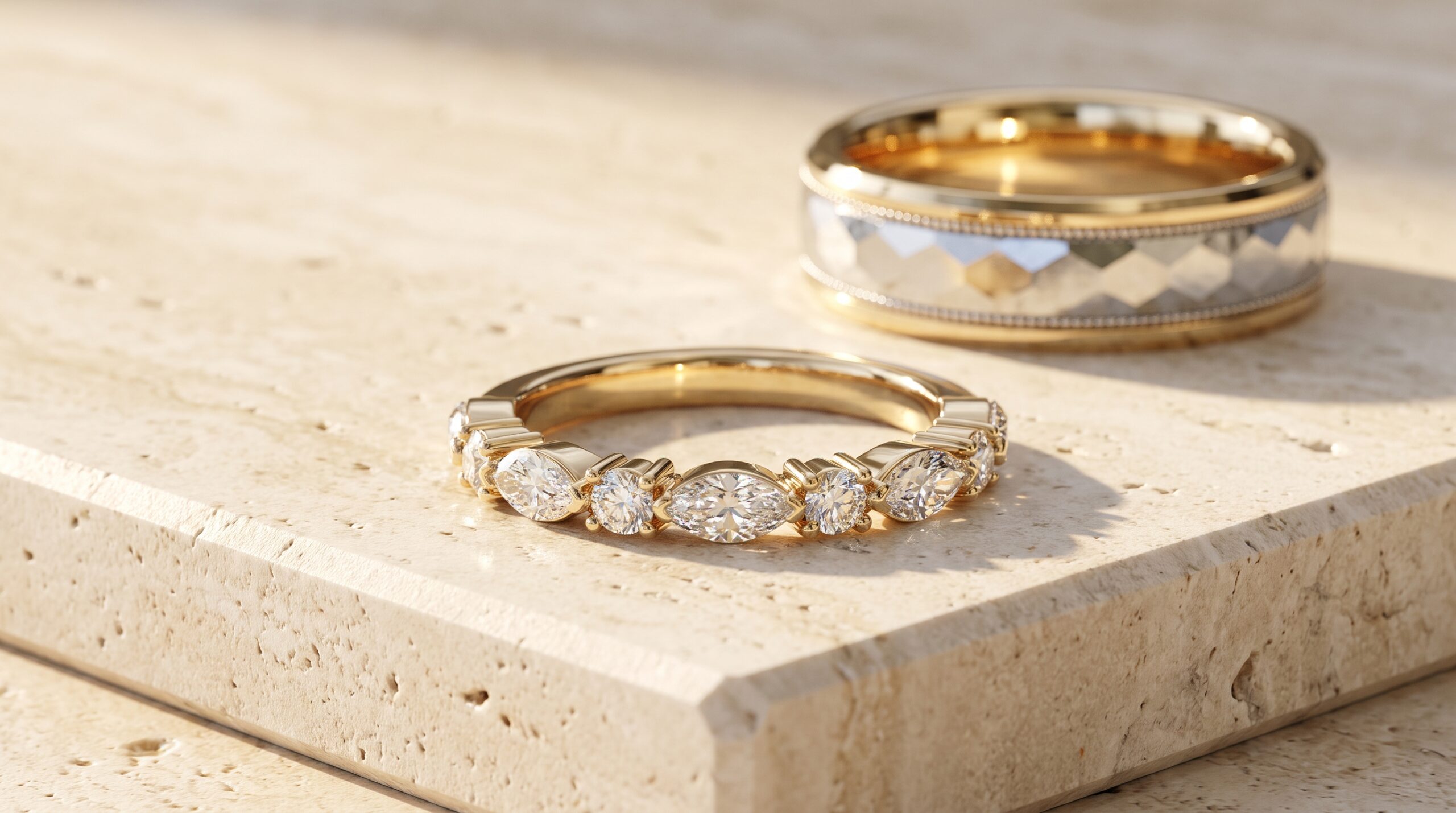
A wedding band gets worn every day for years, which makes the choice between plain metal and diamond-set styles more practical than it first appears. The question isn’t whether one style looks nicer. It’s whether the band fits the hand wearing it, the routine it goes through, and the budget behind it.
Plain bands and diamond bands solve different problems. One prioritizes ease and durability. The other adds sparkle at the cost of some upkeep. Neither is the “correct” default, and the right answer depends on how the ring will actually be worn.
What Is a Plain Wedding Band?
Simple Metal Construction
A plain wedding band is a ring made from a single metal, with no gemstones set into it. Common choices include 14k or 18k gold, platinum, and alternative metals like tungsten or titanium. The surface is smooth and continuous, sometimes finished with a matte, brushed, or hammered texture, but without raised settings or stones to catch on clothing or gloves.
Why Buyers Choose Plain Bands
The appeal comes down to low friction, both literally and figuratively. A plain band has no prongs to snag, no stones to check periodically, and no risk of losing a diamond from daily wear. For someone who works with their hands, gold and platinum alloys used in plain bands are also generally easier to reshape and polish over time, since there’s no stone placement to protect during resizing. The style also holds up over decades without looking dated, since it’s not tied to a particular setting trend.
What Is a Diamond Wedding Band?
Diamond-Set Construction
A diamond wedding band has stones set into the metal, usually running partway or fully around the ring. The three most common settings are pavé (small diamonds set closely together with minimal metal showing), prong (individual stones held by small metal claws), and channel (stones set between two parallel metal rails with no visible prongs). Each setting changes how much the diamonds catch light and how exposed they are to everyday contact.
Why Buyers Choose Diamond Bands
Diamond bands add brilliance that a plain band can’t replicate, which matters to buyers who want their wedding band to read as more ceremonial or who are building a layered bridal stack. They’re also a common choice for buyers who want the wedding band to visually connect with a diamond engagement ring, since matching stone sizes and settings can make the two rings look designed as a pair rather than two separate purchases.
Plain Wedding Bands vs Diamond Bands: Main Differences
| Feature | Plain Band | Diamond Band |
| Appearance | Understated, smooth | Adds sparkle and visual detail |
| Durability | No stone loss risk | Depends on setting security |
| Maintenance | Occasional polishing | Regular cleaning and prong checks |
| Comfort | Smooth surface | Can feel textured depending on setting |
| Cost | Lower, driven by metal weight | Higher, driven by stone count and setting labor |
| Resizing | Usually straightforward | Depends on how much of the band is set with stones |
| Best for | Active hands, minimal style preference | Sparkle, decorative stacking |
Appearance
A plain band reads as understated no matter the metal or finish. A diamond band, even a subtle one like a thin channel setting, introduces visual texture that changes how the ring catches light and how it photographs.
Durability
Plain bands carry no risk of stone loss because there’s nothing set into them to loosen or fall out. Diamond bands are only as durable as their setting. A well-made prong setting checked periodically holds up fine for daily wear, but a poorly secured setting can lose stones over years of contact with hard surfaces.
Comfort
Smooth plain bands have no raised elements to snag on gloves, fabric, or hair. Diamond bands vary: a flush pavé setting sits close to the metal surface and feels similar to a plain band, while a prong setting sits higher and can feel more noticeable against the skin of an adjacent finger.
Cost
Diamond bands cost more than plain bands of comparable metal weight because the price reflects both the stones themselves and the labor of setting them securely. The exact difference depends on cttw (total carat weight across all stones in the band, not the size of a single stone) and the complexity of the setting work.
Pros and Cons of Plain Wedding Bands
| Pros | Cons |
| Smooth for daily wear | No sparkle |
| Generally easier to resize | Can feel too minimal for some bridal stack preferences |
| Lower maintenance | Scratches show more visibly on high-polish finishes |
| Well suited to manual work or active hands | |
| Ages well without looking dated |
Pros and Cons of Diamond Bands
| Pros | Cons |
| Added brilliance | Requires more regular maintenance |
| More decorative, works well in a bridal stack | Costs more due to stone count and setting labor |
| Pairs naturally with a diamond engagement ring | Heavily set styles can have resizing limits |
| Available in pavé, channel, eternity, and contour styles | Prong-set styles need periodic security checks |
Which Style Is Better for Daily Wear?
For Active Lifestyles
If the ring goes through manual work, frequent hand washing, gym sessions, or contact with tools and equipment, a plain band holds up with less to think about. There’s no setting to check and no risk of a stone loosening from repeated impact.
For Sparkle and Formal Styling
If the priority is a coordinated bridal look or a band that reads as more decorative next to an engagement ring, a diamond band delivers that without requiring the buyer to give up daily wearability, as long as the setting is secure and appropriate for the wearer’s routine.
For Mixed Priorities
Buyers who want some sparkle without full maintenance commitment have middle-ground options: a half eternity band (diamonds across the front half only, plain metal on the underside), a channel setting (stones protected between two metal rails rather than exposed prongs), or a low-profile pavé that sits flush against the finger.
Durability and Maintenance Differences
Plain Band Care
Plain bands need cleaning with mild soap and water, occasional professional polishing to remove surface scratches, and little else. There’s no setting to inspect because there’s no setting at all.
Diamond Band Care
Diamond bands benefit from more frequent cleaning to keep facets clear of buildup, along with periodic prong or setting checks. The American Gem Society recommends regular professional inspections for jewelry with set stones, since a loose prong isn’t always visible to the wearer before it results in a lost stone.
What to Avoid
Don’t assume a diamond band is maintenance-free just because it’s described as durable. Durability refers to how well the metal and setting hold up structurally, not how often the ring needs attention.
Resizing and Long-Term Fit
Plain Band Resizing
A plain band can usually be resized up or down within a reasonable range without affecting the ring’s appearance, since there’s no stone placement to preserve.
Diamond Band Resizing
Resizing a diamond band is more constrained. A band with diamonds only on the top portion can often be resized normally, since the resizing work happens on the plain underside. A full eternity band, with diamonds set all the way around, is harder to resize without disturbing the stone spacing, and some jewelers won’t resize them significantly in either direction.
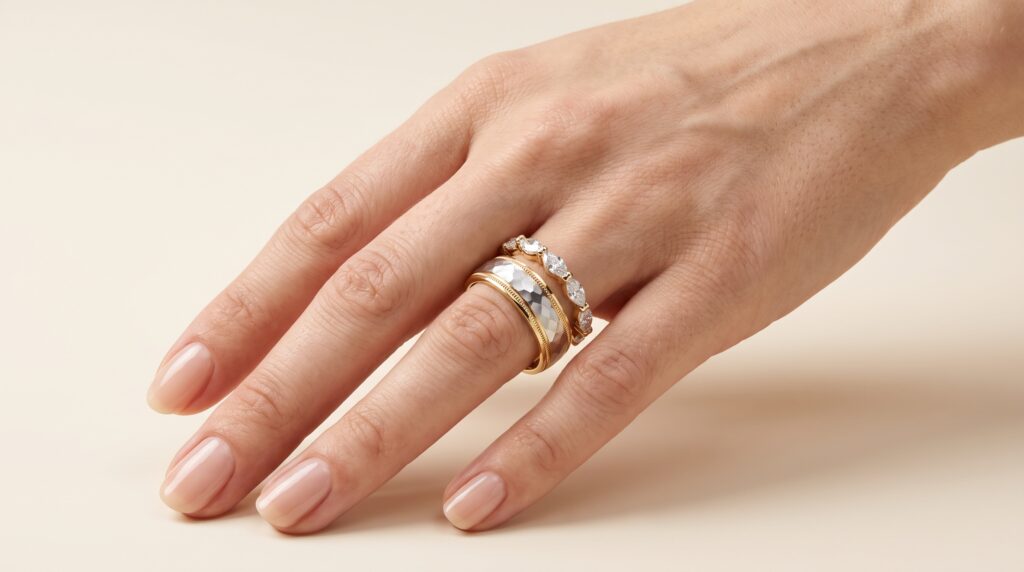
Stacking With an Engagement Ring
Before finalizing a wedding band, try it on stacked with the engagement ring it will be worn alongside. Check that the two rings sit flush, that prongs from one ring don’t catch on the other, and that the pairing rotates comfortably on the finger rather than pinching.
How to Choose Between Plain and Diamond Bands
Choose a Plain Band If
You want lower maintenance, your daily routine involves manual work or frequent hand contact with hard surfaces, you prefer a minimal look, or you want the flexibility to resize the ring easily in the future.
Choose a Diamond Band If
You want visual sparkle, you’re building a layered bridal stack, you’re comfortable with periodic cleaning and setting checks, or you want the band to echo the stone pattern of an engagement ring.
Consider a Middle-Ground Option
Half eternity bands, channel-set diamonds, low-profile pavé, or a plain band with subtle engraving or hammered texture all offer some visual interest without the full maintenance load of a heavily set diamond band.
Buying Plain or Diamond Bands Online
Product Details to Look For
Check the metal type and karat or alloy (a hallmark stamp inside the band is one way manufacturers indicate metal purity, a practice with roots in historical hallmarking standards used to verify precious metal content). Also confirm band width, comfort-fit interior shaping, the setting type for diamond bands, the cttw breakdown, and any stated resizing limitations.
Visuals That Build Confidence
Look for profile views showing the band’s side profile and thickness, stack simulations showing how it sits next to an engagement ring, close-up images of the setting, and real product photography rather than only rendered images.
Red Flags
Be cautious of listings without close-up images, vague diamond descriptions that don’t specify cttw or clarity, claims that a diamond band is “maintenance-free,” unlisted alloy composition, or no information at all about resizing.
Frequently Asked Questions
Are plain wedding bands more durable than diamond bands?
Plain bands carry no risk of stone loss since there’s nothing set into the metal, which makes them structurally simpler over time. Diamond bands can be just as durable in terms of the metal itself, but their overall durability also depends on how securely the stones are set and how often that setting is checked. Neither style is inherently fragile, but a plain band has one less variable to worry about.
Are diamond wedding bands practical for daily wear?
Yes, with some caveats. A diamond band with a secure setting, such as a flush pavé or channel style, can hold up to daily wear reasonably well. Prong-set styles need more attention, since the raised prongs are more exposed to contact with hard surfaces and benefit from periodic professional checks to catch loosening before a stone is lost.
Can diamond bands be resized?
It depends on how much of the band is set with diamonds. Bands with stones only across the top portion can usually be resized using the plain metal on the underside. Full eternity bands, with diamonds set continuously around the ring, are more limited in how much they can be resized without disturbing the stone spacing, and some jewelers cap how far the size can be adjusted.
Do plain gold bands scratch?
Yes. Softer gold alloys, particularly higher-karat gold like 18k, show surface wear more readily than harder alloys or platinum. A high-polish finish will show scratches more visibly than a brushed or matte finish, since the reflective surface highlights any texture change. Occasional professional polishing restores the original finish.
Which style is better for active jobs?
Plain bands tend to work better for jobs involving manual labor, frequent hand washing, or regular contact with tools and equipment. There’s no setting to catch or check, and any surface scratches can be polished out without affecting stone placement. Some buyers in active jobs choose a plain band for daily wear and save a diamond band for occasions when the ring sees less physical use.
What is the difference between pavé and channel diamond bands?
Pavé settings use small diamonds set closely together with minimal metal visible between them, creating a continuous line of sparkle. Channel settings hold diamonds between two parallel metal rails with no prongs exposed, which protects the stones from catching on fabric or other surfaces. Pavé generally shows more brilliance from multiple small stones, while channel settings prioritize stone protection over maximum sparkle.
Are diamond bands worth the extra cost?
That depends on what the buyer values. The added cost reflects the diamonds themselves and the labor of setting them securely, and it buys visual brilliance that a plain band doesn’t offer. For someone who wants a decorative stack or a ring that echoes their engagement ring, that cost delivers a specific result. For someone prioritizing low maintenance and simplicity, the same money might be better spent on a higher metal purity or a more substantial band width in a plain style.
Should my wedding band match my engagement ring?
Matching isn’t required, but it’s a common preference for buyers who want a cohesive look. If the engagement ring has a diamond in a prong or pavé setting, choosing a wedding band with a similar setting style and stone size often creates a stack that reads as coordinated. Buyers who prefer contrast sometimes deliberately pair a plain band with a diamond engagement ring to let the engagement ring stand out on its own.