
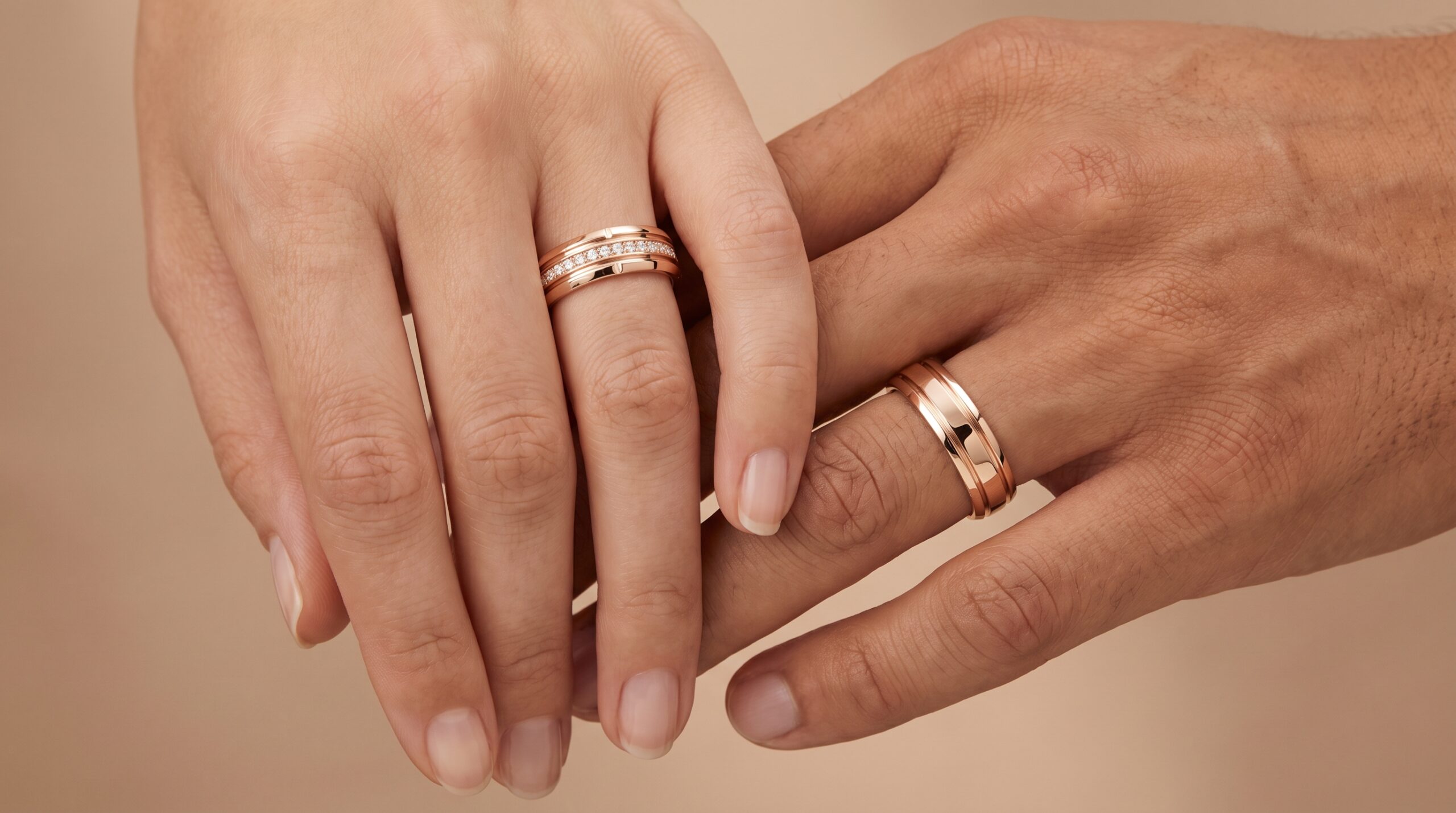
Wedding bands are chosen together but worn separately, on two different hands, through two different daily routines. That’s the tension couples run into when they start shopping for a “matching” set: the rings need to feel connected, but they also need to actually suit the person wearing each one. The good news is that matching doesn’t require identical. It requires a shared design language, which can be built from just one or two consistent details rather than a full duplicate.
What Are Matching Wedding Band Sets?
Matching Does Not Always Mean Identical
A coordinated set can share any combination of metal color, karat, finish, width proportion, a repeated motif like milgrain edging, a similar edge bevel, or a stone setting style echoed at a smaller scale on one ring. None of these require the two bands to be the same width, the same design, or even the same base metal color. A textured yellow gold band and a polished yellow gold band still read as a pair because the metal ties them together, even though the finish differs.
Why Couples Choose Matching Sets
The appeal is straightforward: two rings that share a visible thread feel intentional rather than like two separate purchases made at different times. That’s a matter of personal preference rather than a rule, and plenty of couples choose bands with no shared design element at all and are perfectly happy with the result.
Matching vs Coordinated Wedding Bands
| Approach | What Matches | Best For |
| Identical | Design, width, metal, finish | Couples with similar taste and similar proportions |
| Complementary | Metal and finish, different widths or details | Couples who want unity but need different sizing or styling |
| Metal-only | Metal color and karat, nothing else | Couples with different style preferences or tighter budgets |
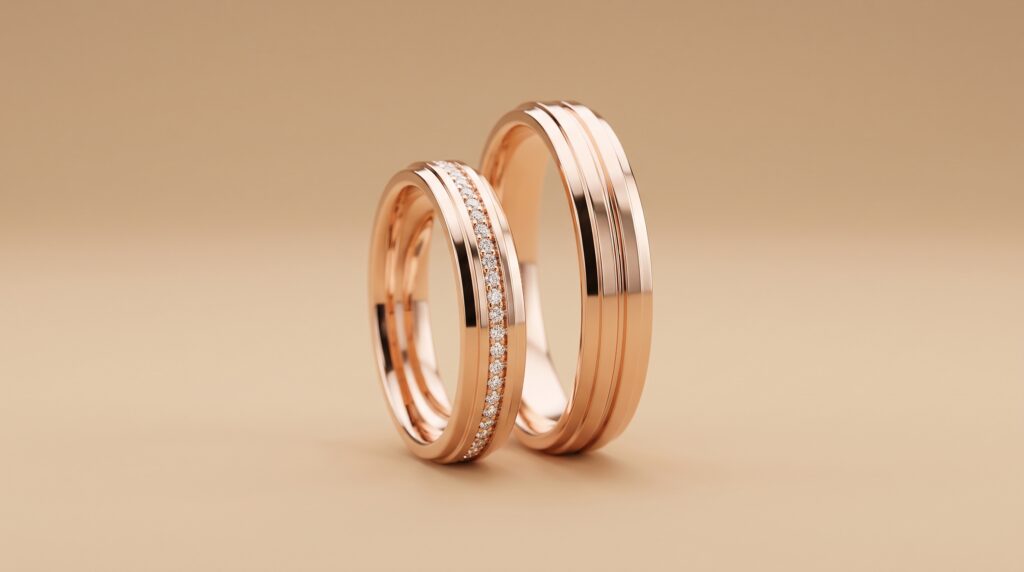
| Diamond motif | A repeated stone or setting detail, not full duplication | Couples where one wants sparkle and the other prefers simplicity |
Identical bands work well when both partners actually like the same width and design, which happens, but isn’t universal. Complementary bands solve the more common situation: one partner wants a slim 3mm band, the other wants a substantial 7mm band, and matching metal and finish is what ties them together instead of matching dimensions. Metal-only matching is the loosest form of coordination and works for couples who want a subtle connection without constraining either ring’s design. Diamond motif coordination lets one ring carry the sparkle, with the other repeating a smaller version of the same setting style, a matching bevel, or a similar engraving, rather than mirroring the stones exactly.
Design Elements That Can Make Rings Feel Coordinated
Metal Type and Color
Yellow gold, white gold, rose gold, and platinum each read differently, and matching color across both rings is one of the simplest ways to create visual unity. Mixed-metal pairing, where one ring is platinum and the other is rose gold, can still work as a set if there’s another shared element, like a matching finish or motif, tying them together.
Finish
Polished, brushed, matte, hammered, and satin finishes change how a ring catches light. Two rings in different finishes but the same metal can still feel coordinated, since the metal color is doing the work of unifying them. Matching finish exactly is an option too, but not a requirement.
Width and Proportion
Coordinated sets often use different widths rather than identical ones, since hand size and personal comfort vary between partners. Women’s bands commonly run 3mm to 5mm and men’s bands commonly run 6mm to 8mm, though these are typical ranges rather than fixed rules, and choosing proportionally rather than identically usually looks more balanced on two different hands.
Shared Motifs
A detail repeated across both rings, milgrain edging, a channel setting, a grooved center line, a beveled edge, or matching engraving, creates a connection without requiring the rest of the ring to match. This is often the easiest way to coordinate two otherwise different designs.
Diamond or Stone Details
If one partner wants diamonds and the other prefers a plain band, the connection can come from repeating the setting style at a smaller scale, echoing the shape of the stone arrangement, or using the same metal and finish as the anchor point instead. Neither ring needs to include the same number or size of stones for the pair to read as a set.
How to Match a Wedding Band Set With an Engagement Ring
Stack Compatibility
The women’s wedding band, if it will be worn stacked with an engagement ring, needs to be tested with that specific ring before buying rather than judged from a diagram or product photo alone. Two rings that look fine separately can sit awkwardly together if the shapes don’t align.
Contour vs Straight Bands
A contour band is shaped with a curve or notch designed to sit flush against a specific engagement ring setting, usually one with a prominent stone or raised profile. A straight band has no such shaping and works better with engagement rings that have a simpler, low-profile shank.
Metal and Finish Consistency
Matching the wedding band’s metal color and finish to the engagement ring tends to make the pairing look like it was chosen as a set, even if the two rings were purchased separately or years apart. A mismatch in metal color, gold next to platinum for example, is still workable but will read as more of a deliberate contrast than a coordinated pair.
Before buying, it helps to check: does the band sit flush against the engagement ring? Does the combined profile still feel comfortable? Does the metal color match or intentionally contrast? Does the width feel proportionate next to the engagement ring’s shank? Is there enough clearance around the engagement ring’s setting so the two rings don’t rub or catch?
Choosing Matching Bands for Different Lifestyles
If One Partner Wants a Plain Band
Coordinate through the shared metal, finish, or an edge detail like a bevel or groove, rather than trying to introduce stones on both sides.
If One Partner Wants Diamonds
Repeat a smaller version of the detail, a subtle setting line or matching edge treatment, on the plain band rather than mirroring the stones exactly.
If Partners Have Different Hand Sizes
Proportional widths, chosen separately for each hand, generally look more balanced than forcing both rings to the same width. A wide band that suits one hand can look oversized on a smaller hand, and the reverse is also true.
If Both Partners Want Everyday Durability
Choosing the same metal type and karat for both rings means they’ll wear and age at a similar rate, which keeps the set looking coordinated over years of daily use rather than one ring showing more wear than the other.
Cost Factors in Matching Wedding Band Sets
Diamond details, custom coordination work, more complex finishes, wider bands, and higher metal weight all push cost upward, and a fully custom matched set with diamonds on both rings will cost more than two simple bands bought separately. Couples working with a tighter budget can still coordinate meaningfully by matching metal only, choosing a simple shared finish, using engraving as the connecting detail instead of stones, or choosing complementary designs rather than trying to match full complexity on both rings.
Quality and Craftsmanship Considerations
Check that both rings carry consistent hallmarks indicating metal purity, that the metal composition matches if consistency is the goal, that any diamond settings are secure, and that finish quality is comparable across both pieces. It’s also worth confirming that warranty terms are similar for both rings and that appraisal documentation, where applicable, covers both pieces clearly, particularly if the rings were purchased from different sources.
Care and Maintenance for Matching Wedding Band Sets
Keep Cleaning Schedules Consistent
Cleaning both rings on the same schedule helps them stay visually aligned over time, since a neglected ring can dull or discolor faster than one cleaned regularly.
Annual Inspections
The GIA recommends regular cleaning and inspection to keep stones secure and settings intact, a practice worth applying to both rings in a set rather than just the one with more visible detail.
Finish Wear Over Time
Brushed and matte finishes tend to show fine scratches less than high-polish finishes, but they also gradually smooth out with handling and may need periodic refinishing to maintain their original texture. If both rings in a set share a matte or brushed finish, it’s worth refinishing them on a similar timeline so one doesn’t visibly diverge from the other.
How to Choose the Right Matching Wedding Band Set
Start by deciding how closely the two rings should match: identical, complementary, or connected by metal alone. From there, choose a shared metal or color as the anchor point, since that single decision does more to unify two rings than almost anything else. Select widths proportionate to each hand rather than forcing identical dimensions. Decide whether diamonds or a shared motif will carry the design, and if only one ring will have stones, plan how the other will echo that detail. If either ring will be stacked with an engagement ring, test that combination in person before finalizing sizing. Confirm each ring is comfortable and correctly sized on its own. And review warranty, appraisal, and return policies for both rings before completing the purchase.
Frequently Asked Questions
Do wedding bands need to match?
No. Matching is a stylistic choice some couples make for the sense of unity it creates, not a requirement. Plenty of couples choose bands with no shared metal, finish, or design element and are equally happy with the result. The decision comes down to what feels meaningful to the couple, not a rule either ring has to follow.
Can one wedding band have diamonds and the other be plain?
Yes, and this is a common approach when one partner wants sparkle and the other prefers simplicity. The two rings can still feel like a set if they share the same metal, finish, or a smaller repeated design detail, such as a matching bevel or engraving, even though only one carries stones.
Should matching bands be the same width?
Not necessarily. Since hand size and comfort preferences differ between partners, proportional widths, chosen separately for each hand, often look more balanced than identical widths forced onto two different hand sizes. The connection between the rings usually comes from metal, finish, or a shared motif rather than matching dimensions.
Can matching bands use different metals?
Yes, though mixed-metal pairs read as more of an intentional contrast than a tightly coordinated set. If the goal is a strong sense of unity, matching metal color is the most direct way to achieve it. If the couple is drawn to two different metals, a shared finish or motif can still tie the pair together.
What is the difference between matching and coordinated bands?
“Matching” often implies identical or near-identical rings, while “coordinated” describes rings that share one or more design elements, metal, finish, width proportion, or motif, without being copies of each other. Coordinated sets tend to give each partner more flexibility to choose a ring that actually suits their hand and style.
How should a wedding band match an engagement ring?
The most reliable way is to physically test the wedding band against the engagement ring before buying, checking that the two sit flush, that the combined profile is comfortable, and that there’s enough clearance around the engagement ring’s setting. A contour band, shaped to curve around a specific setting, works well with engagement rings that have a raised or prominent stone, while a straight band suits simpler, lower-profile engagement ring shanks.
Are matching wedding band sets more expensive?
It depends on how the set is coordinated, not on whether it’s a “set” at all. Diamond details, custom work, wider bands, and more complex finishes increase cost regardless of whether the rings are purchased as a matched pair or separately. A simple metal-only match costs no more than choosing two bands independently, while a fully custom set with diamonds on both rings will cost more than two plain bands.
Should both rings have the same finish?
It’s an option, not a requirement. Matching finish is one of the simplest ways to create visual unity, but two rings in different finishes, one brushed and one polished, can still feel coordinated if they share the same metal color or another consistent design detail.