
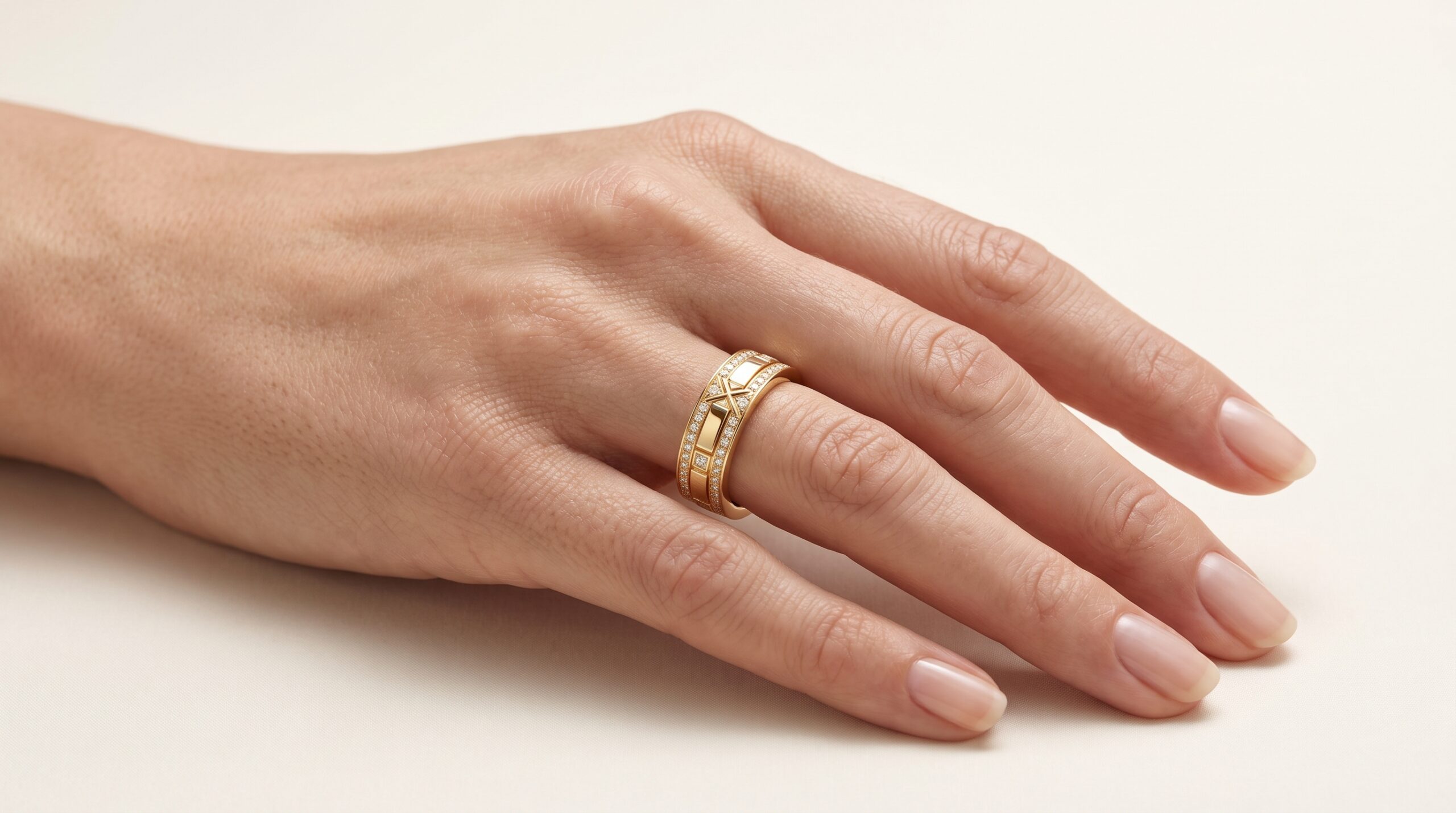
Some wedding bands only need to fit a finger. Others need to sit flush against an engagement ring with an irregular setting, carry a private engraving, or match a design one partner sketched on a napkin. When a ready-made ring can’t do that, custom design is the option worth understanding, not because it’s automatically better, but because it solves problems ready-made inventory can’t.
This guide walks through how custom wedding bands are designed, what affects cost and timeline, how fit and durability are handled, and what to check before committing to a jeweler.
What Are Custom Wedding Bands?
Custom vs Ready-Made Wedding Bands
A ready-made band is selected from existing inventory: a fixed width, metal, and finish that a buyer either accepts or passes on. A custom band starts from the buyer’s specifications and is built to match them, whether that means a particular contour, a specific stone layout, or a metal weight suited to a particular hand.
The tradeoff is time and, usually, cost. Ready-made bands ship quickly because they already exist. Custom bands go through design, approval, and production stages before they’re wearable, which means longer lead times and, in most cases, higher labor costs.
What Can Be Customised
A custom order can touch nearly every physical attribute of a band, including:
- Metal type and alloy (yellow gold, white gold, rose gold, platinum, and others)
- Band width and profile
- Surface finish, such as polished, brushed, hammered, or matte
- Stone placement, cut, and setting style
- Engraving, inside or outside the band
- Contour shape built to nest against a specific engagement ring
- Coordinated designs for matching or complementary his-and-hers sets
- Personal or symbolic details, such as fingerprints, handwriting, or heirloom metal
Not every order uses all of these. Some buyers change only the width and finish of an otherwise standard band. Others rebuild the design from the ground up.
When Is a Custom Wedding Band Worth Considering?
You Need a Band to Fit an Engagement Ring
If an engagement ring has a raised setting, a curved shank, or side stones that extend past the center, a straight band can leave a visible gap or sit unevenly against it. A contoured band is shaped to follow that profile so the two rings sit close together. This is the most practical, least sentimental reason to go custom, and often the strongest one.
You Want Personal or Sentimental Details
A private engraving, a design inspired by a family ring, or metal reworked from an heirloom piece all require custom work because they don’t exist in a catalog. These details don’t need to be elaborate. A single date engraved inside the band accomplishes the same goal as a more visible design choice.
You Cannot Find the Right Design Ready-Made
Some buyers want a width, finish, or stone arrangement that simply isn’t available in stock, or they want to combine features from two different rings they’ve seen. Custom design lets them specify exactly what they want instead of compromising on the closest available option.
You Want Coordinated Custom Bands
Couples designing matching or complementary bands, such as a wide brushed band and a slimmer polished version of the same design, often find that ready-made pairs don’t quite match. Custom design lets both bands share proportions, finish, or a design motif while still fitting each person’s hand and preference.
The Custom Wedding Band Design Process
Most custom orders move through a similar sequence, though the exact steps and their order vary by jeweler and production method.
- Initial consultation to discuss goals, budget, and timeline
- Inspiration gathering and design direction, often using reference images or sketches
- Measurements, including ring size and, if relevant, an assessment of the engagement ring the band needs to fit
- CAD render or hand sketch for design approval
- Wax prototype or 3D printed model, when the design or budget calls for one
- Revisions and final sign-off before production begins
- Casting, hand-fabrication, or finishing work
- Final inspection, quality check, and delivery
Why Revisions Matter
A design proof, whether a CAD render or a wax model, exists so problems get caught before metal is cast or cut. Reviewing proportions, stone placement, and contour fit at this stage is far less costly than discovering an issue after production. Most jewelers build one or more revision rounds into the process for this reason: it’s the point where the design can still be adjusted freely, before any material is committed.
Why Measurements Matter
Accurate ring sizing is the baseline, but custom orders often require more. A contoured band needs precise measurements of the engagement ring it will sit against, including the height and width of the setting. A stacked design needs to account for how the bands sit together on the finger over time, not just how they look side by side in a photo. Getting these measurements wrong is one of the more common reasons custom orders need reworking.
Custom Wedding Band Process Timeline
| Step | What Happens | Buyer Responsibility | Why It Matters |
| Consultation | Discuss design goals, budget, and timeline | Share inspiration, priorities, and constraints | Sets expectations before design work starts |
| Design direction | Jeweler proposes an initial concept | Confirm ring size and provide reference images | Aligns the design with what the buyer actually wants |
| Measurements | Ring sizing and engagement ring assessment, if applicable | Provide the engagement ring or accurate measurements | Prevents fit problems after production |
| CAD or sketch approval | Design is rendered digitally or drawn by hand | Review proportions and details, request changes | Catches issues before metal work begins |
| Wax or 3D model | A prototype is produced for physical review | Try on or inspect the model if offered | Confirms fit and scale beyond a screen render |
| Revisions | Adjustments are made based on feedback | Approve the final design in writing | Reduces the chance of post-production disputes |
| Production | Casting, fabrication, or stone setting takes place | Wait for the agreed timeline | Skilled labor and metalwork take real time |
| Final inspection and delivery | Jeweler checks fit, finish, and stone security | Inspect the ring on arrival | Confirms the piece matches what was approved |
CAD, Hand-Fabrication, Modified Stock, and Wax Models Explained
Jewelers use different production methods depending on the design’s complexity, the buyer’s budget, and how much revision flexibility is needed.
CAD Custom
Computer-aided design software lets a jeweler build a digital model of the ring, adjust it in fine detail, and generate a render for the buyer to review before anything is cast. <cite index=”1-0″>Bostonian Jewelers notes that CAD gives buyers a way to preview and refine a design before it’s produced</cite>, which makes it well suited to precise contours and designs that go through several rounds of revision.
Hand-Fabricated Bands
Hand-fabrication means a jeweler shapes the metal directly, using tools like saws, hammers, and torches rather than a cast mold. This method suits designs with irregular textures, hammered or forged finishes, or vintage-inspired details that are difficult to reproduce through casting. It typically takes longer and costs more because it depends on a jeweler’s manual skill rather than a repeatable digital file. Under the <cite index=”4-0″>FTC’s Jewelry Guides, describing a piece as hand-forged, hand-engraved, or hand-finished carries specific meaning</cite>, so it’s worth asking a jeweler exactly which parts of a “hand-fabricated” band were made by hand.
Modified Stock
This starts with an existing ring design that gets adjusted in limited ways, such as changing the width, adding an engraving, or swapping a stone. It offers less design freedom than a full custom build but moves faster and usually costs less, since the base design already exists.
3D Printed Wax Models
A wax or resin model, printed directly from a CAD file, gives the buyer something physical to hold and try on before the final metal casting. This step is most useful for complex geometries or contours where a flat digital render doesn’t fully convey how the ring will look and feel on the hand.
Custom Wedding Band Production Methods
| Method | Best For | Pros | Limitations | Typical Timeline |
| Modified stock | Buyers wanting light customisation with a faster turnaround | Lower cost, quicker production | Limited design freedom | 2 to 4 weeks |
| 3D printed wax | Testing complex shapes before final casting | Physical preview before metal is cast | Adds a step and some cost to the process | 4 to 8 weeks |
| CAD custom | Precise contours and designs needing revisions | Detailed digital preview, easier to adjust before production | Requires design software fees and time | 6 to 10 weeks |
| Hand-fabricated | Artisanal textures or vintage-inspired details | Unique, hand-worked character | Longer production time, higher labor cost | 8 to 12 weeks |
How Long Do Custom Wedding Bands Take?
Timelines depend on the production method, the design’s complexity, how many rounds of revision are needed, and how busy the jeweler is at the time of the order. <cite index=”0-1″>Aurora Designer describes the custom process as running from initial consultation through design, prototyping, and production before a ring is ready to wear</cite>, and that sequence takes real time at each stage.
As a general range, modified stock designs often take 2 to 4 weeks, 3D printed wax models commonly run 4 to 8 weeks, CAD custom work typically takes 6 to 10 weeks, and hand-fabricated bands may take 8 to 12 weeks. These are starting points, not guarantees. A jeweler with a full order book, a design requiring extra revisions, or a complex stone-setting job can extend any of these ranges. Buyers working toward a wedding date should build in a buffer beyond the quoted estimate rather than planning around the shortest possible timeline.
How Much Do Custom Wedding Bands Cost?
Main Cost Drivers
Custom pricing is built from several variables rather than a single flat rate:
- Metal type and total weight
- Stone choices, including size, quality, and number of stones
- Labor time, which scales with design complexity
- CAD design fees, where applicable
- Contoured or geometrically complex shapes
- Hand-fabrication work
- Number of revision rounds beyond what’s included
- Engraving
- Whether the order includes a matched pair or coordinated set
Budget Expectations
Custom work often costs more than a comparable ready-made band because it includes design time and, in many cases, individual labor that a mass-produced ring doesn’t require. <cite index=”0-2″>Aurora Designer notes that the added labor and design work involved in custom pieces is a factor in their cost</cite>. That doesn’t mean every custom order is expensive. A modified stock band with a simple engraving can cost close to its ready-made equivalent, while a hand-fabricated band with an intricate stone layout will cost considerably more.
Custom Wedding Band Cost Factors
| Cost Factor | Why It Affects Price | Buyer Consideration |
| Metal type and weight | Precious metal cost scales with weight and purity | Ask for the metal weight in writing, not just the karat |
| Stones | Size, cut quality, and stone count all add cost | Clarify whether stones are natural, lab-grown, or a mix |
| Labor | Complex designs take longer to build | More intricate work means higher labor charges |
| CAD design fees | Digital modeling takes design time | Ask whether the fee is separate or bundled into the quote |
| Contour or geometry | Irregular shapes require more precise fabrication | Confirm this is priced in before design approval |
| Hand-fabrication | Manual metalwork is slower than casting | Weigh the aesthetic value against the added cost |
| Revisions | Extra rounds beyond the included limit add time | Ask how many revisions are included in the base price |
| Engraving | Adds a production step | Usually a smaller, fixed add-on cost |
Fit, Comfort, and Engagement Ring Compatibility
Custom Contours
A contour band is shaped to follow the profile of a specific engagement ring rather than sitting as a straight line beside it. <cite index=”2-0″>Helzberg explains that a custom band can be designed to fit closely around an engagement ring’s setting</cite>, which reduces gaps and keeps the two rings sitting flush when worn together. This only works reliably when the jeweler has accurate measurements or the physical ring to work from.
Wax Try-Ons and Fittings
When a wax or 3D printed prototype is part of the process, it gives the buyer a chance to try the shape on before the final metal is cast. This step catches sizing or contour issues that a flat CAD render can miss, since it’s easier to judge how a shape sits on the hand in person than on a screen.
Daily Wear Considerations
A ring that looks right in a design proof still needs to hold up to daily wear. Worth discussing with a jeweler: whether the band rotates on the finger during the day, whether a contoured design leaves any sharp edges against the skin, whether the interior is finished for comfort, and how the band will wear over years of use rather than just its appearance on delivery.
Fit Questions to Ask Before Approving a Custom Band
- Has the jeweler measured or physically inspected the engagement ring the band needs to fit?
- Does the interior have a comfort-fit edge, and is that included by default or as an add-on?
- How does the design account for finger swelling or seasonal size changes?
- If the band and engagement ring will be worn stacked, has the jeweler confirmed they sit evenly?
- Is there a wax or physical prototype to try on before final production?
Quality, Craftsmanship, and Durability
Can Custom Wedding Bands Be Durable?
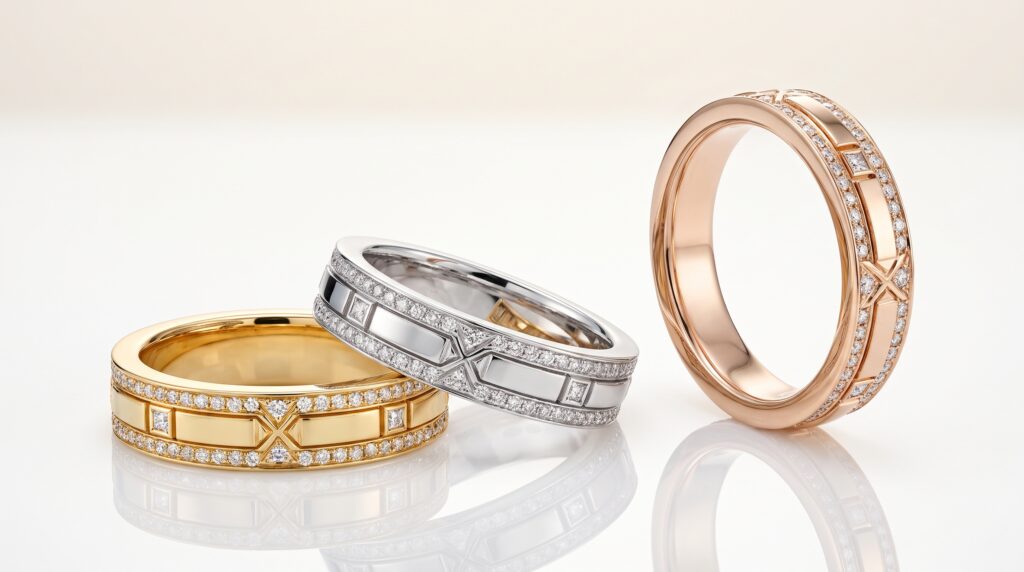
A custom band can hold up to daily wear as well as a ready-made one, provided it’s engineered correctly. This means adequate metal thickness at stress points, properly secured stone settings, and construction methods suited to the design. Durability isn’t a given just because a piece is custom-made; it depends on the specific engineering choices behind that particular ring, which is why reviewing a jeweler’s craftsmanship matters more than assuming custom automatically means higher quality.
What to Review in a Jeweler’s Portfolio
Before committing to a custom order, look at examples of a jeweler’s finished work rather than only sketches or renders. <cite index=”1-1″>Bostonian Jewelers points to reviewing a jeweler’s past projects as part of deciding whether they’re the right fit for a custom order</cite>. Pay attention to:
- Similar past projects, ideally in a comparable style or complexity
- Clean, secure stone settings without visible gaps or uneven prongs
- Smooth contours with no rough transitions or tool marks
- Balanced proportions between band width, stone size, and overall design
- Finished, delivered pieces rather than only concept renders
Documentation to Request
A custom order should come with paperwork that verifies what was actually made. This can include a fabrication certificate describing the work performed, written details of the alloy and metal weight used, CAD files or a design record showing the approved specifications, stone certificates for any graded gemstones, and appraisal documentation for insurance purposes. Grading reports and appraisals serve different functions, and it’s worth understanding the distinction before requesting either one; <cite index=”17-0″>GIA explains that a grading report documents a stone’s quality characteristics, while an appraisal is a separate estimate of monetary value that typically references the grading report</cite>.
Online Buying Confidence for Custom Wedding Bands
Ordering a custom band without visiting a jeweler in person adds a layer of trust that needs to come from somewhere else: clear documentation and policy. Before placing an online custom order, check for a clear pricing structure that breaks down labor, materials, and design fees; a written deposit policy; cancellation terms; a stated revision timeline and limit; CAD previews or design proofs before production starts; portfolio examples of finished work; material samples where relevant; and a defined final approval step before the ring goes into production.
The absence of these is worth treating as a warning sign. A jeweler with no visible portfolio, vague or bundled pricing, no CAD previews or other design proofs, unclear limits on revisions, or no written policy covering deposits and cancellations makes it harder to resolve a dispute if the finished ring doesn’t match what was agreed.
How to Care for Custom Wedding Bands
Follow Metal-Specific Care
Different metals need different maintenance. Platinum develops a matte patina over time that some buyers prefer and others have polished off periodically, while white gold typically needs rhodium replating every year or two to maintain its bright white finish. <cite index=”3-0″>GIA recommends routine cleaning and periodic professional inspection to keep fine jewelry in good condition</cite>, and the same applies to custom pieces, particularly those with detailed surface finishes that show wear differently than a simple polished band.
Inspect Custom Stone Settings
Prong, pavé, and micro-pavé settings should be checked periodically for looseness, since a custom design with an unusual setting style may wear differently than a standard prong setting. A jeweler can typically check settings during a routine cleaning or inspection visit.
Keep Documentation
Hold on to appraisals, fabrication certificates, CAD records, and any care instructions provided at delivery. These documents matter for insurance claims, resizing requests, and any future repair work, since they give a future jeweler a reference for the original materials and construction.
A custom wedding band works best when a clear design goal is paired with accurate measurements, a realistic timeline, and a jeweler willing to put pricing, revisions, and policies in writing. None of that requires knowing how casting or CAD software works in technical detail. It requires asking the right questions before production starts, since that’s the point where changes are still cheap. Buyers considering the custom route are better served by gathering reference images, deciding which details actually matter to them, and bringing both to a consultation than by trying to specify every detail alone in advance.
Frequently Asked Questions
How long do custom wedding bands take?
Timelines vary by production method and design complexity. Modified stock designs often take 2 to 4 weeks, 3D printed wax models commonly run 4 to 8 weeks, CAD custom work typically takes 6 to 10 weeks, and hand-fabricated bands may take 8 to 12 weeks. A jeweler’s current workload and the number of revision rounds needed can extend any of these estimates, so it’s worth asking for a specific timeline rather than relying on general ranges when a wedding date is fixed.
Are custom wedding bands more expensive?
Often, though not always. Custom work tends to cost more than a comparable ready-made band because it includes design time and, in many cases, labor specific to that one piece rather than a repeatable production run. A simple modified stock band can cost close to its ready-made equivalent, while a hand-fabricated design with an elaborate stone layout will cost considerably more. The best way to understand pricing for a specific design is a written quote that breaks down metal, labor, stones, and any design fees separately.
What is CAD in jewelry design?
CAD stands for computer-aided design. In jewelry, it means building a digital 3D model of a ring that can be adjusted in detail and rendered for the buyer to review before any metal is cast. It functions similarly to an architectural rendering, giving both the buyer and the jeweler a shared, precise reference for the design before committing to production.
Can a custom band fit around my engagement ring?
Yes, through a technique called contouring, where the band is shaped to follow the profile of the engagement ring’s setting. This requires accurate measurements or, ideally, the physical engagement ring for the jeweler to reference. A contoured band reduces gaps between the two rings and helps them sit evenly when worn together, though the result depends on how carefully the measurements were taken.
Can custom wedding bands be resized?
In many cases, yes, though it depends on the design. A simple band with no stones or a straight interior is usually easier to resize than a contoured band built to match a specific engagement ring, since resizing can affect how well the contour still lines up. Bands with stones set close to the shank, engraving that spans the full circumference, or unusual metal combinations may have more limited resizing options. It’s worth asking a jeweler about resizing limits before finalizing the design.
What happens if I don’t like the first design?
Most custom processes include a defined number of revision rounds before final production, typically reviewed through a CAD render or sketch. This is the stage to raise concerns about proportions, stone placement, or overall style, since changes are far easier to make before casting or fabrication begins. It’s worth confirming in advance how many revisions are included in the base price and what additional rounds cost.
Do I need a wax model?
Not always. A wax or 3D printed prototype is most useful for complex geometries, contoured shapes, or designs where it’s hard to judge fit and proportion from a flat digital render alone. Simpler designs, such as a modified stock band with a straightforward engraving, often move directly from CAD approval to production without needing a physical prototype.
Are custom bands durable enough for everyday wear?
Yes, when they’re engineered correctly. Durability depends on factors like metal thickness at stress points, how securely stones are set, and whether the construction method suits the design, not simply on whether the piece is custom-made. A well-built custom band should hold up to daily wear the same way a well-built ready-made band does. Reviewing a jeweler’s past work and asking directly about their approach to durability is a more reliable indicator than assuming custom work is automatically sturdier or more fragile.
What documents should come with a custom band?
Depending on the design, expect a fabrication certificate describing the work performed, written details of the alloy and metal weight, a CAD file or design record reflecting the approved specifications, stone certificates for any graded gemstones, and appraisal documentation for insurance purposes. Keeping these on file makes future resizing, repair, or insurance claims considerably more straightforward.