
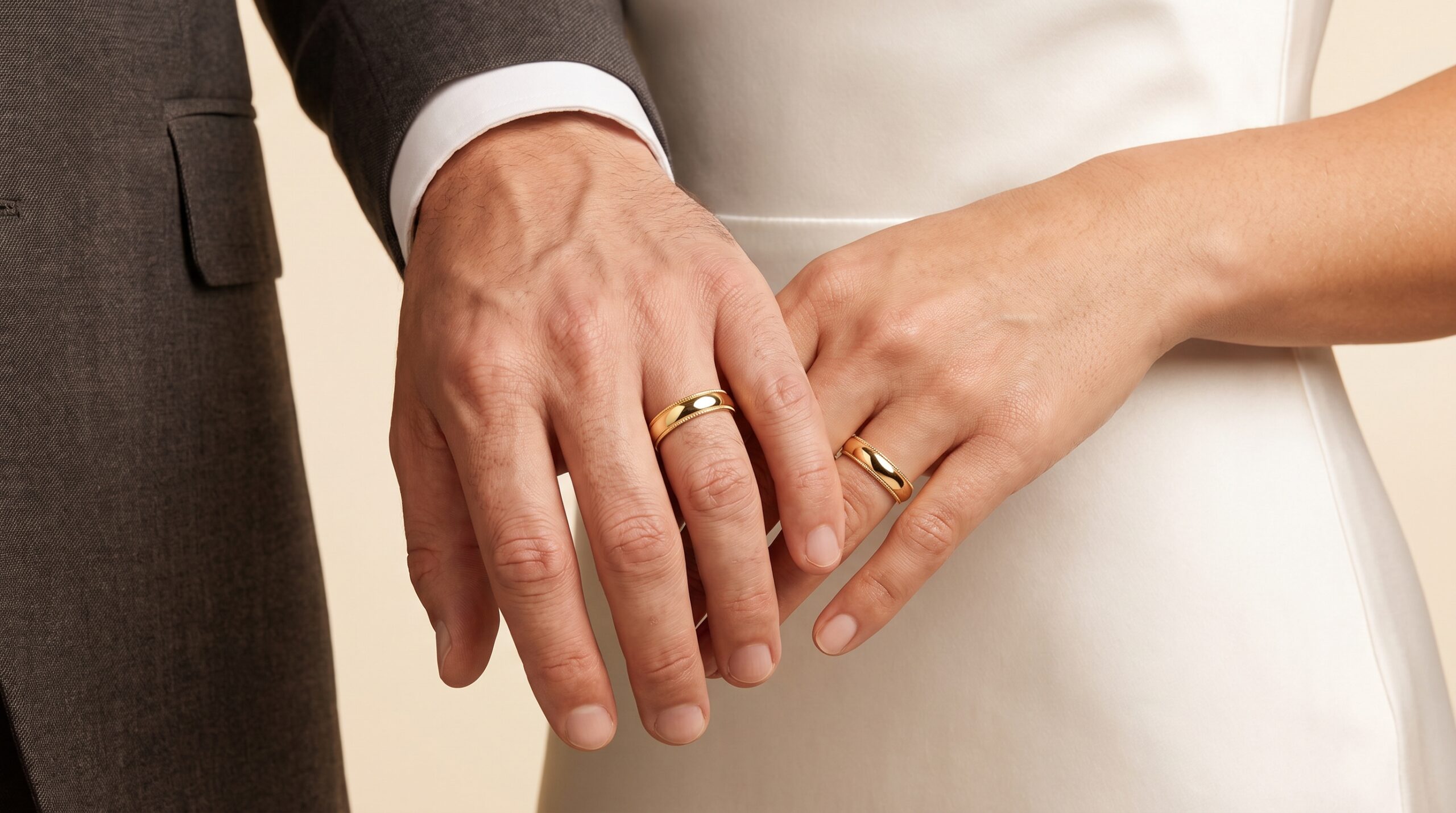
An anniversary band is not a replacement for the ring you already wear. It’s an addition, usually worn alongside an engagement ring and wedding band, chosen to mark a specific year or a moment worth recognizing outside the wedding itself. The confusion that sends most people searching for answers is simple: does this new ring belong on the same finger as the original set, and does it need to match?
It doesn’t have to match, and it doesn’t replace anything. What it does need to do is work with the rings already in rotation, hold up to the way you actually wear jewelry day to day, and reflect whatever the milestone means to you. That’s the part worth getting right before you buy.
What Is an Anniversary Band?
Anniversary Bands Explained
An anniversary band is a ring given or purchased to commemorate a wedding anniversary or another significant point in a relationship, marking years of marriage or a milestone rather than the wedding ceremony itself. Some couples buy one at a fixed interval, like five or ten years. Others buy one after a specific event: a vow renewal, an adoption, paying off a house, or simply deciding the relationship deserves a new piece of jewelry.
There’s no registry or rulebook that dictates when an anniversary band is appropriate. The category exists because people wanted a way to mark ongoing commitment with something more than a card or a dinner reservation, and jewelers built product lines around that instinct.
How Anniversary Bands Are Usually Worn
Most people stack the anniversary band with the engagement ring and wedding band on the left ring finger. That’s the most common arrangement, and it’s why fit and profile matter so much (more on that below).
Some wearers put the anniversary band on the right hand instead, either because the left-hand stack is already full or because they want it to stand as its own piece. Neither approach is more correct than the other. A right-hand anniversary band still carries the same meaning; it’s just worn separately from the bridal set.
Anniversary Band vs Wedding Band
A wedding band represents the marriage itself: the ring exchanged during the ceremony. An anniversary band comes later and marks a different moment. The two rings can look completely different, share a similar profile, or be selected as a deliberate pair. What separates them is timing and purpose, not design.
Popular Anniversary Band Styles
Four styles come up most often when people start shopping: eternity bands, three-stone bands, birthstone bands, and pavé stackable bands. Each carries a different kind of symbolism and a different set of practical tradeoffs.
Eternity Anniversary Bands
An eternity band sets diamonds or gemstones continuously around the full circumference of the ring, so the sparkle doesn’t stop at the front. The design is often read as a symbol of unbroken commitment, since the stones circle the band with no visible beginning or end and the pattern never stops to mark a clear front or back.
The tradeoff is practical rather than aesthetic: a full eternity band leaves very little plain metal to work with if the ring ever needs to be resized. That limitation is covered in more detail further down.
Three-Stone Anniversary Bands
The three-stone band, sometimes called a trilogy or trinity ring, places three stones (often a larger center stone flanked by two smaller ones) in a row. The three stones are commonly read as representing a couple’s past, present, and future together, which makes this style a popular choice for milestone anniversaries where the symbolism carries as much weight as the design.
Birthstone Anniversary Bands
A birthstone band uses gemstones tied to a specific month, often chosen to represent children, family members, or the month of the wedding or anniversary itself. This is the most personal of the four styles, since the stone selection is tied to real dates and real people rather than a general design tradition.
The tradeoff here is durability. Not every birthstone is suited to daily wear, and that’s worth understanding before falling for a particular color. It’s addressed in the gemstone quality section below.
Pavé Stackable Anniversary Bands
Pavé bands set small diamonds close together across the surface of a thin band, creating a continuous sparkle without the visual weight of larger stones. Because they’re typically thin and low-profile, pavé bands are popular with people who want to add more than one ring over time rather than commit to a single, larger anniversary piece.
Anniversary Band Style Comparison
| Style | Symbolism | Pros | Considerations | Best For |
| Eternity band | Continuity, unbroken commitment | Sparkle from every angle, timeless design | Full eternity settings are harder to resize | Buyers who want maximum sparkle and are confident in their ring size |
| Three-stone band | Past, present, and future | Strong emotional meaning, works as a statement piece | Larger center stones raise cost | Milestone years where symbolism matters as much as style |
| Birthstone band | Personal or family connection | Highly personal, easy to customize by date | Some birthstones need more careful wear | Family milestones, children’s birth months, sentimental gifts |
| Pavé stackable band | Layered sparkle over time | Thin profile, easy to add to a stack, generally lower cost per piece | Prongs need periodic inspection | Buyers who plan to add rings gradually |
How to Choose an Anniversary Band by Milestone
Milestone traditions are a useful starting point, not a set of rules. Nobody is required to buy an eternity band at year ten or a three-stone ring at year twenty-five. Treat the guidance below as inspiration for narrowing down styles, not as a checklist to follow exactly.
5th Anniversary
A refined, wearable band works well here: something that adds a subtle layer to the existing set without competing with the engagement ring. A thin pavé band or a simple half-eternity design tends to fit this stage, since it introduces a new piece without overhauling the look of the stack.
10th Anniversary
Ten years is when eternity bands and diamond-focused designs become a common choice. It’s a milestone people tend to mark with something a little more substantial than the fifth anniversary, whether that’s a full eternity band, a wider pavé design, or a diamond band with a heavier stone count.
25th Anniversary
A twenty-fifth anniversary often calls for a more significant piece: a three-stone band with a larger center stone, an elevated diamond design, or a ring intended to be worn as a standalone statement rather than tucked into a stack. This is also the milestone where some buyers choose a piece meant to become a family heirloom.
Family or Life Milestones
Birthstone bands, engraved bands, and stackable pieces are common choices for marking a child’s birth, a vow renewal, or another life event outside the standard anniversary calendar. These milestones don’t follow a fixed schedule, and the ring choice tends to be more personal than traditional.
How to Match an Anniversary Band With an Existing Wedding Set
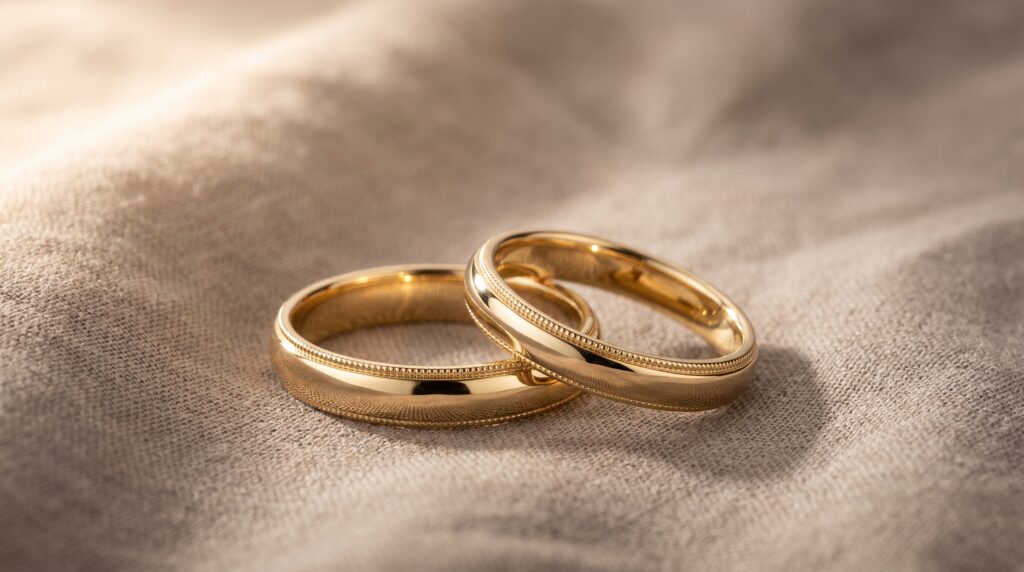
An anniversary band that looks great on its own can still feel wrong once it’s stacked. Matching isn’t about buying an identical ring; it’s about making sure the new piece sits comfortably next to the rings already worn every day.
Metal Compatibility
Matching metal color keeps the stack visually unified, but intentional contrast, like a white gold anniversary band next to a yellow gold wedding set, can work too if it’s a deliberate choice rather than an accident. What matters more than color is understanding what you’re buying. Pure gold, or 24 karat gold, is soft, so it’s mixed with other metals to increase its hardness and durability when used in jewelry, and platinum and silver are marked differently depending on their purity, according to the FTC’s guidance on buying precious metal jewelry. Knowing the karat or purity of each ring in the stack helps predict how the metals will wear against each other over time.
Profile and Height
A low-profile setting sits closer to the finger and tends to layer more comfortably against other rings. A tall, elevated setting might look striking on its own but can catch on clothing or sit awkwardly next to a flatter wedding band once stacked.
Contour and Stack Fit
Rings with compatible contours, meaning the inner and outer curves line up reasonably well, reduce gaps and rotation within the stack. A contoured wedding band designed to nestle against a solitaire engagement ring may not sit flush against a flat-profile anniversary band, so it’s worth checking how the shapes interact rather than judging each ring individually.
Width and Proportion
Thinner bands, generally in the 2 to 4 millimeter range, tend to layer more easily than wide bands. A wide anniversary band can still work in a stack, but it usually needs more space and may push other rings out of alignment on the finger.
Anniversary Band Stack Compatibility Checklist
- Does the band sit comfortably against the engagement ring and wedding band, or does it pinch or rotate?
- Does the profile height match closely enough with the rest of the stack to avoid catching?
- Does the metal color coordinate, or is any contrast intentional?
- Is the setting low enough to hold up to the way you use your hands daily?
- Does the full stack, not just the new ring, still fit the finger comfortably?
Eternity Bands, Resizing, and Practical Considerations
Why Eternity Bands Can Be Harder to Resize
A standard ring is resized by adding or removing a small section of plain metal from the band and reshaping it. Full eternity bands, where stones are set around the entire circumference, leave very little plain metal available for that adjustment, which limits how much a jeweler can safely resize the ring without disturbing the stone settings.
This doesn’t mean an eternity band can never be resized. It means the range is narrower, and larger adjustments may not be possible at all without resetting some of the stones.
When a Half-Eternity Band May Be More Practical
A half-eternity band sets stones across the front and sides of the ring, leaving the back portion in plain metal. From the front, it can look nearly identical to a full eternity band while remaining considerably easier to resize, since the plain metal at the back gives a jeweler room to work with. It’s also generally easier to clean and less prone to snagging, since there’s less exposed metal-to-stone edge along the underside of the finger.
Sizing Before Purchase
Size the ring based on how it will sit within the full stack, not on its own. A ring that fits comfortably by itself can feel tight once it’s squeezed between an engagement ring and a wedding band. Many jewelers can size a mock stack in store, or at minimum can account for stack width when recommending a size.
Diamond and Gemstone Quality Considerations
Carat Total Weight
Carat total weight, abbreviated cttw or tcw, is the combined weight of every stone set in the band, not the weight of a single stone. According to GIA’s explanation of carat weight, a ring set with many small melee diamonds can carry the same total carat weight as a solitaire set with one larger diamond, yet cost significantly less, since the value depends on how that weight is distributed. That’s a useful distinction when comparing two anniversary bands with similar cttw listings: the number tells you the total sparkle, not how it’s distributed or how much any individual stone costs.
Melee Diamonds
Melee refers to the small diamonds, typically under 0.2 carats each, used to fill pavé and eternity settings. Melee stones are graded less individually than a center stone would be, since they’re evaluated more as a group for consistent color and clarity across the setting.
Birthstone Durability
Not every gemstone holds up the same way to daily wear. GIA’s guidance on gem durability defines durability as a stone’s ability to withstand wear, heat, light, household chemicals, and changes in humidity, and breaks it down into three factors: hardness, toughness, and stability. Hardness, measured on the Mohs scale, is a good indicator of how well a stone resists scratches and abrasions, but it isn’t the whole picture. A stone can rank high on hardness and still be prone to chipping if its structure makes it brittle.
Diamond, sapphire, and ruby rank at the harder end of that scale and tend to hold up well to daily wear. Softer birthstones, such as opal, pearl, or emerald, can still be set in an anniversary band, but they’re better suited to occasional wear or to a protective setting than to a ring worn every day without a second thought.
Gem Documentation
For diamonds, a grading report from an independent laboratory such as GIA documents the stone’s carat weight, color, clarity, and cut, giving the buyer a record independent of the seller’s own description. For colored gemstones, a gemological report can confirm identification and disclose any treatments. Documentation matters most for larger center stones; melee diamonds in a pavé or eternity setting are typically not individually certified.
Setting Styles for Anniversary Bands
Channel Settings
A channel setting holds stones between two parallel strips of metal, with no prongs exposed on the sides. That metal edge protects the stones from side impact, which makes channel settings a reasonably durable choice for daily wear, though the enclosed design can make thorough cleaning around each stone a little harder.
Prong Settings
Prong settings hold each stone with small metal claws, exposing more of the stone’s surface to light. That’s part of why prong-set stones tend to look brighter than channel-set ones, but the tradeoff is that prongs can bend, catch on fabric, or loosen over time, so they need regular inspection to make sure each stone is still held securely.
Pavé Settings
Pavé settings use small beads or prongs to hold closely-spaced stones across the surface of the band, creating a continuous sparkle. The tiny prongs that hold pavé stones in place are more delicate than the prongs on a larger solitaire, which means pavé bands generally need more frequent checks to catch a loose stone before it’s lost.
Anniversary Band Setting Comparison
| Setting | Look | Durability | Maintenance | Best For |
| Channel setting | Clean, streamlined, smooth edge | Good protection against side impact | Lower; harder to clean between stones | Active daily wear, half-eternity designs |
| Prong setting | Maximum light exposure, brighter stones | Moderate; prongs can bend or loosen | Higher; needs periodic prong checks | Center stones and three-stone designs |
| Pavé setting | Continuous fine sparkle | Lower; small prongs are more delicate | Higher; regular inspection recommended | Stackable bands, layered looks |
Cost Considerations for Anniversary Bands
What Affects Price
Several factors move the price of an anniversary band independently of each other, which is why two bands that look similar in a product photo can be priced very differently:
- Total carat weight across all stones
- Diamond or gemstone type, since sapphires, rubies, and fancy-color diamonds price differently than white diamonds
- Metal choice, with platinum generally costing more than gold at the same purity
- Full eternity versus half-eternity design, since a full eternity band uses more stones
- The size and quality of the center stone in a three-stone design
- Setting complexity, since hand-set pavé work takes more labor than a simple channel setting
How to Choose Within Budget
Rather than trying to maximize every factor at once, it helps to decide which one matters most for this particular ring: symbolism, daily wearability, sparkle, stack compatibility, or long-term heirloom quality. A buyer prioritizing daily wearability might choose a smaller total carat weight in a protective channel setting, while a buyer prioritizing symbolism might accept a smaller budget for the setting in order to put more of it toward a meaningful center stone.
Care and Maintenance
Cleaning Stacked Rings
Stacked rings collect more buildup than a single ring worn alone, since lotion, soap residue, and everyday grime settle into the small gaps between bands. Regular cleaning and inspection help fine jewelry hold up over time, according to GIA’s jewelry care guidance. A soft brush and mild soap and water, followed by a thorough rinse and dry, is usually enough for routine cleaning at home.
Prong and Pavé Inspection
Prong-set and pavé bands should be checked periodically, ideally by a jeweler, to catch a bent or worn prong before a stone works loose. This matters more for rings worn daily than for pieces reserved for special occasions.
Storage
Store anniversary bands separately rather than pressed against other rings in a drawer or jewelry box. Harder stones, particularly diamonds, can scratch softer metals and gemstones on contact, so a lined box with individual compartments protects the full collection better than tossing everything into one pouch.
How to Buy an Anniversary Band Online
Buyer Confidence Factors
A trustworthy product listing gives you enough detail to evaluate the ring without seeing it in person. Look for a clearly stated carat total weight, specific gemstone details (not just “diamond” or “gemstone” with no further description), profile and height measurements, photos showing the ring stacked with other bands rather than only on its own, and clear return, resizing, and warranty policies.
Red Flags
A generic “eternity” label with no indication of whether it’s a full or half-eternity design is worth questioning, as is a listing with no layering photos, no disclosed carat total weight, or no guidance on resizing. Missing gemstone details, especially on birthstone bands, make it hard to know what you’re actually buying until the ring arrives.
Buying an anniversary band online works well when the listing gives you the same information a jeweler would walk you through in person. If that information isn’t there, it’s reasonable to ask for it before purchasing rather than guessing.
The right anniversary band is the one that fits comfortably into daily life: it sits well in the stack, holds up to how it’s actually worn, and marks the milestone in a way that feels specific rather than generic. Comparing a few styles side by side, checking stack compatibility before finalizing a size, and asking for gemstone and carat details up front will do more for the final decision than any milestone tradition.
Frequently Asked Questions
What is an anniversary band?
An anniversary band is a ring given or purchased to mark a wedding anniversary or another meaningful relationship milestone. It’s typically worn alongside an existing engagement ring and wedding band rather than in place of either.
Is an anniversary band the same as a wedding band?
No. A wedding band is exchanged during the wedding ceremony and represents the marriage itself. An anniversary band is added later to mark a specific year or occasion, and it can be styled very differently from the original wedding band.
Which finger do you wear an anniversary band on?
Most people wear it on the left ring finger, stacked with the engagement ring and wedding band. Some wearers choose the right hand instead, either because the left-hand stack is full or because they prefer to wear the anniversary band as a separate piece.
Do anniversary bands replace wedding rings?
No. Anniversary bands are designed to complement an existing bridal set, not replace it. The wedding band and engagement ring typically stay in place, with the anniversary band added to the stack or worn separately.
Are eternity bands resizable?
Full eternity bands, where stones circle the entire band, are harder to resize because there’s little plain metal left to adjust. Half-eternity bands, which leave the back portion of the ring in plain metal, are generally easier to resize. It’s worth sizing the full stack, not just the new ring, before buying either style.
What anniversary is best for an eternity band?
There’s no fixed rule, but eternity bands are commonly chosen around the tenth anniversary as a more substantial milestone piece. Earlier anniversaries often lean toward thinner, more subtle bands, while an eternity design tends to suit a year that calls for something more noticeable.
Can anniversary bands include birthstones?
Yes. Birthstone anniversary bands are a common way to personalize the ring, often using a child’s birth month, the month of the wedding, or another significant date. Some birthstones are softer than diamond and need a bit more care to hold up to daily wear.
How do I stack an anniversary band?
Check that the profile height, contour, and width of the new band work with the rings already in the stack, and size the ring based on how the full stack fits rather than sizing it alone. A thinner, low-profile band generally layers more easily than a wide or tall one.
What is cttw?
Cttw, or total carat weight, is the combined weight of every stone in a piece of jewelry, not the weight of any single stone. Two rings with the same cttw can look and cost very differently depending on whether that weight comes from one larger stone or many smaller ones.
Are pavé anniversary bands good for everyday wear?
Pavé bands are thin and comfortable for daily wear, but the small prongs holding each stone in place are more delicate than the prongs on a larger solitaire. Periodic inspection helps catch a loose stone before it’s lost, which makes pavé bands a reasonable daily-wear choice as long as they’re checked regularly.