
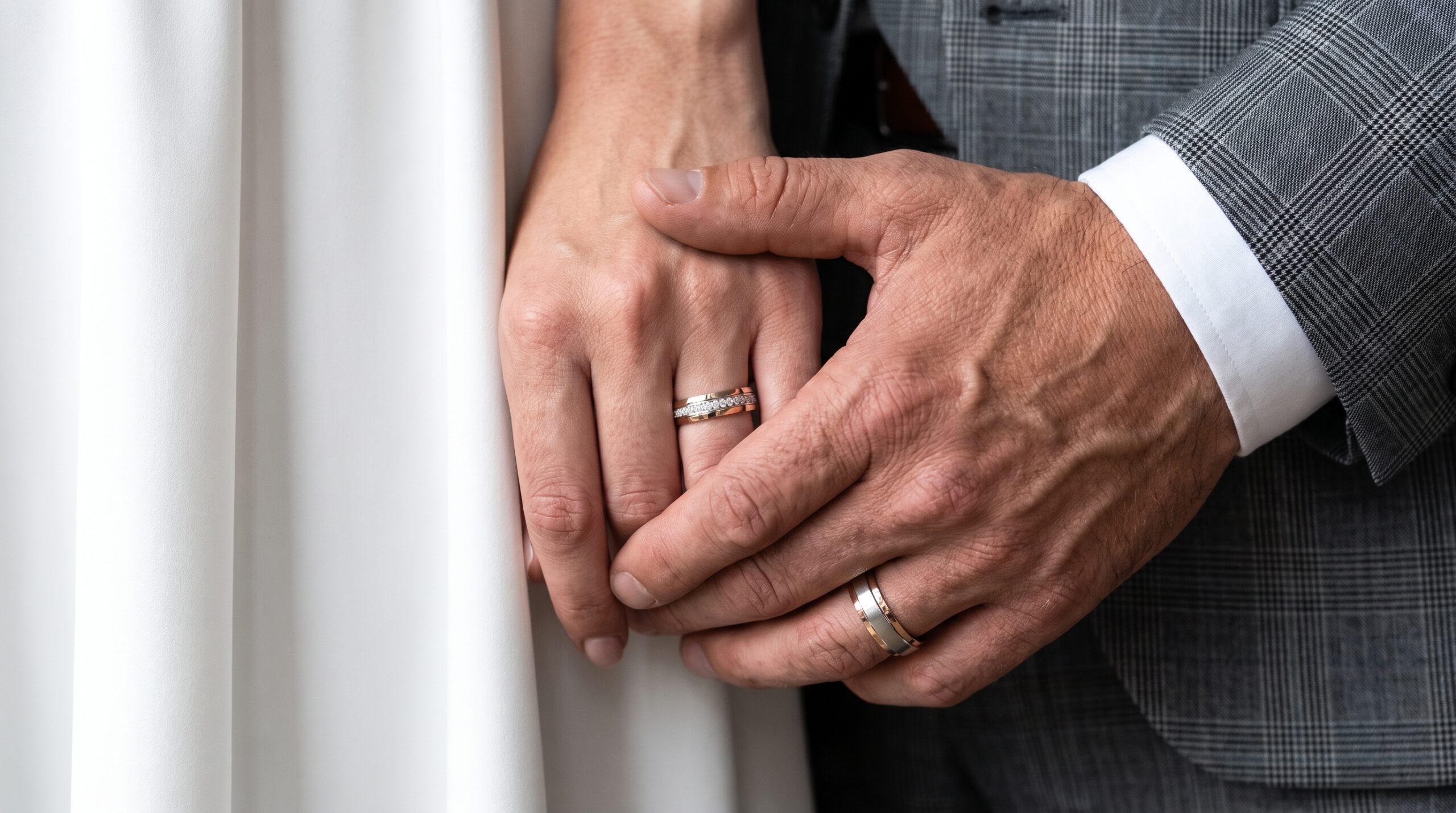
Choosing a wedding band shouldn’t mean picking a single metal colour and living with it forever. A two tone wedding band lets you combine yellow gold with white gold, platinum with rose gold, or any number of other pairings, in one piece of jewellery. The result can coordinate with a mixed collection of rings, watches, and other pieces instead of locking you into one metal tone.
The design choice is only part of the story. A two tone band is also a construction decision. How the metals are joined, whether they wear at similar rates, and how clean the transition looks after a few years of daily use all affect whether the ring holds up. This guide walks through what two tone bands are, the styles available, how they’re built, and what to check before you buy one.
What Are Two Tone Wedding Bands?
Two Tone Wedding Bands Explained
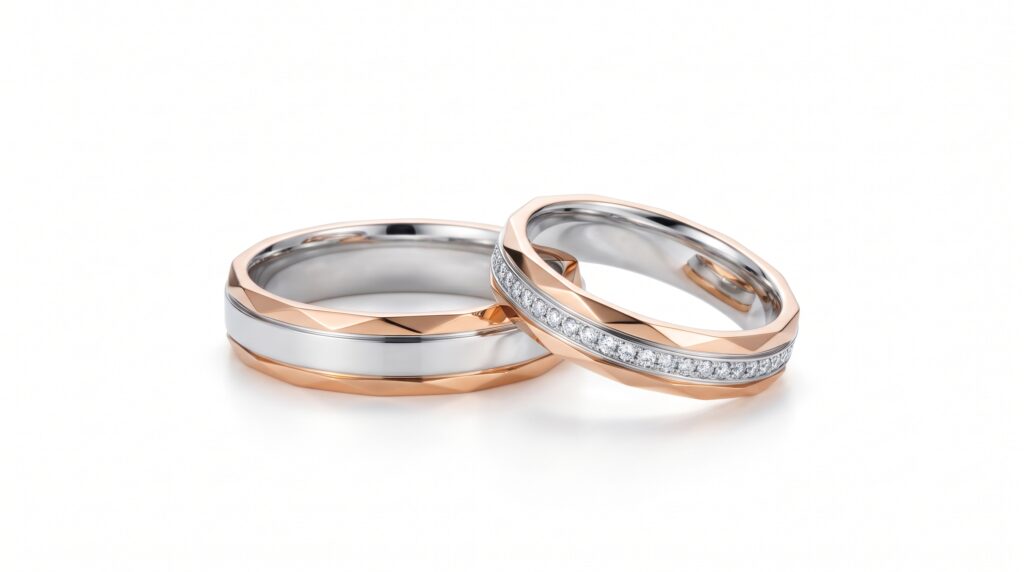
A two tone wedding band is a ring made with two contrasting precious metals worked into a single design. The metals might sit side by side, one inlaid into the other, or woven together depending on the style. What defines the category is the presence of two visibly different metal colours in one band, not a plated finish or a decorative coating.
Common Metal Combinations
The most common pairings are:
- Yellow gold and white gold
- Yellow gold and platinum
- Rose gold and white gold
- Rose gold and platinum
Each pairing produces a different contrast level. Yellow and white gold create a warm-cool split that reads as classic. Rose gold against platinum or white gold tends to look softer, since the pink hue is less saturated than yellow gold.
Why People Choose Two Tone Bands
Two tone bands appeal to people who don’t want to commit to a single metal tone across their jewellery. If one partner already wears mostly white metals and the other favours yellow gold, a two tone band can bridge the two without either person switching their existing pieces. Some buyers also choose two tone designs because the contrast reads as more distinctive next to a plain single-metal band, particularly in simpler ring styles where metal colour is the main visual detail.
Two Tone vs Single-Metal Wedding Bands
Neither option is inherently better. The right choice depends on what you’re trying to match, how much upkeep you’re willing to do, and how the ring will be worn day to day.
| Feature | Two Tone Band | Single-Metal Band | Buyer Consideration |
| Appearance | Visible contrast between two metal colours | Uniform colour throughout | Two tone suits mixed-metal jewellery collections |
| Durability | Depends on seam and construction quality | Wears evenly across the whole band | Ask how the metals are joined before buying |
| Maintenance | May need different polishing approaches for each metal | Simpler, single-process cleaning and polishing | Two tone bands benefit from periodic seam checks |
| Cost | Often higher due to dual-metal fabrication | Generally lower for comparable karat and width | Complexity of the pattern affects price |
| Resizing | Can be more complex depending on construction | Usually straightforward | Ask your jeweller how resizing affects the seam or inlay |
| Best for | Buyers who wear mixed metals or want contrast | Buyers who prefer a consistent, low-maintenance look | Match the choice to your existing jewellery habits |
Single-metal bands are simpler to maintain because there’s only one metal to polish, refinish, or match against future purchases. Two tone bands trade some of that simplicity for design range, but the tradeoff only pays off if the construction is solid.
Popular Two Tone Wedding Band Designs
Centre Inlay Bands
A centre inlay band sets one metal as a stripe running through the middle of the ring, framed by the second metal on either side. It’s a balanced, symmetrical look that reads as understated rather than busy, which makes it a common choice for buyers who want contrast without a lot of visual complexity.
Diagonal Weave Bands
Diagonal weave designs angle the two metals across the band rather than running them in straight lines. The effect is more dynamic and modern, though the additional pattern work usually adds to the fabrication cost.
Cable or Rope Bands
Cable or rope styles twist the two metals together to create a textured, rope-like appearance. These tend to work better on wider bands, since the twist pattern needs enough surface area to read clearly.
Milgrain Edge Bands
Milgrain styles use fine beaded detailing along the edge where the two metals meet. It’s a vintage-influenced look, and the beading can also help disguise a transition line, though it adds another surface that needs occasional inspection.
| Design | Look | Pros | Considerations | Best For |
| Centre inlay | Clean, symmetrical stripe | Balanced, easy to pair with other rings | Seam runs the full circumference | Buyers who want subtle contrast |
| Diagonal weave | Dynamic, modern crossing pattern | More visual interest | More complex fabrication, higher cost | Buyers who want a bolder look |
| Cable or rope | Twisted, textured | Distinctive texture | Works best on wider bands | Buyers who want dimension over flat contrast |
| Milgrain edge | Vintage beaded transition | Beading can soften the seam line | Beaded areas need periodic inspection | Buyers who like antique-inspired detail |
How Two Tone Wedding Bands Are Made
Soldered Construction
In soldered construction, two separate metal sections are joined at a seam. This is one of the more traditional approaches and can produce a strong bond when done well, but the seam is also the point most likely to show wear first if the join wasn’t finished properly.
Inlay Construction
Inlay construction sets one metal into a channel or recess cut into the other, rather than joining two separate pieces edge to edge. This method is common in centre inlay designs and, depending on how deep the inlay sits, can be more resistant to the inlay metal popping loose over time.
Cast or Integrated Construction
Some two tone designs are built through more integrated casting or fabrication methods that reduce the number of separate joins in the ring. These approaches vary by jeweller and by design, so it’s worth asking how a specific ring is constructed rather than assuming all two tone bands are made the same way.
Why Seam Quality Matters
A rough or poorly finished seam can catch on clothing, feel uneven against the skin, or wear through faster than the rest of the band. According to the Gemological Institute of America, fine jewelry should be inspected periodically for wear and damage, which applies directly to the joined or inlaid areas of a two tone ring since those are the sections most likely to show stress first. A well-finished seam should be smooth to the touch and shouldn’t be visible as a raised or uneven line when you run a finger across it.
Durability and Metal Compatibility
Metal Hardness
Metal hardness describes how well a metal resists scratching, denting, and general surface wear. Platinum, gold, and their various alloys don’t all behave the same way under daily use, and karat and alloy composition affect hardness even within the same metal type.
Why Hardness Pairing Matters
When two metals with very different wear properties are joined in one ring, they can age at different rates. A softer metal section may pick up scratches and wear thinner over years of wear while the harder section next to it stays closer to its original finish. That mismatch doesn’t make the ring unsafe to wear, but it can make the two sections look less uniform over time.
Platinum and Gold Pairings
Platinum is denser and more resistant to wear than most gold alloys, so a platinum edge or accent set against gold can, when properly engineered, help protect the softer gold section from the brunt of daily contact. This isn’t a guarantee against all wear, just a design factor worth discussing with a jeweller if durability is a priority.
Transition Line Strength
Very thin transition lines between metals concentrate stress in a narrow area. A thicker, well-supported transition tends to hold up better than a hairline seam, particularly on bands that see daily wear like manual work, gym use, or frequent hand washing.
| Metal Pairing | Visual Effect | Wear Consideration | Buyer Note |
| Yellow gold and white gold | Warm and cool contrast, classic look | Similar wear rates if karats match | Confirm both sections use comparable karat gold |
| Yellow gold and platinum | Strong colour contrast | Platinum section wears more slowly than gold | Ask how the platinum edge is engineered against the gold |
| Rose gold and white gold | Softer, muted contrast | Similar wear rates if karats match | Rose gold alloys vary in hardness by copper content |
| Rose gold and platinum | Subtle but distinct tonal shift | Platinum outlasts rose gold under equal wear | Best suited to buyers prioritising the platinum’s durability |
Comfort, Fit, and Daily Wear
Smooth Transitions
The areas where two metals meet should feel smooth against the skin, with no ridge, gap, or rough edge. This matters more on a wedding band than most other jewellery since it’s worn continuously rather than for occasional events.
Comfort-Fit Profiles
Many two tone bands, like single-metal bands, use a comfort-fit interior: a slightly domed inner edge that reduces surface contact with the finger and makes the ring easier to slide on and off. This design choice is independent of the two tone construction itself and is worth confirming separately when comparing rings.
Weight and Feel
Combining two metals can create small variations in weight distribution around the band, particularly with denser metals like platinum on one side. In practice, a properly made two tone band should feel comparable in weight and fit to a single-metal band of the same width and profile.
Cost Considerations for Two Tone Wedding Bands
Why Two Tone Bands May Cost More
Several factors typically push the price of a two tone band above a comparable single-metal design:
- Dual-metal fabrication requires more labour than working with one metal
- Seam or inlay work adds a finishing step that single-metal bands don’t need
- More complex patterns, like diagonal weaves, take longer to produce
- Wider bands use more material and more surface area to finish
- Pairings that include platinum carry the metal’s higher base cost
When the Added Cost May Be Worth It
The additional cost buys design flexibility and, when the construction is done well, a ring that coordinates with a broader range of other jewellery. Whether that’s worth the premium over a single-metal band depends on how much you value that versatility against a simpler, typically less expensive option.
Care and Maintenance
Different Metals May Need Different Finishing
Gold and platinum don’t always respond to polishing the same way. Platinum tends to develop a soft patina with wear that some owners prefer to leave alone rather than repolish to a mirror finish, while gold is more commonly restored to a bright polish. A jeweller working on a two tone band needs to account for both metals rather than treating the ring as a single uniform surface.
Annual Seam Inspection
Because the joined or inlaid sections carry more wear risk than a solid single-metal band, it’s worth having a jeweller check the seams, inlays, and transition areas on a regular basis, not just when something visibly changes. Catching a loosening seam early is generally a smaller repair than waiting until a section separates.
Cleaning Guidance
Keep cleaning practical:
- Use gentle cleaning methods rather than abrasive tools
- Avoid harsh chemicals, including some household cleaners and chlorine
- Ask your jeweller for guidance specific to your metal pairing before using any at-home cleaning solution
- Have professional polishing done by someone experienced with mixed-metal rings, since aggressive polishing on one metal can affect the adjacent section
The Gemological Institute of America recommends regular professional cleaning and inspection for fine jewelry generally, and that guidance applies with extra weight to two tone rings given the additional seams and finishes involved.
How to Buy a Two Tone Wedding Band Online
Required Product Details
Before buying, look for listings that disclose:
- Exact metal types and karats for each section
- The ratio of each metal used
- The joining or inlay technique used to construct the ring
- Close-up photos of the seam or inlay area
- Cross-section photos showing how the metals meet
- Dual hallmarks identifying both metals
- Alloy disclosures relevant to skin sensitivity, where available
Hallmarks are official markings that identify the precious metal content of a piece. In the UK, hallmarking guidance from the Assay Office Birmingham explains that hallmarks verify the metal content of an item, which is one of the more reliable ways to confirm what you’re actually buying, particularly for a ring combining two different metals under one design.
Red Flags
Be cautious of listings that use vague language like “fused metal” without specifying what the metals actually are, that don’t show close-up images of the seam or inlay, that omit metal composition details entirely, that lack dual hallmarks, or that say nothing about maintenance or seam inspection. These gaps don’t automatically mean a ring is poorly made, but they make it harder to judge quality before you buy.
A two tone wedding band can be a durable, versatile choice, but durability comes from how the ring is engineered, not from the fact that it uses two metals instead of one. Before buying, ask specifically how the metals are joined, whether their hardness levels are compatible, and what the seam or inlay looks like up close. A jeweller who can answer those questions clearly, and who backs the ring with proper hallmarks and material disclosure, is generally a safer bet than one who leans on design language alone.
Frequently Asked Questions
What is a two tone wedding band?
A two tone wedding band is a ring made with two contrasting precious metals combined in a single design, such as yellow gold paired with white gold or platinum. The metals can be arranged as a centre inlay, a woven pattern, or joined sections, depending on the style.
Are two tone wedding bands durable?
Two tone bands can be just as durable as single-metal bands when the construction is sound. Durability depends on how well the metals are joined, whether their hardness levels are compatible, and how the transition areas are finished, not simply on the fact that two metals are used.
Do two tone rings require special care?
They often benefit from more attentive care than single-metal bands because two different metals may need different polishing approaches, and the seam or inlay areas should be checked periodically for wear. This doesn’t mean the ring needs constant maintenance, just that the care routine should account for both metals rather than treating the band as uniform.
Can two tone wedding bands be resized?
Many two tone bands can be resized, but the process can be more involved than resizing a single-metal band, particularly if the design includes a seam or inlay that runs near the area being cut and rejoined. It’s worth asking a jeweller how resizing would affect the specific construction of the ring before buying.
Which metal pairings are best?
There’s no single best pairing. Yellow gold and white gold offer a classic, familiar contrast with similar wear rates when the karats match. Platinum paired with gold offers strong visual contrast, with the platinum section generally outlasting the gold under equal wear. The right choice depends on the look you want and how much you’re prioritising even long-term wear between the two metals.
Are two tone bands more expensive?
They often cost more than a comparable single-metal band because of the additional labour involved in joining or inlaying two metals, the finishing work required at the seam, and, in some pairings, the higher base cost of platinum. The exact premium depends on the design’s complexity and the metals chosen.
Can two tone bands cause skin reactions?
Skin reactions are more often linked to specific alloys, such as certain nickel-containing white gold formulations, than to the fact that a ring combines two metals. If you have known metal sensitivities, ask for the specific alloy composition of each section before buying.
What is a centre inlay?
A centre inlay is a design where one metal is set into a channel running through the centre of the band, framed by the second metal on either side. It’s one of the more balanced and commonly chosen two tone styles because the pattern is simple and symmetrical.
What should I check before buying online?
Look for clear disclosure of the metal types and karats used in each section, close-up and cross-section photos of the seam or inlay, dual hallmarks, and any available information on alloy composition. Listings that avoid these details, or that describe the construction only in vague terms, are harder to evaluate for quality.