
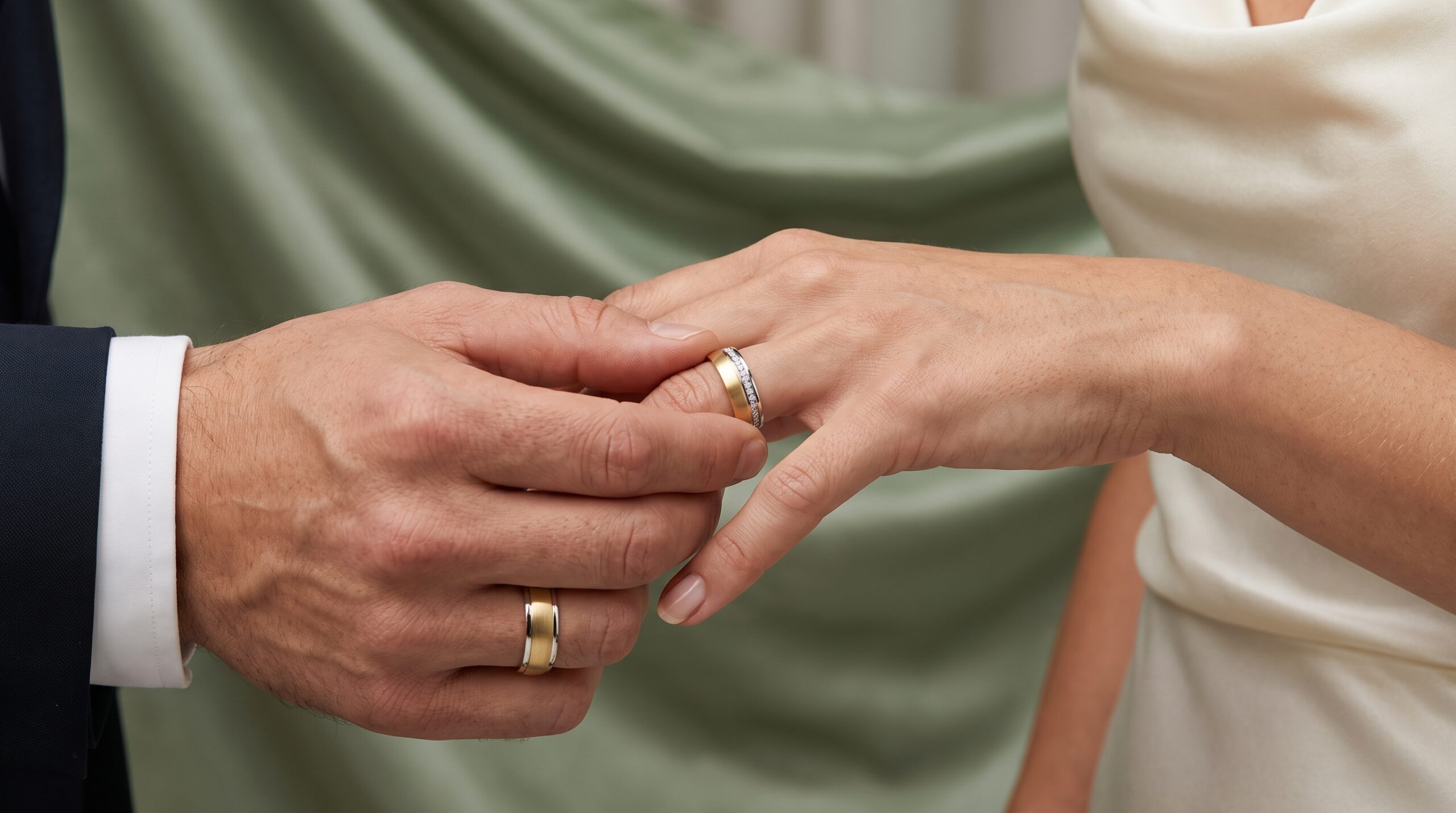
An engraving turns a wedding band from a beautiful object into something only the two of you fully understand. It might be a date, a private joke, a set of coordinates, or a single word that means nothing to anyone else and everything to you. The hard part usually isn’t deciding whether to engrave the ring. It’s figuring out what to say, where to put it, and how to make sure it still reads clearly a decade from now.
The best engraving isn’t the most poetic one. It’s the one that fits the band, stays legible, and still means something years after the wedding. This guide covers what to engrave, where to put it, which engraving methods exist, how much space you actually have, and what to check before anything gets etched permanently into metal.
What Is Wedding Band Engraving?
Wedding Band Engravings Explained
Wedding band engraving is a personalized inscription or symbol cut into the inside or outside surface of a ring. It can be as simple as a set of initials or as specific as a date written in Roman numerals. Unlike a stone setting or a design detail chosen at the time of manufacture, engraving is added specifically for the couple, which is what makes it feel personal rather than decorative.
What Can Be Engraved
Common engraving content includes:
- Names or initials
- Wedding dates
- Roman numerals
- Coordinates
- Short phrases
- Symbols
- Two-ring split messages, where each band carries half of a phrase
- Religious or cultural references, where appropriate to the couple
Why Couples Choose Engraving
Some couples engrave a ring because they want a message no one else will see: interior engraving is invisible unless the ring comes off. Others want something visible, like a small symbol on the outer band, as a design detail that also carries meaning. Either way, the appeal comes down to attaching something specific to an object that’s otherwise mass-produced or, at best, custom-fit but generic in meaning.
Interior vs Exterior Wedding Band Engraving
Interior Engraving
Interior engraving sits on the inside surface of the band, against the skin. It’s the more common choice for private messages, dates, and initials, since the wearer is usually the only one who sees it regularly. Because it’s protected from daily contact with surfaces, it also tends to hold its detail longer than an exterior engraving of similar depth.
Exterior Engraving
Exterior engraving sits on the outside of the band, visible to anyone who looks at the ring. It works well for symbols or decorative motifs meant to be seen, like a small heart, a milgrain border, or a geometric pattern. The tradeoff is exposure: exterior engraving sits in the same space that picks up scratches, contact with tools, and general wear from daily use.
Which Placement Is Better
Neither placement is objectively better. Interior engraving suits private, personal content and holds up better against wear since it’s shielded by the finger. Exterior engraving suits visible design elements but needs to be engraved with enough depth to withstand more direct contact.
| Placement | Best For | Pros | Considerations | Wear Exposure |
| Interior | Private messages, dates, initials | Hidden from view, protected from surface contact | Requires removing the ring to read | Low |
| Exterior | Visible symbols, decorative motifs | Visible as part of the ring’s design | More exposed to scratches and daily contact | Higher |
Popular Wedding Band Engraving Ideas
Names, Initials, and Dates
The most straightforward engraving option is also the most durable choice in terms of meaning: a partner’s name, initials, or the wedding date. It doesn’t require translation or explanation, and it stays relevant regardless of how the relationship evolves.
Roman Numeral Dates
Writing a date in Roman numerals is a common way to make a wedding or proposal date feel more deliberate than a standard numeric format. A date like October 12, 2024 could be rendered as X.XII.MMXXIV, which takes up a specific but manageable amount of space and reads as more considered than digits alone.
Coordinates
Coordinates mark a specific location, whether that’s where the proposal happened, the wedding venue, or a first home. They require precise formatting (latitude and longitude to a consistent number of decimal places) and should be checked against the actual location before engraving, since a single transposed digit changes the place entirely.
Short Romantic Phrases
A short phrase works better than a long one, both for legibility and for how it reads once it’s condensed into ring-sized text. Rather than listing every possible phrase, think about what you’d actually say to each other in a few words: a shared reference, a line from something specific to your relationship, or a phrase short enough to read at a glance.
Private Jokes or Personal Codes
Some couples choose an engraving that means nothing to an outside observer: a nickname, an inside joke shortened to a few letters, or a number that refers to something only they’d recognize. This works well for people who want personal meaning without it being legible or obvious to anyone else.
Symbols and Motifs
Common symbol choices include:
- Heart
- Infinity symbol
- Star
- Moon
- Religious symbol
- Small floral or geometric motif
Symbols take up less linear space than text, which makes them a practical choice for narrower bands where a full phrase wouldn’t fit clearly.
Two-Ring Split Engravings
A two-ring split engraving divides one message across both bands, so each ring carries half a sentence or complementary halves of a phrase. The idea only makes full sense when both rings are considered together, which is part of the appeal for couples who like the idea of each ring being incomplete on its own.
Laser vs Hand vs Rotary Engraving
Laser Engraving
Laser engraving uses a focused beam to cut precise, consistent lines into the metal. It’s well suited to small text, fine detail, and symbols, since the laser can maintain uniform depth and width even at a small scale. It’s also one of the more common methods used by jewelers offering standard engraving services, largely because of the consistency it provides across repeated orders.
Hand Engraving
Hand engraving is done manually with hand tools, which gives it a texture and depth that machine methods don’t fully replicate. It has a more traditional, artisanal look, with slight variation in line weight that some buyers specifically want. It typically costs more and takes longer than laser engraving because of the skill and time involved.
Rotary Engraving
Rotary engraving uses a rotating tool to cut the design or text into the metal. It’s a practical, tool-based method often used for straightforward text and simple designs, generally faster than hand engraving but without the same fine control as laser engraving for very small or detailed work.
| Method | Look | Best For | Pros | Considerations |
| Laser | Clean, precise, uniform | Small text, fine detail, symbols | Consistent depth and width | Can look less textured than hand engraving |
| Hand | Textured, slightly variable line weight | Traditional or artisanal designs | Distinct handmade character | Higher cost, longer turnaround |
| Rotary | Practical, tool-cut | Straightforward text and simple designs | Faster than hand engraving | Less fine control for intricate detail |
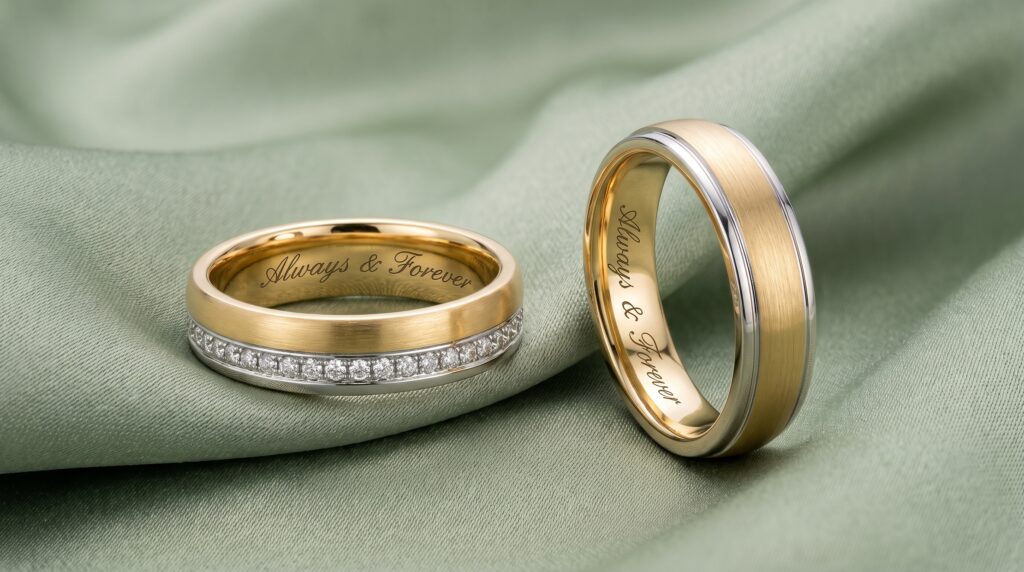
How Long Should a Wedding Band Engraving Be?
Why Shorter Is Often Better
A wedding band offers a narrow, curved surface, which limits how much text can fit while staying legible. Cramming in a long phrase usually means shrinking the font to a point where it’s hard to read without a loupe, which defeats the purpose of an engraving meant to be read and understood.
Character Limits by Engraving Type
Exact limits vary by jeweler and band width, but as general guidance:
- Interior text on a standard band often fits around 12 to 18 characters comfortably
- Some jewelers allow slightly more, closer to 15 to 20 characters, depending on font and band width
- Exterior symbols usually need to be kept to one or two small motifs rather than a full phrase
- Coordinates require careful formatting since they include numbers, periods, and directional letters that all take up space
Ask your jeweler for the specific character limit on the exact ring you’re ordering rather than assuming a general figure applies.
How Band Width Affects Engraving
A wider band gives more vertical space for taller lettering or a slightly longer line of text, while a narrow band limits both the character count and the font size that will still read clearly. If you know you want a longer message, factor that into the band width you choose rather than trying to fit extra text into a slim profile.
Choosing the Right Font
Script Fonts
Script fonts have a romantic, handwritten quality that suits sentimental phrases. At small sizes, though, the connecting strokes and flourishes that make script fonts appealing can also make them harder to read, particularly for anyone with limited close-up vision.
Block Fonts
Block fonts are cleaner and more legible, which makes them a practical choice for dates, initials, and coordinates where precision matters more than decorative flair. They hold up better at small sizes than most script options.
Roman Numerals
Roman numerals work well for dates and milestone numbers specifically because the character set is simple: straight lines and a handful of letters, which stay legible even in a compact space.
Readability should generally take priority over ornamentation, especially for interior engravings that are viewed up close in low light.
Durability and Long-Term Wear
Metal Choice
Harder metals tend to hold engraved detail more clearly over time than softer ones, since the cut lines resist smoothing out from repeated handling and contact. This is one more reason engraving depth and metal choice are worth discussing together with a jeweler rather than treating them as separate decisions.
Engraving Depth
Sufficient engraving depth helps prevent the text or symbol from wearing shallow and eventually illegible. A very shallow engraving might look fine on the day it’s finished but soften faster under the friction of daily wear, particularly on an exterior surface.
Interior vs Exterior Wear
As placement affects visibility, it also affects durability. Interior engravings are shielded by the finger and see less direct contact, so they typically retain legibility longer than exterior engravings of the same depth, which are exposed to the same scratches and knocks as the rest of the ring’s outer surface.
Restoration
If an engraving does soften over years of wear, professional restoration can often refresh it, deepening the existing lines rather than starting over. This isn’t guaranteed to be possible in every case, since it depends on how much metal remains around the engraved area, but it’s a reasonable option to ask about if legibility fades.
What to Check Before Finalizing Your Engraving
Before approving a final engraving, confirm:
- Spelling of every name, word, and phrase
- Date format (day/month/year order varies by convention)
- Coordinate accuracy, checked against the actual location
- A font preview at the actual size the engraving will be
- The character limit for your specific band
- Placement (interior or exterior)
- The engraving method being used
- The jeweler’s revision policy if an error is found before production
- A mock-up approval on the exact ring, not just a generic sample
This is the step most likely to prevent a permanent mistake. Engraving errors are far easier to catch on a proof than after the ring has already been cut.
Online Buying Confidence for Engraved Wedding Bands
Look For
When ordering engraving online, look for jewelers who provide:
- Font previews before you commit
- Sample engravings showing actual output, not just a rendering
- Mock-ups on the exact band you’re ordering, not a generic placeholder
- Stated character limits specific to the ring
- Details on engraving depth
- A clear revision policy
- A clearly stated engraving method (laser, hand, or rotary)
Red Flags
Be cautious of listings with no samples of actual engraved work, no proof or preview step before production, no stated character limits, vague descriptions of the engraving method, or “free engraving” offers that don’t explain anything about depth, method, or quality. Free engraving isn’t a problem in itself, but it’s worth confirming what you’re getting rather than assuming it matches a paid service.
A wedding band engraving doesn’t need to be long or elaborate to carry meaning. A name, a date, or three or four words chosen carefully will outlast a longer phrase that’s hard to read or that felt right at the time but doesn’t hold up over years of wear. Confirm the spelling, check the proof, and pick a message you’d still want to see on the ring in twenty years.
Frequently Asked Questions
What should I engrave on my wedding band?
There’s no single right answer, since the best engraving depends on what feels meaningful to you specifically. Common choices include a partner’s name or initials, the wedding date (often in Roman numerals), coordinates of a meaningful location, a short phrase, or a symbol like a heart or infinity mark. Shorter, simpler content tends to stay legible longer and is easier to fit clearly within the limited space of a ring.
Is laser engraving better than hand engraving?
Neither method is universally better. Laser engraving produces precise, consistent lines and is well suited to small text or fine detail, while hand engraving has a textured, artisanal quality with slight natural variation that some buyers prefer for a more traditional look. Laser engraving is generally faster and less expensive, while hand engraving usually costs more and takes longer to complete.
How many characters fit inside a wedding band?
This depends on the band’s width and the jeweler’s font options, but interior engravings commonly fit somewhere around 12 to 20 characters on a standard band. Wider bands can generally accommodate more text or larger lettering than narrow ones. Ask your jeweler for the exact limit on the specific ring you’re ordering rather than relying on a general estimate.
Does engraving affect ring size?
Engraving itself doesn’t change the ring’s size, but it can affect resizing later. Depending on how deep the engraving is and where it’s placed relative to any resizing point, a jeweler may need to take extra care, or in some cases the engraving may be affected if the band needs to be cut and rejoined during resizing.
Can engraving wear off?
Engraving can soften over years of wear, particularly on exterior surfaces that see more direct contact, or if the engraving wasn’t cut deeply enough to begin with. Interior engravings, protected by the finger, typically hold their detail longer. If an engraving does fade, professional restoration can often deepen the existing lines, depending on how much metal remains in that area of the band.
Is interior or exterior engraving better?
It depends on what you want from the engraving. Interior engraving suits private messages and tends to last longer since it’s shielded from daily wear. Exterior engraving suits visible symbols or design details but is more exposed to scratches and general wear over time. Neither option is universally better; the choice comes down to whether you want the engraving to be private or visible.
Can coordinates be engraved on a wedding band?
Yes, coordinates are a common engraving choice for marking a proposal site, wedding venue, or another meaningful location. They need to be formatted carefully and double-checked against the actual location before engraving, since a single incorrect digit changes the coordinates to a different place entirely.
Can engraved wedding bands be resized?
In most cases, yes, but resizing an engraved band can be more involved than resizing a plain one, particularly if the engraving runs close to where the band would need to be cut. It’s worth asking your jeweler how resizing would affect the specific engraving before finalizing your order.
How do I care for an engraved ring?
Care for an engraved ring the way you would any fine jewelry: gentle cleaning, avoiding harsh chemicals, and periodic professional attention rather than aggressive at-home polishing that could wear down the engraved detail faster than normal use. The Gemological Institute of America recommends gentle, regular care and professional cleaning for fine jewelry generally, which applies directly to engraved rings since aggressive polishing can soften fine detail over time.