
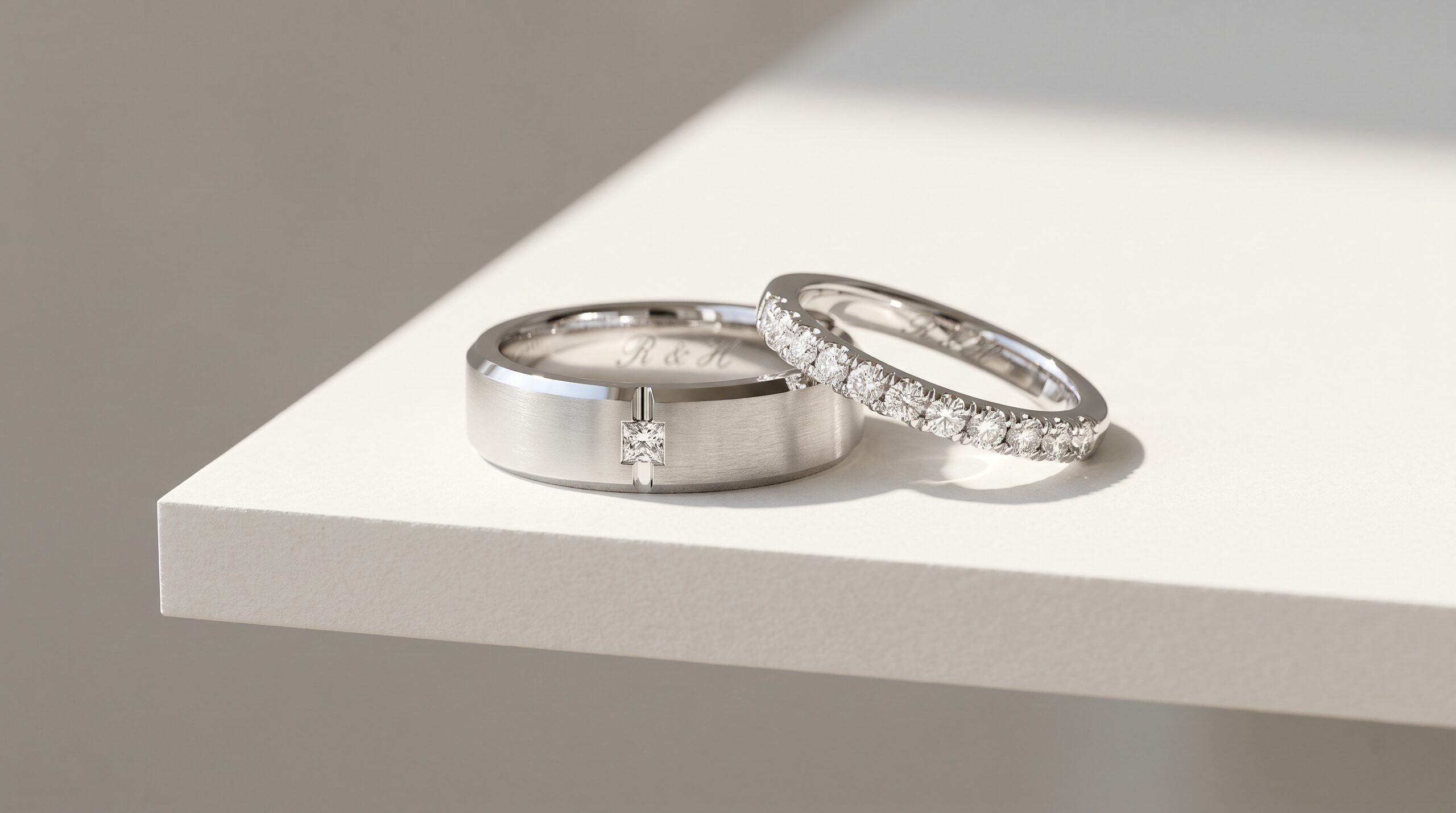
Most couples shopping for wedding bands together eventually hit the same question: do our rings need to match? The honest answer is no, not exactly, and treating “matching” as the only way to feel connected often leads couples toward a compromise neither partner actually wants. A wider, more durable band for one partner and a slimmer, diamond-accented band for the other can feel just as unified as two identical rings, as long as the pairing is intentional rather than accidental.
This guide covers how matching and complementary sets differ, how to coordinate metals, widths, and finishes across two different sets of needs, and what to check before buying so both rings hold up to daily life, not just the wedding day photos.
What Are His and Hers Wedding Band Sets?
Matching sets use nearly identical design elements across both rings: the same metal, similar width proportions, matching finish, sometimes the same engraving. Complementary sets coordinate through related but distinct details, sharing a metal color or a design motif, for instance, while differing in width, texture, or the presence of gemstone accents. Neither approach is more “correct” than the other; they represent different ways of expressing the same idea.
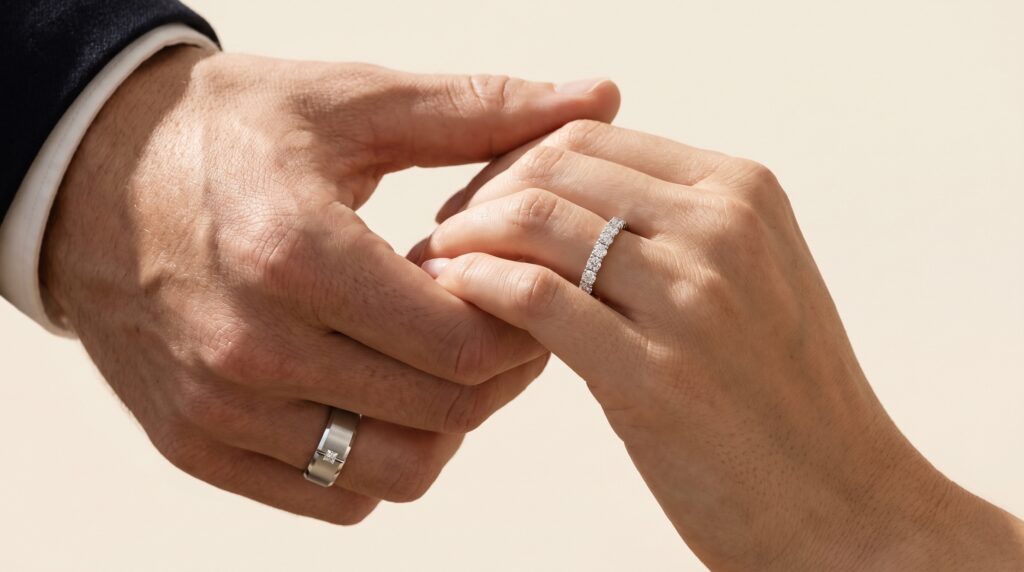
Common design features that create a sense of unity without requiring identical rings include a noticeably wider band for one partner and a slimmer one for the other, a shared metal color even if the finishes differ, matching or complementary engraving, diamond or gemstone accents on one band while the other stays plain, and two-tone elements that echo across both rings without duplicating them exactly.
| Style Type | What It Means | Best For |
| Matching | Nearly identical metal, width, and finish across both rings | Couples who want strong visual symmetry |
| Complementary | Coordinated through shared details like metal color or motif, but distinct in other ways | Couples with different style or lifestyle needs |
Why Couples Choose Coordinated Wedding Bands
Coordinated sets appeal to couples for practical and symbolic reasons that often overlap. There’s a sense of symbolic unity in choosing rings that were selected together, as a set, rather than separately. Visual harmony matters for couples who like the way related rings photograph and look together, particularly for wedding photography where both hands are often shown side by side. A shared design story, meaning the rings tell a coordinated story even if they’re not identical, gives some couples a sense of intentionality they want reflected in the purchase. Shopping as a set can also simplify the process compared to two entirely separate searches, and personalization through shared engraving or a common motif adds meaning without requiring uniformity.
Matching vs Complementary Wedding Bands
Matching bands tend to work best for couples who like visual symmetry, gravitate toward minimalist or classic metal bands without heavy embellishment, and want a shared engraving or detail to feel most impactful when it appears identically on both rings.
Complementary bands tend to work best when partners have genuinely different personal styles, when one partner has different lifestyle or durability needs than the other, when the hers band needs to stack cleanly with an engagement ring in a way the his band doesn’t need to accommodate, or when one partner wants a plain band while the other wants diamond accents.
| Option | Pros | Cons | Best For |
| Matching | Strong visual symmetry, simple to shop for as a set | Less flexibility if partners have different style or lifestyle needs | Similar tastes and daily wear conditions |
| Complementary | Accommodates different styles, lifestyles, and engagement ring pairing needs | Requires more intentional coordination to feel connected | Different tastes, different daily wear conditions |
Popular Types of His and Hers Wedding Band Sets
Precious metal sets in gold or platinum offer a timeless appearance that doesn’t shift with trends, and both metals can generally be resized if either partner’s size changes over time. The tradeoff is a higher cost compared to alternative metals, particularly for platinum.
Alternative metal sets in tungsten or titanium offer strong scratch resistance and generally lower maintenance than precious metals. The tradeoff is resizing: titanium is difficult to resize and tungsten typically can’t be resized at all, so accurate sizing before purchase matters more with this category than with gold or platinum.
Gem-accented sets add diamonds through channel or pavé settings, giving one or both rings extra sparkle and detail. That detail comes with added maintenance, since set stones need periodic inspection to confirm they remain secure, and settings with multiple small stones generally need more careful cleaning than a plain band.
Two-tone sets mix metal colors, such as yellow and white gold in a single band, offering more visual versatility and the option to echo both partners’ metal preferences in one design. The tradeoff is more complex construction and polishing, which can add cost and, in some cases, make future repairs slightly more involved than a single-metal band.
| Set Type | Pros | Cons | Best For |
| Precious metal (gold, platinum) | Timeless look, generally resizable | Higher cost | Couples prioritizing resizing flexibility and classic style |
| Alternative metal (tungsten, titanium) | Scratch resistant, low maintenance | Limited or no resizing | Active lifestyles, lower budget |
| Gem-accented | Extra sparkle and detail | More maintenance, settings need inspection | Couples wanting a dressier look on one or both bands |
| Two-tone | Visual versatility, blends metal preferences | More complex construction and polishing | Couples who want one ring to reference both metal colors |
How to Choose the Right Metal for Both Partners
Gold, particularly 14K, offers the classic wedding band look at a reasonable durability level for daily wear, though it will scratch and dull somewhat over years of use compared to harder alternative metals.
Platinum offers a premium white metal with a durable, substantial feel and the advantage of not needing rhodium plating to maintain its white color, unlike white gold. It comes at a meaningfully higher price point than gold or alternative metals.
Titanium is lightweight and durable, holding up well to active daily use, though it scratches more visibly than tungsten and is difficult to resize.
Tungsten is the most scratch-resistant option in this comparison, maintaining a polished look through years of contact. It’s heavier than titanium, brittle enough to crack under a hard direct impact, and essentially cannot be resized.
| Metal | Feel | Durability | Resizable? | Best For |
| Gold (14K) | Warm, classic | Moderate, scratches over time | Yes | Traditional look with resizing flexibility |
| Platinum | Substantial, premium white | High, retains mass when scratched | Yes | Long-term wear without replating needs |
| Titanium | Light | High, but scratches | No | Active lifestyles, lightweight preference |
| Tungsten | Heavy | High scratch resistance, brittle under impact | No | Low-impact daily wear, scratch resistance priority |
If one partner wants a resizable precious metal and the other wants a low-maintenance alternative metal, that’s a completely reasonable complementary pairing. The set doesn’t need to share a metal type to feel coordinated, particularly if other details, like a matching engraving or a shared finish tone, create the connection instead.
Width, Fit, and Comfort Considerations
His bands commonly range from about 4mm to 8mm, while hers bands often run narrower, typically 2mm to 4mm, partly for aesthetic proportion and partly to stack cleanly alongside an engagement ring. These are common defaults rather than fixed rules; plenty of couples choose wider hers bands or narrower his bands based on personal preference.
Comfort-fit construction, a rounded rather than flat interior edge, makes a ring feel smoother against the finger during daily movement, and it matters more with wider bands and with rigid metals like titanium or tungsten that can’t flex to accommodate the finger the way softer metals do.
When measuring, both partners should get sized together if possible, since it’s easier to coordinate width and comfort-fit decisions in one sitting than across separate visits. Account for knuckle size specifically if it’s noticeably larger than the base of the finger, since a ring that fits over the knuckle comfortably may be loose at the base. Use a proper sizing kit rather than estimating from an old ring, and check the retailer’s return and resizing policies for both rings before finalizing the purchase.
| Width | Visual Effect | Comfort Note | Common Use |
| 2-3mm | Delicate, subtle | Comfortable at standard sizing | Hers bands, stacking with an engagement ring |
| 4-5mm | Balanced, moderate presence | Comfort-fit recommended for rigid metals | Either partner, versatile |
| 6-8mm+ | Substantial, bold | Comfort-fit strongly recommended | His bands, statement styles |
Matching a Hers Band With an Engagement Ring
Engagement ring fit matters more for the hers band than for the his band, since it’s the one being worn stacked alongside another ring daily. Band height on the engagement ring setting, the overall ring profile, and where any gemstone settings sit all affect whether the wedding band will sit flush or leave a visible gap.
A contour band is a wedding band curved or notched to sit closely against an engagement ring’s shape, following the setting rather than sitting as a straight line beside it. If the engagement ring has an unusual silhouette, a solitaire with a raised setting, a halo, or an asymmetric design, a contour band is often the more practical choice over a straight band, which may leave a visible gap or space where the two rings meet.
For stacking generally, consider whether the width of the wedding band balances proportionally with the engagement ring rather than overwhelming or disappearing next to it, whether the metal color matches or intentionally contrasts, whether any gemstones on both rings align reasonably well when worn together, and whether the combined stack feels comfortable rather than bulky on the finger.
Before finalizing a hers band, check whether it sits flush against the engagement ring with no visible gap, whether it rubs or catches against the engagement ring during normal hand movement, whether the profile height difference between the two rings feels too dramatic in either direction, and whether the overall width proportion looks balanced when both rings are worn together.
Personalization Options for Wedding Band Sets
Engraving ideas that work well across a set include initials, the wedding date, a private phrase meaningful to the couple, coordinates from a significant location, or a shared symbol that appears on both rings in a small, consistent way.
Shared design details that create unity without requiring identical rings include a matching finish (both polished, or both matte, even if the metals differ slightly), a matching metal color, a shared motif like a particular engraving style or pattern, intentional two-tone design that echoes across both rings, or a hidden detail, such as an engraving on the inside of the band, that only the couple knows about.
Couples generally do better choosing one or two shared elements deliberately rather than trying to match every detail. A shared engraving plus a shared metal tone, for instance, creates a clear sense of connection without forcing both partners into an identical ring that might not suit their individual style or daily wear needs.
Durability and Daily Wear
For active lifestyles, titanium generally holds up better than more brittle metals, and a low-profile design with a plain band or minimal, secure gemstone setting reduces the risk of snagging or damage during daily activity. Avoid heavily raised gemstone settings on a band meant for hands-on work or frequent physical activity.
For dressier styles worn in lower-impact settings, diamond accents and polished precious metal finishes hold up well, since the daily wear conditions are less demanding than active or manual work.
A few durability tradeoffs are worth understanding before buying. Gold scratches more easily than harder alternative metals, though it can be polished to restore its finish. Tungsten resists scratches exceptionally well but is brittle enough to crack under hard impact, a real consideration if either partner works with tools or machinery. Gemstone accents need periodic inspection regardless of metal, since a stone can loosen from its setting over years of wear. And eternity bands, with stones set continuously around the entire ring, are generally harder to resize than bands with stones only on the top portion, since resizing an eternity design risks disturbing the stone settings around the whole circumference.
What to Look for When Buying His and Hers Wedding Bands Online
A trustworthy listing for a coordinated set should clearly state the metal type and karat or purity for both rings, any gemstone weight and quality details, the width for each ring individually, the finish type, resizing terms for both bands, contour specifications if the hers band is designed to pair with a specific engagement ring style, and warranty coverage.
Visual documentation should include paired images showing both rings together, not just individual solo shots, along with close-up photos of any gemstone settings and, where relevant, images showing how the hers band pairs with a common engagement ring style. Following GIA’s general jewelry care guidance as a baseline for how any set stone or precious metal piece should be handled is a reasonable standard to hold a retailer to when reviewing their product care information.
Red flags include listings with only solo photos of each ring and no paired image, missing hallmarks on either ring, unclear gemstone details (carat weight, clarity, or setting type left vague), no contour information for the hers band, no sizing support for either ring, and vague alloy descriptions that don’t specify actual composition. The American Gem Society sets ethical and educational standards for member jewelers, which is a reasonable reference if you want to confirm a retailer has recognized credentials before making a purchase this significant.
Frequently Asked Questions
Do his and hers wedding bands have to match exactly?
No. Matching and complementary are both legitimate approaches, and a coordinated set can feel just as meaningful through shared details like metal color, engraving, or finish as it can through two identical rings. What matters more than exact matching is that the pairing feels intentional rather than incidental.
What is the typical width difference between his and hers bands?
His bands commonly range from about 4mm to 8mm, while hers bands often run narrower, typically 2mm to 4mm, partly for proportion and partly so the band stacks cleanly with an engagement ring. These are common defaults rather than requirements, and plenty of couples choose different proportions based on personal preference and hand size.
Can one ring have diamonds and the other be plain?
Yes, and this is one of the more common complementary pairings couples choose. A plain band on one side and a diamond-accented band on the other can still feel unified if they share a metal color, finish, or another design detail. There’s no rule requiring both rings to carry the same level of embellishment.
What metal is best for matching wedding band sets?
There’s no single best metal for every couple; the right choice depends on both partners’ lifestyle and durability needs. Gold and platinum offer resizing flexibility and a classic look, while titanium and tungsten offer lower maintenance and, in tungsten’s case, stronger scratch resistance, at the cost of limited or no resizing. If both partners have similar lifestyles, matching metals is straightforward; if not, a complementary approach with different metals may serve each partner better.
Can both rings be resized?
It depends on the materials chosen. Gold and platinum can generally be resized by a jeweler if either partner’s size changes. Titanium is difficult to resize and not something to count on, while tungsten typically cannot be resized at all. If resizing flexibility matters to either partner, that’s worth factoring into the metal choice for that specific ring, even within a coordinated set.
Should the hers band match the engagement ring?
It should coordinate with it, though “match” isn’t always the right word, since a contour band designed to fit an unusually shaped engagement ring may look quite different from the engagement ring itself while still fitting it precisely. What matters most is whether the wedding band sits flush against the engagement ring without gaps or rubbing, which sometimes calls for a contour or curved design rather than a straight band that happens to share the same metal.
Are tungsten wedding band sets a good choice?
They can be, particularly for couples who want strong scratch resistance and lower maintenance, and who aren’t concerned about future resizing. The main consideration is that tungsten cannot be resized at all, so both partners need accurate sizing before ordering, and it’s a better fit for lower-impact daily wear than for jobs or activities involving frequent hard impact, since tungsten can crack under enough force despite its scratch resistance.