
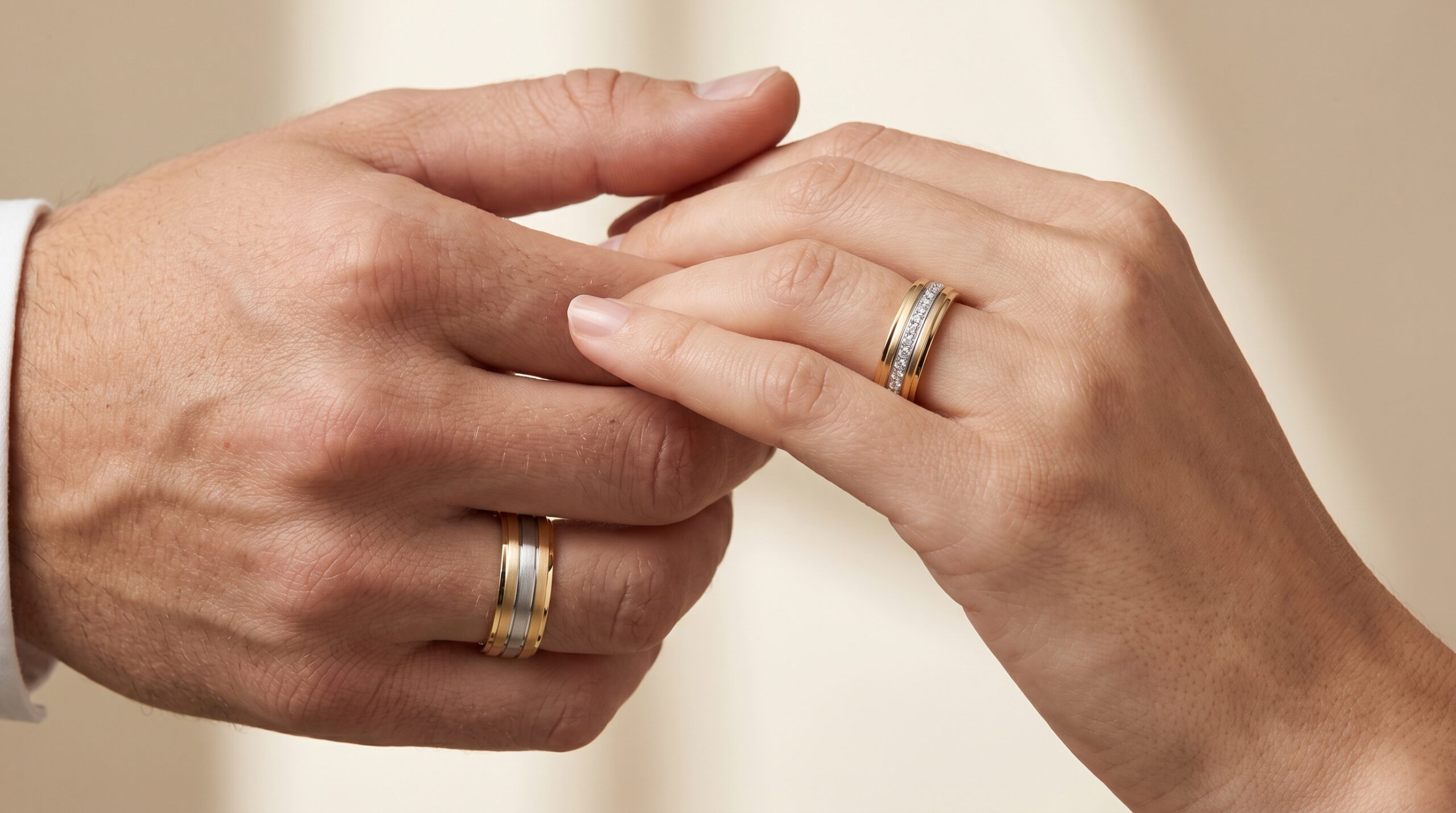
Choosing one metal for a wedding band means picking a side: warm or cool, gold or platinum, traditional or modern. Mixed metal wedding bands remove that requirement. They combine two or more metal colors or materials in a single ring, which is why they’re also called two-tone wedding bands. The appeal is obvious once you see one in person. The harder part is knowing whether the design will hold up, whether it can be resized later, and whether it will actually match the engagement ring sitting next to it every day.
This guide covers what mixed metal bands are, which combinations work well together, how construction quality affects durability, and what to check before buying one.
What Are Mixed Metal Wedding Bands?
Mixed Metal vs Two-Tone Wedding Bands
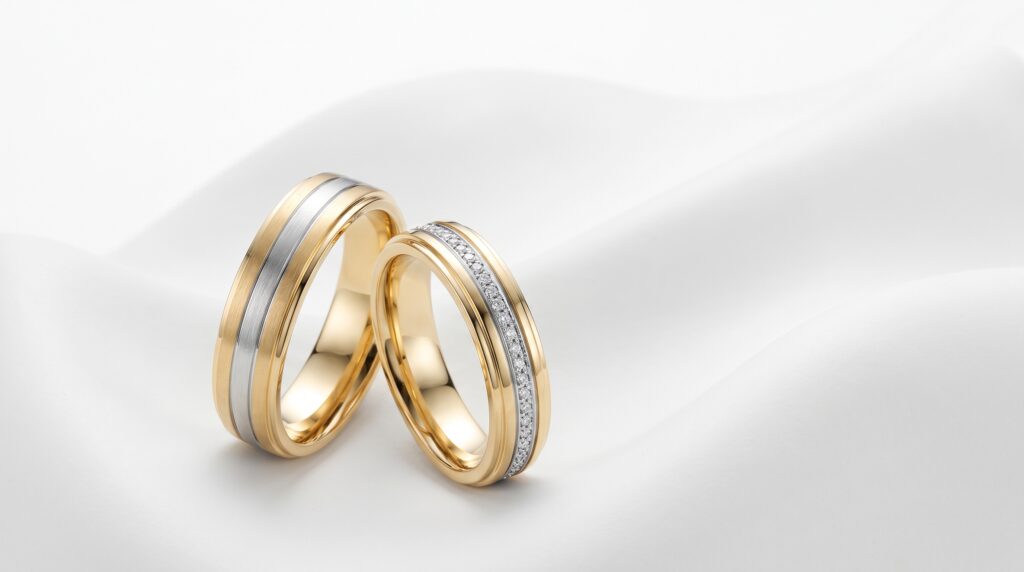
A mixed metal wedding band combines two or more metals or metal colors in one piece of jewelry. Two-tone is the more specific term: it usually describes a ring with two visible metal colors, most often a combination of yellow, white, or rose gold. In practice, jewelers use both terms for rings that mix precious metals like gold and platinum, or that pair a precious metal with a harder material like titanium or tungsten.
Common Mixed Metal Design Styles
The way the metals are combined changes both the look of the ring and how it’s constructed:
- Inlays, where a strip or pattern of one metal is set into a band made of another
- Braided designs, where strands of different metals are woven together
- Half-and-half styles, where the band is split lengthwise between two metals
- Split bands, which use two separate metal profiles joined at the sides
- Contrasting edges, where the rims of the band are one metal and the center is another
- Center stripe designs, a narrow band of contrasting metal running through the middle
| Design Style | What It Looks Like | Best For |
| Inlay | A contrasting strip set into the surface of the band | Buyers who want subtle contrast without a busy pattern |
| Braided | Interwoven strands of two or more metals | Buyers who want texture and movement |
| Half-and-half | Two metals split down the length of the band | Buyers who want a clean, even divide between tones |
| Contrasting edges | Rims in one metal, center in another | Buyers who want a framed look |
| Center stripe | A thin band of contrast running through the middle | Buyers who want a minimal accent |
Why Choose a Mixed Metal Wedding Band?
The reasons people choose mixed metal bands are usually practical as much as aesthetic:
- They coordinate with jewelry in more than one metal tone, so the wearer isn’t limited to matching everything to a single color
- They give more flexibility when the engagement ring itself mixes metals or sits between two tones
- They create visual contrast that a single-metal band can’t produce on its own
- They read as personal rather than ornate, since the interest comes from the pairing rather than added detail
- They blend traditional metals like gold and platinum with a more contemporary construction
- They can represent two elements or people coming together in one piece, which is part of why they’re popular for weddings specifically
None of this makes mixed metal automatically the better choice. It depends on what the wearer already owns, how the engagement ring looks, and how much construction complexity they’re willing to accept in exchange for the contrast.
Popular Mixed Metal Combinations
Yellow Gold and White Gold
This is the most common pairing because it works with almost any jewelry collection. The warm and cool contrast is strong enough to be visible without being loud. The white gold portion is typically rhodium plated, which means the bright white finish can dull over time and may need to be replated to stay looking fresh.
Yellow Gold and Rose Gold
Both metals sit on the warm end of the spectrum, so the contrast is softer than yellow and white gold. This combination suits buyers who already wear warm-toned jewelry and want variation without introducing a cool tone into the mix.
Platinum and Gold
Platinum brings a dense, cool-white finish that reads differently from rhodium-plated white gold, since platinum doesn’t need plating to stay white. Pairing it with yellow or rose gold creates strong contrast and typically costs more than gold-only combinations, since platinum is denser and more expensive per gram.
Titanium and Gold
Titanium is lightweight and scratch-resistant compared to gold, which makes this pairing common for people who work with their hands or wear their ring daily without much thought. Titanium can still pick up surface scratches over years of wear, though it tends to show them differently than gold does.
Tungsten and Rose Gold
Tungsten carbide is one of the hardest materials used in ring construction, so this pairing resists scratching better than most gold combinations. The tradeoff is that tungsten is brittle rather than malleable. It can crack under a sharp impact, and most tungsten rings, including mixed metal designs that use it, cannot be resized.
| Combination | Look | Pros | Considerations | Best For |
| Yellow gold + white gold | Warm and cool contrast | Matches a wide range of jewelry | White gold needs periodic rhodium replating | Buyers who wear both warm and cool metals |
| Yellow gold + rose gold | Soft, warm contrast | Subtle, no plating maintenance | Less contrast if the wearer wants a bold look | Buyers who prefer warm tones overall |
| Platinum + gold | High contrast, premium finish | Platinum doesn’t need replating | Higher cost, denser metal adds weight | Buyers prioritizing a naturally white finish |
| Titanium + gold | Modern, lightweight | Scratch-resistant, comfortable for daily wear | Titanium sections are harder to resize or repair | Active wearers who want low upkeep |
| Tungsten + rose gold | Bold, high-contrast | Very scratch-resistant | Typically not resizable, can crack on impact | Buyers who prioritize durability over flexibility |
Mixed Metal Wedding Bands vs Single-Metal Bands
Mixed metal works best for buyers who already wear multiple metal tones, whose engagement ring doesn’t match a single classic metal, or who want a band that reads as intentional rather than plain. A single-metal band tends to be the simpler choice: it’s easier to polish evenly, easier to resize since there’s only one material to work with, and less complicated to repair if it’s ever damaged.
| Option | Pros | Cons | Best For |
| Mixed metal band | Contrast, versatility, coordinates with multiple metal tones | More complex construction, resizing can be limited, uneven wear between metals | Buyers who wear multiple metals or want visual contrast |
| Single-metal band | Simple maintenance, straightforward resizing, even wear | Less visual variety, may not bridge mismatched jewelry tones | Buyers who want simplicity and long-term ease of care |
How Metal Pairing Affects Durability
Why Metal Hardness Matters
Different metals resist scratching, denting, and general wear at different rates. Platinum and gold are both relatively soft precious metals, though platinum is denser and tends to develop a matte patina rather than deep scratches. Titanium and tungsten are significantly harder and resist surface marks better, which is part of why they’re often paired with softer precious metals in mixed designs.
Mismatched Hardness and Uneven Wear
Pairing a harder and a softer metal in one ring isn’t a flaw by itself, but it does mean the two sections may age visibly differently. A gold inlay next to a titanium band will likely show wear on the gold side first. This is worth expecting rather than being surprised by later, and a well-made ring accounts for it in the design rather than treating both metals as interchangeable.
White Gold Plating and Long-Term Wear
White gold is typically rhodium plated to achieve its bright white color, since gold’s natural tone is closer to pale yellow even when alloyed with white metals. That plating wears down with regular use and contact, which is a standard part of owning white gold rather than a defect. The Gemological Institute of America outlines general jewelry care and maintenance practices, including how plated finishes should be handled over time. Most jewelers can replate a white gold section during a routine cleaning or repair visit.
| Metal Combination | Wear Consideration | Buyer Note |
| Yellow + white gold | White gold plating fades faster than yellow gold surface wear | Plan for occasional rhodium replating |
| Yellow + rose gold | Both wear at similar rates | Minimal maintenance difference between sections |
| Platinum + gold | Platinum develops a patina, gold may show scratches sooner | Some owners prefer platinum’s natural aging, others prefer it polished |
| Titanium + gold | Titanium resists scratches better than the gold portion | Gold section will likely need more frequent polishing |
| Tungsten + rose gold | Tungsten resists scratching, rose gold does not | Rose gold section needs standard gold care |
Construction Quality: What Buyers Should Check
Joins, Seams, and Solder Quality
Where two metals meet, they’re joined with solder or a mechanical fit. Weak or poorly finished joins are where mixed metal rings tend to fail first, whether that’s a visible seam, a section that loosens over time, or a rough edge that catches on clothing. Ken Walker Jewelers’ guidance on mixed metal men’s wedding bands notes that construction quality at these joins is one of the main factors separating a durable ring from one that needs repair within a few years.
Inlay Security
If the design uses an inlay, check that the secondary metal is set securely with no visible gaps, that the edges are smooth to the touch, and that there’s no rough seam line where the two metals meet. A loose or shallow inlay is more likely to shift or wear unevenly.
Custom Fabrication Details
A ring with clear fabrication information is easier to evaluate before buying. Look for fabrication stamps or hallmarks, a breakdown of the alloy used in each section, and any warranty language specific to the joins rather than a generic return policy.
Mixed Metal Quality Checklist
- Are the seams clean, with no visible gaps or rough lines?
- Are the joins smooth to the touch on both the outside and inside of the ring?
- Is each metal and its karat or purity clearly identified?
- Is the interior comfortable, without sharp transitions between sections?
- Does the retailer offer a warranty specific to the construction and joins?
Matching a Mixed Metal Band to an Engagement Ring
Why Mixed Metals Are Useful for Matching
A mixed metal band can bridge the gap when the engagement ring’s metal doesn’t match what the wearer usually wears elsewhere. If the engagement ring is yellow gold but the wearer’s other jewelry is mostly white metal, a yellow and white gold wedding band can sit comfortably next to both.
Choosing the Dominant Metal Colour
The simplest approach is to match the dominant metal in the wedding band to the engagement ring’s metal, then use the secondary metal as the accent. Skin tone and existing wardrobe also play a role: warm undertones tend to read well with yellow and rose gold, while cool undertones often pair better with white gold or platinum, though personal preference matters more than any fixed rule here.
Avoiding Visual Clutter
If the engagement ring already has a detailed setting, an ornate mixed metal band can compete with it rather than complement it. A smoother, simpler mixed metal design, such as a thin inlay or a subtle two-tone edge, tends to pair better with a busy engagement ring than a braided or heavily patterned band would.
| Engagement Ring Metal | Mixed Metal Pairing Idea | Styling Note |
| Yellow gold | Yellow and white gold band | Keeps yellow as the dominant tone with a white accent |
| White gold | White and rose gold band | Adds warmth without losing the cool base tone |
| Rose gold | Rose and yellow gold band | Stays in the warm range with subtle variation |
| Platinum | Platinum and yellow or rose gold band | Uses platinum as the anchor metal with a warm accent |
| Mixed metal engagement ring | Match the dominant accent metal | Reduces the number of distinct tones worn together |
Fit, Comfort, and Resizing Considerations
Comfort Fit Interiors
Many mixed metal bands still use a single, uniform metal on the inside of the ring, even when the outer surface combines two or more materials. This keeps the part that touches the skin consistent, which helps with comfort regardless of how complex the outer design is.
When Mixed Metal Bands Can Be Resized
Resizing is generally possible when the inner band is made from one uniform precious metal, since a jeweler can cut and resolder that section without disturbing the outer design. More complex constructions, where multiple metals run through the full thickness of the band, are harder to resize without affecting the pattern. Tungsten sections typically cannot be resized at all, because tungsten carbide can’t be cut and resoldered the way gold or platinum can.
Width and Wearability
Most wedding bands fall between 4 and 8 millimeters wide. Wider bands show off the contrast between metals more clearly, since there’s more surface area for the pattern to appear on. Smooth, rounded edges reduce the chance of the ring snagging on fabric or catching during daily activities.
| Design Type | Comfort Consideration | Resizing Consideration | Best For |
| Inlay with uniform inner band | Comfortable, consistent interior | Usually resizable | Buyers who may need future resizing |
| Full-thickness braided or split design | Comfort depends on edge finishing | Limited resizing due to pattern complexity | Buyers confident in their current ring size |
| Tungsten combination | Comfortable but rigid | Not resizable | Buyers prioritizing durability over future flexibility |
Care and Maintenance for Mixed Metal Wedding Bands
Gentle Cleaning Basics
Mild soap, warm water, and a soft cloth are sufficient for routine cleaning of most mixed metal combinations. Dry the ring fully afterward, particularly around any seams or inlays where moisture can collect.
Preserving Metal Contrast
Aggressive polishing can wear down the contrast between metals faster than normal use would, especially on inlays and thin stripes. Each metal section should be treated according to its own care needs rather than polished as a single uniform surface, and harsh chemicals, including chlorine and some jewelry cleaning solutions, should be avoided since they can affect certain metals and platings differently.
Maintenance Over Time
Check seams and joins periodically for looseness or wear, particularly if the ring is worn daily. Keep an eye on white gold sections for plating wear, since a dulling or yellowing white gold surface usually means it’s due for replating. Storing the ring in an anti-tarnish pouch when it’s not being worn helps slow oxidation on the softer metal sections.
| Care Task | Why It Matters | Recommended Frequency |
| Clean with mild soap and soft cloth | Removes buildup without damaging plating or finish | Every one to two weeks |
| Inspect seams and joins | Catches loosening before it leads to damage | Every few months |
| Check white gold plating | Prevents prolonged wear on a dull or yellowing finish | Annually, or when discoloration appears |
| Professional inspection and cleaning | Identifies wear that’s hard to see at home | Once a year |
What to Look for When Buying Mixed Metal Wedding Bands Online
Product Details That Should Be Clear
A trustworthy product listing should specify the karat for each gold section, a metal breakdown by section of the ring, details on how the metals are joined, whether any section is plated, the store’s resizing terms, its return policy, and whether there’s a warranty covering the joins specifically. The Federal Trade Commission’s jewelry guides outline what sellers are required to disclose about metal content and plating, which is a useful baseline for what a listing should include.
Visual Documentation
Look for close-up photos of the seams, a 360-degree view of the ring, images that show the metal contrast clearly in natural light, and photos of both the outer edges and the interior of the band.
Red Flags
Be cautious of listings with blurry or absent seam photos, no metal breakdown by section, no plating disclosure, no warranty language covering construction, a rigid no-return policy, or vague resizing guidance that doesn’t specify what is and isn’t possible for that particular design.
Conclusion
A mixed metal wedding band solves a real problem: it lets you wear more than one metal tone without treating the choice as permanent or limiting. The design itself is rarely the risk. The construction is. A band with clean seams, a clear metal breakdown, and honest resizing terms will hold up regardless of which combination you choose. Before buying, ask the seller directly about join warranties and resizing limits for the specific design you’re considering, since those details vary more between rings than the metal combinations themselves do.
Frequently Asked Questions
What is a mixed metal wedding band?
A mixed metal wedding band combines two or more metals or metal colors into a single ring, using methods like inlays, braided strands, split designs, or contrasting edges. The metals can be different colors of gold, such as yellow and white, or different materials entirely, such as gold paired with titanium or tungsten.
Are mixed metal wedding bands the same as two-tone bands?
They overlap but aren’t identical terms. Two-tone specifically refers to a ring with two visible metal colors, most commonly a combination of yellow, white, or rose gold. Mixed metal is a broader term that also covers combinations involving platinum, titanium, or tungsten alongside precious metals.
Can mixed metal wedding bands be resized?
It depends on the construction. If the ring has a uniform inner band made of one precious metal, a jeweler can typically resize it without disturbing the outer design. More complex constructions where multiple metals run through the full thickness of the band are harder to resize, and tungsten sections generally can’t be resized at all since tungsten carbide can’t be cut and resoldered.
Do mixed metal rings wear unevenly?
They can, because different metals have different hardness levels. A softer metal like gold will typically show scratches or wear before a harder metal like titanium or tungsten does when they’re combined in the same ring. This isn’t a defect in the ring, but it’s worth expecting rather than being surprised by after a few years of wear.
Do mixed metal bands match any engagement ring?
Mixed metal bands are useful for bridging engagement rings that don’t match a single classic metal tone, since the wedding band can pick up the engagement ring’s dominant metal and add a secondary accent. They don’t automatically match everything, though, and a heavily patterned mixed metal band can compete visually with an ornate engagement ring rather than complement it.
Does white gold in a mixed metal band need replating?
Yes, in most cases. White gold gets its bright white color from a rhodium plating layer over the naturally pale-yellow gold underneath, and that plating wears down with regular use. Replating is a standard part of owning white gold jewelry rather than a sign that something has gone wrong, and most jewelers can do it during a routine cleaning or repair visit.
Are mixed metal wedding bands trendy or timeless?
Mixed metal designs have been used in jewelry for a long time, including classic yellow and white gold combinations that predate current trend cycles. Some specific patterns or pairings may feel more current than others, but the underlying concept of combining metal tones in one ring isn’t tied to a particular era.
What mixed metal combination is best for sensitive skin?
This depends on which specific metals and alloys are used rather than the fact that the ring combines metals. Higher-karat gold (18k or higher) and platinum tend to cause fewer reactions than lower-karat gold alloys, which contain more base metal. Anyone with a history of metal sensitivity should ask the seller for the exact alloy composition of each section before buying, since nickel content in particular is a common trigger for reactions.