
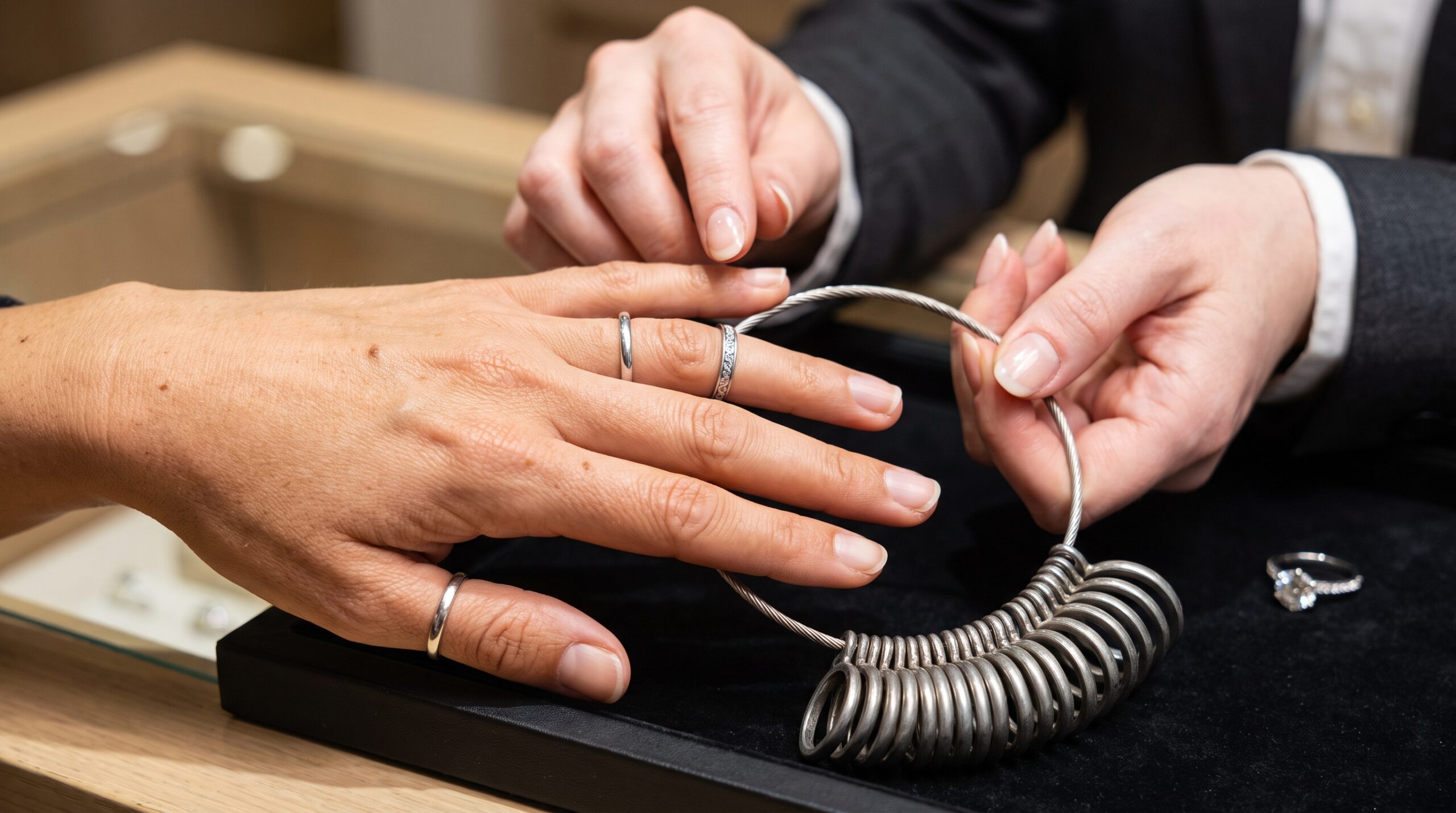
A wedding band that fit perfectly on the day it was chosen doesn’t always stay that way. Fingers change size with weight fluctuations, pregnancy, aging, and even the weather, and a ring that once slid on easily can start pinching, spinning, or feeling loose enough to worry about losing it. Resizing is often the answer, but not every ring can be resized the same way, and some can’t be resized at all.
This guide covers how resizing works, which materials and designs allow it, what the process costs, and when a temporary fix makes more sense than a permanent change.
What Is Wedding Band Resizing?
What Resizing Actually Changes
Resizing adjusts the inner circumference of the ring, either by adding metal to make it larger or removing metal to make it smaller. That change affects how the ring fits over the knuckle, how snugly it sits at the base of the finger, and whether it moves or spins during normal use.
Why People Resize Wedding Bands
The most common reasons are weight changes, pregnancy (during which fingers often swell and then return closer to their original size afterward), aging (finger joints can widen over time), temperature-related swelling from heat or physical activity, and simply being sized incorrectly at the original purchase.
| Fit | What It Means | Typical Cause |
| Too tight | The ring is difficult to remove, or leaves a deep mark | Weight gain, swelling, incorrect original sizing |
| Too loose | The ring spins freely or slides over the knuckle without resistance | Weight loss, temperature changes, incorrect original sizing |
| Proper fit | The ring moves over the knuckle with light resistance and sits securely at rest | Correct sizing for the wearer’s current finger size |
How Do You Know If Your Wedding Band Needs Resizing?
Signs Your Ring Is Too Tight
A ring that’s too tight typically causes ongoing discomfort, leaves a visible indentation or mark on the skin after it’s removed, is genuinely difficult to take off, or feels noticeably tighter during hot weather or physical activity when fingers tend to swell.
Signs Your Ring Is Too Loose
A loose ring spins around the finger on its own, slides over the knuckle with little to no resistance, or has come close to sliding off entirely. Any of these increase the risk of losing the ring, particularly in cold weather when fingers naturally shrink slightly.
What a Proper Fit Should Feel Like
A well-fitted band sits securely at the base of the finger without constant awareness of it being there. It should pass over the knuckle with a bit of resistance rather than sliding freely, and it shouldn’t spin around the finger under normal movement.
| Fit Issue | What It Feels Like | Possible Solution |
| Too tight | Pinching, marks after removal, hard to take off | Size up, or address swelling first if it’s temporary |
| Too loose | Spinning, sliding, risk of loss | Size down, or use a temporary insert if the change may not be permanent |
| Proper fit | Secure at rest, slight resistance over the knuckle | No action needed |
Which Wedding Bands Can Be Resized?
Gold Wedding Bands
Gold is generally resize-friendly. A skilled jeweler can size a gold band up or down, and with careful work, the seam where new metal is added or removed should be minimal and difficult to see once the band is polished.
Platinum Wedding Bands
Platinum can typically be resized using similar methods to gold, though the process often costs more. Platinum has a higher melting point and requires more specialized equipment and labor to work with safely.
Tungsten Wedding Bands
Tungsten carbide is typically not resizable. It’s an extremely hard but brittle material, and the cutting and resoldering process used on gold or platinum doesn’t work on it. Just Mens Rings’ guidance on adjusting men’s wedding bands notes that tungsten rings generally need to be replaced rather than resized if the fit is wrong.
Titanium Wedding Bands
Titanium resizing is often difficult or impossible, depending on the specific ring design and whether a jeweler has the equipment to work with it. Some titanium bands are designed with removable inner sleeves specifically to work around this limitation, but a standard solid titanium band usually can’t be resized using conventional methods.
Diamond and Eternity Bands
Bands with stones set into them require more care during resizing, since the stones may need to be removed and reset rather than simply resized in place. Full eternity bands, where diamonds or other stones circle the entire band, are especially difficult to resize because there’s no plain metal section left to cut or add to. Alain Raphael’s guidance on wedding band resizing notes that partial eternity bands, which leave a stone-free section at the back of the ring, generally allow more resizing flexibility than full eternity designs.
| Material or Style | Usually Resizable? | Key Consideration |
| Gold | Yes | Minimal seam with skilled work |
| Platinum | Yes | Higher labor cost due to melting point |
| Tungsten | No | Brittle structure, typically requires replacement |
| Titanium | Rarely | Depends on design and jeweler’s equipment |
| Full eternity band | Difficult | No plain section to alter without disturbing stones |
| Partial eternity band | Often, with limits | Stone-free section allows more flexibility |
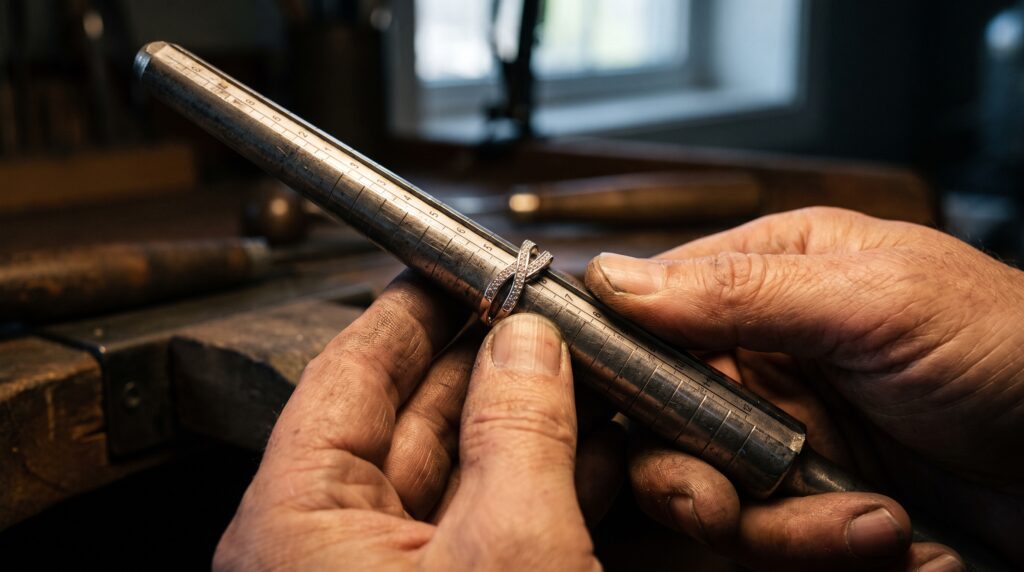
Wedding Band Resizing Methods Explained
Cutting and Adding Metal
This is the standard method for sizing up a gold or platinum band. The jeweler cuts the shank, adds a small section of matching metal, and solders it back together before polishing the seam smooth. It works well for plain bands and moderate size increases.
Removing Metal to Size Down
For a band that’s too loose, the jeweler removes a small section of the shank, then rejoins and polishes the remaining metal. Like sizing up, this works best on plain precious metal bands without stones running through the section being altered.
Stretching a Ring
Stretching mechanically expands the band rather than adding metal to it. It’s limited to minor size increases and works best on simple, unadorned bands. Because it thins the metal slightly as it stretches, it’s not a good option for rings that are already thin or that need more than a small adjustment.
Sizing Beads or Inserts
Small metal beads or a discreet insert can be added to the inside of the band to reduce its inner diameter without permanently altering the ring’s structure. This method is reversible and works well for temporary fit issues, though some wearers notice the beads or insert as a slightly different feel on the inside of the band.
Laser Resizing
Laser resizing uses a more precise, localized heat source than traditional soldering, which makes it useful for rings with intricate detailing or stones close to the area being resized. It requires specialized equipment and typically costs more than standard cutting and soldering.
| Method | Pros | Cons | Best For |
| Cutting and adding metal | Reliable, well-established, works well on plain bands | Not suitable for tungsten or most titanium | Gold and platinum bands sized up |
| Removing metal | Effective for loose rings | Same material limitations as sizing up | Gold and platinum bands sized down |
| Stretching | Fast, no added material needed | Limited range, thins the metal | Small increases on simple bands |
| Sizing beads or inserts | Reversible, no permanent alteration | Adds a slightly different feel inside the band | Temporary fit changes |
| Laser resizing | Precise, safer near stones and detailing | More expensive, requires specialized equipment | Intricate or stone-set designs |
How Much Can a Wedding Band Be Resized?
Most rings can be safely resized within about 1 to 2 sizes in either direction. Beyond that range, the change starts to affect the ring’s proportions and structure, since a significant size increase or decrease changes how much metal makes up the band relative to its original design. Nelson Estate Jewelers’ guidance on professional ring sizing notes that repeated resizing over the life of a ring can weaken the shank over time, and for some rings, a size change beyond what’s considered safe is better handled by remaking the ring than by heavily altering the original.
Ask a jeweler whether your specific ring can be resized safely before assuming any size change is possible. The answer depends on the metal, the design, and how much of a change is actually needed.
How Much Does Wedding Band Resizing Cost?
Cost Factors
Price varies based on the metal type, how many sizes the ring needs to change, whether the band has stones or diamonds that need to be worked around or reset, whether the metal is platinum (which generally costs more to work with than gold), how intricate the band’s detailing is, and whether laser resizing is required.
General Cost Expectations
Simple resizing on a plain gold band may start around 25 to 200 dollars depending on the jeweler and the amount of change needed. Diamond or stone-set bands typically cost more, particularly if stones need to be removed and reset as part of the process. These figures vary by jeweler and region, so getting a specific quote before committing to the work is the more reliable approach.
| Ring Type | Typical Cost Factor | Why It Affects Price |
| Plain gold band | Metal amount, labor time | Straightforward cut-and-solder work |
| Platinum band | Metal type, labor | Higher melting point requires more specialized work |
| Stone-set band | Stone removal and resetting | Extra labor and risk of stone handling |
| Full eternity band | Design constraints | May require partial remaking rather than simple resizing |
| Intricate or detailed band | Precision required | Laser resizing or slower manual work needed |
Temporary vs Permanent Resizing Solutions
When Temporary Inserts Make Sense
Sizing beads or inserts work well for pregnancy-related swelling, seasonal changes in finger size, short-term weight fluctuations, or any situation where the final size isn’t yet clear. They can be removed later without leaving a permanent change to the ring.
When Permanent Resizing Makes Sense
Permanent resizing is the better option when the fit change is expected to last, when the ring is significantly loose enough to risk falling off, or when discomfort from a tight fit is ongoing rather than tied to a temporary cause like heat or short-term swelling.
| Situation | Better Option | Why |
| Pregnancy | Temporary insert | Finger size often returns closer to its original measurement afterward |
| Seasonal swelling | Temporary insert | The change isn’t permanent |
| Weight loss that has stabilized | Permanent resizing | The new size is likely to hold |
| Ongoing tightness or discomfort | Permanent resizing | Temporary fixes won’t resolve a persistent fit issue |
| Uncertain future size | Temporary insert | Avoids committing to a permanent change too early |
Risks and Limitations of Resizing
Resizing carries some real limitations, though they’re manageable when the work is done by a skilled professional rather than avoided altogether. A visible seam is possible if the work is done poorly, though a competent jeweler should be able to make it nearly invisible on a plain band. Repeated resizing over the years can weaken the shank, since each cut and rejoin slightly changes the metal’s structure at that point. Rings with stones carry a risk of the stones loosening if they’re not properly checked and reset during the process. Stretching can thin the metal if pushed beyond a small adjustment. Eternity bands and certain intricate designs have real resizing limits that a plain band doesn’t, and some materials, tungsten in particular, can’t be resized through standard methods at all.
None of this means resizing should be avoided. It means the ring should be evaluated by a jeweler who can explain what’s realistic for that specific piece before any cutting, adding, or stretching begins.
What to Ask Before Resizing Your Wedding Band
- Can this metal be resized, or does the design require a different approach?
- How many sizes can it safely change?
- Will any stones need to be removed and reset?
- Will resizing affect an engraving on the inside of the band?
- Will the seam be visible after polishing?
- How long will the work take?
- Will the jeweler document the ring’s condition before and after the work?
- Is there a warranty covering the resizing itself?
Caring for a Wedding Band After Resizing
Inspect the Ring After Resizing
Check the seam for smoothness and any visible line, confirm that any stones are secure and haven’t shifted, try the ring on to confirm the fit is comfortable, and check that the band’s shape is even and symmetrical rather than distorted from the process.
Long-Term Maintenance
A yearly seam inspection can catch early signs of weakening before they become a bigger issue. Diamond and stone-set bands benefit from a professional stone check on the same schedule, since prongs and settings can loosen gradually with wear. Gentle polishing keeps the metal looking consistent, and any further adjustments should go back to a professional jeweler rather than being attempted at home, since DIY resizing attempts can damage the metal or loosen stones in ways that are expensive to correct. The Gemological Institute of America’s jewelry care guidance covers general maintenance practices that apply well to a ring that’s recently been resized.
| Care Step | Why It Matters | Frequency |
| Seam inspection | Catches early wear or weakening | Yearly |
| Stone security check | Prevents loosening or loss of stones | Yearly, for stone-set bands |
| Gentle polishing | Maintains consistent appearance | As needed |
| Professional adjustments only | Avoids damage from DIY attempts | Whenever further sizing is needed |
Conclusion
Resizing protects both comfort and the ring itself when the metal, design, and amount of change all line up. Gold and platinum bands handle it well within a size or two. Tungsten generally doesn’t handle it at all, and eternity or heavily detailed designs sit somewhere in between depending on how they’re built. Before approving any work, have the ring evaluated by a jeweler who can tell you plainly whether resizing is the right move for that specific piece, or whether a temporary insert or a different solution makes more sense.
Frequently Asked Questions
Can all wedding bands be resized?
No. Resizing depends on the ring’s metal and design. Gold and platinum bands are generally resize-friendly, while tungsten typically can’t be resized at all, and titanium is often difficult or impossible depending on the specific ring and the jeweler’s equipment.
Can tungsten wedding bands be resized?
Generally not through standard resizing methods. Tungsten carbide is extremely hard but brittle, and it can’t be cut and resoldered the way gold or platinum can. If a tungsten band no longer fits, replacement is usually the more realistic option.
Can titanium wedding bands be resized?
It depends on the ring. Some titanium bands are built with removable inner sleeves that allow for size adjustments, but a solid titanium band typically can’t be resized using conventional cutting and soldering methods. Check with a jeweler who has experience working with titanium specifically before assuming it’s possible.
Can eternity bands be resized?
Full eternity bands, where stones circle the entire ring, are difficult to resize because there’s no plain metal section available to cut or add to without disturbing the stones. Partial eternity bands, which leave a stone-free section at the back, generally allow more flexibility since that section can be altered more easily.
How long does wedding band resizing take?
Timing varies by jeweler, the amount of change needed, and whether stones need to be removed and reset. Simple resizing on a plain band is often completed within a few days to about a week, while more involved work, including laser resizing or stone resetting, can take longer.
How much does resizing cost?
Cost depends on the metal, the amount of size change, and whether stones are involved. Simple resizing on a plain gold band may start around 25 to 200 dollars, while stone-set or platinum bands typically cost more due to the added labor and materials. Getting a direct quote from a jeweler is the most reliable way to know the actual cost for a specific ring.
Is resizing bad for a ring?
Resizing isn’t inherently harmful when it’s done by a skilled jeweler and stays within a reasonable range, typically about 1 to 2 sizes. Repeated resizing over many years can gradually weaken the shank, and pushing a ring beyond a safe size range can affect its structure and proportions, which is why an evaluation before the work begins matters.
What should I do if my ring is only slightly loose?
A slightly loose ring doesn’t necessarily need permanent resizing. Sizing beads or a discreet insert can tighten the fit without altering the ring’s structure, which is a reasonable option if the looseness might be temporary or if you’re not ready to commit to a permanent change.
Should I resize during pregnancy?
Finger swelling during pregnancy is common and often temporary, with size returning closer to its original measurement afterward. A temporary insert or sizing beads are generally a better fit for this situation than permanent resizing, since a permanent change made during pregnancy may no longer fit correctly once swelling subsides.