
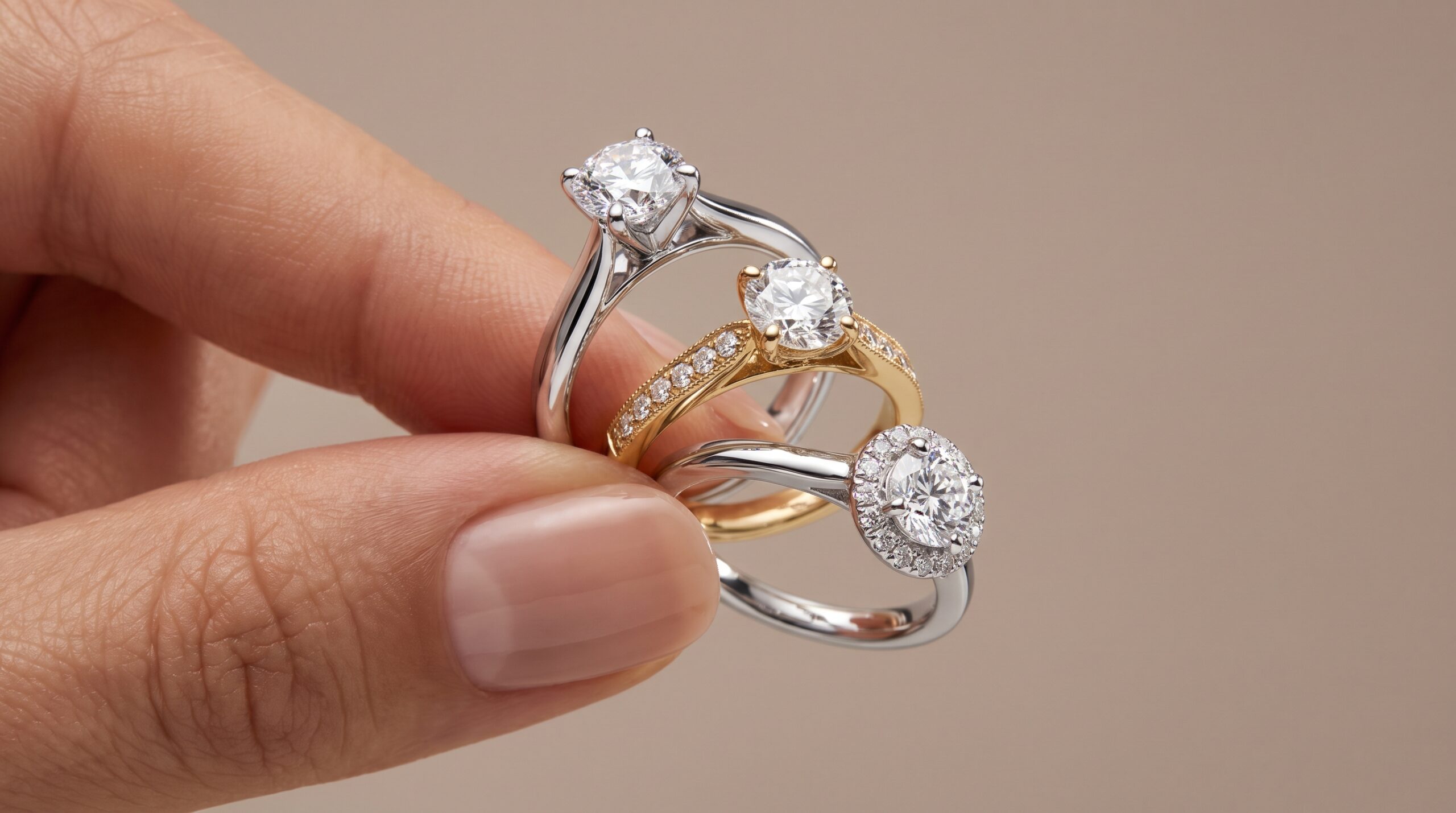
Choosing between a vintage-inspired ring and a modern one usually comes down to two different instincts: one ring tells a story through detail, the other makes its statement through restraint. Neither is the safer choice or the better investment. The right one depends on how your partner actually wears jewelry, how much upkeep feels reasonable, and how the ring will need to sit next to a wedding band later on.
This guide compares the two styles on the things that actually affect ownership: design, comfort, durability, cost, band pairing, and what to check before buying online.
Vintage vs Modern Engagement Rings at a Glance
“Vintage-inspired” means a ring made today that borrows design language from earlier periods, most often Art Deco, Victorian, or Edwardian jewelry. It is not the same as a true vintage or antique ring, which is an actual piece from that period, sold secondhand. Modern rings, by contrast, favor simplified silhouettes: solitaires, bezels, and clean geometric lines with little surface ornamentation.
| Feature | Vintage-Inspired | Modern |
| Overall look | Detailed, romantic, ornate | Clean, sleek, minimal |
| Common details | Milgrain, filigree, halos, side stones | Solitaires, bezel settings, geometric lines |
| Lifestyle fit | Best for detail lovers | Best for everyday simplicity |
| Maintenance | Often higher | Often lower |
| Wedding band pairing | May need a custom or curved band | Usually easier to stack |
What Is a Vintage-Inspired Engagement Ring?
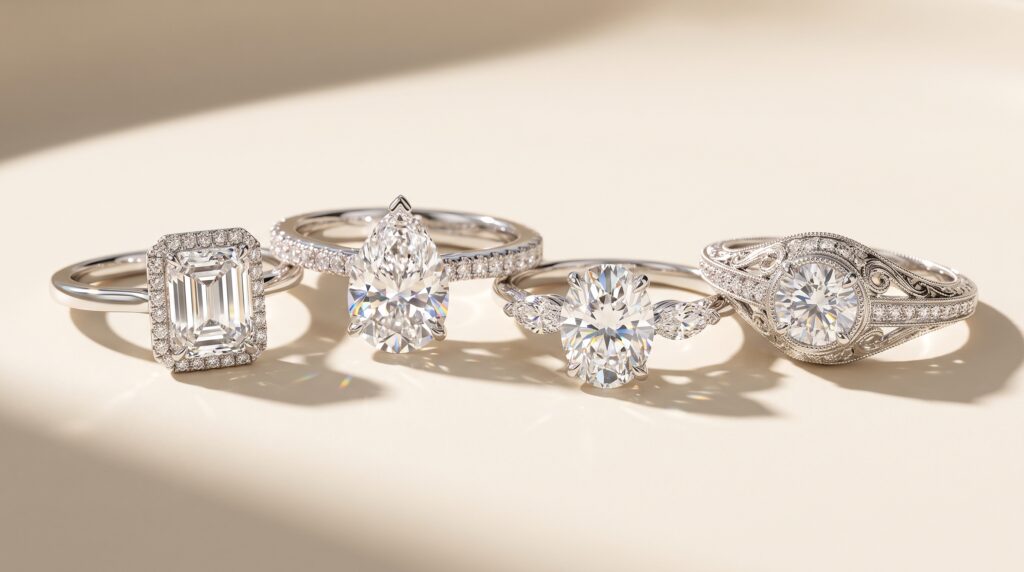
Vintage-inspired designs pull from a handful of recognizable eras. Art Deco rings tend to use strong geometric outlines, often stepped or symmetrical, paired with contrasting metals. Victorian designs lean romantic, with floral motifs and warmer gold tones. Edwardian rings are lighter and lacier, built around platinum and intricate metalwork that was only possible once platinum became workable in fine jewelry. Three-stone designs, halo settings, and cushion-cut center stones show up across all three periods and remain common in vintage-inspired pieces sold today.
Design details worth knowing
A few terms come up constantly in vintage-inspired listings, and knowing what they mean changes how you read a ring’s price and care needs:
| Term | What It Means | Common Style | Buyer Consideration |
| Milgrain | A row of tiny raised beads pressed along the metal edge | Edwardian, Victorian | Adds texture but can wear down with age |
| Filigree | Delicate, lace-like metalwork, often twisted or perforated | Art Deco, Edwardian | More surface area to clean and inspect |
| Pavé | Small diamonds set close together across a band or halo | All vintage eras, also used in modern halos | More prongs mean more points to check |
| Step cut | A rectangular cut with parallel facets, as in emerald or Asscher cuts | Art Deco | Shows inclusions more than brilliant cuts |
| Halo | A ring of small stones surrounding the center diamond | Victorian, modern | Increases visual size of the center stone |
Vintage-inspired versus true vintage
A vintage-inspired ring is newly manufactured using older design cues. A true vintage or antique ring was made during that period and has already been worn, resized, or repaired by previous owners. If a listing says “vintage-inspired,” expect modern manufacturing and modern metal purity standards, not an actual antique with its own wear history.
What Is a Modern Engagement Ring?
Modern rings strip the design back to a few decisions: the shape of the stone, the profile of the band, and how the stone is held in place. A solitaire in a simple four- or six-prong setting is the clearest example. Bezel settings, where a metal rim wraps around the stone’s edge instead of prongs holding it up, are another common modern choice, along with east-west settings that turn an oval or marquise stone sideways for a different look.
The appeal isn’t that modern rings are plain for the sake of being plain. A well-proportioned solitaire puts the focus entirely on the stone’s cut and clarity, since there’s no competing detail to distract from it. That simplicity also tends to mean fewer surfaces that catch on fabric, fewer small stones to lose, and less metal for buildup to collect in.
Style Comparison: Which Look Fits Your Partner?
Design taste is the starting point, not lifestyle or budget. A ring that photographs beautifully but doesn’t match how someone actually dresses or accessorizes day to day tends to feel wrong once the excitement of the proposal settles.
| Partner’s Style | Better Fit | Why |
| Romantic and sentimental | Vintage-inspired | Detail and craftsmanship read as personal and storied |
| Minimalist and practical | Modern | Clean lines wear well with everyday clothing and don’t compete with other jewelry |
| Draws toward antiques and older design | Vintage-inspired | Familiar references to historical eras |
| Prefers contemporary fashion | Modern | Geometric shapes feel current rather than nostalgic |
| Appreciates both | Hybrid style | A modern band with subtle vintage detailing, such as light milgrain on a solitaire |
Durability and Daily Wear
Durability has less to do with “vintage” or “modern” as labels and more to do with construction: how the stone is set, how many small stones are involved, and how high the setting sits off the finger.
Rings with milgrain, filigree, or pavé have more surface detail, which means more edges that can catch on hair, fabric, or gloves, and more small prongs that need periodic tightening. That doesn’t make them fragile. It means they benefit from routine inspection, the same way any ring with multiple stones does. Jewelers of America’s jewelry care guidance recommends professional cleaning and prong checks on a regular schedule, which matters more for detail-heavy settings than for a plain band.
Modern rings with low-profile settings and fewer stones are generally easier to maintain day to day. A bezel-set solitaire, for example, has no raised prongs to catch on anything, which is one reason people with active jobs or hands-on hobbies often gravitate toward that setting style.
Pros and cons at a glance:
Vintage-inspired rings offer more visual detail and often a stronger emotional connection to a specific design era, but they typically need more frequent professional inspection and can be harder to clean thoroughly at home.
Modern rings offer simpler daily maintenance and a lower snag risk, but a very plain solitaire can look less distinctive next to rings with more surface interest, which is a matter of personal taste rather than a durability issue.
Cost and Craftsmanship Differences
Vintage-inspired rings often cost more when they include hand engraving, filigree work, or multiple accent stones, since that detail takes more bench time to produce. That’s a manufacturing cost, not a markup tied to the word “vintage.”
Modern rings can be more budget-flexible because a simple solitaire setting requires less labor, but that’s not a rule. A modern ring in platinum with a large, high-clarity stone can cost as much as or more than a moderately detailed vintage-inspired design in gold. The center stone’s carat weight, cut, and clarity usually drive price more than the setting style does, a point covered in the GIA’s guide to diamond shapes and settings.
Matching a Wedding Band
This is where style choice has consequences beyond the engagement ring itself. A curved or contoured wedding band is designed to nest against an engagement ring with an irregular profile, such as a halo or a three-stone setting with side stones that flare outward. Without that curve, the two rings can leave a visible gap between them.
| Engagement Ring Style | Band Pairing | Flush Fit Likelihood | Tip |
| Vintage-inspired halo | Curved or contoured band | Lower without customization | Bring the ring to a jeweler for a custom-fit band |
| Vintage-inspired solitaire | Straight or slightly curved band | Moderate | Test with a plain band before ordering a matching set |
| Modern solitaire | Straight or eternity band | Higher | Most standard bands will sit flush |
| Modern bezel | Straight band | Higher | Low profile leaves little to work around |
A quick way to check before buying: if the engagement ring’s band flares or widens near the center stone, ask whether a straight band will sit flush against it, or whether a curved or open-gap band will be needed instead.
Care and Maintenance Expectations
| Ring Type | Cleaning Needs | Professional Checks | Buyer Note |
| Vintage-inspired | More detailed cleaning around milgrain and filigree | More frequent prong and detail checks | Comfortable with a regular care routine |
| Modern solitaire | Simple cleaning, few surfaces to reach | Standard annual checks | Lower ongoing maintenance |
| Pavé or halo | Extra attention to small stones and settings | Regular inspections for loose stones | Ask about warranty coverage for stone replacement |
Routine care for both styles includes avoiding harsh chemicals, removing rings before manual labor or swimming in chlorinated water, and having a jeweler check prong tightness on a regular schedule, all points covered in the Jewelers of America care guidance.
How to Shop Online With Confidence
Photos and video matter more when you can’t hold the ring in person. Look for 360-degree video and close-up images that show the setting from the side and back, not just a straight-on shot of the top of the stone. A side profile tells you the setting height, which affects how much the ring will catch on things during the day.
Confirm the band width and setting height in the listing’s measurements, not just the visual. Ask for the diamond’s certification from an independent grading lab, since that report verifies the stone’s cut, color, clarity, and carat weight independently of the seller’s own description.
Check metal hallmarks or stamps, which indicate purity (such as 14K, 18K, or platinum markings). The FTC’s Jewelry Guides set the federal standards for how gold, silver, and platinum content can be marked and advertised in the United States, which is useful context if a listing’s claims seem inconsistent with its price.
Before purchasing, confirm the return window, whether resizing is included or charged separately, and whether the retailer offers a maintenance or warranty plan covering prong retightening and stone inspection. Reading reviews that specifically mention comfort and durability over time, rather than just unboxing photos, gives a better sense of how the ring holds up after the first year.
Quick Decision Guide
- Start with your partner’s everyday style, not just what looks striking in a photo.
- Consider how their hands are used daily, whether that’s manual work, typing, or frequent hand washing.
- Decide how much surface detail feels right, from a plain band to a fully detailed vintage-inspired setting.
- Check the setting height and how it will feel against gloves, pockets, or other jewelry.
- Think ahead to the wedding band and whether it will need to be curved or custom-matched.
- Confirm certification, return policy, and resizing terms before finalizing the purchase.
The ring that wears well for years usually comes down to matching these practical points to personal taste, rather than choosing the most photographed style.
Frequently Asked Questions
What is the difference between vintage, antique, and vintage-inspired rings?
An antique ring is generally at least 100 years old and was made and worn during that period. A vintage ring is typically 20 to 99 years old and also has an ownership history. A vintage-inspired ring is newly manufactured today using design details borrowed from earlier eras, such as Art Deco geometry or Edwardian filigree, without the wear history or resale provenance of an actual older piece.
Are vintage-inspired rings more fragile?
Not inherently. Fragility depends on construction, such as how many prongs hold the stones and how much metal surrounds each one, not on whether the design references an older era. A well-made vintage-inspired ring with pavé or filigree does typically need more frequent inspection than a plain band, since there are more small components that can loosen over time, but that’s a maintenance consideration rather than a sign of weaker construction.
Are modern engagement rings more durable?
Modern rings with fewer stones and simpler settings generally require less maintenance and have fewer points that can snag or need tightening. That’s different from saying they’re inherently stronger. A poorly made modern ring can have the same durability issues as a poorly made vintage-inspired one. Setting height, prong count, and metal choice matter more than the overall style category.
Which style is easier to wear every day?
Low-profile modern settings, such as bezel-set solitaires, tend to be easier for people who use their hands frequently during the day, since there’s less raised metal to catch on gloves, fabric, or equipment. Detailed vintage-inspired rings with raised halos or multiple prongs can still be worn daily, but they benefit from more frequent cleaning and periodic professional checks.
Can a vintage-inspired ring be customized to feel more modern?
Yes. Reducing the number of accent stones, choosing a smoother band profile, or pairing a vintage-style setting with a modern metal finish are common ways jewelers adjust a vintage-inspired design without losing its core character. The reverse also works, where a plain modern solitaire gets subtle milgrain or a thin halo added for more detail.
Do vintage rings always use yellow or rose gold?
No. While yellow and rose gold were common in Victorian and early Edwardian jewelry, platinum became widely used in fine jewelry starting in the early 20th century, particularly in Art Deco and later Edwardian designs, because it allowed for finer, more delicate metalwork than gold alloys of the time. Vintage-inspired rings made today are available in platinum, white gold, yellow gold, and rose gold regardless of which era’s design they borrow from.
Which style pairs better with a wedding band?
Modern rings with straight or low-profile bands generally pair more easily with standard wedding bands, since there’s less irregular metalwork to work around. Vintage-inspired rings with halos, three-stone settings, or flared shoulders often need a curved, contoured, or custom-fit band to sit flush without a visible gap. This isn’t a reason to avoid a vintage-inspired style, but it is worth planning for before the wedding band is purchased.
Is vintage-inspired usually more expensive?
Not as a rule. Cost depends more on the center stone’s carat weight, cut, and clarity, along with the metal type, than on whether the design is vintage-inspired or modern. Vintage-inspired rings can cost more when they include hand engraving, filigree, or multiple accent stones, since that detail adds labor time, but a simple vintage-inspired setting can cost less than a modern ring built around a larger or higher-clarity stone.