
You’ve picked the moment. You might even have the ring in mind. What you don’t have is a number, and asking directly means explaining why you want to know.
Guessing isn’t the only option, and it isn’t a good one either. A ring that’s noticeably off can turn a proposal into an awkward conversation about resizing before the celebration even settles in. There are several discreet ways to get a real measurement or a close estimate, each with different levels of accuracy and different risks of getting caught. This guide walks through them, along with the mistakes that cause the most problems and what to check before you buy.
Why Ring Size Matters for a Surprise Proposal
A ring that’s too tight will be hard to get on in the moment you’ve been planning for weeks. One that’s too loose can spin on the finger or slide off entirely, which isn’t the impression you want in the first photos of the engagement. Comfort and fit affect whether the ring feels like it belongs there from day one.
None of this means a slightly wrong size ruins the proposal. Most jewelers offer resizing, and a ring that’s a half size off can usually be adjusted within days. The goal isn’t a flawless guess. It’s getting close enough that resizing, if needed, is a minor fix rather than a full remake.
Ring Sizing Basics to Know First
What ring size actually measures
Ring size refers to the circumference of the band’s inner edge, or equivalently, its inner diameter. In the US, sizes run on a numbered scale (a size 6 is smaller than a size 8), while the UK and several other countries use a letter scale instead. If you’re measuring an existing ring, what you actually want is that inner diameter, since that’s what a jeweler or a printable chart will convert into a size.
Why the correct finger matters
Fingers aren’t uniform. The left ring finger is often close in size to the right ring finger, but it isn’t guaranteed to match, and it’s rarely the same as other fingers on either hand. If you’re borrowing a ring your partner already wears, the closest match comes from a ring worn on the same finger, the left ring finger, since that’s where the engagement ring will go.
Why timing changes the reading
Fingers swell slightly with heat, physical activity, and time of day. A measurement taken after a hot day or a workout will run larger than one taken first thing in the morning. If you’re measuring directly (string, paper, or a sizer), try to do it when your partner’s hands are at a normal temperature and not swollen from exercise or a long flight.
The Best Ways to Secretly Find Their Ring Size
Some methods give you a physical reference to bring to a jeweler. Others are closer to an educated guess. The right one depends on whether your partner already wears rings and how much risk of discovery you’re willing to accept.
| Method | Accuracy | Risk of being noticed | Best for | Key caution |
| Borrow an existing ring | High | Low, if returned quickly | Partners who already wear a ring on the left ring finger | Don’t keep it longer than a day |
| Trace the ring on paper | Moderate | Low | A quick reference before visiting a jeweler | Tracing distorts slightly; verify with a jeweler if possible |
| Press the ring into soap | Moderate | Low | Getting an impression without handling the ring for long | Soap can compress; measure carefully |
| Printable ring sizing chart | Moderate | Low | Comparing a borrowed ring’s inner diameter to a size | Printer scaling can throw off results if not printed at 100 percent |
| Ring sizing app | Low to moderate | Low | A rough starting point, not a final answer | Phone camera and screen calibration both introduce error |
| String or paper around the finger while sleeping | Low to moderate | Moderate | Partners who don’t wear rings and can’t be measured any other way | Waking someone or pulling too tight skews the result |
| Ask a trusted friend or family member | Varies | Low | Getting a second opinion or an existing size on file | Only as reliable as what that person actually knows |
| A casual jewelry try-on moment | Moderate to high | Moderate | Couples who sometimes browse jewelry together anyway | Works only if it doesn’t feel out of character |
Borrowing a ring already worn on the correct finger is generally the most reliable of these methods, since it gives you a physical object rather than an estimate. Jewelers can measure a ring’s inner diameter directly and convert it to a size with more precision than a home chart or app. Printable ring sizers and charts from established retailers can help you get a working estimate, but they depend on accurate printing and careful measurement of the inside width of the ring.
Most Accurate Method: Borrowing an Existing Ring
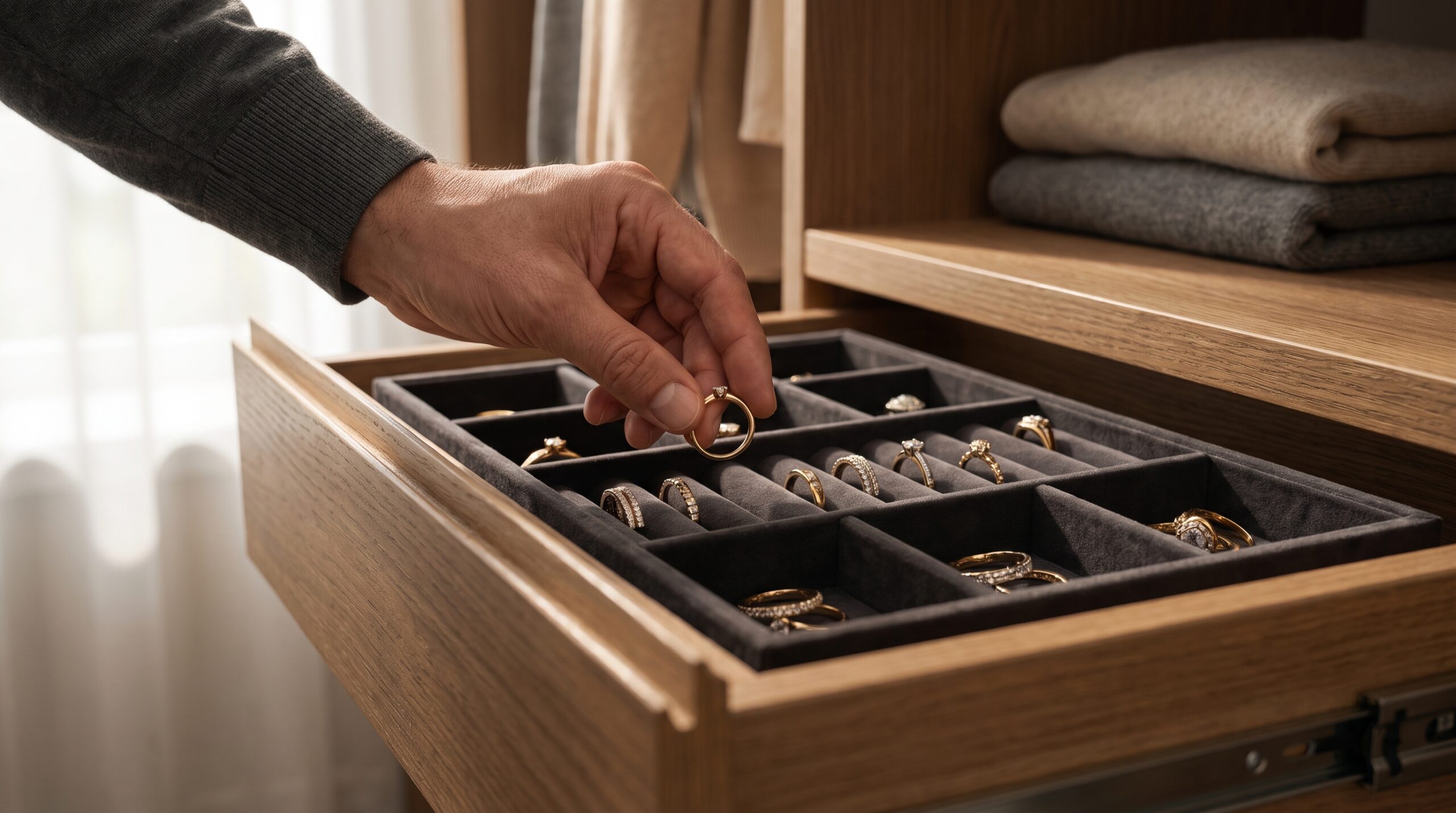
If your partner wears a ring on the left ring finger, even an inexpensive one, this is your best option. Take it to a jeweler for an exact measurement, or compare it against a printable ring size chart at home if a jeweler visit isn’t practical before the proposal.
The advantages: it’s a direct physical reference rather than a calculated guess, jewelers can measure it in minutes, and it accounts for the actual finger the engagement ring will be worn on.
The limitations: you need to return the ring before it’s missed, which usually means a same-day trip. Ring width also matters here. If the ring you’re borrowing has a noticeably different band width than the one you plan to buy, a jeweler should factor that in, since wider bands tend to fit more snugly at the same nominal size.
If They Do Not Wear Rings
Not everyone wears jewelry on their hands day to day, which removes the most reliable option. A few approaches still work, in rough order of reliability:
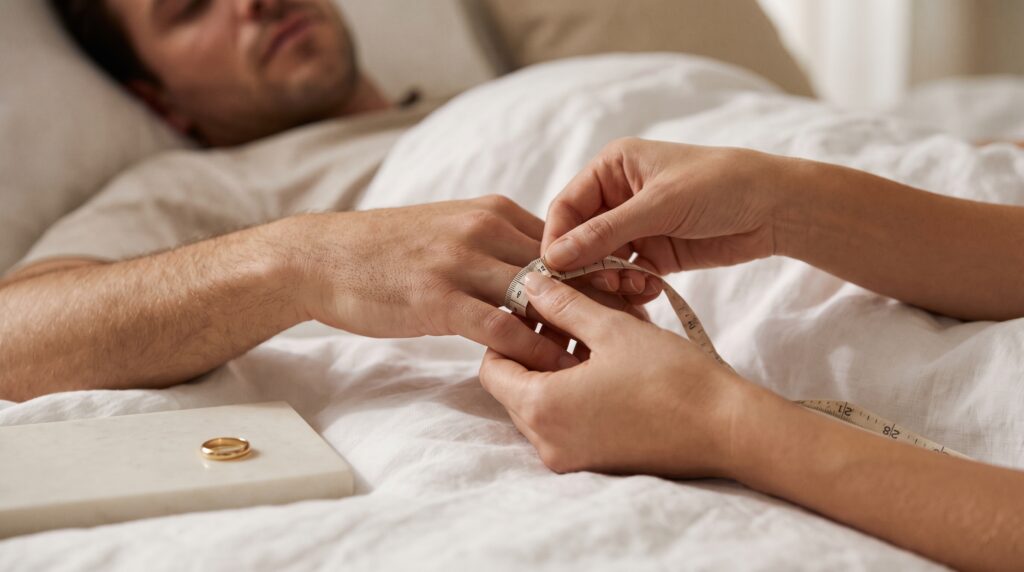
Measure with string or paper, but only if you can do it without waking your partner and without pulling the material tight enough to compress the skin. Wrap it loosely around the base of the finger, mark where the ends meet, then lay it flat against a ruler.
Ask someone close to them, a sibling, close friend, or parent, who may already know the size or can find out without raising suspicion the way a direct question from you might.
Look for a natural opportunity to browse jewelry together, even casually, and note reactions or try-on moments if the situation allows it without feeling staged.
If none of these are realistic, lean toward a ring style that’s easy to resize later (more on that below), and treat the purchase as a first estimate rather than a final fit.
Common Ring Sizing Mistakes to Avoid
Measuring the wrong finger. A size taken from a different finger, even one on the same hand, won’t match the left ring finger reliably.
Using a ring from the wrong hand as your only reference. It’s a reasonable backup, but treat it as an estimate rather than confirmation.
Pulling string or paper too tight during a sleep measurement. This is the single most common source of a size that runs too small.
Measuring right after exercise, a hot shower, or a long day, when fingers are more likely to be swollen.
Assuming any ring can be resized to whatever degree you need. Some settings have hard limits, covered in the next section.
Ignoring band width when converting a measurement. A wide band at the same numerical size fits tighter than a narrow one.
Buying from a seller that doesn’t spell out its resizing or exchange terms before you commit.
How Ring Style Affects Resizing
Not every engagement ring style tolerates the same amount of adjustment. This matters if your sizing guess turns out to be off, since it determines how much room you have to correct it after the fact.
| Ring style | Resizing flexibility | Caution |
| Classic solitaire | Usually flexible, often up to two sizes in either direction | Simple bands with a single stone are the easiest to resize |
| Plain band, no stones | Usually flexible | Straightforward metal work in most cases |
| Pave or channel-set band | Limited | Stones set into the band restrict how much metal can be added or removed |
| Eternity or full-diameter band | Very limited | Diamonds set around the entire circumference leave little room to adjust |
| Tension setting | Very limited | The setting depends on precise metal tension, which resizing can disrupt |
| Wide bands generally | Fits tighter at the same size compared to narrow bands | Worth noting when converting a borrowed ring’s size to a wider style |
The Gemological Institute of America notes that pave, channel-set, and eternity styles are among the hardest to resize because the settings occupy the band itself, leaving little metal to work with, according to its ring sizing guide. If you’re not confident in your sizing, a simpler setting gives you more room to correct course later.
What to Ask Before Buying
Before you commit to a ring, especially one bought online without an in-person fitting, get answers to these:
Is this ring resizable, and if so, by how much in either direction?
Is resizing included in the price, or is it a separate charge?
What’s the return or exchange window if the size is significantly off?
Can you order a ring sizer in advance to double-check before the ring itself ships?
Does the ring style you’ve chosen fall into the easy-to-resize category or the limited one?
A jeweler who answers these clearly, before you’ve paid, is a better sign than one who brushes past the question.
Final Guidance
The goal here isn’t a perfect guess. It’s a reasonable one, backed up by a resizing policy that gives you room to fix a fit that’s slightly off. Borrowing an existing ring and having a jeweler confirm the measurement is the strongest approach if it’s available to you. If it isn’t, a careful estimate combined with an easy-to-resize style and a clear return policy covers most of the risk.
If you’re still unsure after trying one of these methods, ask the jeweler directly about their sizing support before you buy. Many will walk through a borrowed ring’s measurements with you or send a ring sizer ahead of the purchase, which takes most of the guesswork out of the final decision.
Frequently Asked Questions
What is the most accurate secret sizing method?
Borrowing a ring your partner already wears on the left ring finger and having a jeweler measure its inner diameter is generally the most reliable approach, since it’s based on a physical object rather than an estimate. If that’s not possible, a printable ring size chart compared against a borrowed ring from any finger, or a careful string or paper measurement, can get you close.
Can I use a ring from another finger?
You can, and it’s better than no reference at all, but treat it as an estimate rather than a confirmed size. Finger sizes vary from one finger to the next and between hands, so a ring worn on, say, the right middle finger won’t necessarily match the left ring finger.
Can I measure their finger while they sleep?
It’s possible with string or paper, wrapped loosely around the base of the finger without waking your partner. The main risk is pulling the material too tight, which produces a reading smaller than the actual size. This method works better as a rough estimate than as a final confirmation.
Are ring sizing apps accurate?
They can get you into the right general range, but phone camera calibration and screen size both introduce error that a physical measurement doesn’t have. Use an app result as a starting point, and confirm with a jeweler or a borrowed ring if you can.
Should I size up if I am unsure?
Many jewelers suggest this as a general rule of thumb, since it’s usually easier to remove metal from a ring that’s slightly too large than to add metal to one that’s too small. That said, it’s a tendency, not a guarantee, and it depends on the specific ring style and how much resizing room it allows.
What if the ring does not fit after the proposal?
Most jewelers offer resizing within a set window after purchase, often for simple styles like solitaires and plain bands. Ask about this before you buy so you know the timeline and whether there’s a cost involved. This is also why a clear resizing or exchange policy matters as much as the initial size guess.
Are some engagement rings difficult to resize?
Yes. Styles with stones set into the band, such as pave, channel-set, or eternity rings, have less metal to work with and are harder to adjust than a plain band or classic solitaire. The Gemological Institute of America points to these as the styles most likely to have resizing limits in its guide to determining ring size, which is worth factoring in if your sizing information is uncertain.