
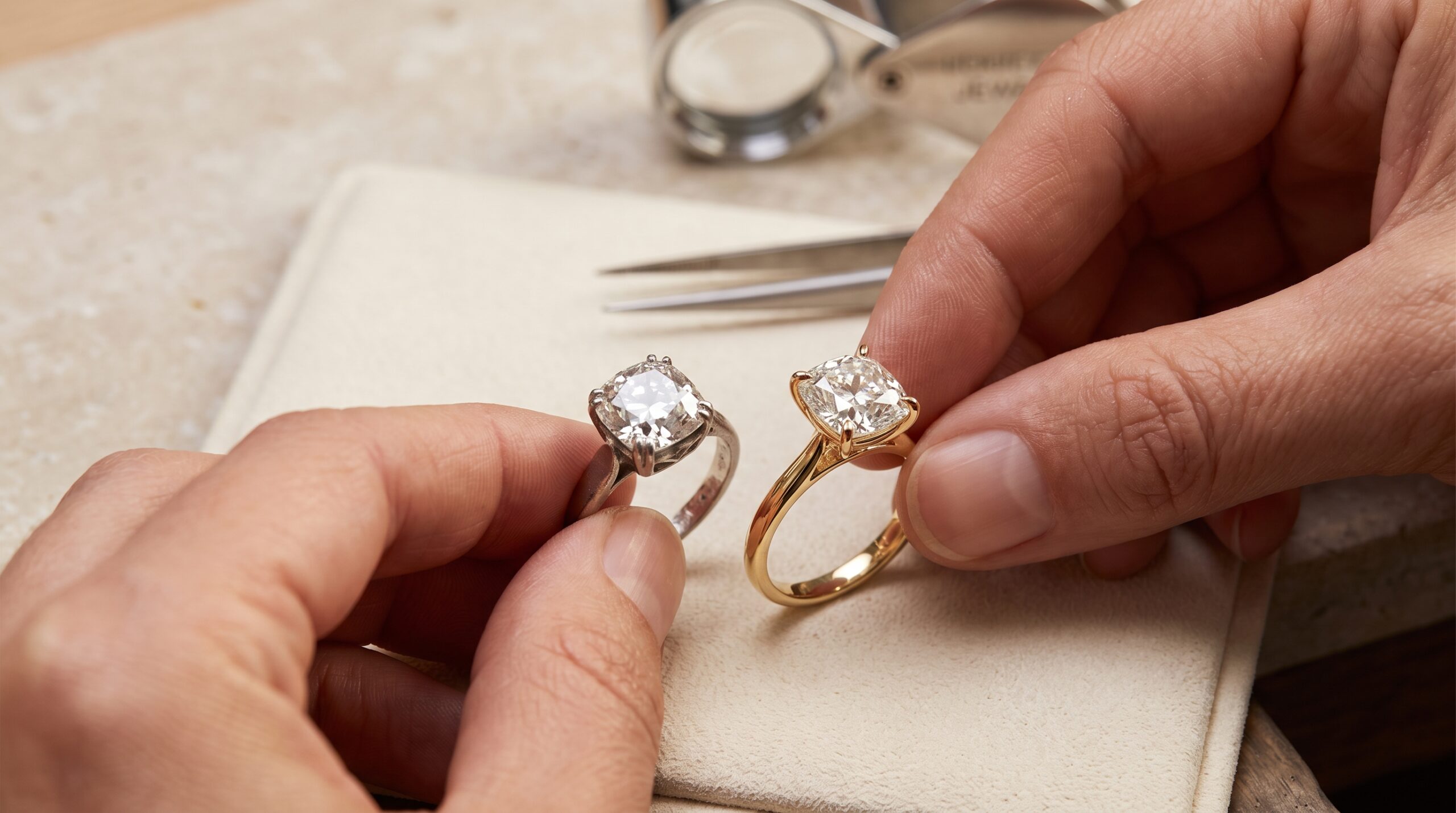
Most first-time buyers spend the bulk of their attention on the diamond: carat weight, cut, color, clarity. The setting gets treated as an afterthought, chosen mostly on how it looks in a product photo. But the setting is what actually determines how the ring wears every day: whether the stone stays secure, whether it catches on sweaters and gloves, how much light reaches the stone, and how easy the ring is to clean or resize later. Getting the stone right and the setting wrong still leaves you with a ring that’s frustrating to wear.
What Is an Engagement Ring Setting?
The setting is the structure that holds the stone in place on the ring. It’s usually made of prongs, a metal rim, or a channel cut into the band, depending on the style. Beyond simply holding the stone, the setting affects how much light enters and exits (which changes how the stone sparkles), how high the stone sits above the finger, how the ring feels during daily tasks, how difficult it is to clean, and whether it will sit flush against a wedding band.
Two rings with identical diamonds can look and wear completely differently based on setting choice alone. That’s why it’s worth understanding the options before falling for a photo.
Why the Setting Matters
Stone security depends on how much metal is holding the stone and how that metal is shaped. A setting with more metal contact, like a bezel, generally protects the stone better against impact than a setting with minimal contact, like a thin prong. That’s a tradeoff, not a flaw: less metal contact usually means more light reaches the stone, which increases sparkle.
Comfort and maintenance follow a similar pattern. Settings with more surface texture or more small stones, such as pavé, need more frequent cleaning to keep dirt from dulling their sparkle. Settings with smooth profiles, such as bezel or flush settings, are easier to keep clean and less likely to snag on clothing.
Resizing flexibility and wedding band fit are less visible considerations but matter over the life of the ring. Some settings, particularly those with stones set into the band itself, have a narrower range for resizing. And if the engagement ring has a curved or raised profile, finding a wedding band that sits flush against it takes more planning than it would with a plain band.
The Most Common Engagement Ring Settings
Prong setting
Small metal claws, usually four or six, hold the stone above the band and expose most of its surface to light. This is the most common setting for solitaire diamonds because it maximizes sparkle and shows off the stone’s shape clearly. The tradeoff is that prongs can loosen over time or catch on fabric, so they need periodic checking, ideally as part of a routine jewellery inspection like the ones recommended by Jewelers of America.
Bezel setting
A thin rim of metal wraps around the stone’s edge, holding it in place without prongs. This gives strong physical protection and a smooth, low-snag profile that works well for people who use their hands often. The visual tradeoff is that a full bezel covers part of the stone’s sides, which can slightly reduce how much light enters compared to an open prong setting.
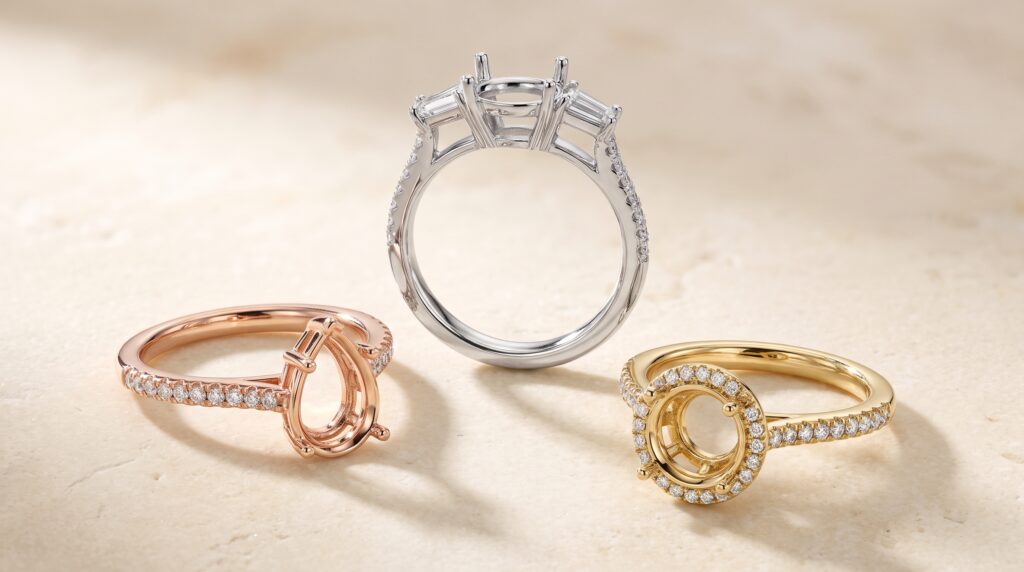
Pavé setting
Small diamonds or gemstones are set closely together along the band, held by tiny beads or prongs, creating a continuous line of sparkle. Pavé adds brilliance to the overall ring without dramatically increasing the size of the centre stone. It requires more careful cleaning than a plain band, since dirt collects more easily between closely set stones, and it generally has a narrower resizing range because the stones run along the band itself.
Halo setting
A ring of smaller accent stones surrounds the centre stone, increasing its apparent size and adding extra sparkle around the perimeter. A halo is a practical option for buyers who want a larger look without paying for a larger centre stone. Maintenance is similar to pavé: more stones mean more surfaces to keep clean, and more prongs to check over time.
Channel setting
Stones are set into a groove cut into the band, with metal on both sides holding them in place and no metal visible between the stones. This creates a smooth, snag-resistant surface, which makes it a common choice for wedding bands and for engagement ring accents. Channel-set stones are well protected from impact, but the setting typically can’t be resized as easily as a plain band, since resizing changes the shape of the channel itself.
Tension setting
The stone appears to float between two ends of the band, held in place by pressure from the metal rather than prongs or a bezel. It’s a distinctive, modern look that shows off the stone from multiple angles. The security depends entirely on the metal’s tension holding correctly, so tension-set rings usually need professional inspection more regularly, and resizing typically requires the original jeweller because of how precisely the tension has to be calibrated.
Flush or inlay setting
The stone is set directly into the metal so its surface sits level with the band, with no raised prongs or rim. This is one of the smoothest, most snag-resistant options available, which makes it popular for accent stones on bands meant for daily manual work. The stone size is usually smaller in a flush setting, since larger stones need more surrounding metal for stability.
Cathedral setting
Arches of metal rise from the band to support the centre stone, resembling the arched structure of a cathedral ceiling. This adds height and an elegant profile without fully enclosing the stone, and it can make a smaller stone look more prominent by drawing the eye upward. The added height means a cathedral setting sits higher off the finger, which increases the chance of snagging compared to a low-profile design.
Basket setting
A series of small metal bars or a lattice-like structure cradles the stone from below, similar in concept to a prong setting but with more visible support structure underneath. It’s often used with a solitaire stone to add subtle detail without a full halo. The open structure underneath the stone can collect residue and dust, so it needs periodic cleaning attention along the underside.
Three-stone setting
A centre stone is flanked by two smaller stones, often meant to represent past, present, and future, though that symbolism is a marketing convention rather than a rule. Structurally, each stone typically has its own prongs or setting, so the security and maintenance depend on how those individual settings are built. It’s a classic style that reads as timeless because the format has stayed consistent for decades.
Split-shank setting
The band splits into two (or more) strands as it approaches the centre stone, rather than staying as a single continuous band. This creates a distinctive, modern silhouette and can make the centre stone appear larger by drawing the eye toward the split. Because the band isn’t a single continuous piece near the stone, resizing can be more complex and may cost more than resizing a plain band.
Engagement Ring Settings Compared
| Setting | Look | Security | Sparkle | Maintenance | Best for |
| Prong | Classic, stone fully visible | Moderate, needs periodic checks | High | Low to moderate | Buyers who want maximum brilliance |
| Bezel | Smooth, modern rim | High | Moderate | Low | Active lifestyles, hands-on work |
| Pavé | Continuous sparkle along band | Moderate | High | Higher | Buyers who want extra brilliance without a larger centre stone |
| Halo | Larger visual presence | Moderate | Very high | Higher | Buyers who want size without a larger centre stone |
| Channel | Smooth, no visible prongs | High | Moderate | Low | Snag-resistant daily wear |
| Tension | Stone appears to float | Depends on calibration | High | Higher (regular inspection) | Buyers who want a distinctive, modern look |
| Flush or inlay | Level with the band | High | Lower | Low | Manual work, minimalist style |
| Cathedral | Raised, elegant arches | Moderate | High | Moderate | Buyers who want height and drama |
| Basket | Detailed underside structure | Moderate | High | Moderate | Buyers who want subtle detail without a halo |
| Three-stone | Symmetrical, classic | Depends on individual settings | High | Moderate | Buyers who want a traditional, symbolic design |
| Split-shank | Modern, band splits near stone | Moderate | High | Moderate | Buyers who want a non-traditional silhouette |
Best Settings by Lifestyle
Someone who works with their hands regularly, whether that’s manual labour, frequent hand-washing, or sports, is usually better served by a bezel, flush, or low-profile prong setting, since these minimize snag points and protect the stone from impact.
A minimalist style pairs naturally with bezel, solitaire prong, or flush settings, since these keep the visual focus on a single clean line rather than added texture.
Buyers prioritizing maximum sparkle tend toward halo, pavé, or cathedral settings, which either add extra stones or lift the centre stone higher to catch more light.
Classic taste is generally best matched with prong, cathedral, or three-stone settings, styles that have remained visually consistent for decades rather than following recent trends.
Modern style leans toward bezel, tension, or split-shank settings, which tend to break from traditional silhouettes and read as more architectural.
These are general starting points, not strict categories. A bezel setting can look just as intentional on someone with classic taste as on someone with a minimalist one; the lifestyle factors matter more than the aesthetic label.
High-Profile vs Low-Profile Settings
Setting height refers to how far the stone sits above the finger. A high-profile setting, like a tall prong or cathedral design, lifts the stone up so more light can reach it from multiple angles, which generally increases perceived sparkle. It also makes the ring more prominent visually.
A low-profile setting keeps the stone closer to the band, reducing the chance it will catch on clothing, hair, or gloves during the day. The tradeoff is that less light reaches the stone from underneath, which can slightly reduce brilliance compared to a higher setting with the same stone.
Setting height also affects wedding band pairing. A high-profile engagement ring may need a contoured or notched wedding band to sit flush against it, while a low-profile ring is more likely to pair cleanly with a plain, straight band.
| Profile | Look | Comfort | Best for |
| High-profile | Prominent, more light exposure | Higher snag risk during manual tasks | Buyers prioritizing maximum sparkle and visual presence |
| Low-profile | Subtle, closer to the finger | Lower snag risk, easier for daily wear | Active lifestyles, manual work, minimalist preference |
Which Settings Are Easiest to Resize?
A simple prong setting on a plain band is usually the easiest to resize, since a jeweller can add or remove metal from the band without disturbing the stone or any surrounding detail. Bezel and cathedral settings are also relatively straightforward, as long as the resizing doesn’t need to alter the structure holding the stone itself.
Pavé and channel settings are more constrained. Because these designs have stones set directly into the band, resizing beyond a small range can distort the spacing between stones or require removing and resetting stones entirely, which adds cost and time. Tension settings are the most restrictive: the metal’s spring-like grip on the stone is calibrated precisely, so resizing almost always needs to go back to the original jeweller, and some tension designs have very limited resizing range regardless.
Eternity-style bands, where stones run the full circumference, generally can’t be resized at all without significant rework, since there’s no plain metal section left to add or remove material from.
Care and Maintenance by Setting
Prongs should be checked periodically to confirm they haven’t loosened, since a loose prong increases the risk of losing the stone. This is typically part of a standard jewellery inspection.
Pavé and halo settings need more detailed cleaning because their many small stones and surfaces trap dirt and oils more easily than a single larger stone. A soft brush and mild solution usually handle routine cleaning, but buildup around numerous small stones is harder to fully clear at home than with a professional cleaning.
Bezel, channel, and flush settings are generally the most forgiving for wear and tear, since their smoother profiles have fewer places for dirt and debris to collect and fewer protruding parts to catch or bend.
Across all settings, periodic professional inspection is worth the time. Jewelers of America recommends regular cleaning and inspection to catch loose stones or worn prongs before they become a bigger problem.
How to Choose the Right Setting
Start with your partner’s existing style: do they wear delicate, minimal jewellery, or bolder statement pieces? That’s usually the clearest early signal for setting style.
Next, consider daily lifestyle honestly. Someone who works with their hands or plays sports regularly will likely be happier with a lower-profile, more protective setting than a high, ornate one, regardless of what looks best in a photo.
From there, decide how much sparkle matters relative to other priorities. A halo or pavé setting adds brilliance and visual size but comes with more maintenance; a bezel or flush setting trades some sparkle for durability and ease of care.
Think through comfort and setting height together. A ring that looks striking in a display case can feel impractical if it’s caught on a sleeve three times a day.
Check resizing and maintenance needs before finalizing the design, especially if you’re not fully confident about ring size. Some settings tolerate a size change easily; others don’t.
Finally, confirm wedding band compatibility if that’s part of the plan. A curved or high-profile engagement ring may need a matching contoured wedding band, which is easier to plan for before the engagement ring is finished than to work out afterward.
Frequently Asked Questions
What is the most secure engagement ring setting?
Bezel and channel settings generally offer the most physical protection, since they surround more of the stone with metal and leave fewer points where the stone could be knocked loose. Prong settings are also secure when well-maintained, but they rely on individual metal claws that can loosen gradually and need periodic checking. No setting is entirely maintenance-free, so “most secure” is really about which style tolerates the least frequent inspection, and bezel and channel settings tend to hold up longest between checkups.
Which setting sparkles the most?
Halo and pavé settings typically produce the most overall sparkle, since they add multiple smaller stones that catch light from different angles around the centre stone. A high-profile prong setting on a single stone also performs well, since it exposes more of the stone’s surface to light than a bezel or flush setting would. Sparkle isn’t only about setting style, though; cut quality has a significant effect on how a diamond reflects light, as explained in GIA’s diamond quality education.
What setting is best for an active lifestyle?
Bezel, flush, and low-profile prong settings tend to work best for active lifestyles, since they minimize snag points and keep the stone closer to the band, which reduces impact risk during manual tasks or sports. A high halo or tall cathedral setting isn’t off-limits for an active lifestyle, but it will likely need more frequent inspection and carries a higher chance of catching on gloves, equipment, or clothing.
Are bezel settings less sparkly?
Bezel settings do let in somewhat less light than an open prong setting, since the metal rim covers part of the stone’s sides. This doesn’t mean a bezel-set stone looks dull; it changes the character of the sparkle rather than eliminating it, often giving a more contained, focused glow instead of the wider flash pattern typical of a fully exposed prong setting. Whether that tradeoff matters comes down to personal preference and how much the wearer prioritizes protection over maximum brilliance.
Are pavé rings hard to maintain?
Pavé settings need more frequent cleaning than simpler settings because dirt and oil collect more easily between closely spaced small stones. This isn’t the same as being fragile: pavé stones are typically secure when properly set. The maintenance difference is mostly about appearance, since buildup between stones can make the sparkle look duller over time if it’s not cleaned regularly.
Can all settings be resized?
No. Simple prong and bezel settings on plain bands are generally easy to resize within a normal range. Settings where stones are set directly into the band, such as pavé, channel, or eternity styles, have a narrower resizing range or may not be resizable at all without significant rework. Tension settings are typically the most restrictive, since resizing usually requires returning to the original jeweller to recalibrate the metal’s grip on the stone.
What setting is most timeless?
Prong, cathedral, and three-stone settings have stayed visually consistent for decades, which is a reasonable indicator of what tends to age well rather than look tied to a specific trend period. This doesn’t mean other settings will look dated; it simply means these particular styles have a longer track record of staying in circulation without falling out of favor.
What setting is best for a wedding band to sit flush?
A low-profile setting on a straight, unadorned band is the easiest to pair flush with most wedding bands, since there’s no curve or raised structure to work around. High-profile settings, cathedral arches, or split-shank designs often need a contoured or notched wedding band custom-fitted to match the engagement ring’s shape, which is worth planning for before either ring is finalized rather than discovering the mismatch afterward.