
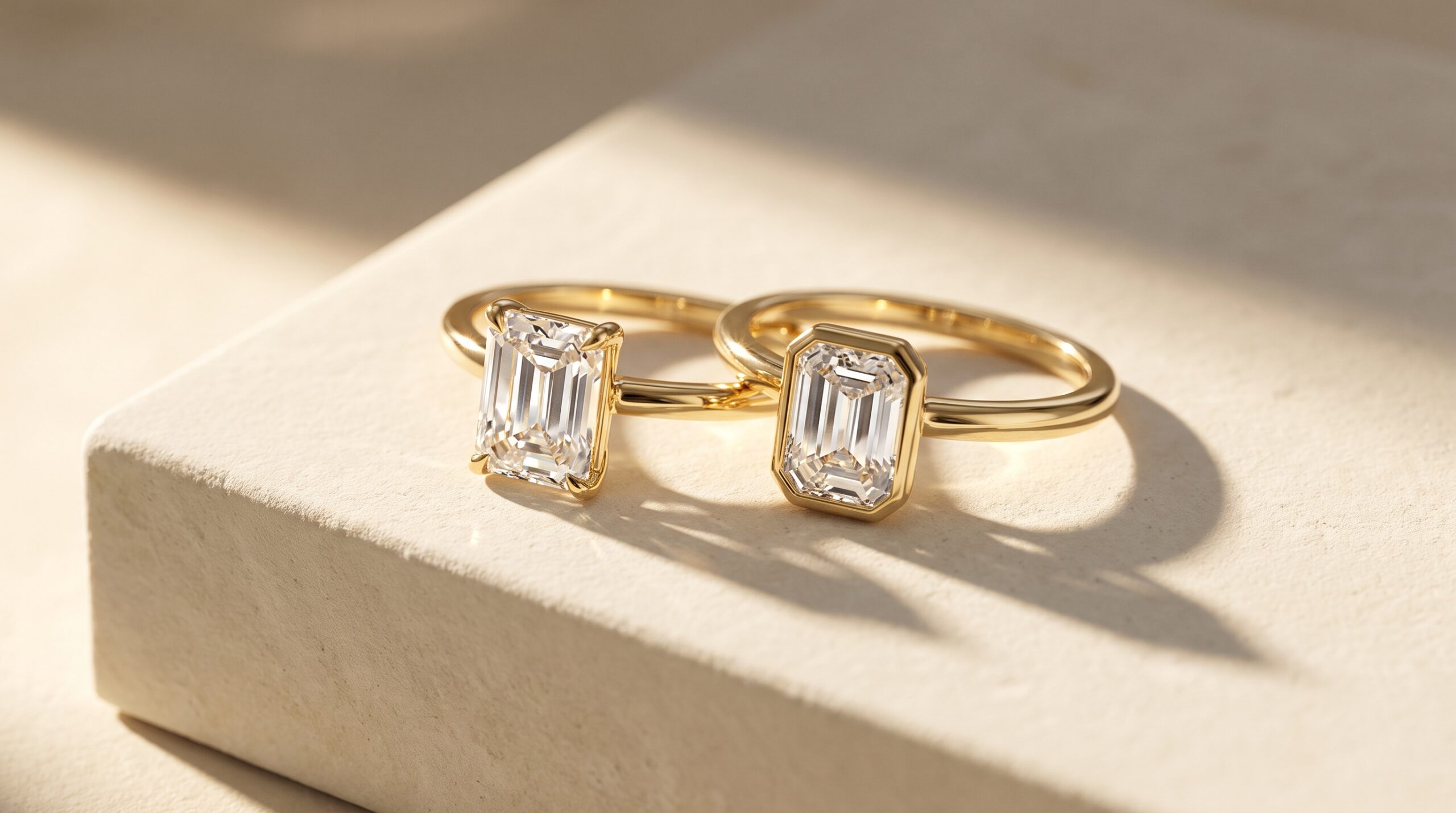
Most buyers narrow their choice down to two settings before they realize how different those two settings actually feel to wear: prong, which shows off the stone, and bezel, which wraps around it. The dilemma comes down to a real tradeoff. More metal touching the stone means more protection and less light reaching it. Less metal means more sparkle and more exposure to knocks. Neither setting is objectively better. The right one depends on how the ring will actually be worn, not just how it photographs.
What Is a Prong Setting?
How Prong Settings Hold a Stone
A prong setting uses small metal claws, typically four or six, welded to the band and bent over the stone’s edge to hold it in place. The claws leave most of the stone’s surface open, so it sits slightly raised above the band rather than flush with it.
Four-prong settings use less metal, which lets the diamond read as the focal point and gives square or rectangular shapes like princess and cushion cuts a cleaner outline. Six-prong settings, popularized by Tiffany & Co.’s solitaire design over a century ago, add two additional points of contact for extra security and better protection along the stone’s girdle, the thin edge where the top and bottom of the diamond meet.
Why Prong Settings Are So Popular
The open structure of a prong setting lets light enter the stone from more angles than a setting with a solid metal rim, which is part of why it remains the standard for solitaire engagement rings. It also keeps the visual emphasis on the center stone rather than the metalwork around it, and it’s straightforward for a jeweler to inspect, tighten, or rebuild if a claw wears down.
Potential Downsides
Raised claws can catch on sweaters, gloves, and hair, especially with a six-prong setting sitting higher off the band. Prongs also wear down gradually from daily friction, and a claw that thins too much can let the stone shift or fall out. That’s a maintenance issue rather than a defect: it’s the reason jewelers recommend periodic prong checks, not a reason to avoid the setting.
| Feature | 4-Prong | 6-Prong |
| Metal coverage | Less metal, more of the stone exposed | More metal, more of the stone covered |
| Security | Lower: losing one prong risks the stone falling out | Higher: losing one prong still leaves the stone held in place |
| Best stone shapes | Princess, cushion, and other squared cuts | Round and other shapes where extra girdle protection helps |
| Visual effect | Emphasizes the stone’s outline | Can make a round stone look rounder |
According to GIA’s comparison of four-prong and six-prong settings, six prongs hold a diamond more securely and protect the girdle better, while four prongs create a more open, squared look that suits certain cuts. GIA also flags a common misconception directly: more prongs or fewer prongs don’t change how much a diamond sparkles. Sparkle comes from the quality of the cut, not from how many claws are holding the stone.
What Is a Bezel Setting?
How Bezel Settings Work
A bezel setting surrounds the stone with a continuous rim of metal instead of individual claws. A full bezel wraps entirely around the stone’s perimeter. A partial bezel covers only part of the edge, often leaving the sides open while still anchoring the stone securely at the top and bottom.
Why Buyers Choose Bezel Settings
The metal rim in a bezel setting distributes contact around the stone’s edge instead of concentrating it at a few points, which makes the setting more resistant to impact. Because there are no raised claws, a bezel also sits lower and smoother against the finger, which matters for anyone who wears gloves, uses their hands at work, or simply doesn’t want a ring that catches on things throughout the day. The look reads as more contemporary than a traditional prong solitaire, with a clean, unbroken line around the stone.
Potential Tradeoffs
A full bezel covers more of the stone’s sides, which reduces how much light enters and exits compared with an open prong setting. That changes the character of the sparkle rather than eliminating it: the stone tends to show a more contained glow instead of the wider flash pattern typical of a prong setting. A bezel also shows more metal at the edge of the stone, which some buyers read as more modern and others read as less traditional, depending on taste.
| Feature | Full Bezel | Partial Bezel |
| Coverage | Metal surrounds the entire stone edge | Metal covers part of the edge, leaving sides more open |
| Protection | Highest level of impact protection | Moderate protection, more exposure than a full bezel |
| Light exposure | Lowest, since more metal blocks the sides | Higher than a full bezel, since more of the stone is open |
| Aesthetic | Clean, modern, minimal | Balances openness with security |
Prong vs Bezel Settings at a Glance
| Factor | Prong Setting | Bezel Setting |
| Sparkle | Higher, more light reaches the stone from the sides | Lower with a full bezel, since metal blocks some light |
| Security | Depends on prong count and condition | Generally higher, due to continuous metal contact |
| Maintenance | Needs periodic prong checks and tightening | Needs less frequent structural checks |
| Comfort | Raised profile can catch on fabric | Low, smooth profile with fewer snag points |
| Snag risk | Higher, especially with tall or six-prong designs | Lower |
| Visual style | Classic, stone-forward | Modern, rim-forward |
| Cleaning | Easier to reach the stone’s underside | Dirt can build up where the rim meets the stone |
| Stone protection | Moderate, concentrated at prong points | Higher, distributed around the stone’s edge |
Sparkle and security sit at opposite ends of the same tradeoff. A prong setting exposes more of the stone to light, which is why it remains the default for buyers who want maximum brilliance. A bezel setting sacrifices some of that light exposure in exchange for a sturdier, lower-profile structure. Comfort and cleaning follow the same logic: fewer snag points and simpler upkeep on the bezel side, more visual openness on the prong side.
Which Setting Is Better for Everyday Wear?
Best for Active Lifestyles
Healthcare workers, people who spend time at the gym, parents handling young children throughout the day, frequent travelers, and anyone in a hands-on profession tend to be better served by a bezel setting or a low-profile prong design. The lower the setting sits and the less it protrudes, the less likely it is to catch on equipment, clothing, or another person during ordinary contact.
Best for Low Maintenance
A bezel setting needs less frequent structural attention because there’s no individual claw that can bend or wear thin. Prong settings need routine inspection: a jeweler checks that each claw is still gripping the stone tightly and rebuilds or re-tips any that have worn down. Both settings still benefit from regular professional cleaning, but the inspection schedule matters more for prongs specifically because prong wear is what leads to a lost stone.
Best for Long-Term Durability
Durability in either setting depends heavily on how well it was built in the first place. A poorly cast prong that’s too thin will wear out faster than a well-proportioned one, and a bezel with metal that’s too thin at the rim can also wear down or crack over years of wear. The setting style sets the general pattern for how the ring will hold up, but craftsmanship quality within that style determines how long it actually lasts.
Which Setting Looks Bigger and More Sparkly?
Light Performance and Visibility
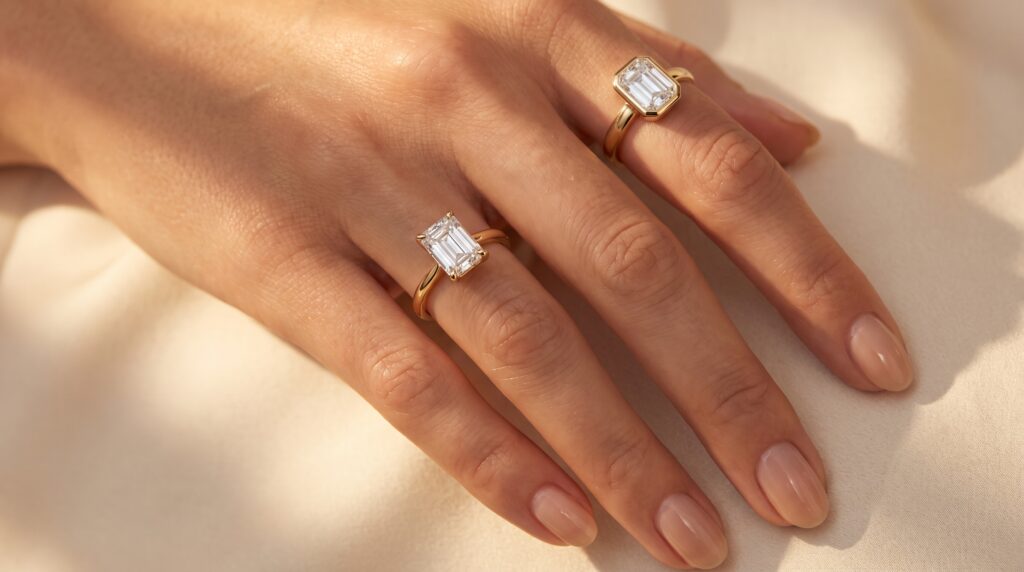
A prong setting exposes more of the stone’s pavilion, the lower portion below the girdle, to light entering from the sides and underneath. That additional light path is why prong-set stones generally read as brighter than the same stone in a full bezel. It’s worth separating this from prong count: as GIA notes, four prongs and six prongs perform the same in terms of sparkle, since brightness is governed by the diamond’s cut, not by how many claws are holding it.
How Bezels Change Visual Perception
A bezel doesn’t dim a stone so much as reframe it. The metal rim creates a defined edge around the diamond, which some buyers find makes the stone look more substantial from a distance, similar to how a mat around a photograph draws the eye to the image inside it. What a bezel does reduce is the amount of light entering from the stone’s sides, since that path is now blocked by metal, so the sparkle pattern shifts from a wide, scattered flash to a more contained glow concentrated at the top of the stone.
Stone Shape Considerations
Round and cushion-cut stones tend to read well in either setting, since their proportions distribute light fairly evenly. Oval and pear shapes often benefit from a prong or partial bezel that leaves the pointed ends more exposed, since a full bezel around a pointed tip can look heavier than the same coverage on a round stone. Emerald-cut stones, with their large open facets, show light loss more noticeably in a full bezel than a round brilliant does, because the step-cut facets rely on unobstructed light entry to avoid looking flat.
Maintenance and Care Differences
Prong Maintenance Expectations
Prongs should be checked by a jeweler roughly every six to twelve months, more often if the ring is worn daily or the wearer works with their hands. Signs that a prong needs attention include a claw that looks thinner than the others, a stone that shifts slightly when tapped gently, or a claw tip that’s no longer flush against the stone’s surface.
Bezel Cleaning Considerations
Because the metal rim sits directly against the stone, dirt and skin oils can collect in the thin seam where the two meet. A soft brush and mild soap solution usually clears this without professional help, but buildup that’s left too long can dull the stone’s appearance from the outside in. Bezels rarely need the same frequency of structural inspection as prongs, though the rim itself should be checked periodically for thinning, particularly on rings worn daily for years.
Warning Signs Buyers Should Not Ignore
A stone that moves or rattles slightly when the ring is tapped against a hard surface signals a setting problem regardless of style. In a prong setting, this usually points to a bent, worn, or broken claw. In a bezel setting, it can mean the rim has developed a small gap or thinned unevenly around the stone. Either sign is worth a jeweler’s visit before the ring is worn again, since continued wear increases the risk of losing the stone entirely.
How to Choose the Right Setting for Your Lifestyle
Start by deciding what matters more day to day: maximum sparkle or maximum peace of mind about the stone staying secure. That single priority narrows the choice more than any other factor.
Consider your daily routine honestly. Manual work, frequent hand-washing, sports, or work with small children all favor a lower-profile, more protective setting over a taller, more open one.
Think about long-term maintenance before falling in love with a specific design. A prong setting is easy for most jewelers to service, but it does require that service on a schedule. A bezel needs less frequent structural attention but can be more involved to resize or repair when work is needed.
Evaluate comfort and profile height together with the setting style. A high six-prong setting and a full bezel can both be secure, but they sit differently on the hand and catch on different things.
Match the setting to the stone type and shape. Softer or more brittle gemstones benefit more from the protection of a bezel than a hard, durable diamond does, and stone shape affects how much a bezel changes the stone’s appearance.
| Lifestyle Type | Recommended Setting |
| Hands-on professions (healthcare, trades, food service) | Bezel or low-profile prong |
| Active or athletic daily routine | Bezel |
| Parents of young children | Bezel or partial bezel |
| Office or low-contact daily routine | Either, based on aesthetic preference |
| Buyers prioritizing maximum brilliance | Prong |
| Buyers who travel frequently and want fewer maintenance visits | Bezel |
What to Check When Buying Online
Side-profile images matter more than straight-on product shots, since they’re the only way to judge how high a stone sits and how much of it a bezel actually covers. Look for the setting height listed in millimeters, the prong count on prong-set rings, the exact metal type and karat, the store’s return and resizing policies, and whether a warranty covers stone security specifically, not just manufacturing defects.
Treat vague product descriptions, listings with no side-view photo, and pages that don’t disclose the metal stamp or purity as reasons to ask questions before buying, not necessarily reasons to walk away. A legitimate seller should be able to answer those questions directly.
Both prong and bezel settings hold up well over years of daily wear when they’re built with adequate metal thickness and checked periodically. The setting style sets the general pattern for sparkle, protection, and upkeep, but how a specific ring is made matters just as much as which style it is. Compare side-profile photos, ask about setting height and metal thickness, and weigh those details against how the ring will actually be worn before deciding.
Frequently Asked Questions
Is a bezel setting more secure than prongs?
Generally, yes. A bezel distributes contact around the entire edge of the stone, so there’s no single point of failure the way there is with an individual prong. A well-built prong setting, especially a six-prong design, is still secure for daily wear, but it depends on each claw remaining properly tightened, which is why prongs need more regular inspection than a bezel does.
Do prongs sparkle more?
A prong setting generally shows more sparkle than a full bezel because more of the stone’s surface is exposed to light entering from the sides. The number of prongs doesn’t affect this: GIA’s comparison of four-prong and six-prong settings notes directly that sparkle comes from the diamond’s cut quality, not from how many claws hold it in place.
Which setting is best for active lifestyles?
A bezel or a low-profile prong setting tends to work better for active lifestyles, since both minimize the raised edges that catch on equipment, clothing, or other people during regular contact. A tall six-prong setting isn’t unsafe for active wear, but it will likely need more frequent inspection and carries a higher chance of catching on something during the day.
Does a bezel make a diamond look smaller?
Not exactly smaller, but a full bezel changes how the stone reads visually. The metal rim covers part of the stone’s outline, which can make it look slightly more contained than the same stone in an open prong setting where the full outline is visible. Whether that reads as smaller or simply more framed depends on the stone’s shape and the width of the bezel itself.
Are bezels harder to resize?
Often, yes. Because the metal rim is fitted precisely to the stone’s dimensions, resizing a bezel setting can require more work than resizing a simple prong setting on a plain band, and in some cases the bezel needs to be partially rebuilt to maintain a snug fit around the stone. A prong setting on a plain band is usually the more straightforward of the two to resize.
Which setting requires more maintenance?
Prong settings generally need more frequent maintenance, specifically periodic checks to confirm each claw is still gripping the stone tightly. Bezel settings need less structural maintenance but still require regular cleaning, since dirt can collect in the seam where the metal meets the stone.
Is a 4-prong ring safe enough?
A well-built four-prong setting is secure for everyday wear, particularly for smaller stones or squared cuts like princess and cushion, where four prongs suit the shape well. The tradeoff is that four prongs offer less redundancy than six: if one claw fails, a four-prong setting has fewer remaining points holding the stone in place. Buyers who want the extra margin of security, especially for larger stones, often choose six prongs instead.