
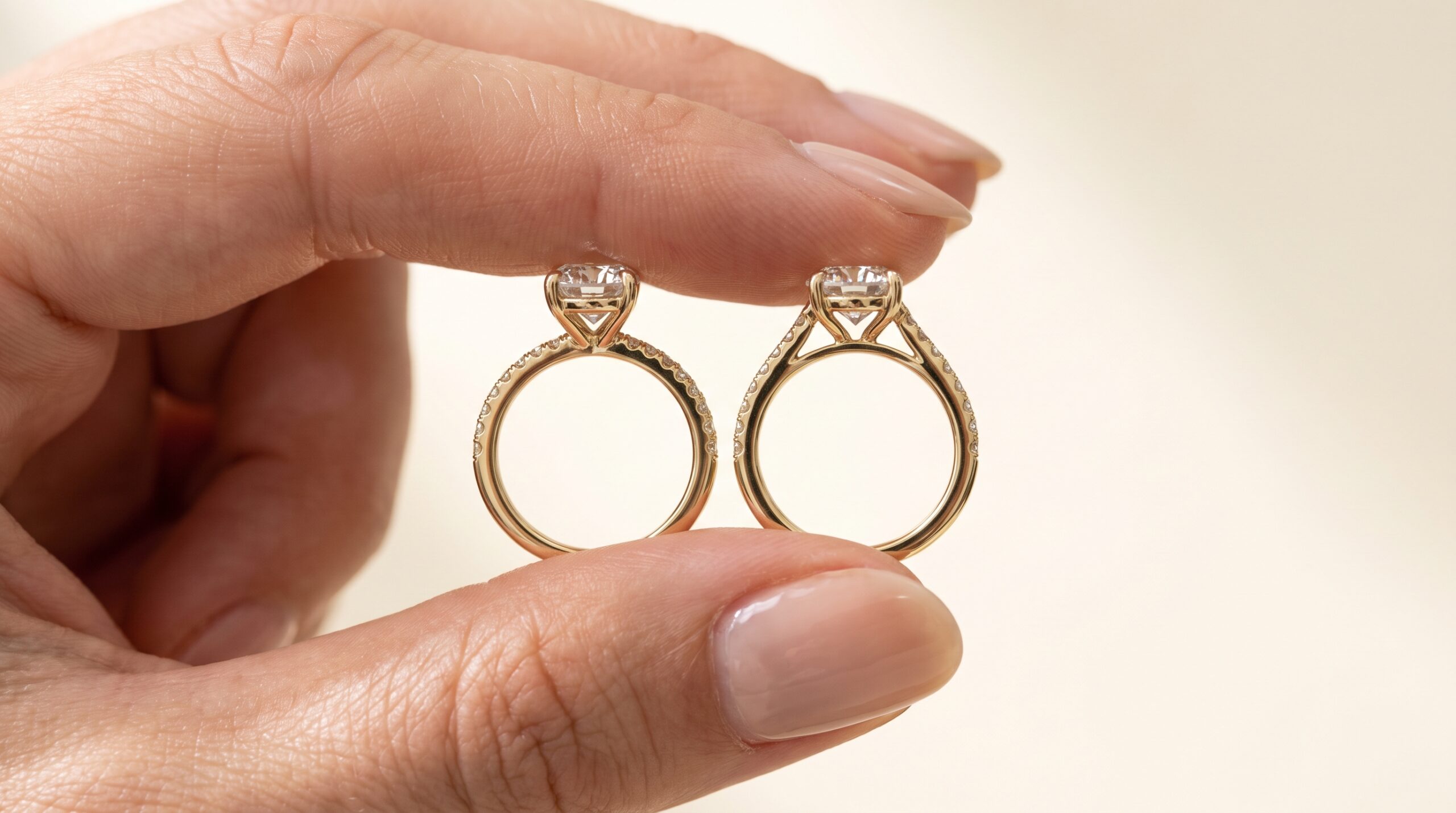
Two rings can look nearly identical in a top-down photo and feel completely different on the hand. The difference usually comes down to profile: how high the setting rises off the finger. That height affects comfort, how the ring catches on gloves or sweaters, whether a wedding band will sit flush against it, and how dramatic the ring looks from the side.
Cathedral settings and low-profile settings are the two ends of that spectrum. Neither is the better choice in general. They’re built around different priorities, and knowing what those priorities are makes it easier to pick the one that fits how you’ll actually wear the ring.
What Is a Cathedral Setting?
A cathedral setting uses arched metal shoulders that rise from the band and lift the center stone above the finger. The name comes from the resemblance to cathedral arches: the metal curves upward on either side of the stone the way a church ceiling arches toward its center point, rather than sitting flat.
The part of the setting that actually holds the stone is called the head, and the open space beneath the stone, visible from the side, is the gallery. In a cathedral setting, the arches lead the eye up into that gallery and toward the stone, which is part of why the style reads as more traditional and formal than a flatter setting.
Buyers choose cathedral settings for a few consistent reasons:
- A classic, traditional bridal look that most people recognize as an engagement ring silhouette
- A taller, more sculptural side profile
- More visual presence, since the arches create shadow and line even when the ring isn’t catching direct light
- Additional metal support around the center stone, which some buyers read as sturdier framing
The tradeoffs are mostly practical. A raised setting has more surface area that can catch on fabric, hair, or glove linings than a flat one. It’s also more noticeable on the hand throughout the day, which is a feature for some wearers and a distraction for others. And because the arches take up space on either side of the stone, cathedral rings don’t always sit flush against a straight wedding band without some adjustment.
What Is a Low-Profile Setting?
A low-profile setting keeps the center stone closer to the finger instead of lifting it on arches or a tall gallery. Jewelers sometimes call this “low-set,” and the profile height, meaning how far the stone sits above the finger, is the measurement that describes it.
The main reason people choose low-profile settings is comfort. A stone that sits close to the hand doesn’t catch as easily on clothing or gloves, and it tends to feel less noticeable during repetitive hand movements like typing or gripping something. Because there’s less structure rising from the band, low-profile rings are also often easier to pair with a straight wedding band, since there’s less metal in the way.
The tradeoffs run the other direction from cathedral settings. A low profile doesn’t have the same side-view drama. Seen from the side, it can look simpler, more like a flat surface than a sculptural piece. That’s a matter of taste, not a quality issue: it’s a genuinely different visual effect, not a lesser one. It’s also worth noting that a low profile alone doesn’t guarantee a flush fit with every wedding band; the head shape and stone cut still matter, so it’s not a given just because the setting sits low.
Cathedral vs Low Profile Settings at a Glance
| Factor | Cathedral Setting | Low-Profile Setting |
| Overall look | Elevated, classic, architectural | Sleek and understated |
| Ring height | Usually taller | Usually lower |
| Comfort | More noticeable on the hand throughout the day | Often more comfortable for continuous wear |
| Snag risk | Higher, due to the raised arches | Lower, since the stone sits closer to the finger |
| Wedding band fit | May need a curved or contoured band to sit flush | Often easier to pair with a straight band |
| Visual drama | More pronounced from the side | More subtle from the side |
| Best for | Buyers who want a classic, statement bridal silhouette | Buyers who prioritize daily comfort and active wear |
Which Setting Is More Comfortable for Everyday Wear?
Height is the main variable. A taller setting has more edges and raised metal that can catch on a sweater cuff, a glove lining, or hair when you run your hand through it. A lower setting has fewer places for fabric or hair to snag because there’s less rising above the finger to begin with.
This matters more in some routines than others. Healthcare workers who wear gloves for much of the day, parents handling young children, people who type for long stretches, frequent travelers moving luggage through airports, and anyone in a hands-on job all encounter more opportunities for a raised setting to catch than someone whose hands stay mostly still. None of this means cathedral rings can’t be worn in these situations; it means the odds of noticing the ring, and occasionally snagging it, go up with height.
Cathedral settings can still work well for active routines if the design keeps the arches subtle or tapered rather than tall and pronounced. A lower cathedral profile splits the difference: some of the classic arched look, without the full height of a traditional cathedral setting.
Choose low-profile if you want minimal interference with gloves, frequent hand-washing, or manual tasks, and if a flatter side profile doesn’t bother you.
Choose cathedral if the side-view elevation and traditional silhouette matter more to you than minimizing snag risk, and your daily routine doesn’t involve constant glove use or heavy hand contact.
Which Setting Looks More Elegant or Dramatic?
Cathedral settings have more visual presence because the arches lift the stone and create depth from the side. That elevation is part of why the style reads as the traditional engagement ring silhouette: the shape has been standard in bridal jewelry for long enough that most people recognize it on sight.
Low-profile settings read as more modern and restrained. There’s less bulk and less going on visually from the side, which some buyers describe as more refined rather than less special. It’s a different kind of elegance: quieter, and closer to how the ring behaves in daily life than how it photographs from an angle.
Stone shape changes how noticeable the profile is. A round or cushion-cut stone sits fairly evenly in either a cathedral or low-profile setting. A longer shape like an oval, emerald cut, or pear draws more attention to the setting’s height along its length, so the same profile height can look more or less dramatic depending on the stone shape it’s paired with.
Wedding Band Pairing and Flush Fit
Flush fit describes a wedding band sitting flat against the engagement ring with no visible gap between them. It’s mostly a fit question, not a style question: two rings can look great individually and still leave a noticeable gap when worn together if their profiles don’t match.
Cathedral settings can complicate a flush fit because the arches occupy the space right next to the band. A straight wedding band may not be able to sit level against the engagement ring without a gap on either side of the arches. Contoured or curved wedding bands, shaped to follow the cathedral’s arch, solve this in most cases, but it does mean cathedral wearers often need to shop for a band designed to pair with their specific setting rather than picking any straight band.
Low-profile settings are generally easier to pair with a straight band, since there’s less raised structure in the way. That said, it still depends on the gallery design and the shape of the setting head: some low-profile rings have enough width at the base that a straight band still needs slight adjustment to sit flush. It’s worth trying the pairing in person or asking a jeweler whether a specific band will sit flush against a specific ring, rather than assuming based on profile height alone.
Durability, Care, and Maintenance
Both settings need periodic checks, though the specific concerns differ.
Cathedral settings have more connection points: the arches meet the band on one end and the setting head on the other, and each of those joints is a place where metal can wear or loosen over time. It’s worth having a jeweler check the arches and prongs periodically, particularly if the ring has taken any noticeable knocks.
Low-profile settings have fewer connection points and, since they sit closer to the finger, tend to take fewer direct impacts than a raised setting. That doesn’t mean they’re maintenance-free. Prongs still loosen with wear regardless of height, and lower settings can still collect dirt in the gallery space beneath the stone.
For both, home care follows the same basic routine: mild soap, warm water, a soft brush to reach tight spaces, and careful drying rather than rubbing. Store rings separately from other jewelry to avoid metal-on-metal scratching. Beyond home care, periodic professional inspection catches wear before it becomes a lost stone or a bent prong, a point echoed in jewelry care guidance from Jewelers of America, and in repair-warning guidance from Revolution Jewelry Works, which lists loose stones and worn prongs as common early signs a ring needs attention regardless of setting style.
What to Check When Buying Online
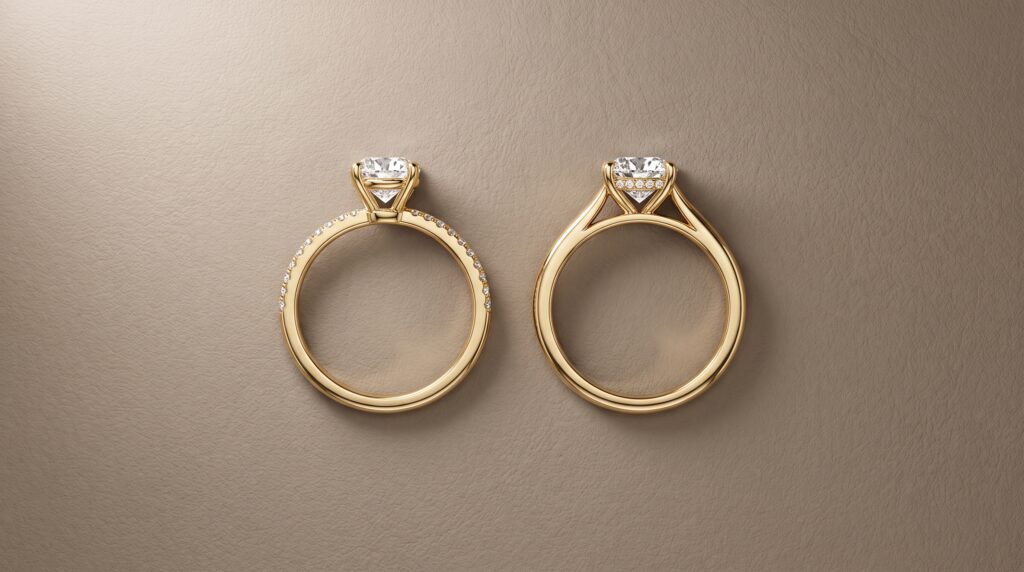
Profile height is nearly invisible in a straight-on product photo. A ring photographed from directly above can look similar whether it’s a tall cathedral setting or a flat low-profile one, which is why side-view images and measurements matter more here than in most other jewelry buying decisions.
Before buying, look for:
- Side-profile photos, not just a top-down angle
- Setting height listed in millimeters
- Band width
- Gallery design, since this affects both the look and how a wedding band will pair
- Any stated flush-fit compatibility with straight or curved bands
- Stone size and shape
- Return policy
- Resizing terms
- Warranty or repair support
Red flags to watch for: no side-view images anywhere in the listing, no height measurement given, vague marketing language like “elevated design” with no specifics, no mention of wedding band compatibility, and no aftercare or warranty information. A seller who provides clear side-profile photos and an exact height measurement is giving you what you actually need to judge fit and comfort before the ring arrives. GIA’s grading and certification standards apply to the center stone itself, not the setting, so setting height and gallery design are details you’ll need to verify separately from any diamond certificate.
Frequently Asked Questions
What is a cathedral engagement ring?
A cathedral engagement ring uses arched metal shoulders that rise from the band and lift the center stone above the finger, creating a taller, more architectural side profile. The name refers to the resemblance between the arches and the curved ceilings of cathedral architecture.
What is a low-profile engagement ring?
A low-profile engagement ring keeps the center stone close to the finger rather than raising it on tall arches or a deep gallery. This is sometimes called a low-set ring, and it results in a flatter, more subtle side view than a cathedral setting.
Which setting is more comfortable?
Comfort depends on daily routine, but low-profile settings are generally easier for continuous wear since there’s less raised metal to catch on gloves, clothing, or hair. Cathedral settings can still be comfortable, especially with a subtler or tapered arch design, but the added height means there’s more surface area that can snag during hands-on activity.
Which setting is better for active lifestyles?
Low-profile settings tend to work better for active routines involving frequent glove use, hand-washing, or manual tasks, since the flatter profile reduces the chance of catching on fabric or equipment. Cathedral settings aren’t automatically ruled out for active wearers, but the decision comes down to how much snag risk someone is willing to accept in exchange for the taller, more traditional silhouette.
Do cathedral rings snag more?
Generally, yes, because the raised arches create more edges and surface area than a flat setting, giving fabric, gloves, and hair more opportunity to catch. This is a matter of degree rather than an absolute rule: a subtle or tapered cathedral design snags less than a tall, pronounced one, and factors like arch height and edge finishing affect the risk as much as the basic cathedral versus low-profile distinction.
Can cathedral rings sit flush with wedding bands?
Sometimes, but it often requires a contoured or curved wedding band shaped to follow the cathedral’s arches rather than a straight band. A straight band can leave a visible gap next to the raised arches, so cathedral wearers typically need to choose a band designed to pair with their specific setting rather than assuming any wedding band will sit flush.
Are low-profile settings less secure?
Not inherently. Security depends on the quality of the prongs and setting work, not on how high or low the stone sits above the finger. A well-made low-profile setting holds a stone just as securely as a well-made cathedral setting, and a poorly made version of either style is more likely to loosen over time regardless of height.
Can a cathedral ring be made lower?
Yes, jewelers can design cathedral settings with shorter or more tapered arches that keep some of the arched silhouette while reducing overall height. This doesn’t eliminate the tradeoffs entirely, since any raised arch still creates more surface area than a fully flat setting, but it narrows the gap between the two styles for buyers who want some architectural detail without the full height of a traditional cathedral.
What should I check before buying online?
Look for side-profile photos in addition to top-down images, along with an exact setting height measurement in millimeters, since these are the details that actually show you how the ring will sit on the hand. Also confirm band width, gallery design, flush-fit compatibility with wedding bands, and the seller’s return, resizing, and warranty policies before purchasing, since these are harder to sort out after the ring arrives than to check in advance.