
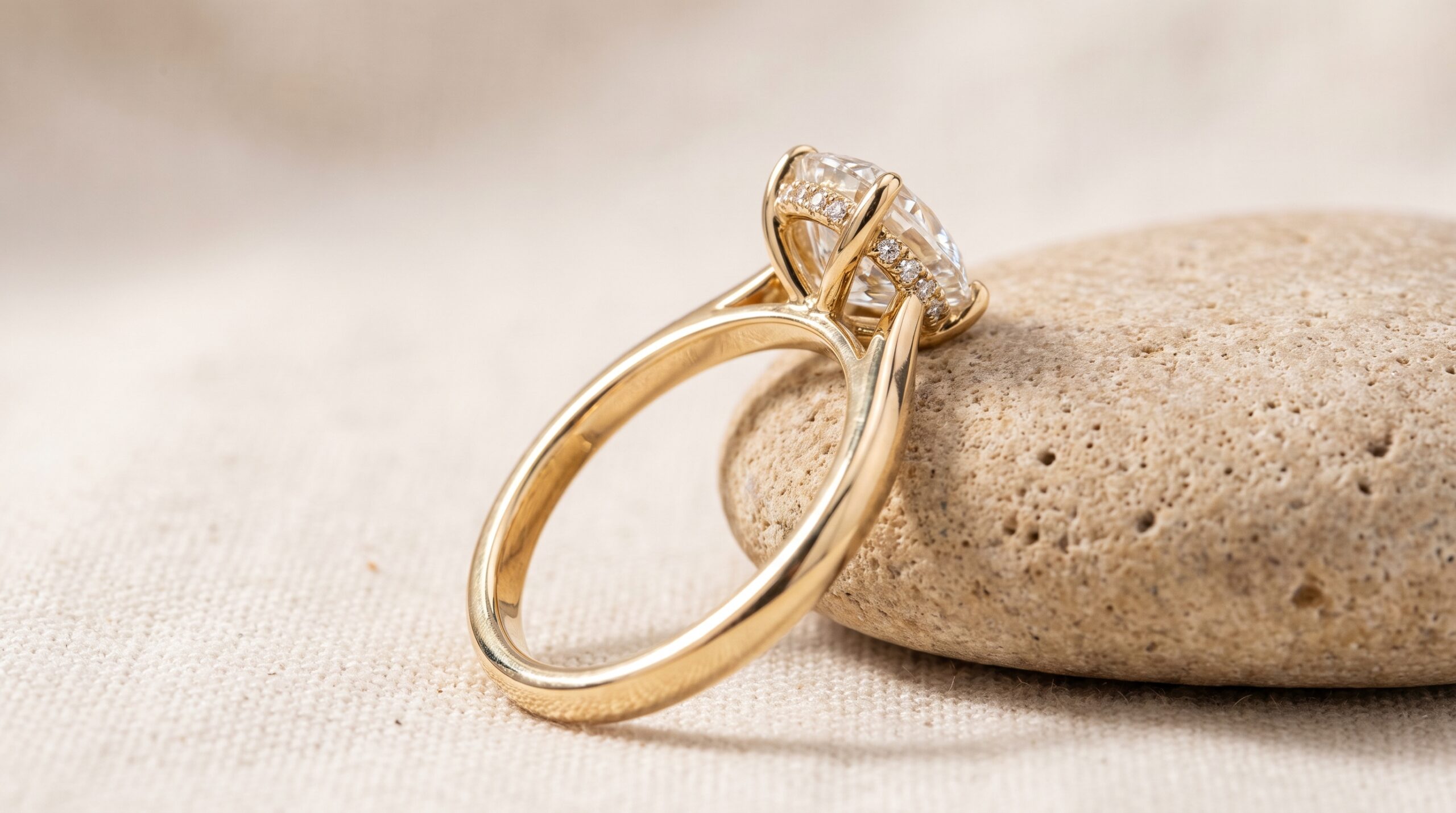
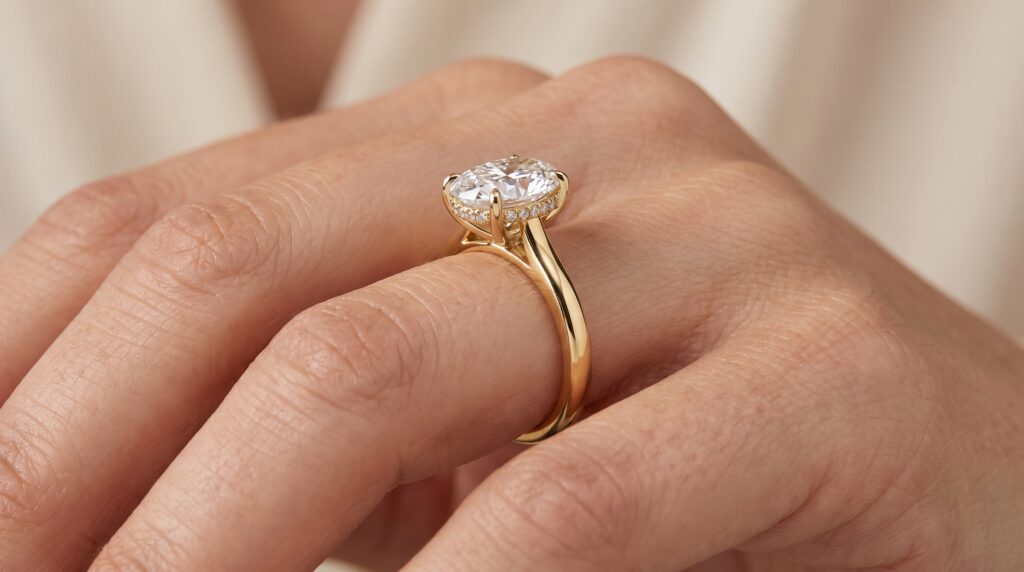
From above, a hidden halo ring can look almost exactly like a solitaire. Tilt it to the side, though, and a ring of small diamonds shows up beneath the center stone, catching light the main stone alone wouldn’t. That’s the whole idea behind the design: sparkle that reveals itself rather than announcing itself.
It’s a different proposition than a traditional halo, which puts small stones in plain view around the center diamond from every angle. A hidden halo asks the buyer to think about profile height, wedding band fit, and maintenance in ways a plain solitaire doesn’t require. This guide walks through what the style actually looks like in wear, how it compares to halo and solitaire settings, and what to check before buying one.
What Is a Hidden Halo Engagement Ring?
A hidden halo is a row of small diamonds set in a circle beneath the center stone, inside the basket (the small cup of metal that holds the stone from underneath). Unlike a traditional halo, which sits at the same level as the center stone and is visible from directly above, a hidden halo sits below the stone’s girdle, which means it shows up mainly when the ring is viewed from the side or at an angle rather than straight on.
That structural difference is the whole distinction between the two styles. A traditional halo changes the ring’s appearance from above. A hidden halo largely doesn’t, at least not dramatically, which is exactly why some buyers choose it.
People choose a hidden halo for reasons that lean toward subtlety rather than maximum sparkle:
- A top view that stays close to a clean solitaire look
- Extra shimmer that shows up from the side, functioning almost like a private design detail
- A modern variation on the halo concept, without the fuller visual presence of a traditional one
- Added interest for a buyer who wants more than a plain band without wanting an obviously decorated ring
Hidden Halo vs Traditional Halo vs Solitaire
| Style | Appearance | Sparkle Effect | Best For | Considerations |
| Hidden halo | Clean from above, detailed from the side | Subtle, revealed mainly at an angle | Buyers who want understated extra detail | Often sits a bit higher due to the basket structure |
| Traditional halo | Visible ring of diamonds around the center stone | Strong sparkle visible from directly above | Buyers who want a fuller, more dramatic look | More visual complexity and more stones to maintain |
| Solitaire | Single stone, no surrounding diamonds | Sparkle concentrated in the center stone | Buyers who want the simplest possible design | Least additional sparkle of the three |
Does a Hidden Halo Make the Diamond Look Bigger?
Not usually, and this is worth being direct about since it’s the most common misconception buyers bring to this style. A traditional halo sits at the same height as the center stone, so from directly above, the small diamonds blend visually with the edges of the center stone and can make it read as larger or fuller. A hidden halo sits below the girdle, out of the direct line of sight from the top, so it doesn’t create that same size illusion.
What a hidden halo does add is a sense of depth and extra brilliance from other viewing angles. It’s a real visual effect, just a different one than a traditional halo produces.
If the priority is making the center stone look larger from directly above, which is the angle most people see first in a photo or at a glance, a traditional halo is the more reliable choice for that specific effect. If the priority is subtle enhancement that doesn’t compete with the center stone for attention, a hidden halo does that instead, without trying to make the diamond appear bigger than it is.
Style Options for Hidden Halo Rings
A plain band with a hidden halo keeps the rest of the ring simple, so the only added detail is the halo itself. This is the closest option to a true solitaire feel, with one quiet addition.
A pavé band paired with a hidden halo adds sparkle along the shank as well as beneath the center stone, which increases the ring’s overall brilliance but also increases the number of small stones that need regular cleaning and inspection. This combination reads as more decorated than a plain band with a hidden halo, closer in overall effect to a fuller halo-and-pavé design.
Hidden halos work with most diamond shapes, including round brilliant, oval, cushion, marquise, and emerald cuts, though the visual effect varies slightly by shape. Round and cushion cuts, which have a more even girdle outline, tend to show a symmetrical ring of sparkle beneath the stone. Elongated shapes like oval, marquise, and emerald cuts show the hidden halo more along the length of the stone than in a perfect circle, since the halo follows the stone’s outline rather than a fixed round shape.
Metal color changes how the hidden halo reads visually, though this is a matter of preference rather than one option being objectively better. White gold or platinum tends to blend with the diamonds for a more seamless, uniform brightness. Yellow gold creates more contrast between the metal and the diamonds, which can make the hidden halo more noticeable when the ring catches the light at an angle. Rose gold sits between the two, adding warmth without the strong contrast of yellow gold.
Comfort, Profile Height, and Everyday Wear
Profile height describes how far the ring sits above the finger. A high profile setting rises further off the hand; a low profile setting sits closer to it. Many hidden halo designs run slightly higher than an equivalent solitaire, simply because the basket needs enough depth to hold the hidden halo’s small stones beneath the center diamond.
That added height is the main practical tradeoff of the style. A slightly raised setting has more surface area that can catch on gloves, sweater cuffs, or hair than a flatter one, the same consideration that applies to any setting with added height, hidden halo or otherwise. This isn’t unique to hidden halos and doesn’t make them impractical, but it’s worth knowing before assuming a hidden halo will wear identically to a plain solitaire.
Choose a hidden halo if you want subtle side-profile sparkle and don’t mind a small amount of added height and detail to maintain.
Choose a lower-profile hidden halo design specifically if you’re on your feet often, work with your hands, or wear gloves regularly, since a shallower basket reduces some of the snag risk without giving up the hidden detail entirely.
Consider a plain solitaire instead if minimizing maintenance and profile height is the top priority and the side-profile detail isn’t something you’d notice or care about day to day.
Wedding Band Pairing and Flush Fit
Flush fit means a wedding band sits closely against the engagement ring with no visible gap between the two. It’s a fit question as much as a style question, and it applies to hidden halo rings the same way it applies to any setting with added structure near the band.
The basket height and the placement of the hidden halo can affect how a straight wedding band sits against the ring. If the basket flares out or sits especially deep to accommodate the hidden halo, a straight band may leave a small gap on either side. Elongated stone shapes paired with a hidden halo sometimes need a contoured band that follows the stone’s outline more closely, similar to how contoured bands work with other non-round center stones.
Before buying, it’s worth asking the seller directly whether a straight wedding band will sit flush against a specific hidden halo ring, whether a curved or contoured band is recommended instead, and whether the seller can show the engagement ring paired with an actual wedding band rather than just describing compatibility in general terms.
Care and Maintenance for Hidden Halo Rings
Home cleaning for a hidden halo ring follows the same basic approach recommended for diamond jewelry generally: warm water, mild dish soap, a soft brush to reach into the basket and around the small stones, and gentle drying with a lint-free cloth afterward.
A few things to avoid: bleach or chlorine, which can damage certain metals and settings over time, harsh chemical cleaners, rough brushing that could catch on a prong, paper towels (which can leave lint or scratch softer metals), and ultrasonic cleaners unless a jeweler has specifically confirmed they’re safe for that ring’s stones and setting.
The hidden halo’s small pavé stones are worth having checked periodically, since pavé settings generally can loosen with wear the same way any small stone setting can. A jeweler inspecting a hidden halo ring will typically check the prongs holding the center stone, the basket structure, and each of the small halo stones. Scheduling this roughly every six to twelve months is a reasonable interval for a ring worn daily, though how often it’s actually needed depends on how much wear the ring sees.
Certification, Quality, and Authenticity
Certification typically applies to the center stone, not to each small diamond in the hidden halo. A center stone graded by an independent lab, following standards like the GIA’s grading criteria for natural diamonds, comes with documentation specific to that stone’s cut, color, clarity, and carat weight. The hidden halo’s small stones are almost never certified individually, since certifying dozens of tiny melee diamonds isn’t standard industry practice, and that’s true across hidden halo, traditional halo, and pavé designs generally.
Beyond the center stone’s certificate, check the metal hallmark for purity (14K, 18K, platinum, and so on) and any maker’s mark, which together confirm what the ring is actually made of.
A few craftsmanship details are worth a close look, whether from photos or in person: even spacing and alignment in the hidden halo stones, secure-looking pavé work rather than stones that appear loosely set, a smooth basket finish without rough or unfinished edges, and clear disclosure from the seller about whether the stones are natural or lab-grown.
What to Check When Buying a Hidden Halo Ring Online
The hidden halo’s whole appeal lives in a viewing angle that a single product photo often doesn’t capture well. A straight-on top view won’t show it at all, which makes side-profile documentation more important here than for many other ring styles.
Before buying, look for:
- A 360-degree video, if available, rather than only static photos
- Side-profile photos that actually show the hidden halo
- Close-up images of the basket itself
- Profile height listed in millimeters
- Band width
- Metal type
- A grading report for the center stone
- Details on the hidden halo diamonds, even if they’re not individually certified
- Wedding band compatibility information
- Return policy
- Resizing rules
- Warranty and repair support
Red flags include a listing with no side-view images at all, no profile height measurement, a vague description that just says “halo” without clarifying whether it’s hidden or traditional, no certification or an unverifiable report for the center stone, no warranty details, and no information about how the ring pairs with a wedding band. A seller who shows the ring from multiple angles and states the profile height plainly is giving you what you need to judge how the ring will actually look and feel, rather than leaving that to guesswork after the ring arrives.
Frequently Asked Questions
What is a hidden halo engagement ring?
A hidden halo engagement ring has a circle of small diamonds set in the basket beneath the center stone, positioned below the stone’s girdle so it’s visible mainly from the side rather than from directly above. This differs from a traditional halo, which sits at the same level as the center stone and is visible from a top-down view.
Is a hidden halo visible from the top?
Not usually, or only minimally. Because the hidden halo sits below the center stone’s girdle, it’s largely out of view when looking straight down at the ring, which is part of why the style keeps a clean, solitaire-like top view while still adding detail from other angles.
Does a hidden halo make the diamond look bigger?
Generally not from directly above, since the halo sits below the stone rather than at the same level, so it doesn’t blend visually with the stone’s outline the way a traditional halo can. A hidden halo adds brilliance and depth from side angles instead of creating the size illusion associated with a traditional halo.
Is a hidden halo more subtle than a traditional halo?
Yes, in the sense that it’s less visible from a typical viewing angle. A traditional halo is designed to be seen immediately from above, while a hidden halo is designed to be discovered from the side, which is a deliberate design choice rather than a lesser version of a halo.
Do hidden halo rings snag?
They can, somewhat more than a plain solitaire, mainly because many hidden halo designs sit slightly higher off the finger to accommodate the basket structure needed to hold the hidden stones. A lower-profile hidden halo design reduces this risk without eliminating the hidden detail, and the actual snag risk depends on the specific setting’s height and finish rather than being the same across every hidden halo ring.
Can a hidden halo ring sit flush with a wedding band?
It depends on the basket design and the center stone’s shape. A straight wedding band sits flush with many hidden halo rings without issue, but designs with a deeper or flared basket, or elongated center stones, sometimes need a curved or contoured band instead. Checking with the seller before buying, ideally with a photo of the specific pairing, is more reliable than assuming based on the style alone.
Are hidden halo rings hard to clean?
They need a bit more attention than a plain solitaire because there are more small stones and tighter spaces where residue can collect, but the actual cleaning method is the same: mild soap, warm water, and a soft brush. The main difference is frequency and care around the basket, not a fundamentally different cleaning process.
Can hidden halo rings be resized?
Generally yes, similar to other ring styles, though the basket structure can make resizing slightly more involved than a plain solitaire since a jeweler needs to work around the small stones and the basket’s shape. It’s worth asking the seller directly about resizing limits for a specific ring rather than assuming it will resize exactly like a simpler setting.
Are the hidden halo diamonds certified?
Usually not individually. The center stone commonly comes with its own certification, but the small diamonds in the hidden halo are typically not certified one by one, since that level of individual documentation isn’t standard practice for small melee stones in any halo or pavé setting. This is normal industry practice rather than a quality concern on its own, though it does mean relying on the seller’s disclosure about stone quality matters more for the hidden halo stones than for the center diamond.
What diamond shapes work best with hidden halos?
Round and cushion cuts tend to show a more symmetrical ring of sparkle beneath the stone, since their girdle outline is more even. Elongated shapes like oval, marquise, and emerald cuts still work well with a hidden halo, but the halo follows the stone’s length rather than forming a perfect circle, which changes the visual effect slightly without making any shape a poor fit for the style.