
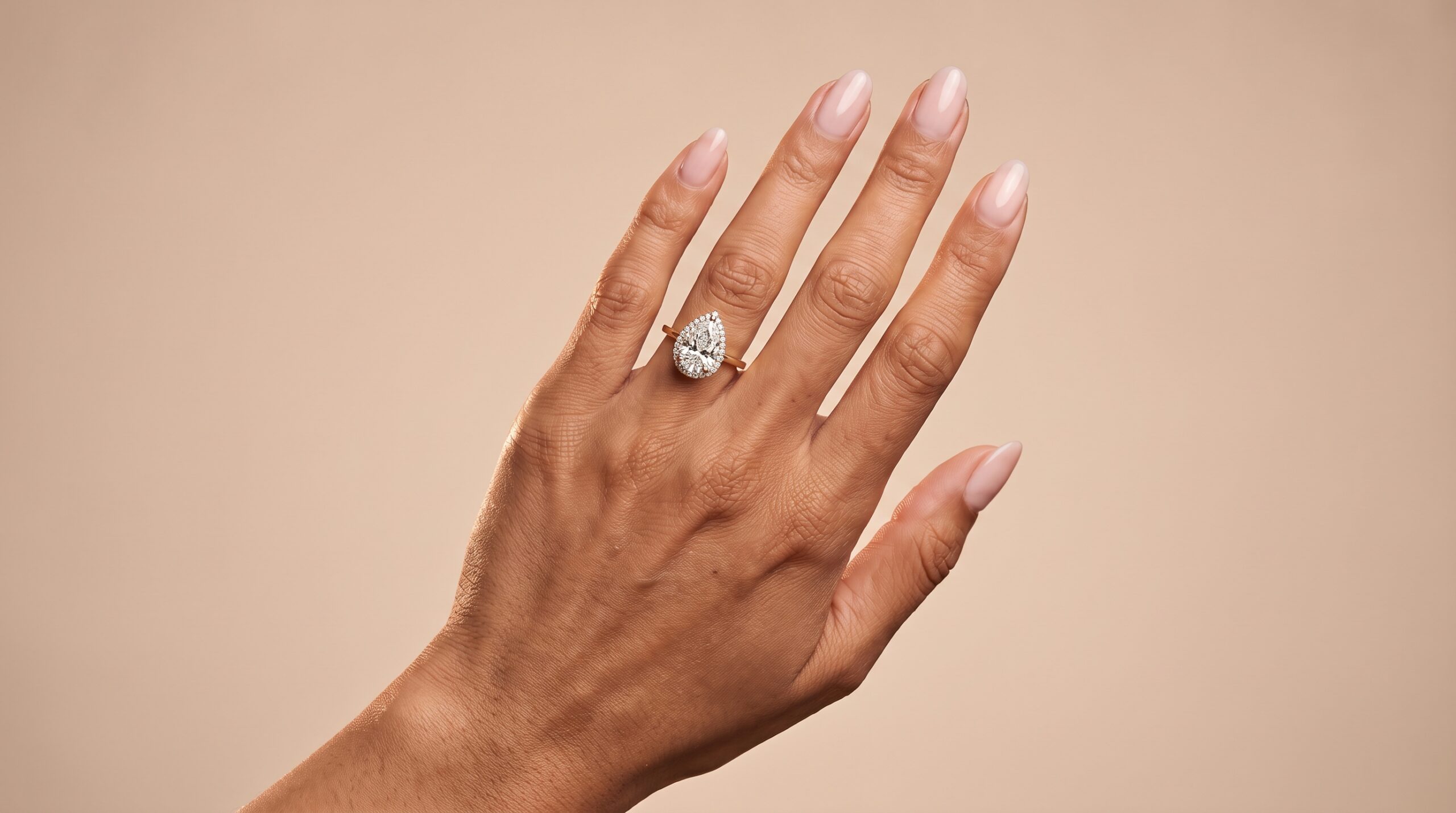
A pear shaped diamond looks like a teardrop: one end rounded, the other tapering to a point. That single detail changes almost everything about how the stone wears, how it catches light, and what kind of setting it needs. Buyers who love the shape on sight often hesitate once they start reading about the bow tie effect, symmetry grading, and whether the pointed tip is going to chip. Those concerns are reasonable, and they’re also manageable once you know what to look for.
This guide walks through what makes a pear cut distinct, how to judge one before you buy, which settings protect it, and what to check if you’re buying online rather than in a store.
What Is a Pear Shaped Engagement Ring?
A pear shaped diamond, sometimes called a teardrop cut, combines features of a round brilliant and a marquise. One end is curved like a round diamond; the other narrows to a single point. The faceting is a modified brilliant cut, meaning it uses the same triangular and kite-shaped facet pattern that gives round diamonds their sparkle, adapted to an asymmetrical outline.
The shape has been cut since at least the 15th century, when Flemish polisher Lodewyk van Berquem is credited with developing more consistent faceting techniques that made asymmetrical cuts like the pear possible. Modern pear cuts use far more precise faceting than early versions, but the basic outline (rounded shoulder, tapering wings, single point) hasn’t changed.
When you look at a pear diamond from above, you’re checking a few specific zones: the tip, the two shoulders (the widest part of the curve), the wings (the sides that taper toward the point), and the symmetry line running down the center. Buyers who understand these terms have an easier time reading a diamond’s grading report and video, because most quality issues in pear cuts show up in one of these zones specifically.
Why Choose a Pear Shaped Engagement Ring?
It elongates the finger
Because the shape is longer than it is wide, a pear diamond draws the eye up and down the finger rather than across it. This is the same visual principle behind marquise and oval cuts, and it’s one reason all three shapes are often recommended to buyers who want a slimming effect on the hand.
It’s established, not just trendy
Pear cuts have shown up in royal jewelry, vintage collections, and mainstream engagement ring lines for decades. That history doesn’t guarantee any individual ring will look dated or current in ten years, but it does mean the shape isn’t a recent invention riding a short trend cycle. Buyers weighing resale value or long-term style can treat pear as a shape with staying power, similar to round or emerald cuts, rather than something more novelty-driven like a heart or trillion cut.
It has strong brilliance
Because the pear cut uses brilliant-style faceting, it reflects light in small, scattered flashes rather than the broad flat planes you’d see in a step cut like an emerald or asscher. Buyers who want maximum sparkle generally prefer pear over step cuts for this reason, though the tip and narrow wings can create dark or dull patches if the cutter didn’t proportion the stone carefully. That’s the tradeoff worth understanding before you shop: brilliance is a strength of the shape, but it’s not automatic.
It can look larger than its carat weight suggests
A pear diamond has more surface area relative to its weight than a round diamond of the same carat, because a round brilliant carries more depth to maintain its light performance. In practice, this means a 1-carat pear often appears larger face-up than a 1-carat round. This isn’t a guaranteed multiplier and depends on the specific cut proportions, but it’s a real and commonly cited effect among diamond cutters and jewelers.
Pros and cons at a glance:
| Consideration | Pear Shaped Diamonds |
| Sparkle | High, due to brilliant-style faceting |
| Finger appearance | Elongating, especially at higher ratios |
| Face-up size | Often appears larger than round of equal carat |
| Symmetry sensitivity | High; poor symmetry is more visible than in round cuts |
| Tip durability | Requires a protective setting |
| Cut grading | No standardized GIA cut grade (unlike round brilliants) |
Understanding the Bow Tie Effect in Pear Shaped Diamonds
Every pear, oval, and marquise diamond shows some version of the bow tie effect: a shadow that crosses the center of the stone, shaped roughly like a bow tie, caused by facets that block rather than reflect light back to the viewer. It happens because elongated brilliant cuts can’t route light through the center as evenly as a round brilliant can. A well-cut round diamond doesn’t show this pattern because its facet arrangement is radially symmetrical in a way that elongated shapes aren’t.
A faint bow tie is normal and, on most well-cut pear diamonds, barely noticeable in daily wear. A dark, wide, or highly asymmetrical bow tie is a cutting flaw, usually caused by shallow proportions or an overly elongated outline that the cutter didn’t compensate for. The difference matters: a subtle bow tie is a characteristic of the shape, while a dominant one signals the stone wasn’t proportioned well.
Photos alone can be misleading here, because a still image catches the stone under one lighting angle. A 360-degree video, viewed at different angles and lighting conditions, shows whether the bow tie stays subtle as the stone moves or turns into a fixed dark band across the middle.
Pear Shaped Diamond Ratios Explained
The length-to-width ratio is what separates a rounder, softer-looking pear from a long, dramatic one. There’s no single correct ratio; the right one depends on personal preference and, to some extent, finger shape and length.
| Ratio Range | Appearance | Style Impression |
| 1.45–1.55 | Shorter, fuller, closer to a rounded teardrop | Soft, classic, less elongating |
| 1.55–1.65 | Balanced proportions | The most commonly chosen range; reads as a “textbook” pear |
| 1.65–1.75 | Longer, narrower silhouette | Dramatic, strongly elongating, more distinctive |
Ratios above 1.75 exist but become harder to cut without an exaggerated bow tie or an oddly narrow waist. Most jewelers steer buyers toward the 1.5 to 1.7 range unless there’s a specific reason to go outside it.
It’s worth handling a few ratios in person or reviewing video comparisons before deciding, since photos of isolated stones rarely convey how the ratio will read on an actual hand.
The 4Cs for Pear Shaped Diamonds
The 4Cs, cut, color, clarity, and carat, are the standard framework diamond buyers use to judge quality, as outlined by the GIA’s 4Cs of diamond quality. Pear diamonds follow the same framework with a few shape-specific wrinkles.
Cut and proportions
Round brilliant diamonds receive a standardized GIA cut grade (excellent, very good, good, and so on). Fancy shapes, including pear, don’t receive that same grade. According to GIA’s guidance on fancy shape grading, the wide variation in fancy shape outlines makes a single standardized grading scale impractical. In practice, this means buyers need to evaluate proportions, symmetry, and bow tie visually, using video or in-person inspection, rather than relying on a single letter grade the way they might with a round diamond.
Clarity
Inclusions near the tip are more visible and more risky than inclusions elsewhere in the stone, both because the point concentrates stress and because it’s a smaller, thinner area with less material to hide a flaw. A clarity grade of VS2 or better is a common recommendation for pear shapes specifically, with extra attention paid to whether any inclusions sit near the point rather than just what the overall grade says.
Color
Color concentrates visually at the point of a pear diamond more than it does across a round brilliant, because the narrow tip has less internal reflection to dilute any yellow or brown tint. Buyers sensitive to color often choose a grade or two higher (say, G instead of I) for a pear than they would for a round of the same size, particularly if the ring will be set in white gold or platinum, where warmth is more noticeable against the metal.
Carat and face-up size
Because pear diamonds spread more per carat than round diamonds, a buyer working within a carat-based budget can often choose a larger-looking stone. This isn’t a fixed ratio and depends on cut proportions, but it’s a real consideration when comparing a pear to a round at the same price point.
Best Settings for Pear Shaped Engagement Rings
The point of a pear diamond is its most vulnerable spot. It’s thinner than any other part of the stone, and it sits exposed unless the setting is designed to protect it. Setting choice affects both how secure the tip is and how the ring looks day to day.
| Setting | Protection Level | Visual Effect | Best For |
| V-prong solitaire | High | Clean, classic, lets the diamond stand alone | Buyers who want a traditional look without hiding the shape |
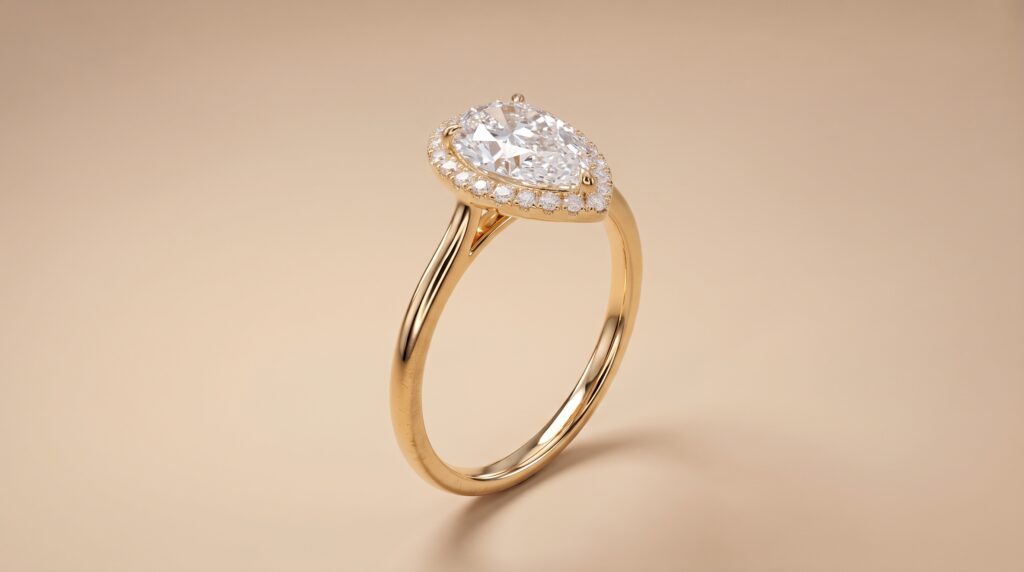
| Halo | High | Adds surrounding sparkle, visually increases size | Buyers who want more brilliance or a larger face-up look |
| Bezel | Highest | Modern, sleek, fully encloses the edge | Active lifestyles or buyers prioritizing durability over max sparkle |
| Three-stone | Moderate to high, depending on prong design | Adds width and symbolic meaning | Buyers who want visual balance alongside the pear’s length |
| East-west | Varies by prong style | Contemporary, unconventional orientation | Buyers wanting a less traditional presentation |
A V-prong is a single prong bent into a V shape that cups the point from two sides at once, rather than relying on a single straight prong that could let the tip sit exposed. It’s the most common way pear diamonds are protected in a simple solitaire setting, and it’s worth confirming the ring you’re considering actually uses one rather than a standard prong at the tip.
A bezel setting wraps a thin band of metal around the entire edge of the stone, point included. It trades some light entry (and therefore some sparkle) for the highest level of physical protection, which is why it’s often recommended for people who wear their ring during manual work, sports, or other activities where a raised setting is more likely to catch or snag.
Are Pear Shaped Engagement Rings Durable?
Diamond is the hardest natural material, rating a 10 on the Mohs scale, so the stone itself resists scratching. Durability concerns with pear shapes come from the geometry, not the material. A thin, exposed point under a hard impact can chip, the same way a corner of a piece of glass is more vulnerable than the middle of a flat pane.
A properly designed setting, V-prong, bezel, or halo, addresses most of this risk in normal wear. The remaining variable is lifestyle. Someone who works with their hands regularly or plays contact sports benefits from a lower-profile, more enclosed setting; someone with a low-impact daily routine has more flexibility to choose an open setting that shows more of the stone.
| Lifestyle | Recommended Setting | Reason |
| Desk-based, low physical activity | V-prong or halo | Tip is reasonably protected without sacrificing sparkle |
| Manual work, frequent hand use | Bezel | Fully encloses the point and edges |
| Active sports or gym-heavy routine | Bezel or low-profile halo | Reduces snagging and impact exposure |
| Frequent jewelry removal for tasks | Any setting, with regular prong checks | Consistency of habit matters more than setting type here |
Routine inspection matters regardless of setting. A jeweler checking prongs every six to twelve months catches loosening before it becomes a lost stone, which is a more common failure mode than an outright chip.
Natural vs Lab-Grown Pear Shaped Diamonds
Both natural and lab-grown pear diamonds are widely available, and they’re chemically and optically identical; a lab-grown diamond is still a diamond, grown in a controlled environment rather than formed underground over geologic time. The main practical differences are price and, for some buyers, personal preference about origin.
Lab-grown diamonds generally cost less per carat than natural ones, which lets buyers choose a larger stone, a higher clarity grade, or both, within the same budget. According to the International Gemological Institute’s overview of lab-grown diamond reports, lab-grown stones receive their own grading reports that document origin alongside the standard 4C details, so buyers can verify what they’re purchasing regardless of which type they choose.
| Factor | Natural | Lab-Grown |
| Price per carat | Higher | Lower, often significantly |
| Physical and optical properties | Identical to lab-grown | Identical to natural |
| Certification | GIA, AGS, and others grade natural stones | GIA, IGI, and others grade lab-grown stones separately |
| Resale market | More established | Still developing, generally lower resale value |
| Origin verification | Requires certification to distinguish from lab-grown | Requires certification to distinguish from natural |
Neither option is objectively better. The choice comes down to budget priorities and whether origin matters to the buyer personally.
How to Buy a Pear Shaped Engagement Ring Online
Buying a pear cut online removes the ability to tilt the stone under different lights yourself, so the burden shifts to documentation. A few checks reduce the risk of an unpleasant surprise on arrival.
Request or review a 360-degree video before purchasing. Photos can hide a dark bow tie or poor symmetry that becomes obvious the moment the stone moves. Watch specifically for how the shadow at the center behaves as the angle changes.
Check symmetry against the diamond’s grading report, and compare what the report states to what the video actually shows. A report might list “good” symmetry while a visible flaw, like a shoulder that’s noticeably higher than the other, is still apparent on camera.
Confirm the certification is from a recognized lab (GIA, AGS, or IGI, for example) and that the measurements listed on the report match the ratio and dimensions advertised for the stone.
Verify the setting details specifically protect the point. Product photos sometimes show the stone from an angle that obscures whether a V-prong or standard prong is used at the tip.
Review the return and resizing policy before purchasing. Engagement rings often need resizing after the proposal, and a retailer’s policy on that (timeline, cost, whether it voids any warranty) should be clear before you commit.
How to Care for a Pear Shaped Engagement Ring
Clean the ring with mild soap, warm water, and a soft-bristled brush, focusing gently on the underside of the stone where oils and lotion tend to build up. The GIA’s guidance on diamond jewelry care recommends avoiding household cleaners and ultrasonic cleaners unless a jeweler confirms the specific setting can handle them, since some settings and treated stones are more sensitive to vibration or chemicals than others.
Avoid chlorine and other harsh chemicals, which can pit or discolor certain metals, particularly gold alloys, over repeated exposure.
Protect the tip from impact by removing the ring during activities with a real risk of a direct hit, gardening, heavy lifting, or contact sports among them.
Take the ring in for a professional inspection every six to twelve months. A jeweler can spot a loosening prong or early wear before it results in a lost or chipped stone.
| Do | Avoid | Reason |
| Clean with mild soap and a soft brush | Household chemical cleaners | Some settings and metals react poorly to harsh chemicals |
| Remove before manual work or sports | Wearing during high-impact activity | Reduces risk of chipping the exposed tip |
| Schedule inspections every 6–12 months | Ignoring loose or worn prongs | Catches problems before a stone is lost |
| Store separately from other jewelry | Tossing in a drawer with other pieces | Prevents scratching from harder stones or metal edges |
Frequently Asked Questions
What is a pear shaped diamond?
A pear shaped diamond is a modified brilliant cut with one rounded end and one pointed end, giving it a teardrop outline. It combines the faceting style of a round brilliant with the elongated silhouette of a marquise, and it’s typically worn with the point facing either toward the hand or toward the fingertip, depending on personal preference.
What is the bow tie effect?
The bow tie effect is a shadow that appears across the center of elongated brilliant cuts, including pear, oval, and marquise diamonds, caused by facets that don’t reflect light as evenly as the facets in a round brilliant. A subtle bow tie is normal and present in nearly all pear diamonds. A dark, wide, or asymmetrical bow tie usually points to shallow or poorly proportioned cutting and is worth avoiding.
Are pear shaped diamonds durable?
The diamond material itself is extremely hard and resistant to scratching. The vulnerability in a pear cut is the pointed tip, which is thinner than the rest of the stone and more exposed to chipping from a direct impact. A protective setting, such as a V-prong, bezel, or halo, addresses most of this risk during normal wear.
What is the ideal pear ratio?
There’s no universally ideal ratio. A range of 1.45 to 1.55 produces a shorter, softer outline, 1.55 to 1.65 is the most commonly chosen balanced range, and 1.65 to 1.75 creates a longer, more dramatic look. The right choice depends on personal style preference rather than a fixed rule.
What setting protects the point best?
A bezel setting offers the highest level of protection because it encloses the entire edge of the stone, including the tip, in metal. A V-prong is the next most protective option and is more common in classic solitaire designs, cupping the point from two sides without fully enclosing it.
Do pear shaped diamonds sparkle?
Yes. Pear cuts use brilliant-style faceting, the same triangular and kite-shaped facet pattern used in round brilliants, which produces scattered flashes of light rather than the broader flat reflections seen in step cuts like emerald or asscher. Proportions still matter: a poorly cut pear can have dull or dark patches near the point or center despite the brilliant-style faceting.
Are pear shaped diamonds timeless?
Pear cuts have been in continuous use since at least the 15th century and have appeared consistently in both vintage and contemporary jewelry. That history suggests the shape has staying power beyond any single trend cycle, though, like any style choice, individual ring designs can still look more or less current depending on the setting and overall design.
What clarity is best for pear diamonds?
VS2 or better is a common recommendation for pear shapes, with particular attention paid to whether any inclusions sit near the pointed tip, where flaws are both more visible and more structurally relevant than they would be in a round diamond of similar clarity grade.
Do pear shaped diamonds look larger?
Often, yes. Pear diamonds have more surface area relative to their carat weight than round diamonds, since round brilliants require more depth to maintain their light performance. A pear diamond frequently appears larger face-up than a round diamond of the same carat weight, though the exact difference depends on the specific cut proportions of each stone.
What should I check before buying online?
Review a 360-degree video rather than relying on static photos, confirm the symmetry and bow tie look acceptable across multiple angles, verify the certification and measurements match what’s advertised, check that the setting specifically protects the tip, and read the return and resizing policy before completing the purchase.