
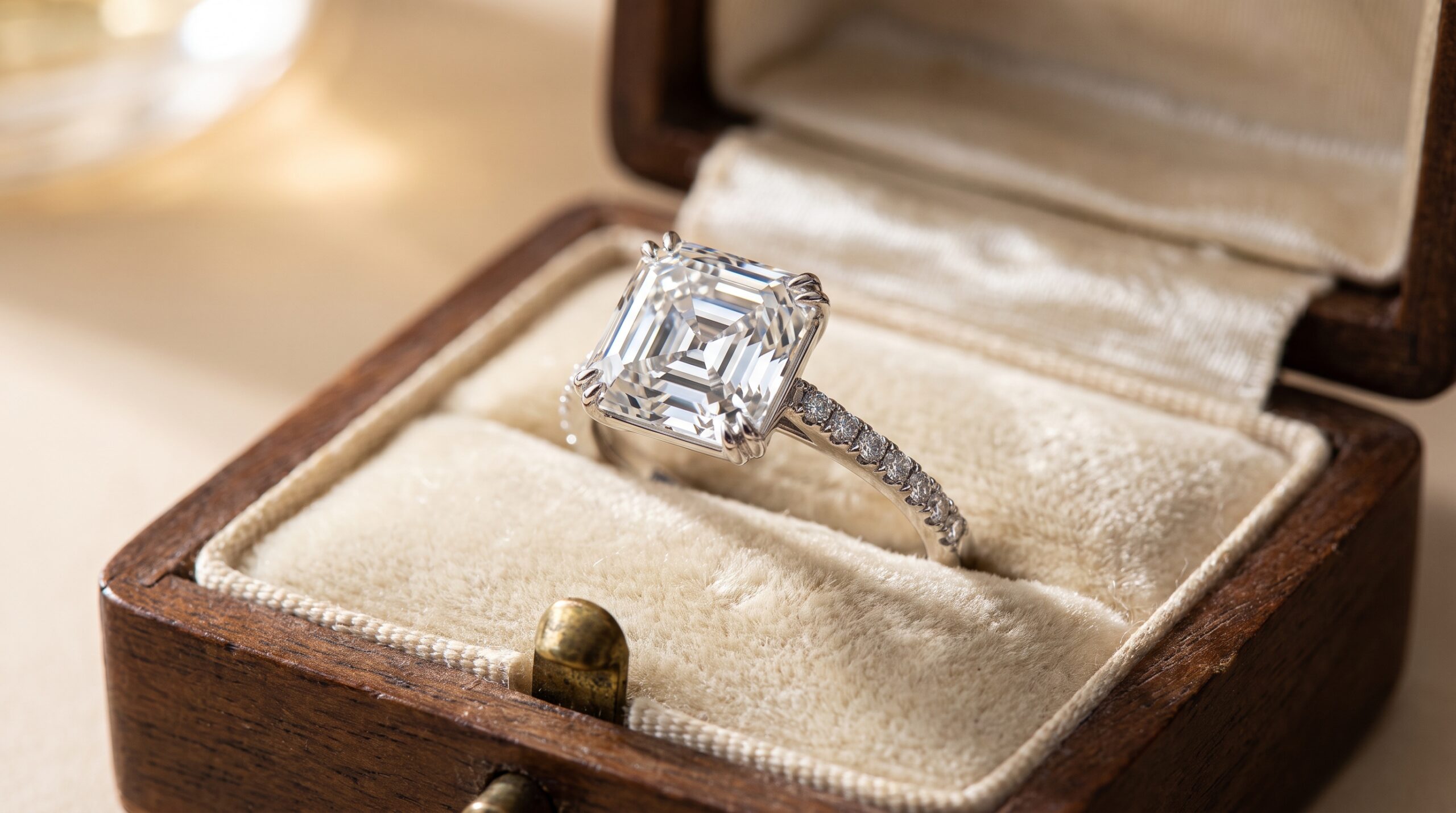
An Asscher cut diamond looks nothing like the round brilliant most people picture when they think “diamond ring.” It’s square, with sharply clipped corners and broad, flat facets that step down toward the center like layers of a staircase. Buyers drawn to that look often aren’t sure how to shop for one: the usual advice about sparkle and clarity doesn’t map cleanly onto a shape that behaves so differently from a brilliant cut. This guide covers what actually changes when you’re evaluating an Asscher, from how it reveals flaws to which settings hold up under daily wear.
What Is an Asscher Cut Engagement Ring?
The Asscher cut is a square step cut, first patented in 1902 by Joseph Asscher of the Asscher Diamond Company in the Netherlands. It predates the Art Deco movement but became closely associated with it during the 1920s and 1930s, when its geometric symmetry matched the era’s design sensibility. According to the GIA’s history of the Asscher cut, the original cut fell out of favor for much of the mid-20th century as round brilliants dominated the market, then returned to popularity in the 1990s after the Asscher family patented a modernized version.
Step cuts, which also include the emerald cut, use parallel, rectangular facets arranged in concentric layers rather than the triangular and kite-shaped facets found in brilliant cuts. Light moves through a step cut in broad, flat flashes instead of the scattered pinpoint sparkle typical of a round brilliant. Jewelers sometimes call this the “hall of mirrors” effect, since the facets reflect each other in a way that creates depth rather than brightness.
The classic Asscher cut has a nearly square outline (a length-to-width ratio close to 1.00) with corners cut at roughly 45 degrees, giving it an octagonal silhouette when viewed from above. The modern “Royal Asscher” cut, trademarked by the original family’s company, adds extra facets and a slightly different crown angle, producing marginally more brightness than the classic version, though the two look similar to an untrained eye.
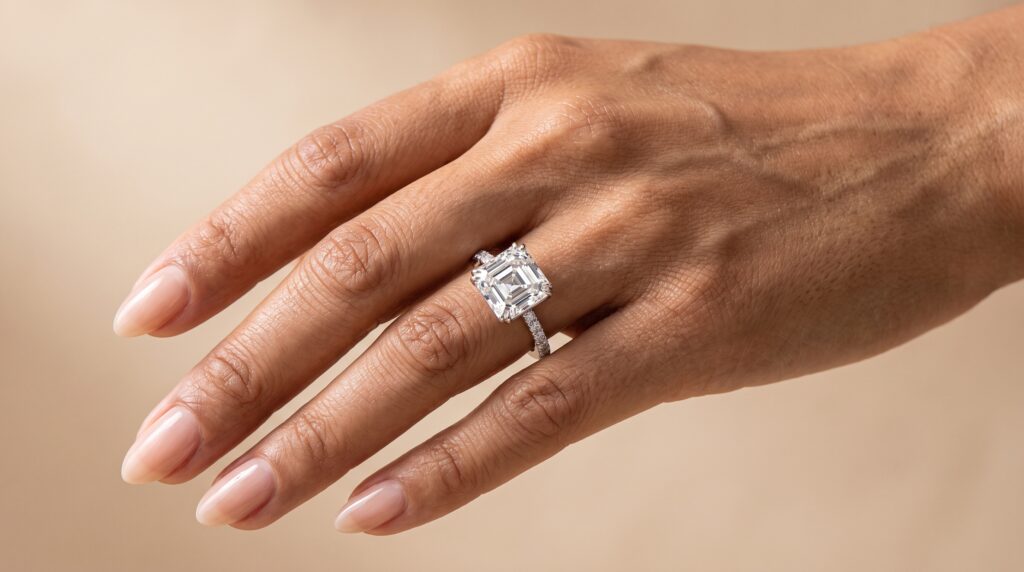
Asscher and emerald cuts are often confused because both are step cuts with clipped corners. The difference is proportion: an Asscher is square, an emerald cut is rectangular. That single difference changes how each shape wears on the hand, an emerald cut tends to look longer and narrower, while an Asscher reads as more compact and geometric.
Why Buyers Choose Asscher Cut Engagement Rings
The appeal is mostly about restraint. An Asscher cut doesn’t throw off the same scattered brilliance as a round or princess cut. Instead, it shows large, clear planes of light and shadow that shift as the stone moves, which reads as more architectural than flashy. Buyers who want a ring that feels considered rather than showy often land on Asscher for this reason.
The shape also carries real vintage weight rather than a manufactured retro look. Because it’s tied specifically to Art Deco design history, an Asscher cut can anchor a ring in that aesthetic without requiring elaborate filigree or milgrain detailing to signal “vintage.”
It suits minimalist settings particularly well. A solitaire Asscher in a simple band lets the step-cut facets do the visual work, which is harder to pull off with a round brilliant that relies partly on the sparkle a busier setting can amplify.
Pros and cons:
| Consideration | Asscher Cut Diamonds |
| Sparkle style | Broad, flashing light and shadow rather than scattered brilliance |
| Vintage appeal | Strong, tied to documented Art Deco history |
| Clarity visibility | High; inclusions are easier to spot than in brilliant cuts |
| Face-up size | Often smaller-looking than round diamonds of equal carat weight |
| Corner vulnerability | Requires protective prongs or a bezel |
| Best suited for | Buyers who prefer understated, geometric design over maximum sparkle |
How Asscher Cuts Compare to Other Diamond Shapes
The most useful comparison is against emerald, round brilliant, and cushion cuts, since buyers considering an Asscher usually have one of these three in mind as an alternative.
Against the emerald cut, the difference comes down to proportion rather than faceting. Both are step cuts with similar light behavior, but the emerald cut’s elongated shape creates a more slimming visual effect on the finger, while the Asscher’s near-square shape reads as more symmetrical and grounded.
Against the round brilliant, the contrast is sharper. A round brilliant is cut specifically to maximize light return through 57 or 58 facets arranged to scatter light in every direction. An Asscher, with far fewer and much larger facets, trades that scattered brilliance for clarity of line. Round brilliants also hide inclusions more effectively because the multitude of small facets breaks up the visual field, whereas an Asscher’s broad facets make flaws more visible, a distinction the GIA notes in its Asscher cut background when discussing how the cut’s clean lines demand higher clarity.
Against the cushion cut, which softens the square shape with rounded corners and brilliant-style faceting, the Asscher looks more angular and formal. Cushion cuts sparkle more actively and hide inclusions better, making them a common alternative for buyers who like the general squarish silhouette but want more forgiveness on clarity and more traditional sparkle.
| Shape | Sparkle Style | Face-Up Appearance | Vintage Appeal | Clarity Visibility | Best For |
| Asscher | Broad flashes, step-cut | Smaller than round of equal carat | Strong (Art Deco) | High; flaws are visible | Geometric, understated style |
| Emerald | Broad flashes, step-cut | Elongated, slimming | Strong | High; flaws are visible | Buyers wanting an elongated silhouette |
| Round brilliant | Scattered, maximized brilliance | Largest face-up per carat | Moderate | Low; flaws are hidden well | Buyers prioritizing sparkle and versatility |
| Cushion | Scattered brilliance, softer shape | Close to round in spread | Moderate to strong | Moderate; more forgiving than step cuts | Buyers wanting a squarish shape with more sparkle |
What to Look for in an Asscher Cut Diamond
Because step-cut facets act like small windows into the stone, both clarity and color read more clearly in an Asscher than in a brilliant cut of the same grade. This is the single biggest thing to understand before shopping: a clarity or color grade that would look fine in a round diamond can show visible flaws or warmth in an Asscher.
For clarity, VS1 or better is a common recommendation, since inclusions at VS2 or below have a higher chance of being visible without magnification in a step cut. This isn’t a hard rule; a stone’s individual inclusion type and placement matter as much as the letter grade, but it’s a reasonable starting point when comparing options.
For color, G or better is typically advised for the same reason: an Asscher’s open facets show body color more readily than a brilliant cut’s smaller, more numerous facets would. Buyers setting the stone in yellow gold have more flexibility here, since warm metal tones can offset a slightly warmer diamond color.
Proportions matter more in an Asscher than people expect. A length-to-width ratio close to 1.00 to 1.05 keeps the classic square look; anything higher starts to read as rectangular, closer to an emerald cut. Table percentage (the size of the flat top facet relative to the whole stone) and depth percentage both affect how open or closed the stone’s “windows” appear, and how much a dark bow-tie-like shadow might show through the center.
Symmetry is worth checking specifically because the clipped corners need to align evenly. An Asscher with uneven corners or an off-center culet (the tiny facet at the bottom point) will show that asymmetry more obviously than a round brilliant would, simply because there’s less faceting to disguise it.
| Factor | Recommended Range | Why It Matters |
| Clarity | VS1 or better | Broad facets make inclusions more visible than in brilliant cuts |
| Color | G or better | Step-cut facets reveal body color more readily |
| Length-to-width ratio | 1.00–1.05 | Keeps the classic square silhouette |
| Table percentage | 60–68% | Affects how open the stone’s center appears |
| Depth percentage | 60–70% | Affects light return and face-up size |
Best Settings for Asscher Cut Engagement Rings
The clipped corners are the structural weak point of an Asscher cut, similar to how the tip is vulnerable on a pear or marquise diamond, though less extreme. A setting needs to secure those corners specifically, not just hold the stone generally.
A solitaire setting with four prongs placed directly over each corner is the standard approach and works well for most buyers. A halo setting adds a ring of smaller diamonds around the center stone, which increases perceived size and adds scattered brilliance to offset the Asscher’s more restrained sparkle, a combination some buyers prefer specifically because it balances the step cut’s understated look with more overall brightness. A bezel setting encloses the entire perimeter, including the corners, in metal, offering the most protection at the cost of a slightly heavier, less open look. Three-stone settings flank the Asscher with smaller side stones, often trapezoids or baguettes cut to complement the step-cut faceting, adding width without changing the center stone’s proportions. Cathedral settings raise the stone on arched shoulders, which can make a smaller Asscher appear more substantial, though the added height also increases the ring’s profile and its chance of catching on fabric or hair.
| Setting | Visual Effect | Protection Level | Maintenance Needs | Best Lifestyle Match |
| Solitaire (corner prongs) | Clean, classic | Moderate to high | Regular prong checks | General everyday wear |
| Halo | Larger appearance, added brilliance | High | More surfaces to clean | Buyers wanting more sparkle |
| Bezel | Sleek, modern, fully enclosed | Highest | Easiest to clean, no prongs to catch | Active or hands-on lifestyles |
| Three-stone | Wider, more elaborate | Moderate | Similar to solitaire, plus side stones | Buyers wanting symbolic or visual width |
| Cathedral | Raised, dramatic profile | Moderate | Higher profile can catch more | Lower-impact daily routines |
Durability, Comfort, and Everyday Wear
Diamond is the hardest natural substance, so scratching isn’t a realistic concern for any cut. The corners are the actual risk: a hard, direct hit at a 45-degree clipped corner can chip it, the same structural principle that makes any pointed or angled edge on a gemstone more vulnerable than a rounded one.
Four secure prongs, one at each corner, address most of this risk in a standard solitaire. A bezel setting removes the risk almost entirely by enclosing the vulnerable edges, which is why it’s the setting most often recommended for people who work with their hands or exercise heavily while wearing their ring.
Low-profile settings sit closer to the finger and are less likely to snag on clothing, hair, or gloves, which matters more for people in physically active jobs or hobbies than it does for someone with a mostly sedentary routine. High-profile settings, including cathedral and larger halo designs, look more dramatic but come with a higher chance of catching on something during the day.
Resizing an Asscher cut ring is generally no more complicated than resizing a round diamond ring, though heavily engraved bands or settings with stones extending down the shank can limit how much a jeweler can adjust the size without disrupting the design. It’s worth asking about this before finalizing a setting if you expect your ring size might change.
| Lifestyle | Recommended Setting | Reason |
| Desk-based, low physical activity | Solitaire or cathedral | Corners are reasonably protected without sacrificing visual openness |
| Manual work, frequent hand use | Bezel | Fully encloses vulnerable corners |
| Active sports or gym-heavy routine | Bezel or low-profile solitaire | Reduces snagging and impact exposure |
| Frequent jewelry removal for tasks | Any setting, with regular prong checks | Consistency of habit matters more than setting type |
Buying an Asscher Cut Engagement Ring Online
Certification from a recognized lab is the baseline requirement, not an optional extra, since it’s the only objective way to confirm the clarity, color, and measurements a listing claims. The GIA’s grading reports document these characteristics using standardized criteria, which lets you compare stones from different sellers on equal footing.
High-resolution photos aren’t enough on their own for a step cut. Because Asscher diamonds show their flaws and color more openly than brilliant cuts, a photo taken under flattering lighting can mask an inclusion or tint that becomes obvious in daylight. A video showing the stone from multiple angles, ideally under a few different lighting setups, gives a more honest picture.
Verify the measurements against the certification. A listing photo can make a stone look more square or more brilliant than its actual proportions support, so cross-check the length-to-width ratio, table percentage, and depth percentage listed on the report against what the retailer’s description claims.
Read the return and resizing policy before buying. An engagement ring often needs resizing after the proposal, and knowing the timeline, cost, and whether resizing affects any warranty protects you from an unpleasant surprise later.
Watch for a few common red flags: certification from an unfamiliar or non-standardized lab, measurements in the listing that don’t match the certificate, or an unwillingness to provide video on request. Any of these is a reasonable reason to ask more questions or look elsewhere.
| What to Verify | Why It Matters | What to Avoid |
| Certification from a recognized lab | Confirms clarity, color, and cut are accurately represented | Unfamiliar or non-standardized labs |
| Video from multiple angles | Reveals flaws and color that photos can hide | Relying on a single flattering photo |
| Measurements matching the certificate | Confirms proportions are accurately advertised | Listings with vague or missing measurements |
| Return and resizing policy | Protects against sizing issues after purchase | Vague or restrictive return windows |
Asscher Cut Engagement Ring Pricing
Clarity and color affect Asscher cut pricing more heavily than they do for round brilliants, because buyers need higher grades to avoid visible flaws, which pushes the price up faster as you move up the quality scale. A round brilliant at SI1 clarity might look eye-clean to most buyers; an Asscher at the same clarity grade is more likely to show something, which means Asscher shoppers often end up paying for VS1 or better where a round diamond buyer could comfortably choose a lower grade.
Lab-grown Asscher diamonds cost meaningfully less per carat than natural ones, following the same pricing gap seen across other shapes. That price difference lets buyers choose a larger stone or a higher clarity and color grade within the same budget, which is particularly useful for a shape where clarity and color carry more visual weight.
| Feature | Natural Diamond | Lab-Grown Diamond |
| Price per carat | Higher | Lower, often 30–40% less |
| Optical and physical properties | Identical to lab-grown | Identical to natural |
| Certification | GIA and other major labs grade natural stones | GIA and other major labs grade lab-grown stones, with origin noted on the report |
| Resale market | More established | Still developing |
There’s no fixed budget threshold that guarantees a good Asscher; the tradeoff is always between carat size and the clarity or color grade needed to keep the stone looking clean. A buyer prioritizing size over grade should expect visible inclusions or warmth at lower price points, while a buyer prioritizing grade over size will end up with a smaller stone for the same budget. Neither approach is wrong, but it’s worth deciding which matters more before comparing specific stones.
An Asscher cut ring rewards the buyer willing to look past first impressions in a listing photo and check the underlying numbers. The shape’s appeal is real, but so is the extra scrutiny it demands compared to a round brilliant. Comparing certified stones side by side, watching video rather than relying on photos, and matching the setting to how the ring will actually be worn day to day are the three things most likely to determine whether the ring holds up to the buyer’s expectations a year in.
Frequently Asked Questions
Do Asscher cut diamonds sparkle?
Yes, but differently than a round brilliant. Asscher cuts use step-cut faceting, which produces broad, flashing planes of light and shadow rather than the scattered pinpoint brilliance of a round or princess cut. Some buyers find this more striking precisely because it’s less busy, while others who want maximum brilliance may prefer a brilliant-cut shape instead.
Are Asscher cuts more expensive?
Not inherently, but the quality grades needed to keep an Asscher looking clean often push the price up. Because inclusions and color are more visible in step cuts, buyers typically need higher clarity and color grades than they would for a round diamond of similar visual quality, and those higher grades cost more per carat.
What clarity is best for an Asscher cut?
VS1 or better is a common recommendation, since grades of VS2 and below have a higher chance of showing visible inclusions through the stone’s broad, open facets. Individual stones vary based on where inclusions sit, so it’s worth reviewing a specific stone’s plot and video rather than relying on the clarity grade alone.
Do Asscher cuts look smaller?
Often, yes, compared to a round diamond of the same carat weight. Asscher cuts tend to have more depth relative to their surface area, which means more of the diamond’s weight sits below the surface rather than spreading out face-up. This isn’t true of every individual stone, since proportions vary, but it’s a reasonable expectation to have going in.
What setting protects an Asscher cut best?
A bezel setting offers the most protection because it encloses the entire perimeter of the stone, including the vulnerable clipped corners, in metal. A well-made four-prong solitaire, with a prong secured over each corner, is the next most protective option and is more common in classic engagement ring designs.
Is an Asscher cut a good everyday ring?
It can be, with the right setting. The corners need protection from direct impact, so a bezel or secure prong setting matters more for an Asscher worn daily than it would for a round brilliant. Buyers with physically active routines should weigh setting choice carefully rather than assuming any setting will hold up equally well.
Are lab-grown Asscher diamonds worth considering?
They’re a reasonable option for buyers prioritizing size or quality grade over natural origin. Lab-grown diamonds are chemically and optically identical to natural ones and typically cost 30 to 40 percent less per carat, which is particularly useful for an Asscher cut where higher clarity and color grades matter more than they do for other shapes.
How is an Asscher cut different from an emerald cut?
Both are step cuts with similar faceting and light behavior, but they differ in proportion. An Asscher cut is square, with a length-to-width ratio close to 1.00, while an emerald cut is rectangular and more elongated. The emerald cut tends to create a more slimming visual effect on the finger, while the Asscher reads as more compact and symmetrical.