
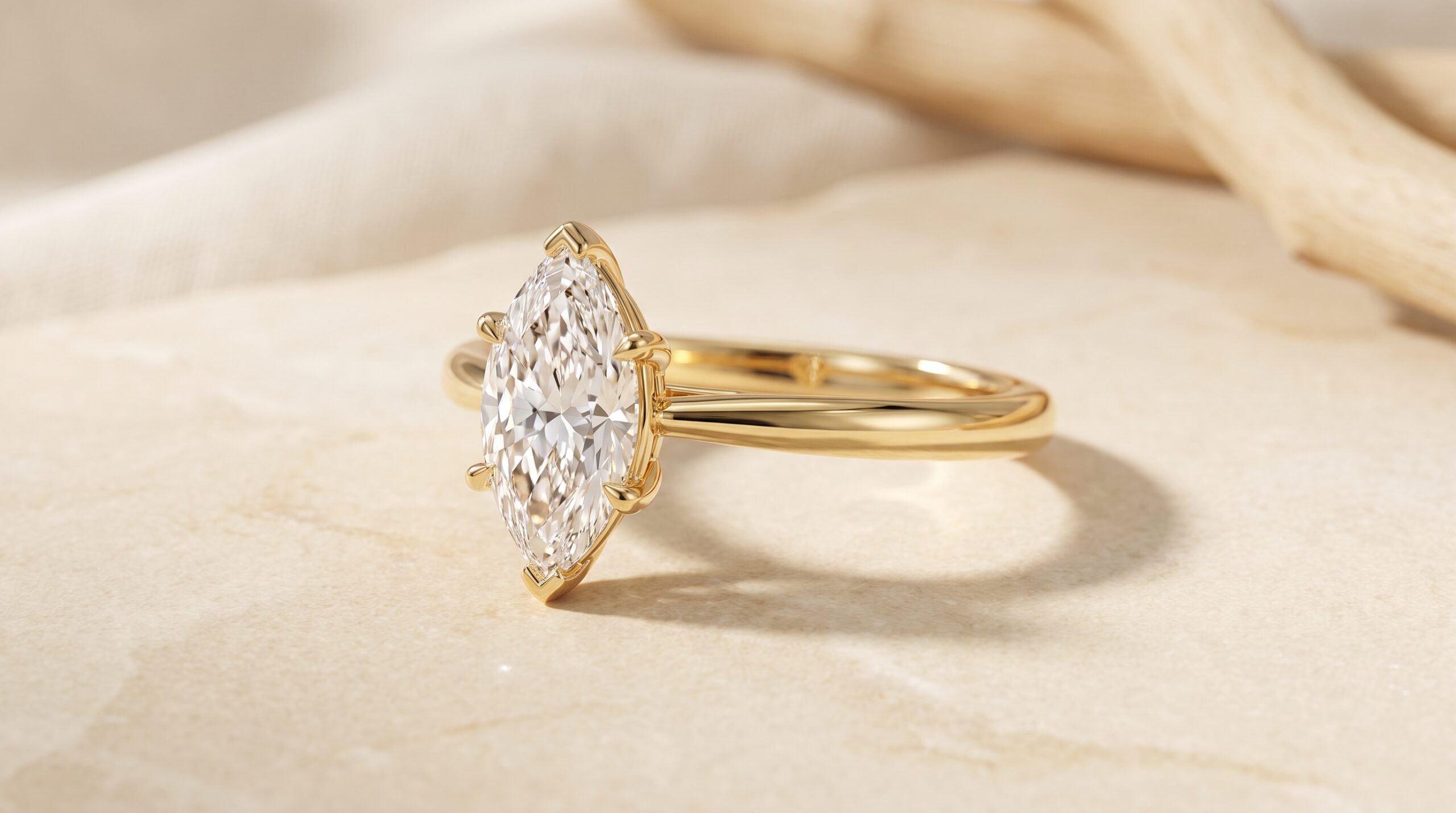
A marquise diamond is easy to spot and hard to evaluate. The long, pointed silhouette reads as dramatic and distinctive the moment you see it, but figuring out whether a specific stone is well cut, whether the pointed tips will hold up to daily wear, or which ratio actually looks good takes more than a glance. This guide covers what to check before buying, from proportions and the bow-tie effect to setting choices that keep the tips protected.
What Is a Marquise Engagement Ring?
A marquise cut is an elongated diamond shape with two pointed ends and curved sides, roughly the outline of a football or a boat hull. It’s also called a navette cut, from the French word for “little boat.” The shape dates to the mid-1700s in France, where, according to popular jewelry history, King Louis XV commissioned a diamond cut to resemble the smile of Madame de Pompadour, though the exact origin story varies by source and can’t be verified with certainty.
Structurally, a marquise is a modified brilliant cut, meaning it uses the same triangular and kite-shaped facet arrangement as a round brilliant, adapted to an elongated outline with two symmetrical points instead of a continuous curve. That faceting is what gives a well-cut marquise strong sparkle, closer to a round or oval than to a step cut like emerald or Asscher.
Compared to an oval, a marquise has two points instead of a fully rounded outline, giving it a sharper, more angular presence. Compared to a pear, which has one point and one rounded end, a marquise is symmetrical on both ends, which changes how it reads on the hand: a pear has a directional “top” and “bottom,” while a marquise looks the same from either end.
| Shape | Outline | Points | Visual Character |
| Marquise | Elongated, curved sides | Two, symmetrical | Sharp, dramatic, boat-shaped |
| Oval | Elongated, fully curved | None | Soft, rounded, elongating |
| Pear | Teardrop | One | Directional, rounded on one end |
Why Marquise Diamonds Look Larger Than Other Shapes
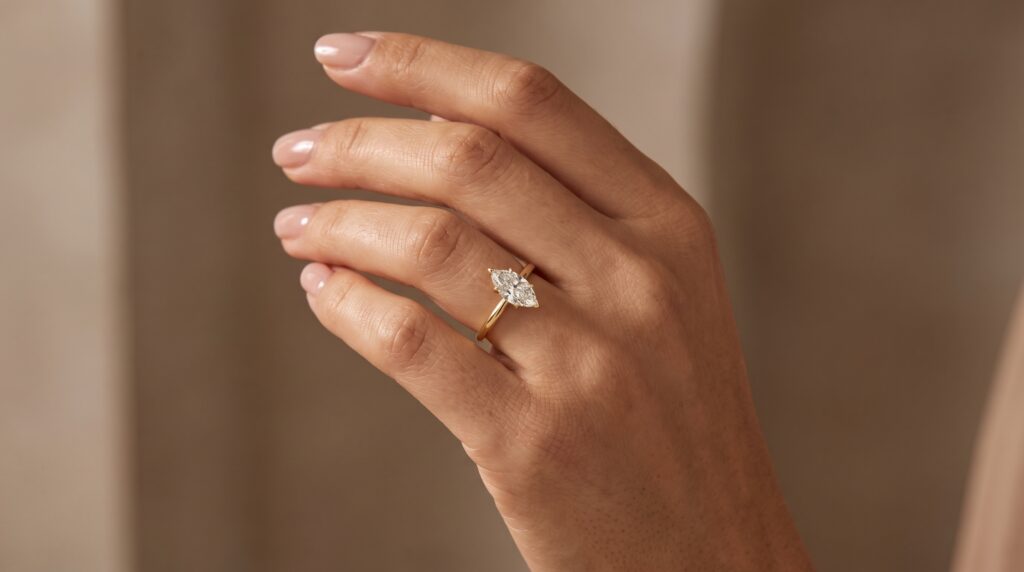
A marquise diamond has more surface area relative to its carat weight than a round diamond of the same weight, because a round brilliant carries more of its weight in depth to maintain its light performance. A marquise, cut shallower and spread across a longer outline, shows more of that weight face-up.
This isn’t unique to marquise; elongated shapes generally spread more per carat than round or square shapes do. But the effect is especially pronounced in marquise because of how long and narrow the outline is compared to other elongated cuts like oval or pear. A 1-carat marquise often looks noticeably larger across the finger than a 1-carat round, though the exact difference depends on the specific stone’s length-to-width ratio and depth.
The same elongation that creates this size effect also produces a slimming, finger-lengthening look, similar to what oval and pear shapes do, but more pronounced because of the marquise’s sharper points and longer typical ratio.
| Shape | Visual Size Appearance | Finger Elongation Effect | Typical Style Impression |
| Marquise | Largest spread per carat among common shapes | Strong | Dramatic, statement-making |
| Oval | Larger than round, less than marquise | Strong | Elegant, versatile |
| Pear | Larger than round, similar to oval | Moderate to strong | Graceful, distinctive |
| Round | Smallest spread per carat | None | Classic, traditional |
Understanding Marquise Diamond Proportions
The length-to-width ratio determines whether a marquise looks fuller and rounder or long and dramatic. A ratio close to 1.75 to 2.00 produces a fuller look, with the points less pronounced and the overall shape closer to a wide oval. A ratio around 2.00 to 2.15 is generally considered the classic, balanced marquise silhouette. Ratios above 2.15, up to around 2.50, create a longer, more dramatic shape with sharper-looking points.
There’s no objectively correct ratio. A fuller marquise reads as slightly softer and more wearable day to day, while a longer one makes a stronger visual statement and elongates the finger more noticeably. The choice comes down to personal preference rather than a rule tied to hand size or finger length.
Symmetry matters more in a marquise than in many other shapes, because the two points and two curved sides need to mirror each other closely. An off-center point, an uneven curve on one side, or a “bow-tie” that sits crookedly across the stone is more noticeable in a marquise than the equivalent flaw would be in a round diamond, simply because there’s an obvious axis of symmetry for the eye to compare against.
| Ratio Range | Appearance | Best Style Match |
| 1.75–2.00 | Fuller, softer points | Buyers wanting a more wearable, less extreme silhouette |
| 2.00–2.15 | Balanced, classic marquise | The most commonly chosen range |
| 2.15–2.50 | Long, dramatic points | Buyers wanting a bold, statement-making look |
The Bow-Tie Effect Explained
Every marquise diamond shows some version of the bow-tie effect: a shadow that crosses the center of the stone, shaped like a bow tie, caused by facets that don’t return light to the eye as evenly as the facets elsewhere in the stone. It happens in every elongated brilliant-style cut (marquise, oval, and pear included) because a round diamond’s radial symmetry doesn’t translate cleanly to an elongated outline.
A faint bow-tie is normal and usually not distracting in daily wear. A dark, wide, or fixed bow-tie that stays visible from multiple angles points to shallow or poorly proportioned cutting, most often tied to a length-to-width ratio pushed too far without adjusting the depth to compensate.
Certificates don’t capture this well. A grading report documents clarity, color, and measurements, but it doesn’t grade bow-tie severity, since that’s a visual effect tied to how the specific facets interact with light rather than a measurable proportion on its own. Watching a video of the actual stone, under a couple of different lighting setups and angles, is the only reliable way to judge it before buying.
A mild bow-tie isn’t automatically a flaw. Some buyers even prefer a subtle one, since it adds visual depth and contrast rather than reading as a flat, uniform sparkle across the whole stone. What matters is whether it stays subtle as the stone moves or turns into a dark, static band that dominates the center.
Best Settings for Marquise Engagement Rings
The two pointed tips are the most vulnerable part of a marquise diamond, thinner than any other section of the stone and exposed unless the setting specifically protects them.
A V-prong setting uses a prong bent into a V shape at each point, cupping the tip from both sides rather than relying on a single straight prong that could leave the point exposed. This is the standard, most common way to protect a marquise in a classic solitaire design.
A halo setting surrounds the center stone with smaller diamonds, adding brightness and increasing the marquise’s already strong face-up size, while also offering some incidental protection to the points since they sit lower and closer to the halo’s edge.
A bezel setting wraps a thin band of metal around the entire perimeter, tips included, giving the highest level of physical protection at some cost to how much light enters the stone from the sides.
An east-west setting rotates the marquise 90 degrees so it sits horizontally across the finger instead of vertically along it, a more contemporary styling choice that changes the visual emphasis without changing the protection needs.
A solitaire design lets the marquise stand alone without a halo or side stones, which shows off the shape’s outline clearly but relies entirely on the prong design (ideally V-prongs) for point protection. A three-stone design flanks the marquise with smaller side stones, often trapezoids or tapered baguettes, adding width and visual balance to the long central shape.
| Setting Style | Protection Level | Style Aesthetic | Potential Drawbacks |
| V-prong solitaire | High | Classic, lets the shape stand alone | Less added sparkle than a halo |
| Halo | High | Bright, appears larger | More surfaces to clean |
| Bezel | Highest | Modern, sleek | Reduces light entry, less sparkle |
| East-west | Depends on prong style | Contemporary, unconventional | Less traditional; may not suit all tastes |
| Three-stone | Moderate to high | Balanced, symbolic | Wider profile may not suit all lifestyles |
Choosing the Right Metal for a Marquise Ring
Platinum is the most durable common choice for an engagement ring setting, resistant to tarnish and dense enough to hold prongs securely over decades of wear, though it’s also the most expensive option and shows fine scratches (a soft patina) over time rather than staying mirror-bright.
White gold looks similar to platinum at a lower cost but typically has a rhodium plating that wears down over years, requiring periodic replating to maintain its bright white finish. This is a routine maintenance cost worth knowing about upfront rather than discovering later.
Yellow gold adds warmth that can offset any slight color tint in the diamond, since a warmer metal tone makes near-colorless grades look whiter by contrast. It’s also generally the most scratch-resistant of the common choices in its 14k form, since 14k gold contains more alloyed metal than 18k.
Rose gold has a similar durability profile to yellow gold, with the pink tone coming from a copper alloy mix, and it pairs particularly well with a marquise’s vintage-leaning silhouette for buyers wanting a softer overall look.
| Metal | Durability | Maintenance | Visual Style | Best Lifestyle Match |
| Platinum | Highest | Low; occasional polishing | Bright white, develops a soft patina | Buyers wanting minimal long-term upkeep |
| White gold | Good | Moderate; periodic rhodium replating | Bright white when freshly plated | Buyers comfortable with routine maintenance |
| Yellow gold | Good | Low | Warm, classic | Buyers wanting warmth or a vintage look |
| Rose gold | Good | Low | Soft, romantic | Buyers wanting a softer, vintage-inspired tone |
Marquise Engagement Rings for Different Lifestyles
Someone with a physically active routine, manual work, or frequent hand use benefits from a bezel or well-secured V-prong setting more than an open halo, since both reduce the exposure of the two vulnerable tips to direct impact. A lower-profile setting, sitting closer to the finger, also reduces how often the ring catches on gloves, clothing, or hair during the day.
Someone with a low-impact daily routine, mostly desk-based work, has more flexibility to choose a more open, higher-profile setting like a halo or cathedral-style mount, since the practical risk of impact damage is lower.
Snagging is a marquise-specific concern worth naming directly: the elongated shape and pointed tips extend further from the finger than a round or cushion stone would, which means the ring has more surface area that can catch on fabric, hair, or bag straps. An east-west orientation can reduce this somewhat by shortening the profile that projects outward from the finger, though it changes the ring’s overall look.
Regular inspection matters regardless of lifestyle. A jeweler checking prong tightness every six to twelve months catches a loosening V-prong before it results in a chipped or lost stone, which is a more common failure point than a sudden impact in most cases.
| Lifestyle | Recommended Setting | Notes |
| Desk-based, low activity | Halo or cathedral solitaire | More flexibility for an open, higher-profile design |
| Manual work, frequent hand use | Bezel or secure V-prong | Reduces exposure of both points |
| Active sports or gym-heavy routine | Bezel or low-profile V-prong | Minimizes snagging and impact risk |
| Frequent glove or fabric contact | East-west or bezel | Shortens the profile that catches on materials |
Natural vs Lab-Grown Marquise Diamonds
Natural and lab-grown marquise diamonds are chemically and optically identical, since a lab-grown diamond is still a diamond, grown under controlled conditions rather than formed underground over geologic time. The differences that matter to most buyers are price, resale expectations, and personal preference around origin.
Lab-grown marquise diamonds typically cost less per carat than natural ones, often by a significant margin, which lets buyers choose a larger stone or a higher clarity and color grade within the same budget. Both types receive grading reports from recognized labs; GIA’s grading standards apply the same clarity, color, cut, and carat framework to both, with lab-grown reports noting origin explicitly.
Resale markets differ. Natural diamonds have a more established secondary market, while lab-grown resale values are generally lower and the market for reselling them is still developing. This matters more to buyers thinking about the ring as a long-term asset and less to buyers who see it purely as a personal purchase.
| Natural Diamond | Lab-Grown Diamond | Cost | Resale Considerations | Best Buyer Fit |
| Formed over geologic time underground | Grown in a controlled lab environment | Higher per carat | More established resale market | Buyers prioritizing traditional origin or resale value |
| Identical optical properties to lab-grown | Identical optical properties to natural | Lower per carat | Resale market still developing | Buyers prioritizing size or grade within a set budget |
How to Buy a Marquise Engagement Ring Online with Confidence
Review the stone’s proportions first, checking the length-to-width ratio and depth percentage against the certificate before looking at photos, since proportions determine the overall silhouette more than any single quality grade does.
Watch a video of the actual stone under a few different lighting conditions and angles, not just the studio-lit product shot most listings lead with. This is the most reliable way to catch a dark or asymmetrical bow-tie, uneven points, or a crooked symmetry line that a flattering photo can hide.
Check the certification details against what the listing claims, confirming the grading lab, clarity, color, and measurements all match. A recognized lab like GIA provides consistent, standardized criteria that make it possible to compare stones from different sellers on equal footing.
Inspect the points and symmetry specifically, either in the video or through detailed close-up photos, since these are the two areas most likely to reveal a lower-quality cut in a marquise that a general overview shot might not show clearly.
Review the return and resizing policy before completing the purchase. Engagement rings often need resizing after a proposal, and knowing the timeline, cost, and whether resizing affects any warranty avoids problems later.
A few red flags are worth watching for: a seller unwilling to provide video on request, measurements in the listing that don’t match the certificate, or certification from an unfamiliar lab with no clear grading standards published. Any of these is a reasonable reason to ask more questions or look elsewhere.
- Review proportions against the certificate
- Watch video in multiple lighting conditions
- Check certification details match the listing
- Inspect points and symmetry closely
- Review the return and resizing policy
Frequently Asked Questions
Are marquise diamonds durable?
The diamond material itself is extremely hard and resistant to scratching, so durability concerns come down to the two pointed tips rather than the stone overall. A thin, exposed point can chip under a direct hit, similar to how any pointed corner on a gemstone is more vulnerable than a rounded edge. A V-prong or bezel setting addresses most of this risk during normal wear, and routine prong inspections catch problems before they become serious.
What ratio is best?
There’s no universally best ratio. A range of 1.75 to 2.00 produces a fuller, less extreme silhouette, while 2.00 to 2.15 is the most commonly chosen balanced range, and anything above that creates a longer, more dramatic look with sharper points. The right choice depends on how bold or subtle you want the shape to read on the hand.
Are marquise rings trendy or timeless?
Marquise has a documented history going back to the 1700s and has cycled in and out of mainstream popularity several times since, most notably in the 1960s and 1970s and again in recent years. That history suggests it has staying power beyond a single trend cycle, though, like any distinctive shape, individual ring designs can still look more or less current depending on the setting.
Which settings are safest?
A bezel setting offers the most protection because it encloses the entire perimeter of the stone, including both points, in metal. A well-made V-prong setting is the next most protective option and is more common in traditional solitaire designs, cupping each point from two sides without fully enclosing it.
Do marquise diamonds sparkle well?
Yes. Marquise cuts use brilliant-style faceting, the same triangular and kite-shaped pattern used in round diamonds, which produces active, scattered sparkle rather than the broader flat flashes seen in step cuts like emerald. Proportions still matter: a poorly cut marquise can show dull or dark patches near the bow-tie area despite the brilliant-style faceting.
Can marquise rings be resized?
Yes, in most cases, resizing a marquise ring is no more complicated than resizing a ring with any other diamond shape. The main limitation comes from the setting design itself: rings with diamonds or engraving extending far down the shank can restrict how much a jeweler can adjust the size without disrupting the design, which is worth asking about before finalizing a setting.
Are marquise diamonds more affordable?
Not inherently, but their larger face-up spread per carat can make them feel like better value for buyers prioritizing visual size over carat weight on paper. A marquise and a round diamond of equal quality and carat weight cost roughly the same, but the marquise will generally look larger across the finger, which is the main practical advantage from a budget standpoint.