
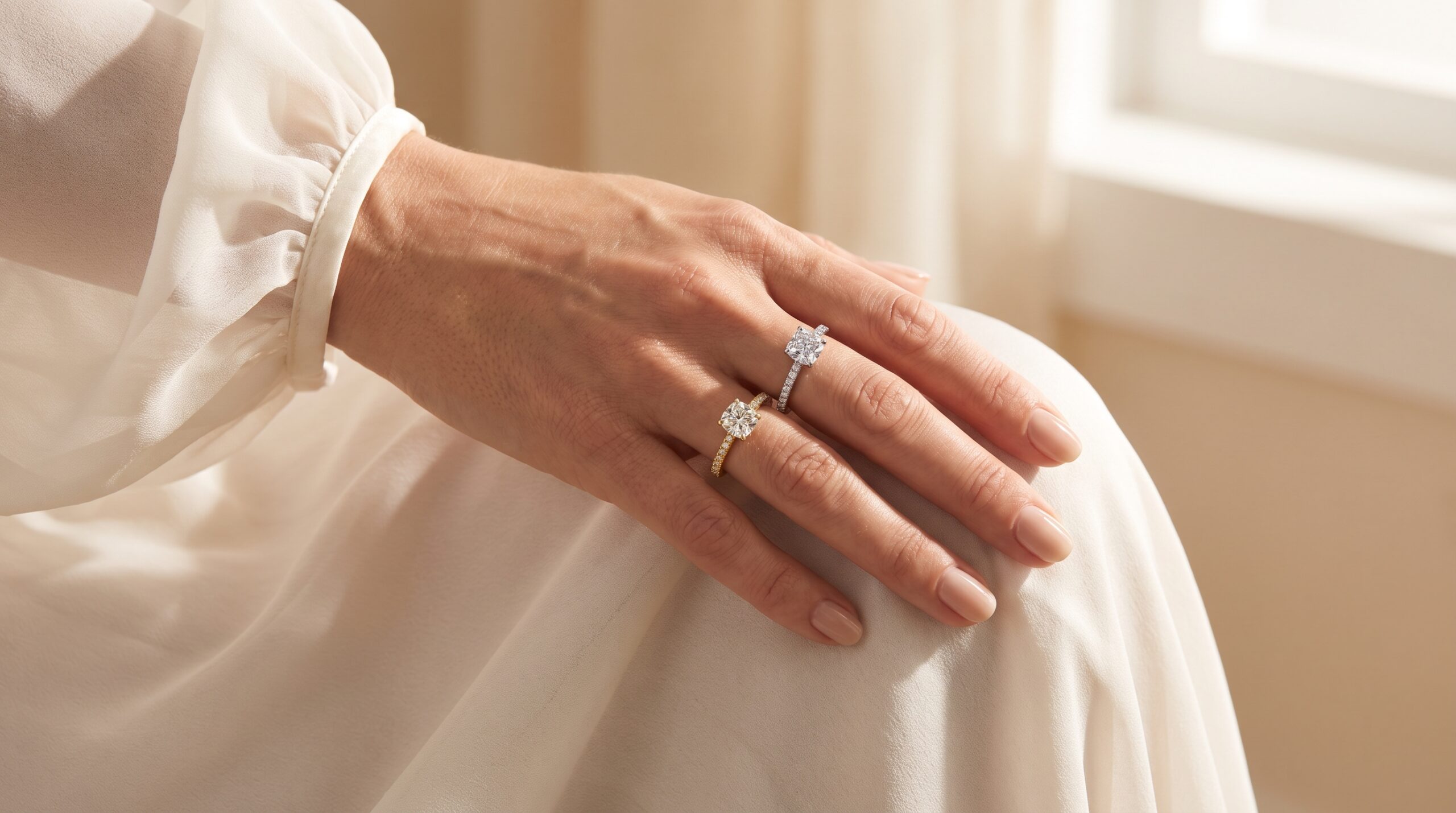
Most engagement ring shoppers start with a color preference and figure the rest will sort itself out. It mostly does, but white gold and yellow gold differ in more than just tone: they age differently, need different upkeep, and interact with a diamond’s color in different ways. Knowing those differences before you buy saves you from being surprised a few years in.
What Is the Difference Between White Gold and Yellow Gold?
Both are real gold. Pure gold (24K) is too soft to hold a ring’s shape under daily wear, so jewelers mix it with other metals to create an alloy strong enough for a setting that has to survive knocks, pressure, and years of contact with everything you touch.
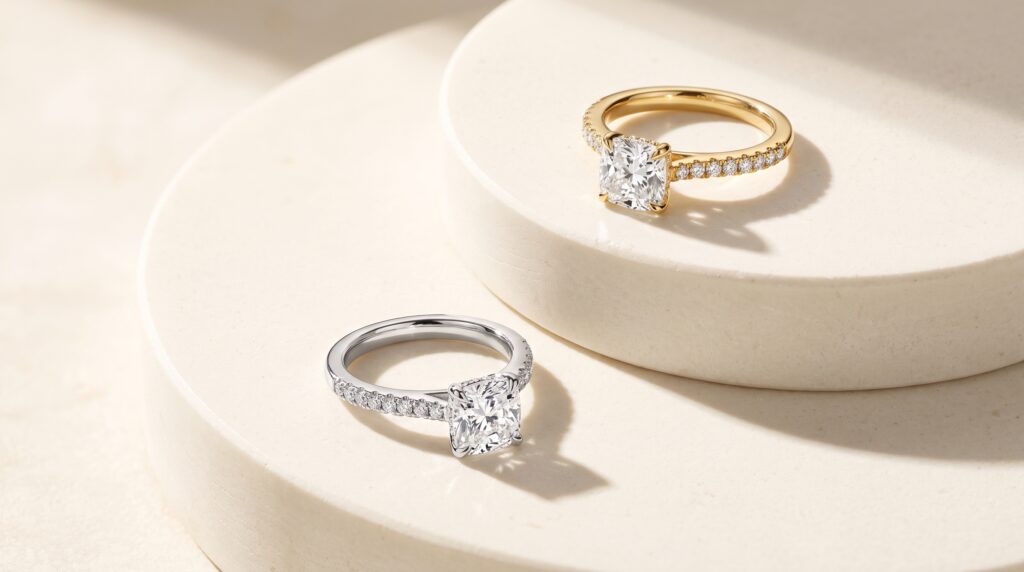
Yellow gold gets its warm color from the alloy itself, typically a mix of pure gold with silver and copper. The proportions vary by karat, but the color stays naturally warm without any additional finishing step.
White gold starts as an alloy of gold mixed with white metals like palladium, silver, or nickel, which produces a pale, slightly grayish-gold color on its own, not the bright white most buyers picture. To get that bright white look, most white gold rings receive a rhodium plating: a thin layer of a very hard, reflective white metal applied over the gold alloy. The color you see on a new white gold ring is mostly the rhodium, not the gold underneath.
| White Gold | Yellow Gold | |
| Base alloy color | Pale gray-gold | Warm yellow |
| Finished color source | Rhodium plating | Natural alloy color |
| Requires replating | Yes, periodically | No |
| Common alloy metals | Palladium, silver, nickel | Silver, copper |
White Gold vs Yellow Gold Appearance
White gold reads as sleek and contemporary. It suits minimalist solitaires, Art Deco-inspired designs, and settings where the goal is a clean, uninterrupted line from metal to stone. Because the metal itself is bright white, it tends to disappear visually against a colorless diamond, letting the stone take center stage without any competing warmth.
Yellow gold reads as warmer and more traditional, though “traditional” undersells how often it shows up in current designs too. It suits vintage-inspired settings, filigree detailing, and richer, more saturated looks. Rather than disappearing behind the diamond, yellow gold creates visible contrast, framing the stone instead of blending into it.
Whether white or yellow gold makes a diamond look “better” depends on what you’re going for, not on a fixed rule. A colorless or near-colorless diamond (grades D through F) tends to look its brightest against white metal, since there’s no warm tone competing with the stone’s own color. A diamond with a faint yellow tint (grades J and below) can look whiter by contrast when set in yellow gold, since the surrounding warmth makes the stone’s own warmth less noticeable. This is a visual trick, not a change in the diamond’s actual grade, but it’s a real effect worth knowing if color grade matters to your budget.
| White Gold | Yellow Gold | |
| Overall look | Sleek, contemporary | Warm, traditional |
| Best for | Minimalist and Art Deco styles | Vintage and richly detailed styles |
| Diamond appearance | Blends in, emphasizes brightness | Creates warm contrast, can offset a faint tint |
| Jewelry matching | Pairs with silver, platinum, white gold pieces | Pairs with yellow and rose gold pieces |
Durability and Everyday Wear
Durability comes down to karat more than color. A 14K white gold ring and a 14K yellow gold ring have roughly the same hardness, since the karat number tells you how much pure gold is in the alloy, not which color metals were used to fill out the rest.
14K gold (58.3% pure gold) is generally more durable than 18K gold (75% pure gold), because a higher proportion of pure gold makes the alloy softer overall. This holds true regardless of color: 14K white gold and 14K yellow gold both resist scratching and denting better than their 18K counterparts.
The practical difference between white and yellow gold in daily wear isn’t structural strength, it’s how scratches and wear show up. White gold’s rhodium layer is very hard but thin, and as it wears down from daily contact, the slightly warmer base alloy underneath starts to show through, which is why white gold needs periodic replating to stay looking bright white. Yellow gold doesn’t have this layer to wear through; small scratches are still visible on any polished metal, but the color itself doesn’t shift over time the way a worn rhodium plating does.
For active lifestyles, 14K in either color is generally the more practical choice, simply because the higher metal content resists dents and scratches better than 18K. Someone who works with their hands often, exercises frequently, or removes and puts on their ring multiple times a day will likely notice the difference in wear over several years more than someone with a lower-impact routine.
Pros and cons at a glance:
| White Gold | Yellow Gold | |
| Structural durability | Equal to yellow gold at the same karat | Equal to white gold at the same karat |
| Requires periodic maintenance | Yes, rhodium replating | No |
| Visible wear pattern | Base color shows through as plating wears | Scratches visible but color stays consistent |
| Best karat for active wear | 14K | 14K |
Maintenance and Long-Term Care
White gold rings benefit from cleaning every couple of weeks with warm water, a small amount of mild dish soap, and a soft brush, focusing on the underside of the setting where oils and lotion build up. Rhodium replating is typically needed every one to three years, depending on how much daily contact the ring gets; rings worn constantly and exposed to more friction (typing, dishwashing, gym use) tend to need replating sooner than rings worn more occasionally. Signs it’s time include a slightly yellow or gray cast appearing at the edges of the setting, or a duller finish that doesn’t restore with normal cleaning.
Yellow gold rings need the same basic cleaning routine, warm water, mild soap, and a soft brush, but without the added replating step. The main maintenance concern is scratch prevention: storing the ring separately from other jewelry (a scratch from a harder gemstone or another ring’s prongs is common if pieces are tossed together in one box) and removing it before activities with a high risk of impact.
Both metals benefit from professional inspection every six to twelve months. A jeweler checking for loose stones, worn or bent prongs, and thinning in the band (a slow process from years of contact with hands, tools, and surfaces) catches problems early, before a stone is lost or a band needs a more involved repair. The Jewelers of America trade organization recommends this kind of routine inspection as standard practice for any ring worn daily.
| Cleaning Needs | Replating Required | Scratch Visibility | Typical Upkeep | |
| White gold | Every 1–2 weeks | Every 1–3 years | Less visible short-term, color shifts as plating wears | Moderate, due to replating |
| Yellow gold | Every 1–2 weeks | Not applicable | More visible immediately, color stays consistent | Lower, no replating needed |
How to Choose the Right Gold Color for Your Style
If you already wear jewelry daily, watches, bracelets, other rings, matching the engagement ring’s metal to what you already own keeps things simple, though mixed-metal styling has become common enough that this isn’t a strict requirement. Many people now wear white and yellow gold pieces together intentionally, treating the mix as a style choice rather than a mismatch.
Ring style plays a role too. Modern solitaires and pavé bands often lean toward white gold or platinum for a seamless, minimal look, while vintage-inspired settings, milgrain detailing, and halo designs with a warmer palette tend to favor yellow gold. Neither pairing is a rule, just a common pattern based on how the two aesthetics developed.
Skin tone is often brought up as a deciding factor, but it’s worth treating as a loose preference rather than a formula. Some general color theory suggests cooler skin undertones pair well with white metals and warmer undertones pair well with yellow, but plenty of people wear either color happily regardless of undertone, and the “right” answer is ultimately whichever one you like looking at on your own hand.
| Preference or Style Goal | Recommended Metal | Why It Works |
| Matching existing silver-toned jewelry | White gold | Creates a consistent, coordinated look across pieces |
| Matching existing gold-toned jewelry | Yellow gold | Same reasoning, warm-toned consistency |
| Minimalist or Art Deco setting | White gold | Blends with the stone for a clean, uninterrupted line |
| Vintage or richly detailed setting | Yellow gold | Complements filigree and warmer design elements |
| Low-maintenance preference | Yellow gold | No replating required |
| Brightest possible diamond contrast | White gold | Neutral backdrop emphasizes stone color and sparkle |
14K vs 18K White and Yellow Gold
Karat measures the proportion of pure gold in an alloy, out of 24 parts. 14K gold is 14 parts pure gold and 10 parts other metals, or 58.3% pure gold. 18K gold is 18 parts pure gold and 6 parts other metals, or 75% pure gold. These purity levels are marked with hallmark stamps, commonly “585” for 14K and “750” for 18K, referring to the parts-per-thousand of pure gold.
18K gold has a richer, deeper color in yellow gold specifically, since there’s more actual gold in the mix and less of the harder alloy metals diluting the tone. In white gold, the purity difference matters less visually, since the rhodium plating determines the surface color either way, but 18K still costs more due to the higher gold content.
14K gold trades some of that richness for meaningfully better scratch and dent resistance, since the added alloy metals make the finished metal harder. For a ring meant to be worn every day for decades, that durability tradeoff is worth weighing seriously against the appeal of 18K’s deeper color, particularly in yellow gold where the difference is most visible.
| Gold Content | Durability | Color Richness | Best For | |
| 14K | 58.3% pure gold | Higher scratch and dent resistance | Lighter, less saturated color (yellow gold) | Everyday wear, active lifestyles |
| 18K | 75% pure gold | Softer, more prone to scratching | Richer, deeper color (yellow gold) | Buyers prioritizing color depth over maximum durability |
Online Buying Tips for White and Yellow Gold Engagement Rings
Check the karat stamp listed in the product details, and confirm it matches the hallmark described (585 for 14K, 750 for 18K). A listing without a clear karat specification is worth a follow-up question before buying.
Review the band width and setting height in the measurements provided, not just the photos, since a ring can look different in scale once it’s actually on a hand compared to a close-up product shot.
For white gold specifically, check whether the listing mentions the rhodium plating thickness or replating policy. Some retailers include an initial replating in the warranty period; knowing this upfront sets clearer expectations for when the first touch-up might be needed.
Read the return, resizing, and warranty policies before purchasing. Confirm whether resizing is included, what it costs if not, and whether any warranty coverage is affected by resizing or by skipping recommended maintenance like replating.
Watch for a few red flags: vague metal descriptions that don’t specify karat or alloy composition, missing hallmark information, or product photography that doesn’t show the ring from multiple angles under consistent lighting. Any of these is a reasonable reason to ask the retailer directly before completing a purchase.
Frequently Asked Questions
Does white gold turn yellow?
Not exactly. The gold alloy underneath a white gold ring’s rhodium plating has a naturally pale, slightly grayish-gold tone, not a strong yellow one. As the rhodium plating wears down from daily contact, that base tone becomes more visible, which can look like a subtle yellowing or dulling of the bright white finish. Replating restores the original bright white look.
Which gold color is more timeless?
Both have long histories in fine jewelry and neither is more inherently timeless than the other. Yellow gold was the dominant choice for most of jewelry history before white metals became widely popular in the 20th century, while white gold and platinum have held strong, sustained popularity for engagement rings over the past several decades. Either can look dated or current depending on the specific design rather than the metal color alone.
Is white gold more expensive than yellow gold?
At the same karat and gram weight, the base metal cost is similar, since both start from the same amount of pure gold. White gold can end up slightly more expensive over time due to the added cost of rhodium replating every few years, a recurring expense yellow gold doesn’t require.
Which metal makes diamonds look bigger or brighter?
Neither metal changes a diamond’s actual size. White gold tends to make a diamond’s brightness and sparkle more noticeable, since the metal doesn’t compete visually with the stone’s color. Yellow gold can make a diamond with a faint warm tint appear whiter by contrast, though this is a visual effect from the surrounding color rather than an actual change in the diamond’s grade.
Is 14K or 18K better for everyday wear?
14K is generally the more practical choice for daily wear, since its higher proportion of alloy metals makes it more resistant to scratching and denting than 18K. 18K offers a richer color, especially noticeable in yellow gold, but that comes with a softer metal that shows wear more readily over years of regular use.
Can white gold and yellow gold be resized?
Yes, both can typically be resized using standard jewelry techniques. The main factors that affect resizing are the setting design rather than the metal color: rings with stones or detailing extending down the band can be harder to resize significantly without disrupting the design, regardless of whether the metal is white or yellow gold.
Which option is easier to maintain?
Yellow gold is generally lower maintenance, since it doesn’t require the periodic rhodium replating that white gold needs to stay looking bright white. Both metals need the same basic routine cleaning and periodic professional inspection for loose stones or worn prongs.
Can I mix white and yellow gold jewelry?
Yes. Wearing white and yellow gold pieces together has become a common styling choice rather than a mismatch, and many buyers now choose an engagement ring in one color specifically to pair intentionally with existing pieces in the other. There’s no rule requiring all your jewelry to match in metal color.