
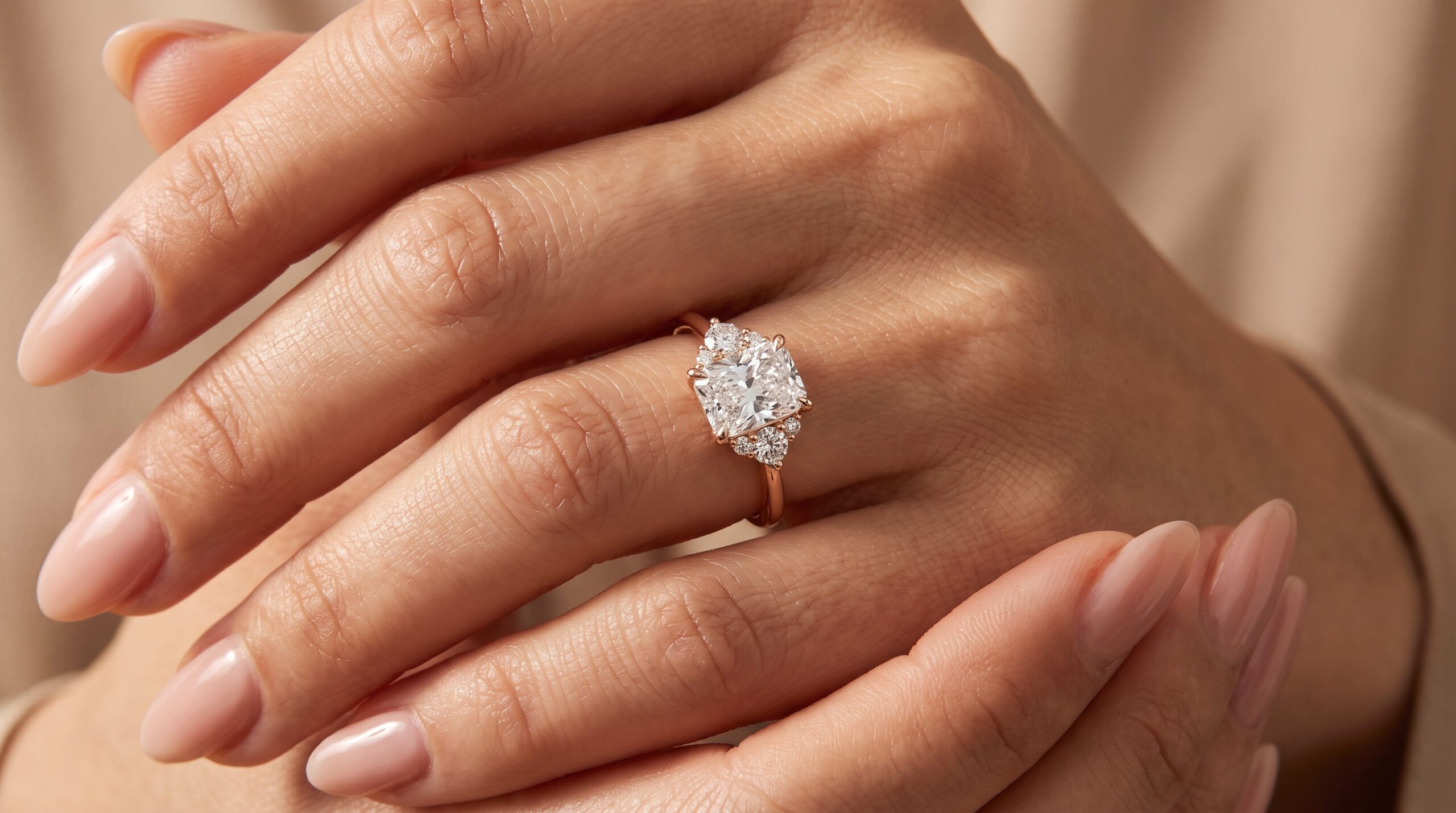
Rose gold’s appeal is immediate: the warm pink tone feels romantic and a little unexpected next to the more familiar white and yellow options. What’s less immediate is knowing whether it’ll hold up to a decade of daily wear, which karat actually makes sense for your lifestyle, and whether a diamond looks as good against it as it does against white gold. Those are fair questions, and they have concrete answers.
What Is a Rose Gold Engagement Ring?
Rose gold is a gold alloy, meaning pure gold mixed with other metals to make it strong enough for daily-wear jewelry. What sets rose gold apart from white or yellow gold is copper: a higher proportion of copper in the alloy mix produces the metal’s characteristic pink tone. Some rose gold blends also include a small amount of silver, which softens the pink slightly and produces a lighter, more muted shade compared to a copper-heavy mix.
The pink color isn’t a coating or treatment. It’s the actual color of the alloy itself, which means, unlike white gold, rose gold doesn’t rely on a plated finish that can wear away over time. Its color stays consistent for as long as the ring exists, short of the metal being melted down and reformed.
Rose gold reads differently than its two counterparts. White gold and platinum create a bright, neutral backdrop that tends to disappear visually behind a diamond. Yellow gold creates a warm, traditional contrast. Rose gold sits in its own category: warm like yellow gold, but with a softer, more romantic tone that leans pink rather than golden yellow, which is part of why it’s become closely associated with vintage-inspired and antique-style settings.
Its rise in popularity over the past decade or so tracks alongside broader trends toward mixed-metal jewelry and vintage-influenced design, though rose gold itself isn’t a new invention. Gold-copper alloys have existed for centuries; what’s changed is how frequently designers reach for it as a primary metal choice rather than an accent.
| Rose Gold | Yellow Gold | White Gold | |
| Color source | Copper content in the alloy | Natural alloy color (silver, copper) | Rhodium plating over a pale base alloy |
| Requires replating | No | No | Yes, periodically |
| Overall tone | Warm, pink | Warm, golden yellow | Cool, bright white |
| Common style association | Vintage, romantic, mixed-metal | Traditional, classic | Modern, minimalist |
14k vs 18k Rose Gold: Which Is Better?
Karat measures the proportion of pure gold in the alloy, out of 24 parts. 14k gold is 58.3% pure gold, with the remaining 41.7% made up of copper and, in some blends, a small amount of silver. 18k gold is 75% pure gold, with less room left for the alloy metals that give rose gold its color and strength.
That difference in proportion affects both durability and color. 14k rose gold, with more copper relative to gold, tends to be harder and more scratch-resistant, since copper is a harder metal than gold on its own. It also produces a deeper, more saturated pink, since there’s proportionally more copper in the mix. 18k rose gold, with less copper diluting the higher gold content, produces a softer, more muted pink and is somewhat less resistant to scratching, though it retains a higher gold purity that some buyers value for its own sake.
Price follows purity: 18k costs more than 14k at the same design and weight, because it contains more actual gold. That said, for most engagement rings, the center stone accounts for a larger share of the total price than the metal does, so the choice between 14k and 18k rose gold often has less budget impact than choosing a different carat weight or clarity grade for the diamond.
Neither karat is objectively better. 14k suits buyers prioritizing durability and a bolder pink tone for daily wear; 18k suits buyers prioritizing higher gold purity and a softer color, and who are comfortable with slightly more careful handling over the ring’s lifetime.
| 14k Rose Gold | 18k Rose Gold | |
| Gold purity | 58.3% | 75% |
| Durability | Higher scratch resistance | More prone to scratching |
| Color intensity | Deeper, more saturated pink | Softer, more muted pink |
| Price | Lower | Higher |
| Best lifestyle fit | Active, hands-on daily wear | Lower-impact daily wear |
| Maintenance | Lower; holds up well with routine care | Slightly more attentive care recommended |
Best Rose Gold Engagement Ring Styles
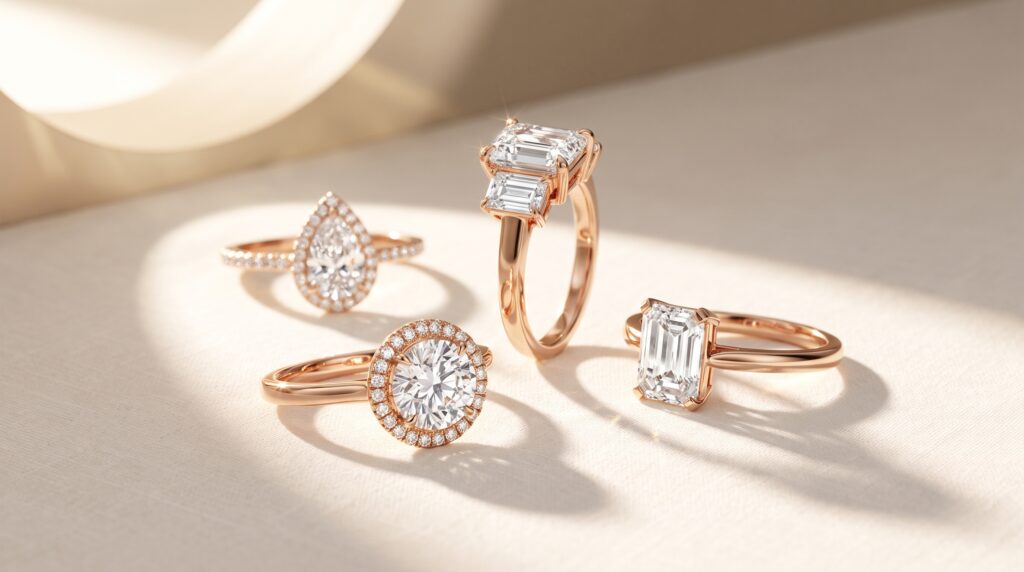
A solitaire setting keeps the focus entirely on the center stone, with no halo or side stones competing for attention. It’s a timeless, minimal option that pairs easily with almost any wedding band, since there’s no elaborate detailing to coordinate around.
A halo setting surrounds the center stone with smaller diamonds, adding sparkle and a fuller, more romantic look, though the added surfaces mean slightly more regular cleaning to keep the small stones bright. Pavé styling, which lines the band itself with small diamonds, has a similar tradeoff: more overall brilliance in exchange for more maintenance.
A bezel setting wraps a thin band of metal around the stone’s edge, offering strong protection and a sleek, modern look. It’s a practical choice for anyone with an active daily routine, since there’s no raised prong to catch on clothing or take a direct hit.
Vintage-inspired designs, with milgrain edging (a beaded texture along the metal’s border) and filigree detailing (delicate, lace-like metalwork), lean into rose gold’s romantic associations and tend to pair naturally with the metal’s warm tone.
Modern minimalist designs, with clean lines and thin bands, offer a contrasting look: rose gold’s warmth without the ornamentation, appealing to buyers who want the color without a strongly vintage aesthetic.
| Setting Style | Appearance | Maintenance | Best For |
| Solitaire | Clean, classic | Low | Buyers wanting the stone to stand alone |
| Halo | Full, sparkling | Moderate to high | Buyers wanting more brilliance and visual size |
| Bezel | Sleek, modern | Low | Active lifestyles, hands-on daily routines |
| Vintage-inspired | Ornate, romantic | Moderate | Buyers wanting an antique aesthetic |
| Modern minimalist | Simple, understated | Low | Buyers wanting warmth without ornamentation |
Which Gemstones Look Best with Rose Gold?
Diamonds against rose gold pick up a subtle warm cast from the surrounding metal, similar to how yellow gold affects a diamond’s appearance, though generally less pronounced since rose gold’s tone is softer than yellow gold’s. Near-colorless diamonds (grades D through F) still read as bright and white in rose gold; the warmth comes through more in diamonds with a faint natural tint (grade J and below), where the pink surroundings can make a slight warm cast less noticeable by blending with it rather than contrasting against it.
Morganite, a peachy-pink gemstone in the beryl family (the same family as emerald and aquamarine), pairs closely with rose gold’s tone, creating a soft, tonal look that’s become a popular alternative to a traditional diamond center stone. Champagne and peach-toned stones follow similar logic, echoing rather than contrasting with the metal’s warmth.
Colored gemstones like sapphire, particularly in yellow or peach tones, and champagne diamonds offer more options for buyers wanting a colored center stone that still coordinates with rose gold’s palette, rather than clashing against a cooler-toned stone like a blue or emerald-green.
Lab-grown and natural diamonds look identical in rose gold, since they’re optically and chemically the same material regardless of origin. The choice between them comes down to budget and personal preference around sourcing, not any visual difference tied to the setting metal.
| Gemstone | Visual Effect in Rose Gold | Durability | Best Aesthetic Style |
| Near-colorless diamond | Bright white contrast | Very high (hardest natural material) | Classic, versatile |
| Diamond with faint warm tint | Warmth blends with the metal | Very high | Budget-conscious buyers |
| Morganite | Soft, tonal harmony | Moderate; more prone to scratching than diamond | Romantic, vintage-inspired |
| Champagne or peach sapphire | Warm, coordinated palette | High | Buyers wanting color with warmth |
Is Rose Gold Durable Enough for Everyday Wear?
Rose gold holds up well to daily wear, in part because copper, its defining alloy ingredient, is a relatively hard metal that adds strength compared to a pure gold or even a silver-heavy alloy. Surface scratches are normal on any polished metal worn daily, rose gold included, and over years of wear the surface can develop a soft patina, a subtle texture from countless small contacts, that some buyers polish away regularly and others simply let develop.
For active lifestyles, gym routines, manual work, frequent hand-washing, a bezel setting or another low-profile, protective design holds up better than an open, raised setting, since there’s less exposed surface and no prongs positioned to catch on clothing or take a direct hit.
Common wear concerns worth knowing about upfront: resizing is possible but, as with any ring, becomes more limited if the design includes stones or detailing extending down the band. Stone security depends on prong condition more than metal color, so regular inspection matters regardless of whether the ring is rose, yellow, or white gold. Prong wear happens gradually from years of contact and is best caught early through routine professional checks rather than after a stone comes loose.
Copper is also the main consideration for skin sensitivity. Some people have mild reactions to copper contact over extended periods, most often experiencing slight skin discoloration (a temporary greenish tint from a chemical reaction between copper, moisture, and skin oils, not an allergic reaction) rather than irritation. Buyers who’ve noticed this with other copper-alloy jewelry may prefer 18k rose gold, which has a lower proportion of copper, or a metal without copper in the alloy altogether.
Ring Width, Fit, and Comfort Considerations
A narrower band, roughly 1.5 to 2mm, gives a delicate, minimal appearance and suits buyers who want the center stone to be the clear visual focus. A wider band, 2.5mm and up, makes more of a statement on its own and tends to distribute pressure more evenly across the finger, which can feel more comfortable for buyers who find narrow bands dig in during activities like exercise or manual tasks.
A comfort-fit band has a slightly rounded interior edge, which reduces friction against the finger compared to a standard flat-interior band. This detail matters more the longer you expect to wear the ring continuously, since even a small amount of daily friction adds up over years.
Low-profile settings sit closer to the finger and catch less on gloves, hair, and fabric than high-profile settings like tall cathedral mounts or large halos. This is worth weighing seriously if your daily routine involves frequent hand use, since a ring that snags regularly is more likely to see prong stress or an accidental knock over time.
Stacking a rose gold engagement ring with a wedding band works most smoothly when the bands are designed to sit flush together, either through a matched curve or a straight-shank design on both pieces. Mixed-metal stacking, pairing rose gold with white or yellow gold pieces, has become common enough that it no longer reads as mismatched, though a contoured wedding band designed to nest against a specific engagement ring setting will fit more comfortably than two unrelated pieces forced together.
| Width Range | Visual Effect | Styling Notes |
| 1.5–2mm | Delicate, minimal | Best for showcasing the center stone |
| 2–2.5mm | Balanced | A common middle-ground choice |
| 2.5mm+ | Substantial, statement-making | More even pressure distribution, more visual presence |
How to Care for a Rose Gold Engagement Ring
Clean the ring every one to two weeks using warm water, a small amount of mild dish soap, and a soft-bristled brush (an old, clean toothbrush works well), paying attention to the underside of the setting where lotion and oils tend to collect.
Avoid abrasive cleaners, chlorine, and other harsh chemicals, which can affect the copper content in the alloy over time. Ultrasonic cleaners can also be risky for rings with certain gemstone types or existing minor damage, so it’s worth checking with a jeweler before using one rather than assuming it’s safe for every ring.
Schedule a professional inspection about once a year. A jeweler checking prong tightness and overall wear can catch a loosening stone or thinning band before it becomes a bigger problem, and can also professionally polish the ring if you prefer to keep the patina from developing.
Store the ring separately from other jewelry, ideally in a soft-lined box or pouch, to avoid scratches from harder stones or metal edges it might otherwise contact in a shared drawer or jewelry box. Keep it away from prolonged moisture exposure, including leaving it in a bathroom during showers, which can accelerate wear on both the metal and any porous or softer gemstones set alongside a diamond.
A simple routine: clean every one to two weeks, avoid harsh chemicals and unnecessary ultrasonic cleaning, get a professional inspection annually, and store the ring separately in a soft-lined container.
What to Check Before Buying a Rose Gold Engagement Ring Online
Verify the metal hallmark listed in the product details. Common stamps include “14K” or “585” for 14 karat gold, and “18K” or “750” for 18 karat gold, referring to the percentage of pure gold per thousand parts. In the United States, gold jewelry marketed by karat is required to carry accurate quality markings under FTC jewelry guidance, which is worth knowing if a listing’s stamp or description seems inconsistent.
Check the diamond’s certification, if applicable, confirming it comes from a recognized grading lab such as GIA, IGI, or AGS, and that the clarity, color, and measurements listed match the certificate rather than relying on the seller’s description alone.
Review product photos and, ideally, video, looking for close-up shots of the setting and hallmark, images showing the ring at finger scale (not just an isolated studio shot), and footage under a few different lighting conditions to get an honest sense of the metal’s actual color and the stone’s brilliance.
Read the return and resizing policy before purchasing, including the timeline, any associated cost, and whether resizing affects a warranty. Ask about insurance and appraisal documentation as well, since many insurers require a current appraisal to cover a ring at replacement value.
Watch for a few red flags: missing metal or stone specifications, no hallmark visible in any photo, no clearly stated return policy, or high-pressure sales tactics urging an immediate decision. Any of these is a reasonable reason to ask more questions or look elsewhere before completing a purchase.
Frequently Asked Questions
Is 14k or 18k rose gold better?
Neither is universally better. 14k rose gold has more copper relative to gold, which makes it harder, more scratch-resistant, and gives it a deeper, more saturated pink tone. 18k has a higher gold purity, producing a softer, more muted pink, but it’s somewhat more prone to scratching since there’s less copper in the mix. The right choice depends on whether you prioritize durability and a bolder color or a higher gold content and a subtler tone.
Does rose gold scratch easily?
Rose gold is reasonably scratch-resistant, particularly at 14k, thanks to its copper content, which is a harder metal than gold alone. Like any polished metal worn daily, it will pick up fine surface marks over time, which can either be professionally polished away periodically or allowed to develop into a soft, matte patina that some buyers come to prefer.
Does rose gold require replating?
No. Rose gold’s pink color comes directly from the alloy itself, unlike white gold, which typically relies on a rhodium plating layered over a paler base alloy. Because there’s no plating involved, rose gold’s color stays consistent over time without needing the periodic replating that white gold requires.
Can rose gold cause skin discoloration?
It can, in some cases, though this isn’t an allergic reaction. Copper, the metal responsible for rose gold’s color, can occasionally react with skin moisture and oils to cause a temporary greenish tint on the skin beneath the ring, more common with lower-karat alloys that contain more copper. Buyers who’ve experienced this with other copper-alloy jewelry may want to consider 18k rose gold, which has less copper, or a different metal altogether.
Will rose gold go out of style?
There’s no way to predict future style trends with certainty, but rose gold’s popularity has held steady for over a decade at this point, and gold-copper alloys themselves have a much longer history in jewelry making generally. A specific ring’s staying power depends more on its overall design, whether it leans heavily into a very of-the-moment style detail or reflects a more classic silhouette, than on the metal color alone.
Can rose gold be resized?
Yes, in most cases, rose gold rings can be resized using standard jewelry techniques, similar to white or yellow gold. The main limitation isn’t the metal color but the setting design: rings with stones, milgrain detailing, or engraving extending significantly down the band can be harder to resize without disrupting the design, which is worth discussing with a jeweler before finalizing a setting if you anticipate needing a resize later.
Do diamonds look good in rose gold?
Yes, and the effect depends on the diamond’s own color grade. Near-colorless diamonds (D through F) still read as bright and white against rose gold’s warm tone. Diamonds with a faint natural warm tint can look more cohesive in rose gold, since the surrounding warmth blends with rather than contrasts against the stone’s own color, an effect some buyers use intentionally to make a lower color grade look more seamless.
Is rose gold good for active lifestyles?
It can be, particularly at 14k and paired with a protective setting like a bezel or a low-profile design that reduces exposed surfaces and snagging risk. The metal’s copper content gives it solid scratch resistance compared to higher-karat, softer alloys, though, as with any engagement ring, an active lifestyle calls for more attention to setting choice than to metal color alone.
Are lab-grown diamonds a good match with rose gold?
Yes. Lab-grown and natural diamonds are chemically and optically identical, so there’s no visual difference in how either looks set against rose gold. The choice between lab-grown and natural comes down to budget and personal preference around sourcing rather than any compatibility issue with the metal.
How often should a ring be professionally inspected?
About once a year is a reasonable standard for a ring worn daily. A jeweler can check prong tightness, look for early signs of band thinning, and catch a loosening stone before it becomes a bigger problem, regardless of which metal or gemstone the ring features.