
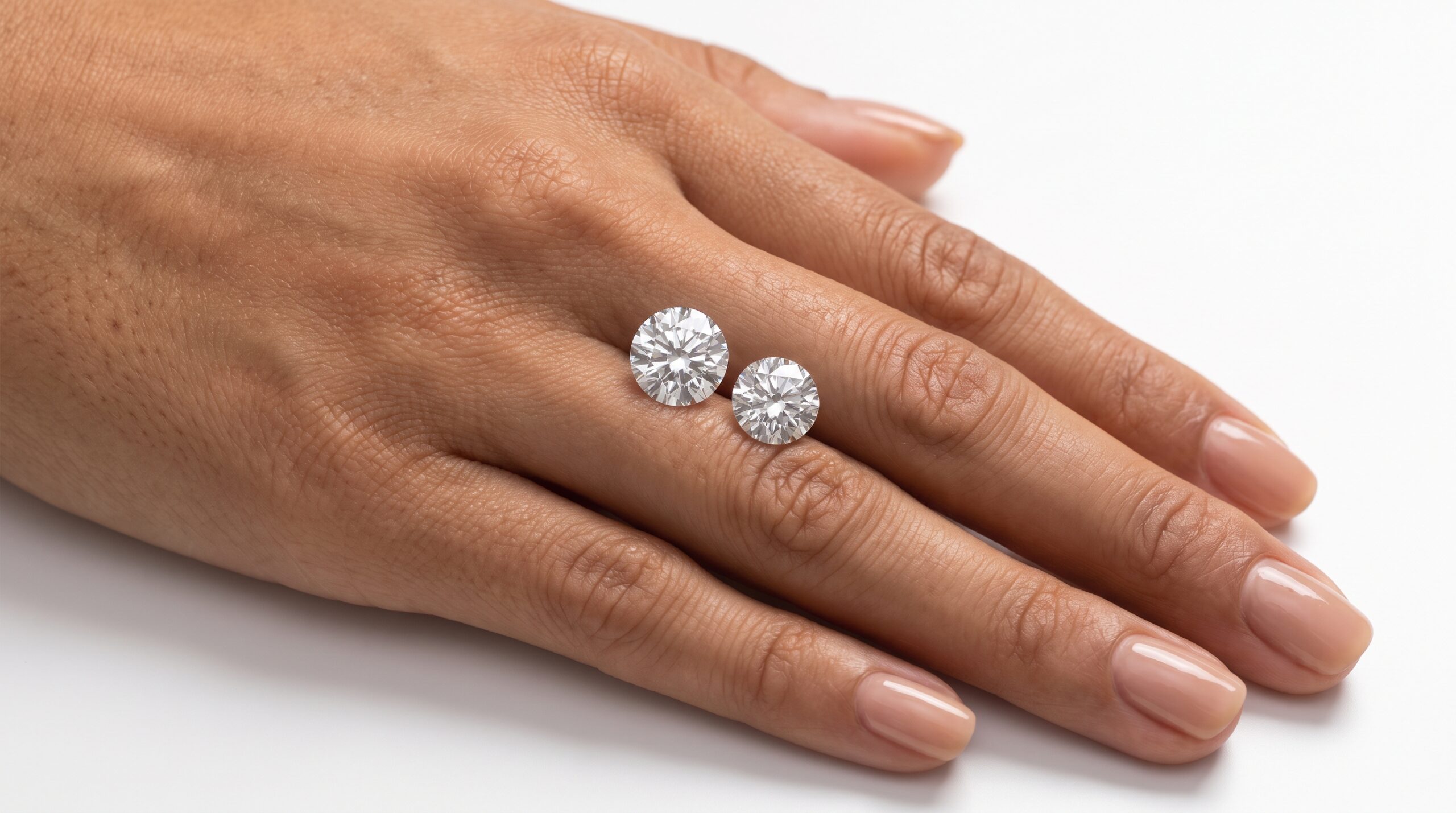
Lab grown and natural diamonds can look identical to the naked eye, yet one often costs a fraction of the other. That gap confuses a lot of first-time buyers, especially when “lab grown” gets mistaken for “fake.” It isn’t. The real differences are about origin, price, resale expectations, and the story behind the stone, not about whether it’s a genuine diamond. Here’s how those differences actually play out.
What Is the Difference Between Lab Grown and Natural Diamonds?
Natural diamonds form roughly 100 miles below the Earth’s surface, under intense heat and pressure, over a span of one to three billion years, before volcanic activity brings them closer to the surface where they can eventually be mined.
Lab grown diamonds are created using one of two methods: HPHT (high pressure, high temperature), which recreates the natural formation conditions in a controlled chamber, or CVD (chemical vapor deposition), which grows a diamond crystal layer by layer from carbon-rich gas. Both methods take weeks to months rather than billions of years, but they produce actual diamond crystal structure, not a substitute material.
That’s the point worth understanding clearly: lab grown diamonds are not the same thing as moissanite or cubic zirconia, which are diamond simulants, materials that look similar but have a different chemical composition and different physical properties. According to GIA’s comparison of natural and laboratory-grown diamonds, lab grown diamonds share essentially the same chemical composition, crystal structure, and optical properties as natural diamonds. The only meaningful difference is where and how each stone formed.
| Natural Diamonds | Lab Grown Diamonds | |
| Formation | Underground, over 1–3 billion years | Lab-created via HPHT or CVD, over weeks to months |
| Chemical composition | Carbon crystal structure | Identical carbon crystal structure |
| Classification | Genuine diamond | Genuine diamond, different origin |
| Not to be confused with | N/A | Moissanite, cubic zirconia (different materials entirely) |
Do Lab Grown and Natural Diamonds Look the Same?
To the naked eye, a well-cut lab grown diamond and a well-cut natural diamond of comparable quality look the same. Brilliance and sparkle come primarily from cut quality, not from whether the stone formed underground or in a lab. A poorly cut natural diamond can look duller than a well-cut lab grown one, and vice versa; origin isn’t the deciding factor in how a diamond performs visually.
Both types are graded using the same basic framework, commonly called the 4Cs, though grading approaches and available reports can vary somewhat by lab and by whether the stone is natural or lab grown.
- Carat: the diamond’s weight, not a direct measurement of visual size, since cut proportions also affect how large a stone appears face-up
- Cut: how well the diamond’s facets are proportioned and aligned to reflect light, the single biggest factor in how much a diamond sparkles
- Color: how close to colorless a diamond is, graded on a scale where less color generally means a higher grade
- Clarity: the presence and visibility of internal or surface characteristics, graded on a scale from flawless to heavily included
Distinguishing a lab grown diamond from a natural one typically requires specialized equipment that detects specific growth patterns or trace elements, not something visible to an untrained eye or even most jewelers without that equipment. This is exactly why certification matters so much for both types, covered in more detail further down.
Lab Grown Diamonds: Pros, Cons, and Best Fit
The clearest advantage of a lab grown diamond is cost. Because production isn’t limited by the same rarity constraints as mining, lab grown diamonds typically sell for significantly less than natural diamonds of comparable size and quality, which lets buyers choose a larger carat weight or higher clarity and color grade within the same budget.
Durability is identical, since the material itself is the same. A lab grown diamond scores the same 10 on the Mohs hardness scale as a natural diamond and holds up to daily wear the same way.
Origin is also unambiguous with proper certification: a lab grown diamond’s report clearly states its laboratory origin, giving buyers a documented, verifiable answer to where the stone came from.
On the consideration side, lab grown diamonds currently have a weaker resale market than natural diamonds. Buyers thinking about long-term resale value, rather than simply wanting the ring itself, should factor this in. There’s also less rarity-based appeal for buyers who specifically value a diamond’s natural, geologically rare origin as part of what makes it meaningful.
Sustainability is often framed as an automatic advantage for lab grown diamonds, and mining impact is avoided entirely, but production still requires energy, and the environmental footprint varies depending on the producer’s energy source. It’s not a simple “lab grown is always more sustainable” equation.
Market pricing for lab grown diamonds has also shifted quickly in recent years as production has scaled, which is worth keeping in mind if you’re comparing prices against older sources or previous quotes.
Natural Diamonds: Pros, Cons, and Best Fit
Natural diamonds carry a geological origin story that some buyers find meaningful in itself, a stone formed over a billion years before being mined and cut. That origin also ties into stronger traditional and cultural associations with engagement rings specifically, since natural diamonds have been the standard choice for generations.
Resale and heirloom perception is more established for natural diamonds. The secondary market for natural diamonds is more developed, and buyers thinking about passing a ring down or reselling it later generally find more established value expectations with a natural stone.
Provenance and traceability options exist for buyers who want to verify a natural diamond’s specific mining origin and supply chain, through certifications and documentation covered in the sourcing and certification sections below.
On the consideration side, natural diamonds cost more upfront than lab grown diamonds of comparable size and quality, which means buyers on a fixed budget often need to choose a smaller carat weight or lower clarity and color grade to stay within range. Mining concerns matter to some buyers specifically, and sourcing a natural diamond responsibly requires more attention to certification and documentation than simply buying based on the 4Cs alone.
Price and Value: Why Lab Grown Diamonds Cost Less
Lab grown diamonds cost less primarily because their supply isn’t constrained by natural rarity or the far higher costs of large-scale mining operations. Once production infrastructure exists, additional stones can be grown without the same geological limitations that cap how much natural diamond material becomes available each year.
Exact price differences vary by size, quality grade, and retailer, and change over time as production scales, so it’s worth checking current pricing rather than relying on older figures. As a general pattern, though, choosing lab grown over natural for the same budget typically means access to either a larger carat weight or a higher clarity and color grade than a natural diamond would allow at the same price point.
| Buyer Priority | Lab Grown Outcome | Natural Outcome |
| Maximize carat size on a fixed budget | Larger stone possible | Smaller stone typically needed |
| Maximize clarity/color grade on a fixed budget | Higher grade possible | Lower grade typically needed |
| Minimize upfront cost | Lower cost for comparable quality | Higher cost for comparable quality |
| Maximize resale/heirloom value | Currently weaker resale market | More established resale market |
Certification: What Buyers Should Ask For
Always ask for an independent grading report rather than relying on a seller’s description alone. For natural diamonds, GIA reports are the most widely recognized standard, documenting the 4Cs using consistent, internationally applied criteria.
For lab grown diamonds, IGI has become a standard reporting lab. According to IGI’s lab-grown diamond report documentation, these reports identify the stone’s laboratory origin and include 4Cs assessments where the mounting allows for full examination. GIA also grades lab grown diamonds and issues reports that explicitly disclose laboratory origin.
Beyond the grading report itself, a few additional details are worth verifying: the report number, which can be checked against the issuing lab’s own database (IGI’s certificate verification portal is one example); laser inscription, a microscopic identifying code etched onto the diamond’s girdle that some reports reference and that can be checked against the physical stone; and clear origin disclosure stating whether the stone is natural or lab grown, which reputable sellers state plainly rather than burying in fine print.
It’s worth understanding the difference between a certificate, an appraisal, and a warranty, since buyers sometimes conflate them. A grading report (certificate) documents the stone’s characteristics using standardized criteria. An appraisal estimates monetary value, often for insurance purposes, and can vary between appraisers. A warranty covers specific defects or issues for a defined period and doesn’t verify the stone’s quality or origin at all.
Grading practices for lab grown diamonds specifically have continued to evolve as the technology and market mature; a 2024 GIA update on laboratory-grown diamond grading notes ongoing changes in how these stones are reported and disclosed. Because of this, it’s worth reviewing the actual report for a specific stone rather than assuming grading language from a few years ago still applies exactly the same way today.
Ethics and Sustainability: How to Think About the Difference
Lab grown diamonds avoid mining-related land disruption and labor concerns entirely, since no mine is involved in producing them. That’s a real advantage for buyers specifically concerned about mining impact. It doesn’t mean lab grown diamonds have no environmental footprint at all: production requires significant energy, and the actual environmental impact depends heavily on the energy source a given producer uses, which varies and isn’t something a buyer can assume without asking.
Natural diamonds carry mining-related environmental and labor considerations that vary enormously by specific mine and region. At the same time, traceable and responsibly sourced natural diamonds do exist, verified through certifications and chain-of-custody documentation that let buyers confirm a specific stone’s mining and trade history rather than relying on general assumptions about mining as a whole.
Neither category deserves a blanket ethical label, positive or negative. A buyer’s actual ethical footprint depends on the specific stone, its documentation, and how transparent the seller is about origin and sourcing, not simply on whether the diamond is labeled “lab grown” or “natural.”
| Consideration | Lab Grown | Natural |
| Mining impact | None; no mine involved | Varies by mine; documented, responsible sourcing options exist |
| Energy use | Significant; impact depends on producer’s energy source | Mining and processing also require energy, varies by operation |
| Traceability | Origin is lab-based and generally straightforward to document | Requires specific certification to trace mine of origin |
| Documentation available | IGI and GIA reports disclose lab origin | GIA reports plus chain-of-custody or responsible sourcing certification where available |
Lifestyle, Setting, and Daily Wear
Both lab grown and natural diamonds are equally suitable for daily wear, because they’re the same material with the same hardness and durability. The setting, not the diamond’s origin, is what actually determines how well a ring holds up to daily life.
A prong setting shows more of the stone but relies on the prongs themselves for security and protection; a bezel setting encloses the stone’s edge in metal, offering more protection at some cost to how much light enters the stone from the sides. For active lifestyles, manual work, frequent hand use, exercise, a low-profile or bezel setting reduces snagging and impact exposure regardless of which diamond type is set into it.
Ring height affects snagging risk: a higher-profile setting, like a tall halo or cathedral mount, sits further off the finger and catches more easily on gloves, hair, or fabric than a lower-profile design. Band width affects comfort more than most buyers expect before wearing a ring daily; a narrower band feels less noticeable but can dig in more under pressure, while a wider band distributes pressure more evenly.
Pairing with a wedding band works most easily with a straight-shank setting, since it sits flush against a straight-edged wedding band. A curved or contoured engagement ring may need a wedding band custom-fitted to nest against it properly.
How to Choose Between Lab Grown and Natural Diamonds
Start by deciding what matters most to you: maximizing carat size or clarity within a set budget, natural geological origin, resale and heirloom value, or minimizing mining-related impact. Few buyers weigh all of these equally, and knowing your actual priority narrows the decision considerably.
Set a realistic budget before comparing specific stones, since price expectations differ significantly between lab grown and natural diamonds of the same size and quality.
Compare cut quality first, then carat weight. A well-cut smaller diamond generally looks brighter and more lively than a larger, poorly cut one, regardless of whether it’s lab grown or natural.
Review the certification for any specific stone you’re considering, checking that the report comes from a recognized lab and that the report number can be independently verified.
Consider the setting and how it fits your lifestyle, since durability and comfort in daily wear depend more on setting choice than on the diamond’s origin.
Confirm return, resizing, warranty, and insurance details before completing a purchase, the same practical checks that matter regardless of which diamond type you choose.
Choose lab grown if maximizing size or clarity within your budget matters most, if you specifically want to minimize mining-related impact, or if resale value isn’t a significant priority for you.
Choose natural if geological origin and rarity matter to you personally, if you’re prioritizing established resale and heirloom value, or if you want to pursue a specific, traceable mining provenance as part of the stone’s story.
Online Buying Checklist
Request the full grading report for any specific stone, not just a summary description, and confirm it comes from a recognized lab.
Verify the report number independently through the issuing lab’s own database rather than trusting a product page’s claim about the report.
Check for clear origin disclosure stating plainly whether the stone is natural or lab grown, not language that could be read either way.
Review high-resolution photos of the actual stone, not just a representative or stock image of a similar diamond.
Watch video of the stone under a few different lighting conditions, since photos alone can flatter a stone’s actual brilliance and clarity.
Confirm measurements are given in millimeters, alongside carat weight, since two diamonds of the same carat weight can have different visible dimensions depending on their cut proportions.
Read the return policy, resizing policy, and warranty terms before purchasing, and confirm customer support is available to answer specific questions about a stone’s documentation.
Frequently Asked Questions
Are lab grown diamonds real diamonds?
Yes. Lab grown diamonds share the same chemical composition, crystal structure, and optical properties as natural diamonds, differing only in how and where they formed. They’re distinct from diamond simulants like moissanite or cubic zirconia, which are chemically different materials designed to resemble diamonds rather than being diamonds themselves.
Can jewelers tell the difference?
Not reliably with the naked eye alone. Distinguishing a lab grown diamond from a natural one typically requires specialized equipment that detects specific growth patterns or trace elements present in one type but not the other. This is part of why certification matters so much: a grading report from a recognized lab provides a documented answer that visual inspection alone can’t reliably give.
Are lab grown diamonds cheaper?
Generally, yes, often significantly so for comparable size and quality. This comes down to supply: lab grown diamond production isn’t limited by the same natural rarity constraints as mining, so more supply is available at a lower relative cost. Exact price differences vary by size, quality grade, and retailer, and have shifted as lab grown production has scaled in recent years.
Do natural diamonds hold value better?
Natural diamonds currently have a more established resale market than lab grown diamonds, meaning buyers reselling a natural diamond generally have more predictable value expectations. That said, engagement ring diamonds of either type typically aren’t purchased primarily as financial investments, and resale value for both types depends heavily on the specific stone’s quality, market conditions at the time of resale, and the buyer found.
Which certificate is best for lab grown diamonds?
IGI and GIA are the two most widely recognized labs currently issuing reports for lab grown diamonds, both disclosing laboratory origin clearly alongside a 4Cs assessment. Whichever lab issued a specific stone’s report, confirm the report number can be independently verified through that lab’s own database.
Which certificate is best for natural diamonds?
GIA is the most widely recognized grading standard for natural diamonds, using consistent, internationally applied criteria for the 4Cs. Other established labs also grade natural diamonds, but GIA reports are generally treated as the benchmark buyers and jewelers compare against.
Are lab grown diamonds ethical?
They avoid mining-related land disruption and labor concerns entirely, which is a genuine advantage for buyers specifically focused on mining impact. They aren’t automatically the more ethical choice in every sense, though, since production requires energy and the environmental footprint depends on the specific producer’s energy source. Meanwhile, natural diamonds aren’t automatically unethical either, since traceable and responsibly sourced options exist with proper documentation. The actual ethical profile of either choice depends on the specific stone and seller, not the category alone.
Which is better for an engagement ring?
Neither is universally better. Both are genuine, durable diamonds suitable for daily wear. The right choice depends on which specific factors, budget, carat size, natural origin, resale expectations, or mining impact, matter most to you personally, which is a values-based decision rather than a quality-based one.
Do lab grown and natural diamonds last the same?
Yes. Both score the same 10 on the Mohs hardness scale, the hardest rating for any natural material, and hold up to daily wear identically, since they’re chemically and structurally the same material. Longevity in a specific ring depends far more on setting quality and care than on which type of diamond is set into it.
Should I prioritize carat size or cut quality?
Cut quality generally has a bigger impact on how a diamond actually looks day to day, since it determines how well the stone reflects light and sparkles. A smaller, well-cut diamond often looks brighter and more lively than a larger, poorly cut one. If choosing between the two within a fixed budget, prioritizing cut quality first, then adjusting carat size to fit what’s left, tends to produce a more satisfying result than the reverse.