
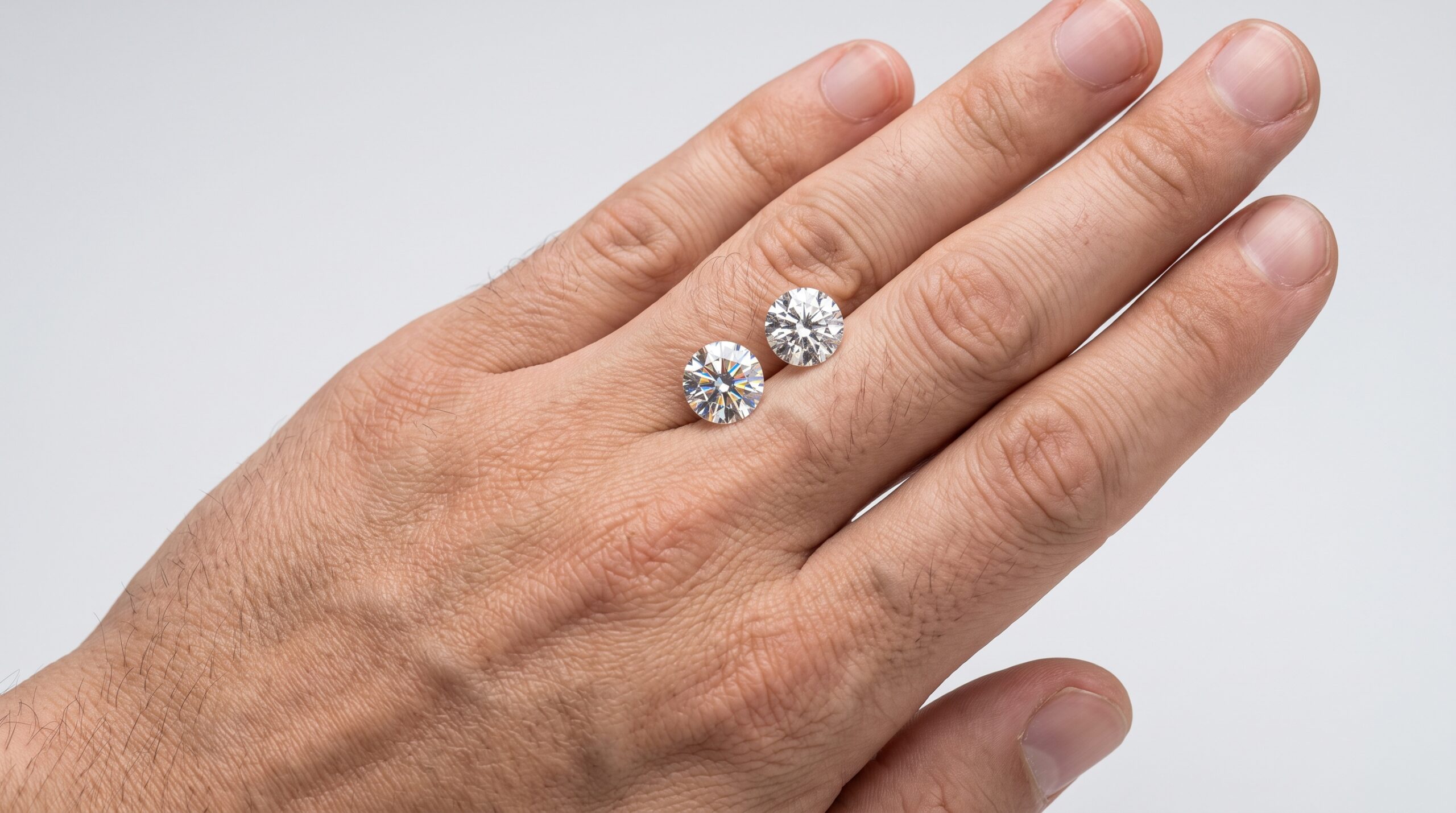
Moissanite and diamond can look close enough in a product photo that the price difference feels almost suspicious. It shouldn’t. They’re genuinely different gemstones with different optical properties, different market histories, and different long-term expectations, and neither is a lesser version of the other. Here’s what actually separates them and how to decide which fits what you want from an engagement ring.
What Is the Difference Between Moissanite and Diamond?
Diamond is pure carbon, crystallized under intense heat and pressure. Moissanite is silicon carbide, a different chemical compound entirely, first discovered in microscopic quantities in a meteorite crater and now produced almost exclusively in laboratories for jewelry use, since natural moissanite is too rare to mine at any meaningful scale.
Diamonds come from two distinct origins: natural diamonds form underground over roughly a billion years before being mined, while lab grown diamonds are created in controlled laboratory conditions using processes that produce the same carbon crystal structure in weeks or months rather than geologic time. Moissanite doesn’t have a natural-versus-lab distinction in practice; virtually all moissanite sold in jewelry today is lab-created, since naturally occurring moissanite is essentially unavailable in gem quality or quantity.
The clearest way to think about moissanite is as a diamond alternative, not a type of diamond. It’s a genuine, durable gemstone in its own right, not a synthetic knockoff or a lesser substitute, but it’s chemically and structurally distinct from diamond in every respect.
| Diamond | Moissanite | |
| Chemical composition | Carbon | Silicon carbide |
| Natural origin | Yes, plus lab grown option | Essentially none in gem quality; almost all lab-created |
| Classification | Diamond (natural or lab grown) | Diamond alternative, not a diamond |
Moissanite vs Diamond Appearance: Sparkle, Fire, and Color
Moissanite has a higher refractive index than diamond, which means it bends light more strongly and tends to show more colorful flashes, often described as “fire,” under typical lighting. Diamond is known for a more balanced mix of white brilliance (the bright white light reflected back), fire (flashes of spectral color), and scintillation (the pattern of light and dark as the stone or viewer moves). Some buyers find moissanite’s more pronounced rainbow flash exciting and distinctive; others prefer diamond’s more classic, restrained sparkle. Neither is objectively better; it’s a matter of which look you’re drawn to.
Color can behave differently between the two as well. Larger moissanite stones, generally above two carats, can show a faint warm or grayish tint depending on the specific stone’s quality, the cut, the lighting, and the metal it’s set in, an effect that’s less pronounced in smaller moissanite stones. Diamond color is graded on the standardized D-to-Z scale, giving buyers a consistent way to compare color across different stones and sellers.
For buyers specifically wanting the traditional engagement ring look most people picture, a classic diamond typically delivers that expectation most directly. For buyers drawn to something brighter, more colorful, or simply different from what’s expected, moissanite’s more prominent fire can feel like a distinguishing feature rather than a compromise.
Durability and Daily Wear
Both stones are hard enough for daily wear as an engagement ring center stone. Diamond rates a 10 on the Mohs hardness scale, the hardest natural material that exists. Moissanite rates around 9.25, still exceptionally hard and well above most other gemstones used in jewelry, including sapphire (9) and emerald (7.5 to 8).
That difference in hardness is real but shouldn’t be overstated for typical daily wear. Any stone, including diamond, can chip if struck directly at the wrong angle against a hard surface, and the practical durability difference between a 10 and a 9.25 rarely shows up in ordinary use. Where hardness matters more is long-term resistance to surface scratching from other hard materials the ring might contact over years, an area where diamond’s slight edge is more relevant to how a stone looks after decades of wear than whether it survives daily life at all.
Setting choice matters as much as the stone’s inherent hardness for long-term protection. A well-secured setting protects either stone from the kind of direct impact that could cause damage, which is covered in more detail in the settings section below.
Price and Value: Why Moissanite Costs Less
Moissanite is typically chosen partly for its lower cost relative to diamond, which lets buyers choose a larger center stone or a more detailed setting while staying within the same budget. This cost difference comes from a combination of factors: moissanite production isn’t constrained by natural rarity the way diamond mining is, and the manufacturing process for lab-created moissanite is generally less resource-intensive than either diamond mining or diamond lab-growing.
Exact savings vary by size, quality, and retailer, and change over time as production methods and market conditions shift, so it’s worth checking current pricing directly rather than relying on general assumptions. As a broad pattern, though, choosing moissanite over diamond for the same budget typically means access to a noticeably larger center stone or a more elaborate setting than a diamond would allow at the same price point.
| Buyer Priority | Moissanite Advantage | Diamond Advantage |
| Maximize visual size for the budget | Larger stone typically possible | Smaller stone typically needed |
| Minimize upfront cost | Lower cost | Higher cost |
| Traditional diamond identity | Not applicable; different gemstone | Genuine diamond, natural or lab grown |
| Established resale/heirloom market | Weaker secondary market | Stronger secondary market, especially for natural diamonds |
Resale, Heirloom Value, and Emotional Meaning
Diamonds, particularly certified natural diamonds, carry stronger traditional and market recognition than moissanite. This shows up concretely in resale: there’s a more established secondary market for diamonds, meaning a diamond ring generally has more predictable resale value expectations than a moissanite one.
This is a market fact, not a statement about what makes a ring meaningful. A moissanite engagement ring can carry exactly as much sentimental and personal significance as a diamond one; resale value and emotional value are separate measures that don’t have to move together. Plenty of meaningful jewelry, family pieces included, has little to no resale market at all without being any less significant to the people who wear it.
Buyers specifically thinking about long-term financial value, whether for eventual resale or as a piece intended to be passed down and appraised for insurance purposes over generations, should factor diamond’s stronger established market into that particular decision. Buyers focused primarily on the ring itself, its look, its story, its meaning to the two people involved, may find this consideration far less relevant to their choice.
Certification and Authenticity
For diamonds, request an independent grading report from a recognized lab rather than relying on a seller’s description. Reports should include the stone’s origin (natural or lab grown), the 4Cs (carat, cut, color, clarity), precise measurements, and identifying details like a laser inscription where applicable. GIA notes that lab grown and natural diamonds share essentially the same chemical, physical, and optical properties, differing specifically in origin, which is exactly what a proper grading report should document clearly. IGI is another widely used lab, and its lab grown diamond reports identify stones with measurements and 4Cs assessments where the mounting allows.
Moissanite doesn’t follow the same universal 4Cs certification system that diamonds do, since it’s a different material with its own quality variations that aren’t standardized across the industry the same way diamond grading is. For moissanite, buyers should instead look for clear seller documentation of the specific stone’s dimensions and quality tier, a warranty covering the stone itself, and a transparent return policy, since these substitute for the kind of independent, standardized report available for diamonds.
Regardless of which stone you’re buying, FTC jewelry guidance sets expectations for how gemstone, laboratory-created, and imitation products should be described to consumers, requiring clear and accurate terminology rather than language that could mislead a buyer about what they’re purchasing. The underlying federal rule is published in 16 CFR Part 23, which spells out specific disclosure requirements for terms like “laboratory-created” and “imitation.”
Ethics and Sustainability
Moissanite is typically lab-created, which means it avoids diamond mining concerns entirely, similar to how lab grown diamonds sidestep the same issue. Neither is automatically “sustainable” in an unqualified sense, though: both require energy to produce, and the actual environmental footprint depends on the specific producer’s energy source and manufacturing process, details that vary and aren’t something a buyer can assume without asking.
Natural diamonds carry mining-related environmental and labor considerations that vary significantly by mine and region. Sourcing a natural diamond responsibly requires attention to certification and documentation, since claims about ethical sourcing should be backed by verifiable paperwork rather than general marketing language.
None of these three options, moissanite, lab grown diamond, or natural diamond, deserves a blanket label as “the ethical choice” without qualification. The actual footprint of any specific purchase depends on the particular stone, its documentation, and how transparent the seller is, more than on which broad category it falls into.
Best Settings for Moissanite and Diamond Engagement Rings
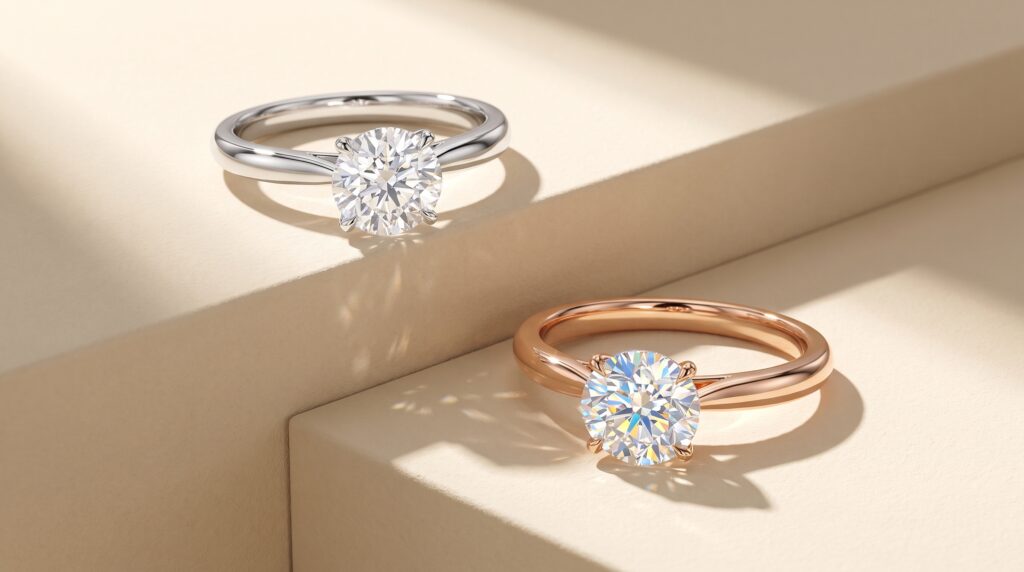
A solitaire prong setting shows the most of the stone and lets light enter from every angle, which works well for both moissanite and diamond, particularly when the goal is showing off the stone’s brilliance and fire without visual competition from surrounding metal or accent stones.
A bezel setting encloses the stone’s edge in metal, offering the most protection against impact and chipping, a practical option for active lifestyles, hands-on work, or anyone who simply wants the lowest-maintenance, most secure setting available regardless of which stone is set into it.
A halo setting surrounds the center stone with smaller accent stones, increasing apparent size and overall sparkle, though it adds more surfaces that need regular cleaning to stay looking its best.
A low-profile setting sits closer to the finger, reducing snagging on gloves, hair, or fabric, a comfortable and practical choice for desk work, hands-on lifestyles, or anyone who prefers a ring that stays out of the way during daily tasks.
| Setting | Look | Protection Level | Best For |
| Solitaire prong | Classic, shows the most stone | Moderate | Buyers wanting maximum brilliance and fire visible |
| Bezel | Modern, sleek | Highest | Active lifestyles, low-maintenance preference |
| Halo | Full, extra sparkle | High (stone sits low, protected) | Buyers wanting more visual size and brightness |
| Low-profile | Understated, close to the finger | Moderate to high | Desk work, hands-on daily routines |
How to Choose Between Moissanite and Diamond
Decide first whether gemstone identity matters to you specifically, whether “diamond” as a category carries meaning beyond appearance, or whether the stone’s specific properties and appearance are what matter most regardless of what it’s technically made of.
Set a budget before comparing specific stones, since price expectations differ significantly between the two.
Decide whether visual size or long-term market recognition matters more to you, since this tradeoff shows up directly in what your budget can get you in each category.
Compare sparkle preference using video, not just photos, since moissanite’s more pronounced fire and diamond’s more balanced brilliance are both easier to judge in motion under real lighting than in a single still image.
Consider your lifestyle and how much setting protection you want, since both stones hold up well to daily wear when paired with an appropriately protective setting.
Review documentation, warranty terms, resizing policy, and return policy before finalizing a purchase, regardless of which stone you choose.
Choose moissanite if maximizing visual size within your budget matters most, if you’re drawn specifically to its brighter, more colorful sparkle, or if gemstone identity beyond appearance isn’t a priority for you.
Choose diamond if traditional gemstone identity matters to you, if you’re prioritizing established resale and heirloom market recognition, or if you specifically prefer diamond’s classic balance of brilliance, fire, and scintillation over moissanite’s more pronounced fire.
Online Buying Checklist
Review actual product photos and video of the specific stone, not stock or representative images of a similar one.
Confirm stone dimensions are listed in millimeters alongside carat weight or carat equivalent, since visible size depends on cut proportions as much as weight.
Check that the stone type is clearly and accurately stated, diamond or moissanite, natural or lab grown, without ambiguous language.
For diamonds, request the full grading report and verify the report number independently through the issuing lab’s database.
For moissanite, request the seller’s documentation or warranty covering the specific stone, since there’s no universal third-party grading system equivalent to diamond certification.
Verify metal hallmarks match the karat or purity claimed in the listing.
Read the return policy, resizing policy, and warranty exclusions before purchasing, and check customer reviews for patterns related to accuracy of stone description and customer service responsiveness.
Frequently Asked Questions
Is moissanite a diamond?
No. Moissanite is silicon carbide, a chemically distinct compound from diamond, which is pure carbon. It’s a genuine, durable gemstone in its own right and a popular diamond alternative, but it isn’t a type of diamond, lab grown or otherwise, and shouldn’t be described or sold as one.
Can people tell moissanite from diamond?
Untrained observers generally can’t distinguish the two by sight alone, especially in smaller stones or under typical indoor lighting. Someone familiar with both, or using specialized equipment, may notice moissanite’s more pronounced rainbow fire compared to diamond’s more balanced brilliance, particularly in larger stones or under bright, direct light where the difference in optical properties becomes more visible.
Is moissanite durable enough for daily wear?
Yes. Moissanite rates around 9.25 on the Mohs hardness scale, just below diamond’s 10 and well above most other gemstones used in jewelry. It holds up well to daily wear, including regular activities like hand-washing, typing, and general use, particularly when set in a setting that offers reasonable protection against direct impact.
Does moissanite sparkle more than diamond?
Moissanite has a higher refractive index than diamond, which typically produces more pronounced flashes of spectral color, often described as more “fire.” Diamond is known for a more balanced combination of white brilliance, fire, and scintillation. Whether moissanite “sparkles more” depends on what kind of sparkle you’re comparing; it’s a different character of sparkle rather than simply more or less of the same thing.
Why is moissanite cheaper?
Moissanite production isn’t limited by natural rarity the way diamond mining is, and the lab-creation process for moissanite is generally less resource-intensive than either diamond mining or lab-growing diamonds. This lets sellers offer moissanite at a lower price point than diamonds of comparable visual size, letting buyers choose a larger center stone within the same budget.
Does moissanite hold resale value?
Not as reliably as diamond. The secondary market for moissanite is much less established than the diamond resale market, meaning buyers shouldn’t expect significant resale value from a moissanite ring. This is separate from the ring’s personal or sentimental value, which isn’t determined by its resale market.
Is moissanite better than a lab grown diamond?
Neither is objectively better; they’re different materials with different properties and different price points. Lab grown diamond is chemically identical to natural diamond and generally costs more than moissanite of comparable visual size, while moissanite is a distinct gemstone that typically costs less and has a more pronounced fire. The choice depends on whether gemstone identity (genuine diamond versus diamond alternative) matters to you and how you weigh cost against that identity.
Which setting is best for moissanite?
The same setting considerations that apply to diamond apply to moissanite, since both are hard, durable stones suited to any common setting style. A bezel setting offers the most protection for active lifestyles, while a solitaire prong setting shows the most of the stone’s brilliance and fire, which is a common priority for moissanite specifically given its more pronounced sparkle.
Can moissanite become cloudy?
Moissanite doesn’t cloud over from normal wear, since its hardness and chemical stability resist the kind of surface degradation that could cause clouding. Any dulling in a moissanite stone’s appearance over time is far more likely to come from a buildup of oils, lotion, or soap residue, which regular cleaning resolves, rather than any inherent change in the material itself.
Should I choose moissanite or diamond for an engagement ring?
Both can make a beautiful, durable engagement ring, and the right choice depends on your specific priorities. Choose moissanite if maximizing visual size on a budget or its distinctive fire appeals to you more than gemstone identity. Choose diamond, natural or lab grown, if traditional diamond identity, established resale value, or diamond’s classic brilliance matter more to you. Neither choice is more romantic or more meaningful than the other; that comes from what the ring represents to the people wearing it, not from the stone’s chemical composition.