
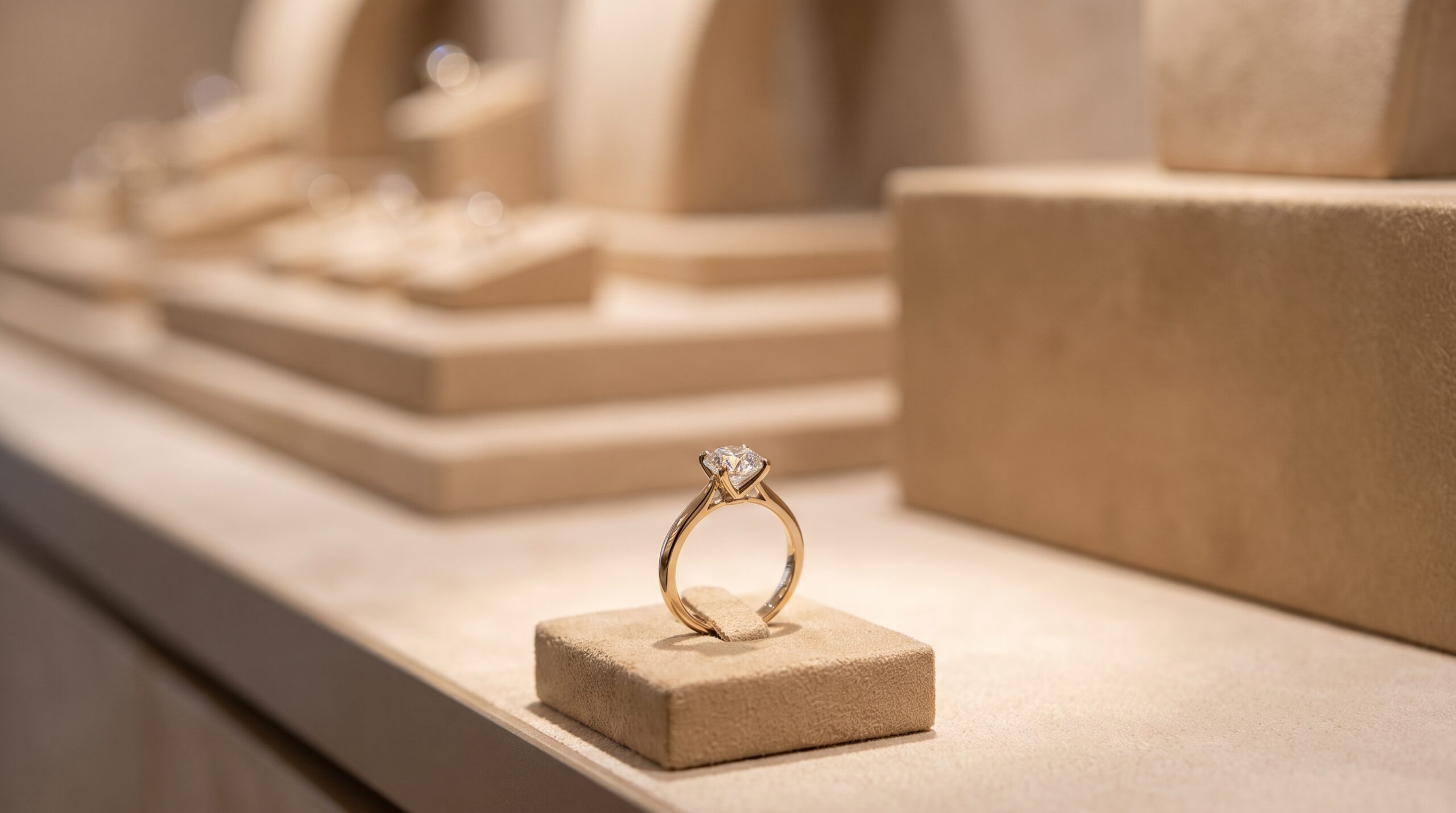
A minimalist engagement ring can look plain in a bad photo and stunning in person, which is exactly the problem with judging the style from a thumbnail. Simplicity in ring design isn’t the absence of thought, it’s the result of it: clean lines, careful proportions, and a stone that gets to be the actual focal point instead of competing with a dozen accent details. Here’s what separates a minimalist ring that reads as intentional from one that reads as an afterthought.
What Is a Minimalist Engagement Ring?
A minimalist engagement ring is defined by clean lines, limited ornamentation, and a design built around a single focal point, usually the center stone, rather than layered detailing. Common features include a solitaire setting, a simple unadorned band, and a restrained overall silhouette without elaborate filigree, extensive pavé, or ornate side details.
Minimalist doesn’t mean tiny, inexpensive, or plain in a negative sense. A minimalist ring can carry a large, high-quality center stone; it can be made from platinum or 18K gold; it can be expensive. What defines the style is restraint in design, not a ceiling on quality or size. A one-carat solitaire in a simple four-prong setting is just as much a minimalist ring as a smaller stone in the same style.
Key features of minimalist engagement rings:
- A single, clear focal point, typically the center stone
- Limited or no additional detailing (no filigree, minimal or no pavé)
- Clean, simple band design
- Proportions that emphasize the stone rather than the setting
- Versatility for daily wear and easy pairing with other jewelry
Why Minimalist Engagement Rings Have Become So Popular
Part of the appeal is timelessness. A clean solitaire or simple bezel design doesn’t tie itself to a specific decade the way heavily detailed vintage-inspired or maximalist styles sometimes can, which matters to buyers thinking about a ring they’ll wear for decades rather than years.
Everyday practicality plays a role too. Fewer raised details and less ornamentation generally mean fewer places for a ring to snag or accumulate the kind of grime that builds up in intricate filigree work, making minimalist designs a natural fit for buyers who want a ring that keeps up with daily life without much fuss.
Minimalist rings also pair more easily with wedding bands and other everyday jewelry, since a simple silhouette doesn’t compete visually with whatever sits next to it. A buyer who likes to stack rings or wear multiple pieces at once often finds a minimalist engagement ring easier to build around than a more elaborate one.
The style also tends to be less trend-dependent than more ornate design movements, which cycle in and out of fashion more visibly. And because the design puts more visual weight on the center stone and less on surrounding detail work, minimalist rings put a natural emphasis on craftsmanship and proportion, the kind of quality that shows up in how well a simple design is actually executed rather than how much is added to it.
Most Popular Minimalist Engagement Ring Styles
A solitaire setting is the classic minimalist design: a single center stone held by prongs, with no halo, no side stones, and no additional detailing competing for attention. It remains the reference point for the style because it does the least to obscure the stone itself.
A bezel setting wraps a thin band of metal around the stone’s edge, creating a smooth, modern profile with strong protection against impact and low maintenance, since there’s no raised prong to catch on anything. It trades a small amount of light entry, and therefore some sparkle, for that added durability and a distinctly clean look.
A low-profile prong setting keeps the classic look of a prong-held stone while positioning it closer to the finger than a traditional high-set solitaire, offering a reasonable balance between showing off the stone’s brilliance and keeping the ring practical for daily wear.
An east-west setting rotates the stone 90 degrees, so an elongated shape like an oval or marquise sits horizontally across the finger rather than vertically along it. This is a distinctly modern take on minimalism, changing the visual orientation without adding any extra detail to the design itself.
Band width plays into the minimalist aesthetic as much as setting choice does. A thin band (roughly 1.5 to 2mm) reads as delicate and understated, keeping visual focus entirely on the stone. A medium-width band (2 to 2.5mm) offers a bit more durability and presence without moving away from a clean, simple look.
| Style | Appearance | Pros | Cons | Best For |
| Solitaire | Classic, single focal point | Timeless, shows the stone fully | Less protection than a bezel | Buyers wanting the archetypal minimalist look |
| Bezel | Smooth, modern | Highest durability, low maintenance | Slightly reduced sparkle | Active lifestyles, low-maintenance preference |
| Low-profile prong | Balanced | Practical without losing classic prong look | Less protection than a bezel | Buyers wanting sparkle and practicality together |
| East-west | Modern, horizontal orientation | Distinctive without added detail | Less traditional; may not suit all tastes | Buyers wanting a contemporary twist on minimalism |
Choosing the Best Diamond Shape for a Minimalist Ring
Round brilliant offers maximum sparkle among common shapes, since its faceting is specifically optimized for light return. In a minimalist setting, this makes the stone itself do most of the visual work, which suits the style’s emphasis on the center stone as focal point.
Oval creates an elongating, elegant look on the finger while retaining strong brilliance, since it uses the same faceting style as round. It’s a common choice for minimalist rings wanting a bit more distinctiveness than round without moving toward a step-cut aesthetic.
Emerald cut brings understated sophistication through its clean, rectangular step-cut facets, which show broad flashes of light rather than scattered brilliance. This pairs naturally with minimalist design principles, since the stone’s own geometry already reads as clean and architectural.
Cushion cut softens the squarish silhouette with rounded corners, offering a gentler overall appearance while still using brilliant-style faceting for strong sparkle.
Marquise creates a finger-lengthening effect through its elongated, pointed silhouette, offering a distinctive shape that still reads as minimalist when paired with a simple setting and unadorned band.
Princess cut delivers a geometric, modern look with a squared silhouette and brilliant-style faceting, appealing to buyers who want a contemporary edge within a minimalist overall design.
| Shape | Sparkle Level | Style Personality | Practical Note |
| Round | Highest | Classic, versatile | Most forgiving of lower clarity grades due to facet pattern |
| Oval | High | Elegant, elongating | Larger face-up appearance per carat than round |
| Emerald | Moderate | Understated, architectural | Clarity and color show more; higher grades recommended |
| Cushion | High | Soft, romantic | More forgiving of inclusions than step cuts |
| Marquise | High | Distinctive, elongating | Pointed tips need protective prong or bezel setting |
| Princess | High | Geometric, modern | Corners need protective setting to reduce chip risk |
Understanding Minimalist Ring Settings
A prong setting holds the stone with metal claws, typically four or six, leaving most of the stone’s surface exposed to light and view. This maximizes sparkle and shows the full outline of the stone, but leaves more surface exposed to potential impact than an enclosed setting, and prongs need periodic checking to catch wear before a stone loosens.
A bezel setting encloses the stone’s edge entirely in metal, offering the smoothest profile and highest durability of the two, at some cost to how much light enters the stone from the sides.
A low-profile setting sits closer to the finger regardless of whether it’s a prong or bezel design, reducing snagging on gloves, hair, or fabric compared to a high-profile setting that raises the stone further off the hand. High-profile settings show off more brilliance and create a more dramatic presence but come with a higher chance of catching on something during daily activity.
| Setting Type | Sparkle | Durability | Maintenance | Lifestyle Compatibility |
| Prong | High | Moderate | Regular prong checks | General everyday wear |
| Bezel | Moderate | High | Low | Active or hands-on lifestyles |
| Low-profile | Depends on prong or bezel choice | Depends on prong or bezel choice | Depends on prong or bezel choice | Best for reducing snag risk broadly |
| High-profile | Highest | Moderate | Regular prong checks | Lower-impact daily routines |
Best Metals for Minimalist Engagement Rings
Platinum is dense, naturally white, and doesn’t require plating to maintain its color, developing a soft patina over years of wear rather than losing surface material outright. It costs more than gold but needs no periodic replating, which appeals to buyers wanting minimal long-term maintenance.
14K gold is generally more durable for daily wear than 18K, since its higher proportion of alloy metal makes it more scratch-resistant, holding true across white, yellow, and rose varieties.
18K gold offers a richer, deeper color, especially noticeable in yellow gold, at the cost of being somewhat softer and more prone to visible wear over time compared to 14K.
White gold looks similar to platinum at a lower initial cost but typically needs rhodium replating every one to three years to maintain its bright white finish as the plating gradually wears down.
Yellow gold provides a warm, traditional tone with no replating requirement, appealing to minimalist buyers who want a low-maintenance option with more visual warmth than white metals offer.
Rose gold shares yellow gold’s low-maintenance profile, with a softer, pink tone from its copper content, often paired with cleaner minimalist settings for a look that reads as both simple and warm.
| Metal | Durability | Maintenance | Color Appearance | Best For |
| Platinum | High | Low; no replating | Naturally white, develops a patina | Buyers wanting minimal long-term upkeep |
| 14K gold | Good | Low | Slightly less saturated color than 18K | Everyday durability at a lower cost |
| 18K gold | Moderate | Low, but shows wear more readily | Richer, deeper color | Buyers prioritizing color depth |
| White gold | Good | Moderate; periodic replating | Bright white when freshly plated | Buyers wanting platinum’s look at a lower cost |
| Yellow gold | Good | Low | Warm, traditional | Low-maintenance buyers wanting warmth |
| Rose gold | Good | Low | Soft, romantic pink tone | Buyers wanting a warm, distinctive tone |
How to Balance Diamond Quality and Budget
Cut quality matters more than any other single factor in a minimalist setting, precisely because the design puts the center stone front and center with nothing else to distract from it. According to GIA’s explanation of diamond cut, cut is the factor that most directly affects a diamond’s brightness, fire, and scintillation, meaning a well-cut diamond will outshine a poorly cut one of higher carat weight or better color and clarity grades.
Color and clarity still matter, but buyers can often find practical value by choosing grades that look clean and bright to the naked eye without paying a premium for distinctions only visible under magnification. G to H color and SI1 clarity are common value points: near-colorless enough to look white in most settings, and clear enough that inclusions typically aren’t visible without a loupe.
Carat weight has real visual impact, but proportions and cut quality often matter more to how large and bright a stone actually looks face-up. A well-cut diamond with good proportions can appear larger and brighter than a poorly cut stone of a higher carat weight, which is worth remembering before assuming a bigger number on paper automatically means a more impressive-looking ring.
A reasonable priority order for most budgets: cut first, since it has the biggest visible impact; then clarity and color together, aiming for grades that look clean without chasing invisible distinctions; then carat weight, adjusted to whatever the remaining budget allows once cut, clarity, and color are set at a level you’re satisfied with.
Minimalist Rings and Everyday Wearability
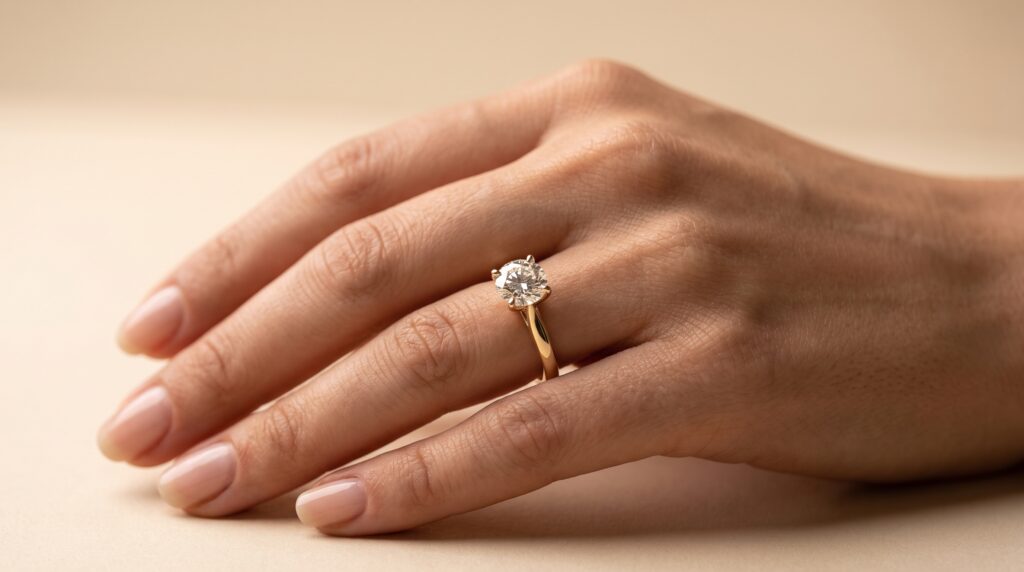
Comfort in a minimalist ring often comes down to band shape as much as width. A comfort-fit interior, with a slightly rounded edge on the inside of the band, reduces friction against the finger compared to a standard flat-interior band, a detail worth requesting regardless of which band width you choose.
Snagging risk is generally lower in minimalist designs simply because there’s less raised detail to catch on gloves, hair, or fabric, though setting height still matters: a high-set solitaire snags more easily than a low-profile bezel, even within the minimalist style.
Stacking with a wedding band works especially well with minimalist designs, since the simple silhouette doesn’t compete visually or physically with whatever sits alongside it. A straight-shank minimalist ring pairs most easily with a straight-edged wedding band.
Active lifestyles benefit from bezel or low-profile prong settings within the minimalist category, since both reduce exposure and snag risk compared to a high-set solitaire.
Glove compatibility improves with lower-profile settings generally, since there’s less raised metal or stone to catch on the glove’s interior lining.
Thin bands, while elegant, do wear faster over time than medium or wide bands, simply because there’s less metal to begin with before thinning becomes noticeable. This isn’t a reason to avoid a thin band, but it’s worth knowing before choosing one purely on appearance.
Long-term maintenance for a minimalist ring generally involves fewer components to check than an elaborate halo or pavé design, since there are fewer prongs and stones overall, though the same basic routine, cleaning, inspection, and, for white gold, replating, still applies.
| Lifestyle | Recommended Setting | Recommended Band Width | Notes |
| Desk-based, low activity | Solitaire or low-profile prong | 1.5–2mm | More flexibility for a delicate, minimal look |
| Manual work, frequent hand use | Bezel | 2–2.5mm | Reduces snagging and impact exposure |
| Active sports or gym-heavy routine | Bezel, low-profile | 2–2.5mm | Minimizes catching on equipment or gloves |
| Frequent stacking with a wedding band | Straight-shank solitaire or bezel | 1.5–2mm | Pairs most easily with a straight-edged band |
How to Choose the Right Band Width
A 1.5 to 2mm band reads as delicate and minimal, keeping the visual focus almost entirely on the center stone. It suits buyers who want the most understated possible presence for the band itself, though it wears faster over time than a wider band and can feel less substantial under repetitive hand use or pressure.
A 2 to 2.5mm band offers a middle ground: still clean and minimal in appearance, but with more metal to resist wear and distribute pressure more evenly across the finger. This width is often recommended as the practical sweet spot for buyers wanting both a minimalist look and reasonable long-term durability.
A 2.5mm or wider band makes more of a visual statement while still reading as clean and minimalist, provided the design avoids extra ornamentation. It offers the most durability and the most even pressure distribution of the three ranges, at the cost of a slightly less delicate overall look.
Finger proportions play a role in what looks visually balanced, though this is ultimately a matter of personal preference rather than a strict rule. Comfort matters more in daily practice: a band that feels good on the hand during normal use will always outperform one chosen purely for how it looks in a photo.
Common Minimalist Engagement Ring Mistakes to Avoid
Prioritizing carat size over cut quality is one of the more common regrets, since a larger but poorly cut stone often looks less impressive than a smaller, well-cut one, especially in a minimalist setting where the stone has nowhere to hide.
Choosing an ultra-thin band without understanding its durability tradeoffs can lead to a ring that shows wear sooner than expected. A thin band isn’t a bad choice, but it should be a deliberate one, made with the wear timeline in mind.
Ignoring wedding band pairing until after the engagement ring is purchased can create fit problems later, particularly with curved or contoured designs. Considering this upfront, even loosely, avoids complications down the line.
Buying without certification removes the only objective way to confirm a stone’s actual clarity, color, and measurements, which matters just as much for a minimalist solitaire as for any other style, since the center stone carries the full visual weight of the design.
Choosing based on trends rather than personal taste can lead to a ring that feels less meaningful once the specific trend fades, somewhat working against the timeless appeal that draws many buyers to minimalist design in the first place.
Not checking profile height before purchasing, particularly when buying online, can result in a ring that looks different in person than expected, since photos don’t always convey how far a stone sits off the finger.
Online Buying Checklist for Minimalist Engagement Rings
Review high-resolution images of the actual ring, not just a rendered or stock photo of a similar design.
Check side-profile views specifically, since these show setting height and overall silhouette more clearly than a top-down shot.
Confirm band width measurements are listed in the product details, and compare them against a ring you already own for a concrete sense of scale.
Note the setting height listed, if available, to judge how far the stone will sit off the finger.
Request or review the certification for the center stone, confirming clarity, color, and measurements match what’s listed.
Read the return policy and confirm the timeline and any conditions attached to it.
Check the resizing policy, including cost and turnaround time.
Verify the metal hallmark information matches the karat or purity claimed in the listing.
Look for real customer reviews, particularly ones mentioning comfort, day-to-day wear, or how the ring compares to its photos.
Watch for video of the ring on an actual hand, which gives a more realistic sense of scale and profile than studio photography alone.
Care and Maintenance for Minimalist Engagement Rings
Clean the ring every one to two weeks using warm water, a small amount of mild dish soap, and a soft-bristled brush, focusing on the underside of the setting where oils and lotion collect.
Schedule a professional inspection about once a year, checking prong tightness and overall wear. GIA notes that even though diamonds themselves are extremely hard, a loose stone can gradually wear down its own prongs through repeated small movements, which is exactly the kind of issue routine inspection is meant to catch early.
Check prongs periodically between professional visits, gently feeling for any looseness in the stone.
If the ring is white gold, plan for rhodium replating roughly every one to three years, depending on how much daily wear the ring sees, to maintain its bright white finish.
Store the ring separately from other jewelry, ideally in a soft-lined box, to avoid scratches from harder stones or metal edges it might otherwise contact.
Remove the ring during activities with a real risk of impact or chemical exposure, heavy lifting, contact sports, cleaning with harsh chemicals, or swimming in chlorinated water.
Frequently Asked Questions
What makes an engagement ring minimalist?
A minimalist engagement ring is defined by clean lines, limited ornamentation, and a design built around a single focal point, usually the center stone, rather than layered detailing like filigree or extensive pavé. It doesn’t require a small stone or a low price; a large, high-quality diamond in a simple solitaire setting is just as minimalist as a smaller one.
Are minimalist engagement rings timeless?
Generally, yes. Clean, simple designs tend to be less tied to a specific style era than more elaborate or heavily detailed rings, which cycle through visible trends more noticeably. A well-proportioned solitaire or bezel setting has remained a recognizable, wearable style across many decades, though, like any design choice, specific details can still feel more or less current depending on execution.
Are minimalist rings durable enough for daily wear?
Yes, particularly when paired with a protective setting like a bezel or a well-secured prong design. Durability in a minimalist ring depends more on setting choice, band width, and metal selection than on the style itself. A thinner band does wear faster than a thicker one over time, which is worth factoring into the decision rather than assuming minimalist automatically means fragile.
What is the best setting for a minimalist ring?
There’s no single best setting; it depends on priorities. A solitaire shows the most of the stone and keeps the classic minimalist look. A bezel offers the highest durability and lowest maintenance at a slight cost to sparkle. A low-profile prong setting balances the two, offering reasonable practicality without moving fully into a bezel’s enclosed look.
Do minimalist rings look cheaper?
Not when proportions, materials, and craftsmanship are considered carefully. A well-executed minimalist ring in a quality metal with a well-cut center stone reads as intentional and refined rather than plain. Perceived cheapness in a simple design usually comes from poor proportions or a poorly cut stone, not from the minimalist style itself.
What band width is best?
There’s no universal answer. A 1.5 to 2mm band offers the most delicate, understated look but wears faster over time. A 2 to 2.5mm band is often recommended as a practical middle ground between minimalist styling and everyday durability. A 2.5mm or wider band offers the most durability and even pressure distribution while still reading as clean and minimalist if the design avoids extra detailing.
Is platinum better than gold?
Neither is universally better. Platinum offers strong durability and requires no replating, appealing to buyers wanting the lowest long-term maintenance, but it costs more and weighs more on the hand. 14K gold offers comparable everyday durability at a lower cost and lighter weight. The right choice depends on which tradeoff, cost and weight versus long-term upkeep, matters more to you.
Should I choose bezel or prong?
A bezel offers more protection and lower maintenance, since it encloses the stone’s edge entirely and has no raised prongs to catch or loosen over time. A prong setting shows more of the stone and generally allows more light in, producing more visible sparkle. Active lifestyles or buyers wanting the lowest-maintenance option often lean toward bezel; buyers prioritizing maximum brilliance often lean toward prong.
What diamond shape looks best in minimalist settings?
Round brilliant is the most common choice for maximizing sparkle in a minimalist solitaire, since its faceting is optimized for light return. Emerald cut suits the style particularly well too, since its clean, architectural lines already align with minimalist design principles. Ultimately, any shape can work in a minimalist setting; the style is defined by the setting’s restraint, not by which shape is chosen.
Can minimalist rings be resized?
Yes, generally without complication, since minimalist designs typically don’t have stones or detailing extending down the band that would restrict resizing the way a full eternity band or heavily engraved design might. This is one of the practical advantages of the style’s simplicity.
Are lab-grown diamonds good for minimalist rings?
Yes. Lab-grown diamonds are chemically and optically identical to natural diamonds, and since a minimalist setting puts full visual weight on the center stone, choosing a lab-grown option can let a buyer prioritize a higher cut quality or larger carat weight within the same budget, both of which have a noticeable visual impact in this style.
Do minimalist rings pair easily with wedding bands?
Yes, generally more easily than more elaborate designs, since a simple silhouette doesn’t compete visually or physically with whatever sits next to it. A straight-shank minimalist ring pairs most easily with a straight-edged wedding band, while a curved minimalist design may benefit from a wedding band designed to nest against its specific shape.