
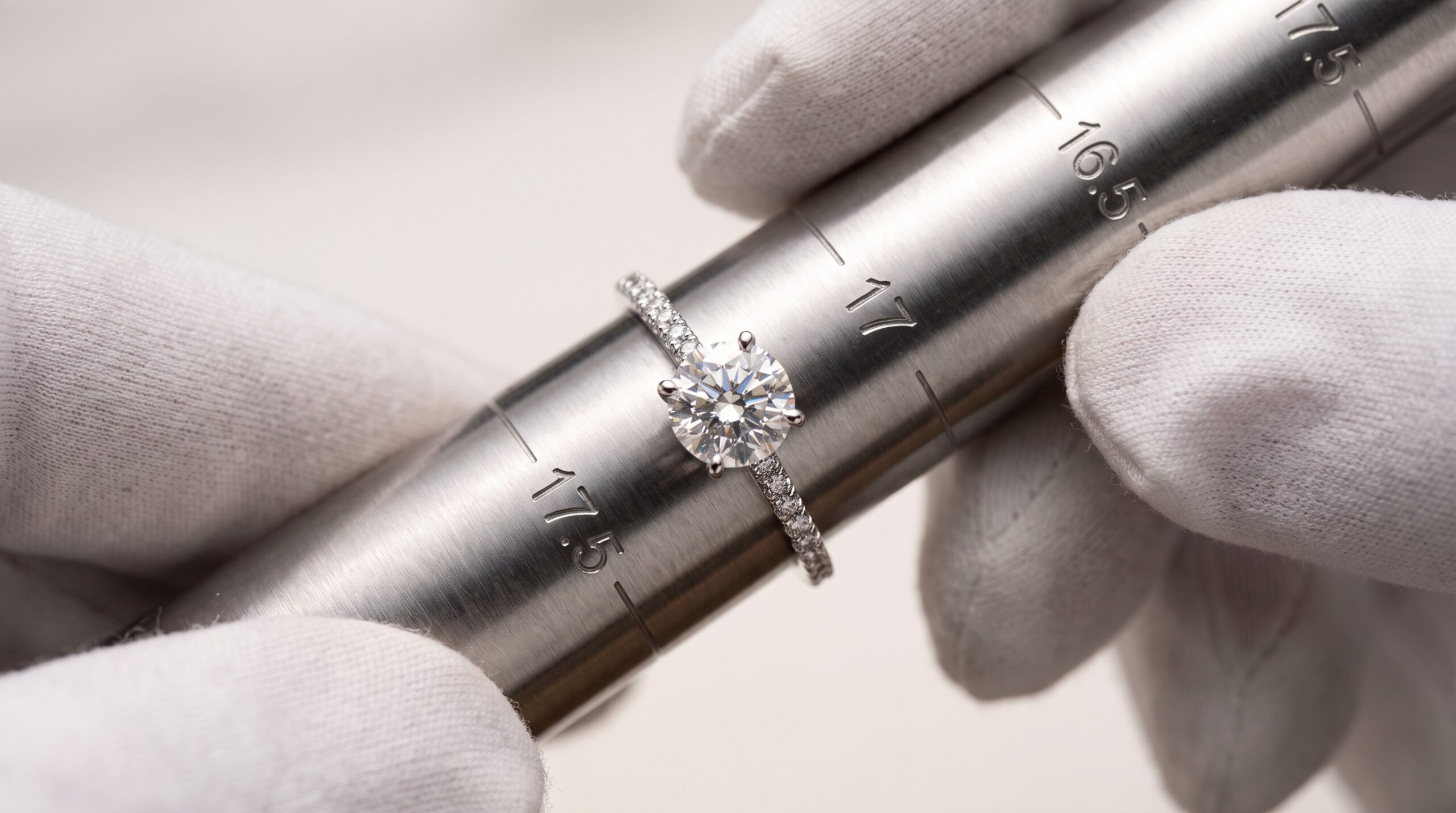
A ring that fit perfectly at the proposal doesn’t always fit the same way six months later. Fingers change size with temperature, time of day, activity level, and the ordinary shifts a body goes through over time, and an engagement ring sized in a jewelry store under one set of conditions can feel different once it’s worn daily. Needing to resize a ring isn’t a sign anything went wrong with the original fitting. It’s a normal part of owning a ring you wear every day.
What isn’t universal is how easy that resizing is. A plain gold band and a diamond-encrusted eternity ring are not the same job, and treating them as if they were is how damage happens. The design, the metal, and how many stones sit around the band all determine what a jeweler can safely do.
What Does Resizing an Engagement Ring Mean?
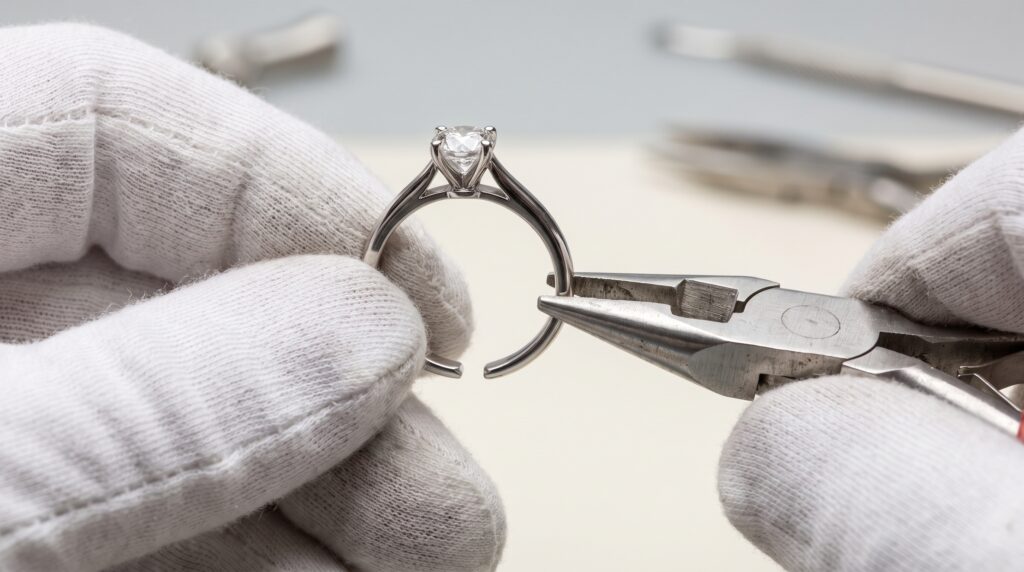
Resizing up, making the ring larger, usually means the jeweler cuts the band at the back, adds a small section of matching metal, and solders it into a seamless join. Resizing down works in the opposite direction: a small section of the band is cut out, and the two ends are brought together and soldered.
Both directions sound simple in description, but the execution is not. Once soldered, the join has to be shaped, filed, and polished to match the rest of the band, and the ring’s proportions, weight distribution, and stone alignment all need to stay consistent with the original design. This is precision work, which is why it should always go to a qualified jeweler rather than being treated as a quick fix.
A ring should sit securely below the knuckle without needing force to get on or off, and it shouldn’t leave deep indentations, pinch, or spin freely around the finger during normal movement. If the current fit falls clearly outside that range, in either direction, that’s the signal resizing is worth considering.
How Do You Know If Your Engagement Ring Needs Resizing?
A ring that’s too tight leaves a visible mark that takes more than a few seconds to fade, feels uncomfortable or painful during wear, or is genuinely difficult to remove even with soap and water. Persistent discomfort or swelling around the ring is a stronger signal than any of these alone.
A ring that’s too loose spins constantly on the finger, slides over the knuckle with little resistance, or feels unstable enough during daily movement that there’s a real risk it could slip off unnoticed. Any of these on their own might be minor. Together, or happening consistently, they point to a fit problem rather than a one-off.
Before deciding a ring needs resizing, it’s worth ruling out temporary causes. Heat and physical activity cause fingers to swell slightly, while cold weather can shrink them. Time of day matters too. Fingers are often smaller in the morning and larger later in the day. If a ring feels tight after a hot afternoon or loose first thing in the morning, that’s not necessarily the ring’s actual size, it’s a temporary condition worth checking again under normal circumstances before booking an appointment. The GIA’s guide to ring sizing covers these fluctuations and how to account for them when measuring size.
| Fit Issue | What It May Mean | What to Do Next |
| Leaves a deep mark or feels painful | Likely too tight for daily wear | Have a jeweler confirm size, consider resizing up |
| Difficult to remove even with soap | Likely too tight, possibly needs resizing | Check consistently over a few days, not just once |
| Spins or slides over the knuckle easily | Likely too loose | Consider resizing down or a temporary fix like sizing beads |
| Fits differently depending on time of day or weather | Likely temporary, not a true sizing issue | Recheck fit under normal, consistent conditions before deciding |
Can All Engagement Rings Be Resized?
Plain solitaires and simple bands, in gold or platinum, are usually the most straightforward rings to resize. There’s a clear section of plain metal at the back of the band to work with, no stones near the cut point, and no pattern that needs to stay aligned across a new seam.
Pavé bands, channel-set bands, engraved bands, and rings with a patterned shank are harder. Cutting and resoldering near small stones risks loosening them or disrupting the setting, and engraving or repeating patterns can be difficult to realign cleanly once metal is added or removed. This doesn’t mean these styles can’t be resized, but the range of safe adjustment is often smaller, and the process typically takes more skill and more time.
Full eternity rings, where stones circle the entire band, present the biggest challenge. There’s often no plain section of metal left to cut, which means resizing may require removing and resetting stones near the join, a more involved and more expensive process than a standard resize. The same applies to highly custom designs, certain alternative metals that don’t solder the way gold and platinum do, and any design where a continuous pattern runs the full circumference of the band.
| Ring Style | Resizing Difficulty | Why | Best Advice |
| Plain solitaire or simple band | Easier | Clear plain-metal section to cut and rejoin | Standard resizing, usually straightforward |
| Pavé or channel-set band | Moderate to difficult | Stones near the cut point risk loosening | Ask a jeweler about safe adjustment range before booking |
| Engraved or patterned shank | Moderate to difficult | Pattern must realign across the new seam | Confirm the jeweler can match the existing pattern |
| Full eternity ring | Often difficult | Stones may circle the entire band, leaving no plain section | Ask whether resizing requires resetting stones near the join |
| Tension setting | Difficult | Stone security depends on precise band tension | Requires a jeweler experienced with this specific setting type |
How Ring Metal Affects Resizing
Gold is the most commonly resized metal, and most gold rings can be adjusted without much difficulty, though higher karat gold is softer and can be more prone to wear at the new seam over time.
Platinum is durable and holds up well long-term, but it has a higher melting point and generally takes more time and skill to work with, which can mean a higher labor cost for the same adjustment compared to gold.
White gold rings are typically finished with a rhodium plating for their bright white color, and that plating can be affected by the heat and polishing involved in resizing. It’s common for a white gold ring to need replating after a resize to restore an even finish, which is a normal follow-up step rather than a sign of a problem.
Rose gold gets its color from a higher copper content in the alloy, and some rose gold formulations are more prone to firescale or discoloration when heated during soldering, which can make the resizing process slightly more demanding for a jeweler to execute cleanly.
| Metal | Resizing Ease | Cost Consideration | Aftercare Note |
| Yellow or gold-tone gold | Generally easier | Standard resizing cost for most karats | Softer gold may wear faster at the new seam over years |
| Platinum | Moderate | Often higher labor cost due to a higher melting point | Holds up well long-term once resized |
| White gold | Moderate | Standard resizing cost, plus possible replating | Rhodium replating is common after resizing |
| Rose gold | Moderate | Comparable to standard gold in most cases | Some alloys are more prone to discoloration when heated |
How Much Can an Engagement Ring Be Resized?
Many jewelers limit resizing to roughly two to three sizes in either direction, though the actual limit depends heavily on the specific ring’s design, metal, and current condition.
Larger adjustments carry more risk. Removing or adding a bigger section of metal can distort the band’s shape, throw off the balance of a setting, or make it harder to keep a pattern or row of stones aligned across the altered section. A ring that needs an adjustment beyond what a jeweler considers safe for that design isn’t necessarily unfixable, but it may call for a different approach.
Sizing beads, small metal bumps added to the inside of the band, can make a slightly loose ring sit more securely without cutting the band at all. Ring guards, which clip or wrap around the band, offer a similar non-permanent fix. For a ring that needs a more significant change than resizing can safely provide, or a design where resizing isn’t practical, exchanging it for a properly sized version or working with a jeweler on a remake are the more realistic options.
Resizing Before or After Buying a Wedding Band
Fit should be checked with the engagement ring and wedding band together, not just the engagement ring alone. Two bands worn side by side on the same finger take up more space than either ring worn individually, and a fit that felt comfortable with one ring can feel noticeably tighter once stacked.
Band width plays into this. A wider band covers more surface area of the finger, which generally makes it feel snugger than a narrow band at the same labeled size. If the wedding band is significantly wider than the engagement ring, that’s worth factoring into the fit conversation rather than assuming the engagement ring’s current size will still work.
If the engagement ring is already uncomfortable or genuinely unsafe to wear on its own, that’s worth addressing before shopping for a wedding band. Trying to fit a second ring around a problem that already exists with the first one just compounds the issue.
What Happens After Resizing?
A jeweler should inspect the ring after resizing, checking that prongs remain secure and the stone hasn’t shifted during the process. This matters more for rings with stones near the resized section, where heat and pressure from the work are closer to the setting.
Resizing typically includes cleaning and polishing as part of the finishing work, since the new seam needs to be smoothed and blended with the rest of the band to look seamless.
For white gold, this is the point where replating usually happens if the original finish was disturbed. It’s worth asking upfront whether replating is included in the resizing cost or billed separately.
Keep the receipt or service record from the resizing work alongside the ring’s other documentation. If the ring is insured, some insurers ask to be notified of alterations like resizing, since it can affect the ring’s condition or valuation on file.
What to Ask Before Resizing Your Ring
A short conversation with the jeweler before any work begins avoids surprises later. Worth asking directly:
- Can this specific ring style be safely resized, and by how much?
- Will the process affect any stones, engraving, or the current finish?
- If it’s white gold, is replating included, and is it needed?
- Does resizing affect the manufacturer’s warranty, if there is one?
- Should the insurance policy or appraisal be updated afterward?
- How long will the ring be out of your possession?
- Will the ring be inspected for stone security after the work is done?
Buying an Engagement Ring Online? Check the Resizing Policy First
Online retailers vary widely in what their resizing policies actually cover, and this is worth reading closely before buying rather than assuming it will work out.
Look for a specific window during which resizing is free or discounted, clear limits on how many sizes can be adjusted, and explicit mention of which styles, particularly pavé or eternity designs, are excluded or handled differently. Also check the expected turnaround time and whether resizing affects the ring’s warranty terms.
Vague language like “resizing available” without specifics is a signal to ask more questions before purchasing. So is a policy that doesn’t mention non-resizable styles at all, since that often means eternity or heavily set designs weren’t considered in the policy, not that they’re automatically covered. A listing that doesn’t specify the band width or setting type also makes it harder to judge resizing difficulty in advance.
Conclusion
Most fit problems are fixable, but the safest path depends on what the ring is actually built like, not just what feels uncomfortable right now. A plain band and a full eternity ring call for different expectations, different costs, and in some cases a different solution entirely.
Before scheduling a resize, get a straight answer from a jeweler on whether your specific ring can be safely adjusted and by how much, and if it’s white gold, ask about replating as part of the same conversation rather than as a surprise afterward. That single conversation settles most of the uncertainty around cost, risk, and timeline before any metal gets cut.
Frequently Asked Questions
How do I know if my engagement ring needs resizing?
Look for consistent signs rather than a single uncomfortable moment. A ring that’s too tight leaves a mark lasting more than a few seconds, feels painful, or is hard to remove even with soap and water. A ring that’s too loose spins constantly, slides over the knuckle easily, or feels unstable during normal daily movement. If either pattern holds up across different days and conditions, not just one hot afternoon or one cold morning, it’s a genuine sizing issue worth addressing.
Can all engagement rings be resized?
No. Plain solitaires and simple bands are usually easy to resize because there’s a clear section of plain metal to work with. Rings with pavé, channel-set stones, engraving, or patterns running along the band are harder, since the cut point is closer to stones or design elements that need to stay intact. Full eternity rings, where stones circle the entire band, often have no plain metal left to alter and may require resetting stones near the join rather than a standard resize.
Is it better to size a ring up or down?
Neither direction is inherently better, since each solves a different problem. Sizing up adds metal for a ring that’s too tight, and sizing down removes metal for a ring that’s too loose. The right direction depends entirely on the actual fit issue, not a general preference.
How many sizes can a ring usually be resized?
Many jewelers work within a range of about two to three sizes in either direction, though the real limit depends on the ring’s specific design, metal, and current condition. A simple band may tolerate a larger adjustment than a ring with stones close to where the cut needs to happen. A jeweler examining the actual ring can give a more precise answer than a general rule.
Can pavé rings be resized?
Often yes, but with more care and a narrower safe range than a plain band. The stones set along the band sit close to where the metal would normally be cut, so resizing pavé rings risks loosening those stones if not done carefully. A jeweler experienced with pavé settings can usually manage a modest adjustment, but it’s worth confirming the safe range before assuming the ring can be resized as freely as a plain solitaire.
Can eternity rings be resized?
Sometimes, but it’s the most difficult category to resize cleanly. If stones circle the entire band, there may be no plain metal section left to cut, which means the jeweler may need to remove and reset stones near the join. This is more involved and typically more expensive than resizing a ring with a plain shank, and in some cases a jeweler may recommend an exchange or remake instead.
Will resizing damage my diamond?
A properly executed resize by a qualified jeweler shouldn’t damage a securely set diamond, since the work focuses on the band rather than the stone itself. The greater risk is to the setting and surrounding stones, particularly in pavé or channel-set designs where the cut point is close to smaller stones. This is why an inspection after resizing matters: it confirms the stone and prongs are still secure once the work is done.
Does resizing affect the warranty?
It depends on the retailer or manufacturer. Some warranties remain valid as long as resizing is done by an authorized or approved jeweler, while others may be voided by any alteration performed outside their own service. This varies enough between brands that it’s worth checking the specific warranty terms, or asking directly, before having the work done elsewhere.
Should I resize before buying a wedding band?
If the engagement ring is already uncomfortable or unsafe to wear on its own, yes, that’s worth resolving first. If the fit is only borderline, it’s better to try the engagement ring and wedding band on together before deciding, since two bands stacked on the same finger take up more space than either ring alone, and a width difference between the two can change how snug the combination feels.
Does white gold need replating after resizing?
Often, yes. The heat and polishing involved in resizing can disturb the rhodium plating that gives white gold its bright white finish, and many rings come out of a resize with a slightly uneven color as a result. Replating restores an even finish and is a common, expected step after resizing white gold rather than an indication anything went wrong during the process.