
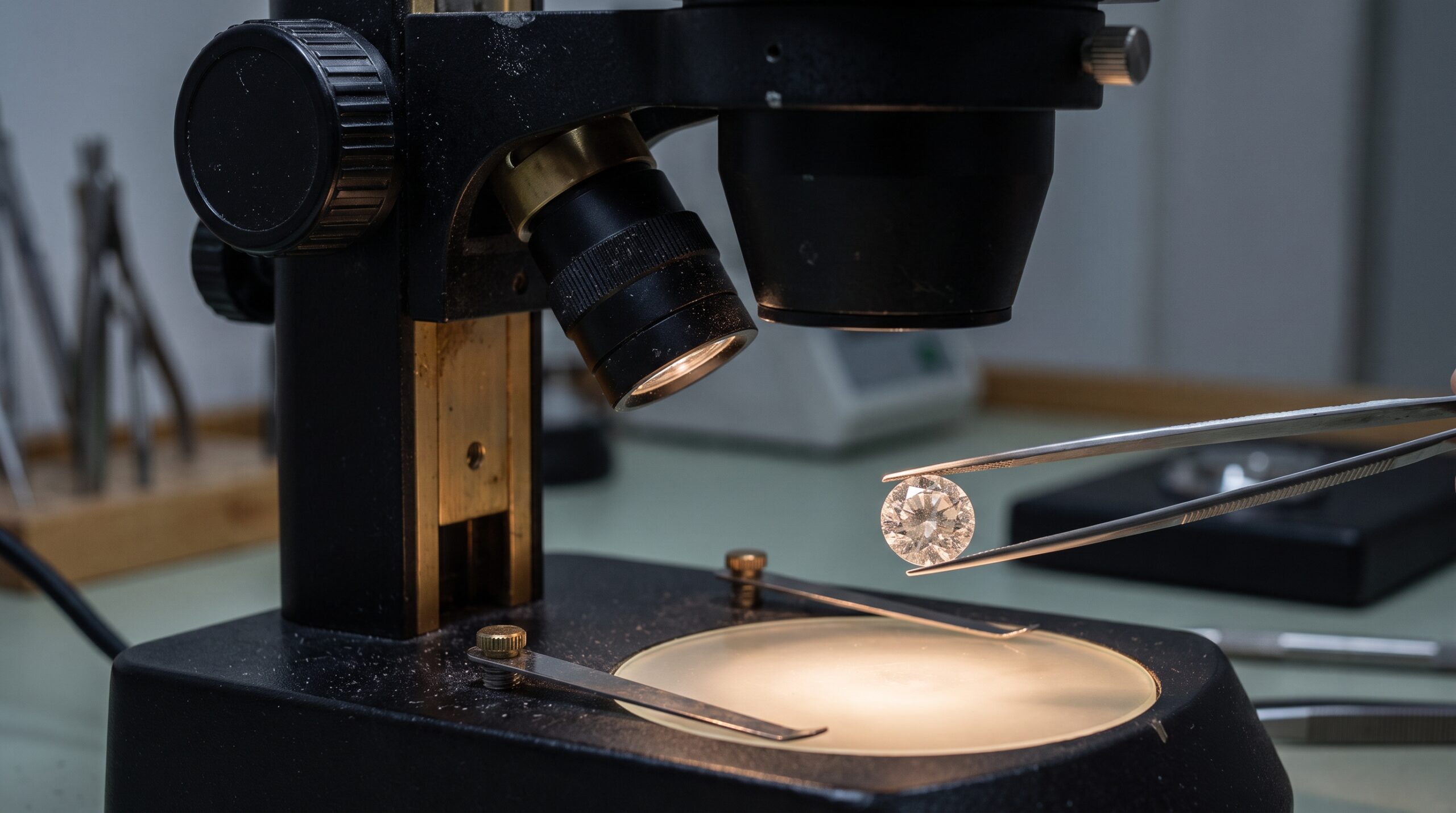
A lab grown diamond doesn’t come out of a machine finished. It starts as a thin sliver of existing diamond, called a seed, and grows outward as carbon atoms attach themselves to that seed’s crystal structure over a period of weeks. Nothing is poured into a mold and nothing prints instantly. The process is closer to cultivating a crystal than manufacturing a part.
That distinction matters to anyone reading a product page or a laboratory report, since terms like HPHT, CVD, “as-grown,” and post-growth treatment show up constantly and get used loosely. This article walks through how a seed becomes a rough diamond crystal, what happens to that crystal before it becomes a finished stone, and where growth method actually matters to a buyer and where it doesn’t.
How a Lab Grown Diamond Is Made at a Glance
The full path from seed to jewelry runs through several stages: a diamond seed is selected and prepared, it’s placed in either an HPHT press or a CVD chamber, conditions are created that let carbon crystallize onto it, the rough diamond is monitored as it grows, then removed and inspected. From there it may receive a post-growth treatment to adjust color, gets planned, cut, and polished, goes through laboratory analysis, and finally gets set into a piece of jewelry with its own quality check. Growth is the part most people picture when they hear “lab grown diamond,” but it’s only the first half of the process.
What Is a Diamond Seed?
A diamond seed, sometimes called a substrate, is a small existing piece of diamond that gives new carbon atoms a structure to follow. It isn’t a placeholder sitting inside a finished replica; it’s the actual starting point that the rest of the crystal grows around or on top of. Both HPHT and CVD production rely on a seed. Once growth finishes, the rough crystal still has to be planned and cut like any other rough diamond, and depending on how the piece is cut, some of the original seed material may remain in the final stone or may be removed entirely during planning.
Think of the seed as the first tile in a pattern that’s been aligned exactly. Everything added afterward follows the structure that first tile established.
The two production methods differ mainly in how they get carbon to that seed.
How HPHT Diamonds Are Made
HPHT stands for high pressure, high temperature, and it’s the older of the two commercial growth methods.
Step 1: Preparing the Growth Capsule
A capsule is loaded with a diamond seed, a solid carbon source, and a metal catalyst or flux that will help move carbon from the source to the seed.
Step 2: Applying Pressure and Heat
The capsule goes into specialized press equipment that creates extreme pressure alongside temperatures commonly above 1,300 degrees Celsius, conditions similar to what naturally forms diamond deep in the earth’s mantle, according to GIA’s description of the HPHT and CVD growth processes.
Step 3: Dissolving and Transporting Carbon
Under that heat, the metal catalyst melts and carries dissolved carbon toward the cooler seed sitting elsewhere in the capsule.
Step 4: Growing the Diamond Crystal
As carbon reaches the seed, it crystallizes onto it, adding new diamond material. How long this takes depends on the equipment, the target size, and the specific production run; there’s no single fixed growth time across the industry.
Step 5: Removing and Inspecting the Rough
Once growth finishes, the rough crystal comes out of the capsule for inspection: size, shape, color, internal features, and whether it’s worth cutting into a particular shape.
Some HPHT-grown stones can show metallic flux inclusions left over from the catalyst, or a blue tint and phosphorescence under certain conditions. None of these show up in every stone, and they’re worth evaluating in the specific diamond in front of you rather than assuming as a category rule.
CVD growth starts from the same kind of seed but builds the crystal a very different way.
How CVD Diamonds Are Made
CVD stands for chemical vapor deposition. Instead of pressure, it relies on gas and energy.
Step 1: Preparing Diamond Seed Plates
Flat diamond substrates are cleaned and placed inside a chamber held at low pressure.
Step 2: Introducing Carbon-Containing Gas
Hydrogen gas and a carbon-containing gas, usually methane, are pumped into the chamber.
Step 3: Creating Plasma
Microwave energy activates the gas mixture and turns it into plasma, an energized gas made up of reactive particles.
Step 4: Depositing Carbon Layer by Layer
Carbon particles from the plasma settle onto the diamond substrate and continue building its crystal structure, one thin layer at a time, a process documented in GIA’s review of CVD-grown synthetic diamonds.
Step 5: Removing and Inspecting the Rough
The resulting rough is removed from the chamber and examined the same way an HPHT rough is, before deciding how it will be planned and cut.
CVD-grown stones can sometimes carry brown or gray undertones, growth layers, strain, or dark inclusions left from the deposition process. Production quality has improved substantially over the past decade in terms of both size and clarity, but as with HPHT, these characteristics don’t appear in every stone and shouldn’t be assumed from the method label alone.
HPHT vs CVD: What Is the Difference?
| Factor | HPHT | CVD |
| Growth environment | High pressure chamber | Low pressure chamber |
| Carbon source | Solid carbon dissolved by a metal catalyst | Carbon-containing gas, usually methane |
| Conditions | Intense pressure, high heat | Plasma generated by microwave energy |
| Rough crystal form | Often more block-like | Often tabular or layered |
| Possible characteristics | Metallic flux inclusions, blue tint, phosphorescence in some stones | Brown or gray undertones, growth striations in some stones |
| Common treatment | Sometimes further HPHT treatment for color | Frequently HPHT-treated after growth to remove brown tint |
| Typical report terminology | Growth method noted where reported | Growth method and treatment noted where reported |
Is HPHT or CVD Better?
Neither method is better across the board. A well-cut HPHT diamond can easily outperform a poorly cut CVD diamond in brightness and fire, and the reverse holds just as well. What determines how a stone actually looks and wears has more to do with the finished cut, the transparency, the color, the clarity as it appears to the eye, the shape and symmetry, the measurements, the price, and whether the documentation can be verified, than with which chamber it came out of.
Growth is the beginning of the process, not the end of it.
What Happens After the Diamond Has Grown?
Initial Inspection
The rough crystal gets assessed for shape, size, internal features, color, transparency, and how much finished, sellable material it’s likely to yield once cut.
Post-Growth Treatment
Some diamonds are treated after growth to improve their color, and this is where HPHT terminology gets confusing. CVD refers only to a growth method. HPHT can refer either to growth itself or to a separate treatment applied afterward, most often to a CVD-grown stone that came out of the chamber with a brownish tint. An HPHT-treated CVD diamond is still a lab grown diamond; the treatment changes its color, not its material identity. According to IGI’s explanation of post-growth treatment stability, color treatment performed properly is generally stable under normal wear conditions. Whether a stone was treated should be disclosed when it’s detected and when the report format calls for it.
Planning the Cut
Before any cutting starts, specialists study the rough to decide how to divide and orient it, balancing finished size against cut quality, shape, where any inclusions sit, and color.
Cutting and Polishing
The rough is laser-cut, sawn, shaped, faceted, and polished, using largely the same skills and tools used on natural diamond rough.
Final Quality Control
The finished stone gets checked for proportions, symmetry, polish, any damage from the cutting process, and overall transparency before it moves on to grading or sale.
Rough crystal, planning, cutting, faceting, polishing, assessment, setting: that’s the full sequence, and skipping any one of those steps would leave a stone unfit for jewelry regardless of how clean its growth was.
What Does “As-Grown” Mean?
“As-grown” means a lab found no evidence that the diamond was treated after it finished growing. It’s a statement about treatment history, nothing more. It doesn’t mean the stone has a better cut, higher color, better clarity, more transparency, greater durability, a smaller environmental footprint, or stronger resale value. A poorly cut as-grown diamond can still look lifeless next to a well-cut treated one. If untreated status matters to you personally, the way to confirm it is a laboratory report that states it explicitly, not a filter on a retail website.
Does Growth Method Affect Diamond Quality?
Manufacturing conditions can influence a rough crystal’s internal features, its graining, or its transparency, but growth method by itself isn’t a quality grade a buyer can shop by.
Cut and Proportions
Cut quality is decided during planning and polishing, after the rough has already grown, and it has more influence on visible brightness and sparkle than anything about the growth chamber does.
Color and Undertones
Rather than assuming every HPHT or CVD stone carries a particular tint, look at actual video of the specific diamond in question. Undertones vary stone to stone, not method to method.
Clarity and Inclusions
Both growth methods can produce internal features. What matters for a buyer isn’t which method produced them but whether they affect the stone’s appearance, its transparency, or its long-term durability.
Transparency
A diamond can carry an appealing clarity grade and still look slightly hazy if internal graining or strain interferes with how light passes through it. A lively diamond behaves like a clean window; a hazy one behaves more like a window with a light mist on it.
Carat and Measurements
Carat is a unit of weight, equal to 0.2 grams according to GIA, and it doesn’t tell you how large a stone will look from above. Millimeter measurements do that more directly, since two stones of identical carat weight can appear noticeably different in diameter depending on how they were cut.
When comparing stones, overall appearance and transparency come first, followed by cut and proportions, face-up dimensions, color, eye-visible clarity, documentation, and growth method last, if it matters to you at all.
Are HPHT and CVD Diamonds Equally Durable?
Yes. Both are diamond, and both are suitable for engagement rings, wedding bands, earrings, and any other piece meant for daily wear. Diamond’s hardness mostly describes resistance to scratching, not immunity to chipping; a hard blow at a vulnerable angle, especially at a pointed tip, can still chip a diamond regardless of whether it grew through HPHT or CVD or formed naturally underground. Setting design usually matters more for how a ring holds up day to day than growth method does. Pointed shapes need extra protection at the tip, and prongs, pavé settings, and the surrounding metal all need periodic inspection.
How Manufacturing Relates to Ring Design and Wearability
Whether a stone grew through HPHT or CVD has no effect on ring size or comfort. What actually affects wearability is the shape and dimensions of the diamond, how high the setting sits, how well the prongs protect its edges, the width of the band, the thickness of the metal, whether it needs to sit flush against a wedding band, how the whole piece balances on the finger, and what the wearer actually does with their hands day to day.
A low-profile solitaire tends to snag less and suits an active routine better than a high-set solitaire, which shows off more of the stone’s profile but sits more exposed. A bezel setting wraps the stone in metal and protects the girdle at the cost of some light entering from the side. A halo adds visual size around a smaller center stone but adds more small stones that need periodic cleaning and inspection. Pavé and channel-set bands both distribute smaller diamonds along the ring, but channel settings tend to be harder to resize since the stones sit between two metal walls rather than under individual prongs. None of these tradeoffs change based on where the center diamond was grown; they come down to how the ring itself was built.
How Laboratory Reports Describe Lab Grown Diamonds
Retailers commonly call these documents “certificates,” but grading report or quality assessment describes them more accurately. A useful report identifies laboratory-grown origin, gives a report or assessment number, states carat weight and measurements, includes quality information, and notes the growth method and any post-growth treatment when that information is part of the report format. Many stones also carry a laser inscription that can be checked against the report number.
Report formats aren’t interchangeable across labs. IGI’s laboratory-grown diamond reports generally provide traditional 4Cs information similar to what appears on a natural diamond report. GIA, since October 2025, has used Premium or Standard quality assessments for eligible colorless to near-colorless lab grown diamonds rather than issuing individual color and clarity grades. Comparing a GIA assessment to an IGI report as though the terminology lines up one to one will lead to the wrong conclusion about which stone is actually better documented.
A report confirms what was examined. It doesn’t guarantee retail value, future resale, the quality of the setting it eventually goes into, environmental performance, or warranty coverage; those are separate matters a buyer needs to check directly with the seller.
Does the Manufacturing Method Affect Price?
Growth method can influence production cost and how much supply is available, but the price of a finished stone depends on far more: carat weight, shape, cut quality, color, clarity, transparency, measurements, the documentation behind it, the metal it’s set in, the retailer’s margin, and what warranty or service comes with the purchase. Live pricing data, such as StoneAlgo’s tracked listings for one-carat lab grown diamonds, reflects a specific snapshot of active listings rather than a fixed market rate, and it should be read that way rather than treated as a number that holds indefinitely. Loose-diamond pricing and finished-ring pricing are also two different figures; a low price on a loose stone doesn’t tell you what the completed ring will cost once it’s set.
How to Evaluate Environmental Claims
Both HPHT and CVD require substantial energy to run. A grower using a coal-heavy electricity grid and one using renewable power can both produce “lab grown” diamonds, and the growth-method label on its own says nothing about which is which. If a sustainability claim matters to a purchase, it’s worth asking where the diamond was grown, where it was cut and polished, what emissions boundaries were used to measure any claim, whether renewable energy was actually used and how that’s documented, and whether an independent party verified any of it. The FTC’s Green Guides set the general standard that environmental marketing claims need to be substantiated, not simply asserted. A program like SCS-007 offers an independent sustainability standard, but it’s a separate document from a gemological grading report and answers a different question entirely.
Online Buying Checklist
Before buying a lab grown diamond online, confirm the listing states its laboratory-grown origin clearly, matching FTC guidance on diamond advertising. Look for actual photos and video of the exact stone rather than stock imagery, and check that the report can be verified directly with the issuing lab. Confirm the carat weight and millimeter measurements, the cut, polish, and symmetry information, and the growth method and treatment details if those matter to you. If a girdle inscription is claimed, check that it matches the report. Read the return and inspection period, any resizing restrictions, the warranty and repair coverage, the metal purity, and the full price including the setting and any customization, before checkout rather than after.
Treat a few things as warning signs: a seller pricing a stone mainly around its HPHT or CVD label rather than its actual quality, report numbers that can’t be verified, “as-grown” presented as if it guarantees superior quality, stock photography passed off as the specific stone, vague origin or treatment language, sustainability claims with no evidence behind them, and customization restrictions that only surface at checkout.
Care and Maintenance
Care is identical regardless of growth method. Clean with warm water, a mild soap, and a soft brush, rinse thoroughly, and dry with a lint-free cloth. Store the piece separately from other jewelry so nothing scratches the metal or the stone. Remove it during heavy manual work, weightlifting, or any activity with a real risk of impact, and avoid harsh chemicals. Have a jeweler check the setting periodically, and get a professional inspection after any strong impact to the ring, even if nothing looks visibly wrong. GIA advises caution with home ultrasonic or steam cleaners if there’s a chance the setting is already loose, since the vibration can make a loose prong worse rather than better. How often to have a ring checked depends on how it’s worn; someone who wears a ring during physical work needs more frequent checks than someone who mostly removes it for that kind of activity.
Knowing how a diamond was grown helps you read a report correctly and ask a seller the right questions, but it isn’t a shortcut past evaluating the actual stone. Compare the diamonds themselves, not the method labels: look at real video, verify the report with the issuing lab, ask about treatment if that matters to you, check the setting as carefully as the stone, and confirm the seller’s return and warranty terms before deciding.
Frequently Asked Questions
What is a diamond seed?
A diamond seed is a small existing piece of diamond used as the starting point for growth. New carbon atoms attach to it and follow its crystal structure, whether the growth happens through HPHT or CVD. It isn’t a placeholder inside a finished stone; it’s the actual foundation the rest of the crystal builds on.
Is CVD better than HPHT?
No single method is better across the board. Each can produce diamonds ranging from included and tinted to clean and colorless, and the finished cut has more influence on how a stone looks than which chamber it grew in. A poorly cut diamond from either method will look flat, and a well-cut one from either method will show good brightness and fire.
How long does it take to grow a diamond?
Growth time varies by equipment, target size, and the specific production run, so there’s no single number that applies across the industry. Larger, higher-quality rough generally takes longer to grow than smaller rough intended for lower-cost stones.
Does the seed remain inside the finished stone?
Sometimes. Depending on how the rough is planned and cut, some seed material may end up inside the polished stone, or it may be cut away entirely. Either outcome is normal and doesn’t affect the classification of the finished diamond as diamond material.
Is an HPHT-treated CVD diamond still real?
Yes. CVD describes how the diamond grew. HPHT treatment, applied afterward, adjusts its color, most often removing a brownish tint. The treatment changes appearance, not material identity; the stone is still diamond before and after treatment.
Is post-growth treatment permanent?
Color treatment performed correctly is generally stable under normal wear, according to industry sources including IGI. That said, “generally stable” isn’t the same as an absolute guarantee under every possible condition, which is one reason a laboratory report should disclose treatment when it’s detected.
Does “as-grown” mean higher quality?
No. It only means no evidence of post-growth treatment was found. An as-grown diamond can still have a mediocre cut, visible inclusions, or a noticeable tint. Treatment history and overall quality are separate questions.
Can buyers see the difference between HPHT and CVD?
Not reliably by eye, and often not without laboratory equipment. Certain characteristics are sometimes associated with one method or the other, but they don’t appear in every stone, and distinguishing origin generally requires the kind of specialized testing GIA and other labs use rather than casual inspection.
Are both methods equally durable?
Yes. Both produce actual diamond material with the same hardness and wear resistance. Durability in daily wear depends much more on the ring’s setting, the prong protection, and how the piece is treated day to day than on which growth method produced the center stone.
Does growth method affect price?
It can influence production cost and available supply, but the price you see on a finished stone reflects carat weight, cut, color, clarity, measurements, documentation, the setting, and the retailer’s own pricing, not the growth method alone.
Can a basic diamond tester identify origin?
No. Standard diamond testers confirm that a stone is diamond rather than a simulant like moissanite or cubic zirconia; they don’t distinguish natural origin from lab grown origin. That determination generally requires the specialized analysis used by major gemological laboratories.
What documentation should accompany a lab grown diamond?
At minimum, a report or assessment from a recognized laboratory that states laboratory-grown origin, carries a verifiable report number, and lists the stone’s measurements and quality information. Growth method and treatment details are useful additions when the report format includes them, and a matching laser inscription, where one exists, adds another point of verification.