
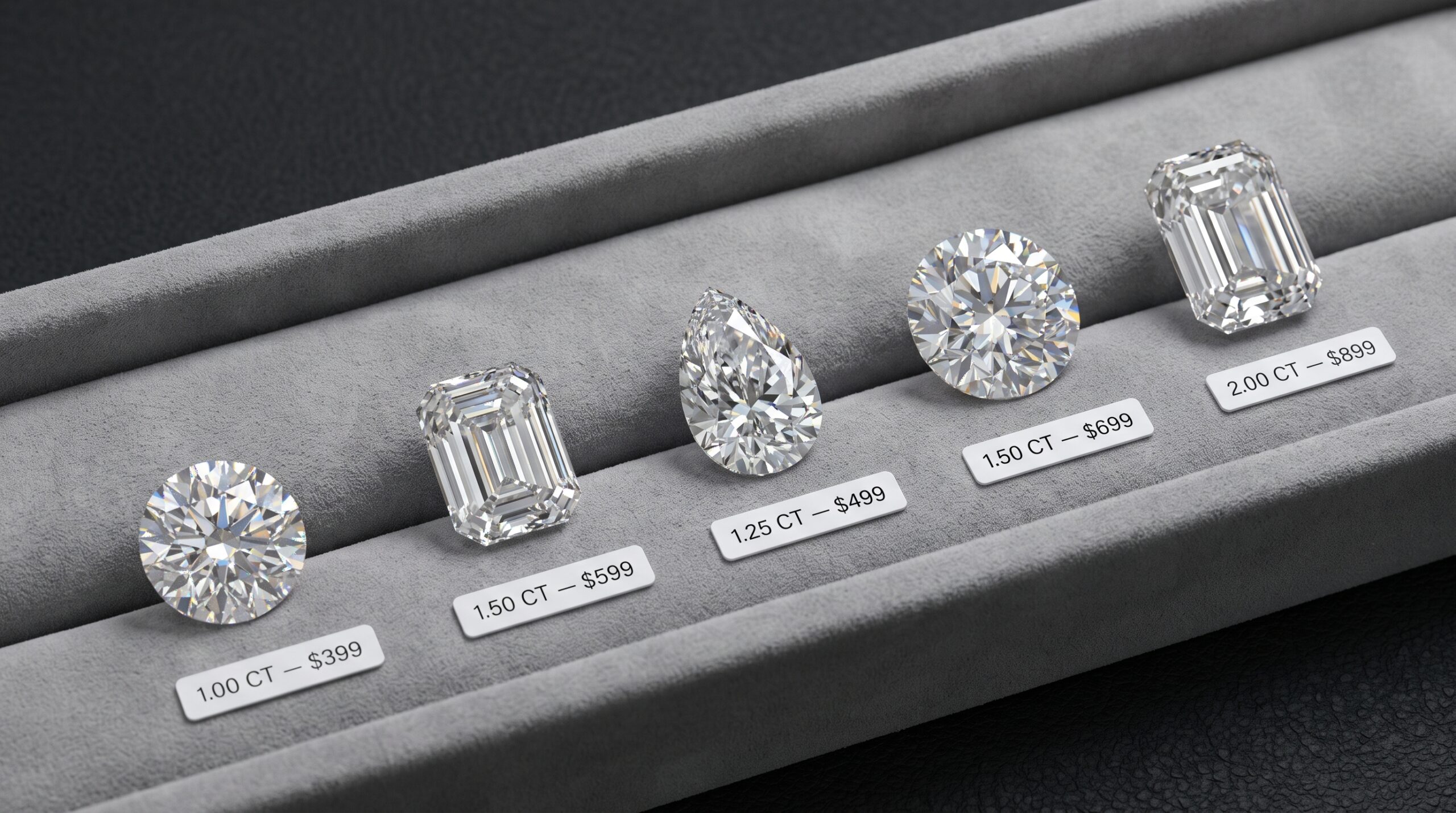
Two one-carat lab grown diamonds can sit at very different prices even when their color and clarity grades look nearly identical on paper. Asking “how much does a lab grown diamond cost” is a bit like asking how much a car costs without naming the model, trim, mileage, or dealer. Carat weight is one input among many, and it’s rarely the one that explains the gap.
Here’s how prices actually break down: current market context, the specific factors that move price up or down, what a complete ring costs beyond the stone, and the traps that lead buyers to overpay for grades they can’t see.
How Much Do Lab Grown Diamonds Cost?
As of July 15, 2026, StoneAlgo’s broad lab grown listing index showed average prices of about $483 for 0.80 carat, $631 for 1.00 carat, $1,302 for 2.00 carats, and $1,846 for 3.00 carats, based on its tracking of current lab grown diamond listing data.
| Carat weight | Broad average (July 2026) | Important context |
| 0.80 carat | $483 | Spans multiple shapes and quality levels |
| 1.00 carat | $631 | Range of roughly $299 to $1,627 across listings |
| 2.00 carats | $1,302 | Loose-diamond average, setting excluded |
| 3.00 carats | $1,846 | Broad inventory average, not one standardized stone |
That $631 figure for one carat isn’t a quote for a specific diamond. It’s an average across 330,230 live listings spanning ten shapes and a D to K color, FL to SI2 clarity range. A round, D color, VS1 diamond and a pear-shaped, K color, SI2 diamond both factor into that average despite looking nothing alike. These numbers are listing prices, not confirmed transaction prices, they cover loose diamonds only, and they’ll have moved by the time you’re reading this. Settings, tax, insured shipping, and any customization sit entirely outside them.
The list of things that actually explain the spread inside that range is long: carat weight, cut and proportions, color, clarity, shape, face-up measurements, transparency and undertone, growth and treatment history, laboratory documentation, retailer markup and service, the setting and metal, and where the market happens to sit at the time of purchase. Carat gets covered first, since it’s the number most buyers fixate on and the one most likely to mislead.
Carat Weight and Price Thresholds
Carat measures weight, not diameter. A 1.00 carat round diamond isn’t necessarily bigger-looking than a 0.95 carat round diamond; it’s 0.05 carats heavier, which may or may not translate to a visible size difference depending on how each stone is cut.
Certain carat weights, sometimes called magic sizes, carry a demand premium simply for crossing a round number: 0.50, 1.00, 1.50, 2.00, and 3.00 carats are the common thresholds. A diamond weighing 0.99 carats can look essentially identical, face up, to one weighing 1.00 carat, while costing noticeably less, because pricing tends to jump right at the round number rather than scaling smoothly. The same logic applies just under 1.50, 2.00, and 3.00 carats. This isn’t a guaranteed discount, since inventory and pricing shift, but it’s a pattern worth checking before settling on an exact round weight.
Cut proportions complicate the weight-to-size relationship further. A diamond cut too deep holds extra weight below the girdle, where it adds no visible size, so a 1.00 carat stone cut poorly can face up smaller than a well-proportioned 0.90 carat stone. This is one reason a diamond’s millimeter measurements, listed on its grading report, matter more for predicting how large it will look than the carat number alone.
Why Cut Deserves Budget Priority
Cut determines how a diamond handles light: brightness, fire, and scintillation all come from the angles and proportions the cutter chose, not from the rough material itself. Two diamonds with identical color and clarity grades can look completely different depending on cut quality, and a well-cut diamond one grade lower in color or clarity will often look better than a poorly cut diamond with superior paper grades.
For round brilliants, starting with a high cut category (GIA’s Excellent or Very Good, for example) is a reasonable baseline, but the label alone doesn’t guarantee ideal light performance within that category. Checking actual proportions and reviewing video of the specific stone still matters.
Fancy shapes need more scrutiny because overall cut grading isn’t standardized the way it is for round brilliants. An oval, cushion, radiant, pear, marquise, or emerald cut needs to be evaluated on its outline symmetry, length-to-width ratio, and whether it shows windowing (a washed-out area where light passes straight through instead of reflecting back) or a bow-tie, a dark shadow across the center common in elongated shapes. Bow-tie severity varies a lot even within the same shape category, and it’s something you can only judge by looking at the actual stone. Corner and tip protection also matters practically, since pear and marquise points are more vulnerable to chipping in daily wear.
How Color Affects Price
D through F, the top of the standard color scale, typically carry a price premium over near-colorless grades (G through J), and that premium doesn’t always correspond to a visible difference, particularly once a diamond is set. How a color grade reads also depends on the metal around it: a G color diamond can look practically colorless in platinum or white gold but slightly warmer set against yellow or rose gold, where the metal’s own tone changes what the eye picks up.
There’s no single “best” color grade that applies across every buyer, shape, and setting. Sensitivity to color varies by person, and a larger stone shows color more readily than a smaller one of the same grade. What’s worth checking regardless of grade is undertone: two diamonds carrying the same letter grade can show different brown, gray, or blue casts depending on the individual stone, something a grade alone won’t tell you. Reviewing video of the exact diamond under normal, unfiltered light (not a jeweler’s spotlight designed to maximize sparkle) is the more reliable check.
How Clarity Affects Price
High clarity grades, especially VVS1 and VVS2, often carry a substantial premium over VS or SI grades without producing any difference visible to the naked eye. “Eye-clean” isn’t an official grading term, but it’s a useful practical standard: whether inclusions are visible without magnification at normal viewing distance. A carefully selected SI1, where the inclusions are small and placed away from the center of the stone, can look identical face-up to a VVS diamond costing considerably more.
Higher clarity earns its price more clearly in a few specific situations: larger stones, where inclusions are easier to spot; emerald and Asscher cuts, whose open step-cut facets make inclusions more visible than a brilliant cut would; stones with dark inclusions positioned under the table, where they’re hardest to hide; and cases where inclusions actually affect the stone’s transparency rather than just its clarity grade on paper. Outside those situations, the grade matters less than checking the specific inclusion type and location on the report and in photos or video.
How Diamond Shape Changes Price and Visual Size
Round brilliants generally sit at a different price position than fancy shapes, largely because more rough material is lost cutting a round from an octahedral crystal than cutting an oval or cushion from the same rough. That difference in cutting yield is part of why fancy shapes often cost less per carat than rounds of comparable quality.
Lower cost per carat doesn’t automatically mean better value, though. Elongated shapes like oval, marquise, and pear tend to cover more visible finger surface for the same carat weight, which is a real advantage for buyers prioritizing size. But shape choice also brings tradeoffs: bow-tie visibility varies by shape, pear and marquise points need protective settings, and availability at specific size and quality combinations differs by shape and by season. A fancy shape priced lower than a round of the same carat weight isn’t automatically the better buy if its outline is uneven or its bow-tie is severe.
Transparency, Undertone, and Other Hidden Price Factors
Two diamonds with matching headline grades on their reports can still look different in hand. Haze, growth graining, and internal strain can all dull a stone’s liveliness without showing up as a clarity or color problem on the report. Brown, gray, or blue undertones affect how “white” a diamond reads even within the same color grade. A poorly placed inclusion, excessive depth, or weak symmetry can each pull down real-world appearance in ways a grade summary won’t capture.
None of this shows up reliably in a spec sheet. It shows up in an actual video of the specific diamond, ideally under a few different lighting conditions, and in the exact millimeter measurements listed on the report. Buying from grades alone, without reviewing the individual stone, is the most common way buyers end up disappointed by a diamond that technically matches what they thought they ordered.
Does HPHT or CVD Affect Price?
Generally, less than finished quality does. Whether a diamond was grown by HPHT or CVD says little on its own about how it will look or wear; a well-cut, transparent stone from either method will outperform a poorly cut one from the other.
Some sellers charge more for as-grown status, traceability information, a named production facility, a Type IIa designation, renewable-energy claims, or third-party sustainability documentation. These can matter to a buyer for personal reasons, and traceability or sustainability documentation in particular can be worth paying for if that’s a genuine priority. But none of them improve sparkle, durability, transparency, or resale value on their own, and a seller implying otherwise is stretching a production detail into a quality claim it doesn’t support.
How Laboratory Reports Affect Comparison
Independent documentation makes comparison possible, but only if you’re comparing like formats. IGI’s lab grown diamond report commonly documents the 4Cs alongside laboratory-grown origin and, depending on the report, growth or treatment comments. GIA currently issues Premium and Standard assessments for eligible colorless to near-colorless lab grown diamonds, a different structure from a full point-by-point grading report.
Treating an IGI D/VS1 entry as directly equivalent to a GIA Premium assessment isn’t accurate, since the two formats don’t measure and present information identically. Before comparing two diamonds by their reports, check who issued each one, the report number, whether origin is identified, carat weight and measurements, the quality information provided, any growth or treatment comments, laser inscription, and whether the number can be verified directly through the lab’s own site, such as GIA’s report verification tool.
Loose-Diamond Price vs Finished-Jewelry Price
The price on a diamond listing is usually the stone alone, before setting, taxes, customization, or any additional service. That’s a meaningful gap to account for before setting a budget.
The setting itself can vary widely in cost depending on the metal (platinum runs higher than 14k or 18k gold), the metal weight, design complexity, whether it’s a prong or bezel construction, whether it includes pavé or side stones, labor and finishing, custom work, and engraving. Beyond the setting, a complete purchase usually includes tax, insured shipping, import duties if ordering internationally, resizing, customization fees, an appraisal, insurance, and future maintenance. A rough formula for the full cost of ownership: loose diamond, plus setting, plus customization, plus taxes, plus shipping or duties, plus insurance.
Retail Markup and Virtual Inventory
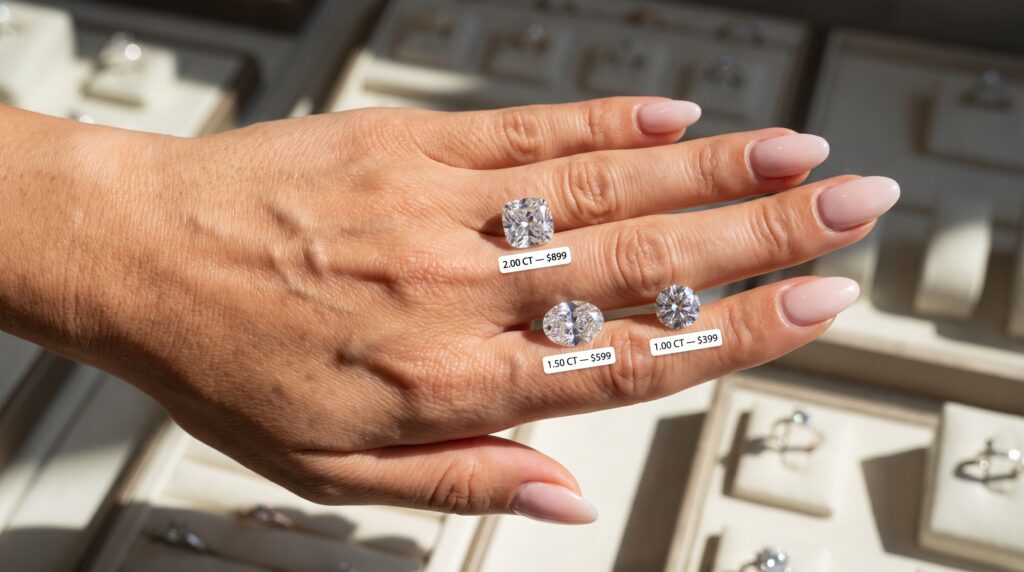
The same physical diamond, identified by its report number, can appear on multiple retailer websites at different prices, because many retailers pull from shared supplier inventory feeds rather than holding unique stock. What differs between listings isn’t the diamond, it’s the markup, return period, shipping terms, warranty, resizing policy, customer support, packaging, and upgrade policy attached to it.
Searching a specific report number across retailers, when a listing provides one, is worth doing before assuming the lowest advertised price is the best deal. A slightly higher price from a retailer offering a longer return window, free resizing, and responsive support can be the better purchase even though the sticker price is higher.
Wholesale Trends vs Retail Prices
Wholesale prices, what retailers pay suppliers, aren’t the same dataset as online listing prices or completed retail sales, and a change in one doesn’t move the others by an identical amount. Diamond analyst Edahn Golan reported that wholesale lab grown diamond prices fell 13 percent year over year in the second quarter of 2026. That figure describes wholesale transactions specifically. It doesn’t mean every retail diamond dropped by exactly 13 percent, since retailers carry different existing inventory, margins, and pricing strategies, and they don’t all adjust retail pricing on the same timeline as wholesale shifts.
The chain runs from manufacturer to wholesaler or supplier to retailer to the buyer, and costs get added at each step: production and cutting at the manufacturer level, margin and inventory risk at the wholesale level, and markup, service, and overhead at the retail level. A wholesale decline is useful context for understanding where the market is heading, not a promise about what a specific retailer will charge.
How to Build a Lab Grown Diamond Budget
Start with the total jewelry budget, not just the number attached to the stone. Reserve a portion for the setting, tax, and service before shopping for the diamond itself, then choose the shape and approximate visual size you want, and prioritize cut quality and transparency before color and clarity grades. Pick a comfortable color range and an eye-clean clarity range rather than chasing the top of either scale, compare actual millimeter measurements across your shortlist, verify the report through the issuing lab, and compare complete retailer offers, not just sticker prices, before deciding. If you’re planning to insure the piece, leave room in the budget for that as well.
A value-focused starting point looks like a diamond just below a magic carat threshold, in the near-colorless range, with eye-clean clarity, strong cut and proportions, and a simple, well-constructed setting. That’s a framework, not a rule that applies to every buyer. A specification-focused buyer might intentionally choose D to F color, VVS or higher clarity, an exact round carat weight, as-grown documentation, or a traceability program, understanding that they’re paying for technical precision or personal priorities rather than a large visible difference. A size-focused buyer might lean toward elongated shapes and larger face-up dimensions, with setting security and daily comfort factored into that choice.
Resale Value, Appraisals, and Insurance
These four terms get used loosely and mean different things. Retail price is what the first buyer pays. Appraisal value is an estimated replacement cost for a stated purpose, usually insurance, and it’s set by an appraiser, not the market. Trade-in credit is whatever a specific retailer’s program allows toward a future purchase. Resale value is what an actual secondary buyer offers, and it’s frequently well below the original retail price and below the appraisal figure.
A high appraisal doesn’t prove you got a bargain, and it doesn’t predict what you’d get back if you sold the piece later. Lab grown diamonds’ expanding supply and falling wholesale prices have limited secondhand demand for them, which is worth knowing going in. That doesn’t mean every lab grown diamond has zero resale value, since actual offers vary by stone and buyer, but treating the purchase as primarily one for wear and personal meaning, rather than as an investment, matches how these diamonds actually behave in the secondary market.
Pricing, Setting, and Everyday Wear
A larger, affordably priced center stone changes more than the number on the receipt. It affects setting height, how much prong strength the ring needs, overall balance, and how easily the stone snags on clothing or hair. Larger stones generally need stronger prongs, wider shanks, and a lower setting profile to sit securely and avoid feeling top-heavy on the hand.
If you’re planning to pair the ring with a wedding band, confirm the engagement ring’s setting allows the band to sit flush, since a high cathedral or basket setting can leave a gap. And check the resizing range before ordering: eternity bands, pavé, and other intricate settings often have limited or no resizing room, since resizing means cutting and rejoining metal that’s already set with stones.
How to Compare Prices Online
A useful comparison starts with tightly matched specifications rather than a broad shape or grade category. From there: compare actual millimeter measurements, review video of the exact stone, check for transparency issues and undertone, verify the report number directly with the issuing lab, search for the same report number at other retailers, confirm whether a price is for the loose stone or the finished ring, add in setting costs, tax, and customization, and compare return, resizing, and warranty terms before finalizing anything. Documenting the offer, including screenshots of the listing and price, is worth doing before you commit.
A few signs a listing deserves more scrutiny: the word “certified” used without naming which laboratory issued the certificate, a report number that can’t be verified, a permanent-looking high-percentage discount, an appraisal value presented as proof of savings, missing millimeter measurements, stock photography presented as the actual stone, setting or customization fees that appear only at checkout, claims that prices are about to rise, unclear disclosure of lab grown origin, or return terms that are unusually short or hard to find. The FTC’s guidance on diamond jewelry advertising notes that sellers should disclose manufactured origin clearly, and that comparing quality, price, and service across sellers is a reasonable step for buyers to take.
Care, Maintenance, and Ownership Costs
Clean the diamond with warm water, mild soap, and a soft brush, then rinse and dry with a lint-free cloth. Store it separately from other jewelry, remove it during activities with real impact risk, and have the setting checked periodically, with a professional inspection after any hard knock even if nothing looks wrong. Home ultrasonic and steam cleaners are worth using cautiously, since they can loosen certain settings. GIA’s guidance on diamond care notes that diamond’s resistance to scratching doesn’t mean the jewelry is immune to chipping or setting damage from a hard impact.
For insurance, base the coverage amount on a realistic replacement cost rather than an inflated appraisal figure. A higher appraisal number generally means a higher premium, without necessarily buying any additional real-world protection if it doesn’t reflect what the piece would actually cost to replace.
Frequently Asked Questions
How much does a one-carat lab grown diamond cost?
As of July 2026, broad market listings averaged around $631 for one carat, with individual prices ranging roughly from $299 to $1,627 depending on shape, color, clarity, and cut. That average blends many different specifications together, so it’s a starting point for market context rather than a quote for any specific diamond. The actual price for a one-carat stone matching your preferred cut, color, and clarity will fall somewhere in that range, and it will also depend on which retailer you’re buying from and what’s included in the price.
Why do diamonds with the same grades have different prices?
Grades on a report describe a range, not an exact point, so two diamonds both graded G color and VS1 clarity can still differ in cut precision, transparency, undertone, and inclusion placement in ways the grade alone doesn’t capture. Retailer markup, service level, warranty terms, and where a stone falls within its grade range all add up to real price differences even between diamonds that look identical on paper.
Is price per carat a reliable comparison?
On its own, no. Price per carat treats weight as the main driver of value, but cut quality, shape, color, clarity, transparency, and documentation all affect price independently of weight. Two diamonds with the same price per carat can differ substantially in how they actually look, and two diamonds that look nearly identical can have very different price-per-carat figures depending on shape and cut.
Are CVD diamonds more expensive than HPHT diamonds?
Not as a rule. Growth method has less influence on price than cut, color, clarity, and overall stone quality. Where price differences do show up between HPHT and CVD stones, they usually trace back to specific quality factors, or to additional features like as-grown documentation or traceability programs that some sellers charge extra for, rather than the growth method itself.
Does a grading report increase resale value?
A report supports resale by making a diamond’s specifications verifiable to a future buyer, but it doesn’t set or guarantee a resale price. Resale value depends on what an actual buyer is willing to pay at the time of sale, which is influenced by current market supply, the specific stone’s quality, and buyer demand, not by the existence of a report alone.
Is D color worth paying more for?
That depends on the buyer and the setting. D color sits at the top of the color scale and carries a price premium, but the visible difference between D and a near-colorless grade like G or H is often difficult to see once a diamond is set, particularly in yellow or rose gold. Buyers who specifically want the technical top grade may find it worth the premium; buyers focused on visible appearance often get comparable results from a lower grade at a lower price.
Is VVS clarity necessary?
For most buyers, no. VVS grades are essentially flawless to the naked eye, but so is a well-selected VS or SI1 diamond in most cases, since the difference lies in inclusions only visible under magnification. VVS becomes more relevant for larger stones, step cuts like emerald or Asscher where inclusions are easier to spot, or for buyers who specifically want the higher technical grade regardless of visible difference.
Can buying below one carat save money?
Often, yes, particularly just under a round-number threshold like 0.90 to 0.99 carats compared to 1.00 carat. Diamonds priced right at a popular carat threshold tend to carry a premium tied to that round number rather than to a proportional increase in size or quality. Buying just below the threshold can offer a similar face-up appearance for less, though the exact savings vary by current inventory and can’t be promised as a fixed percentage.
Why are round diamonds priced differently from fancy shapes?
Cutting a round brilliant from rough diamond material typically wastes more of the rough than cutting an oval, cushion, or other fancy shape, which affects cost. Round diamonds also see the highest demand of any shape, which adds to the price difference. The result is that fancy shapes often cost less per carat than rounds of similar quality, though the shape itself should be chosen based on appearance and design fit, not price alone.
Will a lab grown diamond retain its purchase price?
Generally not at the original retail price. Lab grown diamond supply has expanded and wholesale prices have declined in recent periods, which limits demand and pricing in the secondary market. Resale offers are commonly well below what a buyer originally paid. This isn’t unique to lab grown stones in the sense that diamond jewelry generally isn’t purchased as an investment vehicle, but the price trends specific to lab grown diamonds make that gap more pronounced currently.
How much can the setting add to the total?
The setting can represent a substantial portion of the total price, depending on metal choice, design complexity, and labor, though the exact amount varies too widely by retailer and design to state as a fixed range. Platinum settings cost more than gold ones of similar design, and features like pavé, halo details, or custom engraving add labor and material cost on top of the base setting price. Getting a specific setting quote from the retailer you’re considering is more reliable than assuming a general percentage of the diamond price.
How can an online buyer determine whether a price is fair?
Compare tightly matched specifications rather than broad categories, review actual measurements and video of the specific stone rather than relying on grades alone, verify the report number directly through the issuing lab, and check whether the same report number appears at other retailers for comparison. Beyond the stone price, factor in the complete cost including setting, tax, and shipping, and weigh return policy, resizing terms, and warranty coverage alongside the price itself, since a lower sticker price with worse terms isn’t necessarily the better offer.