
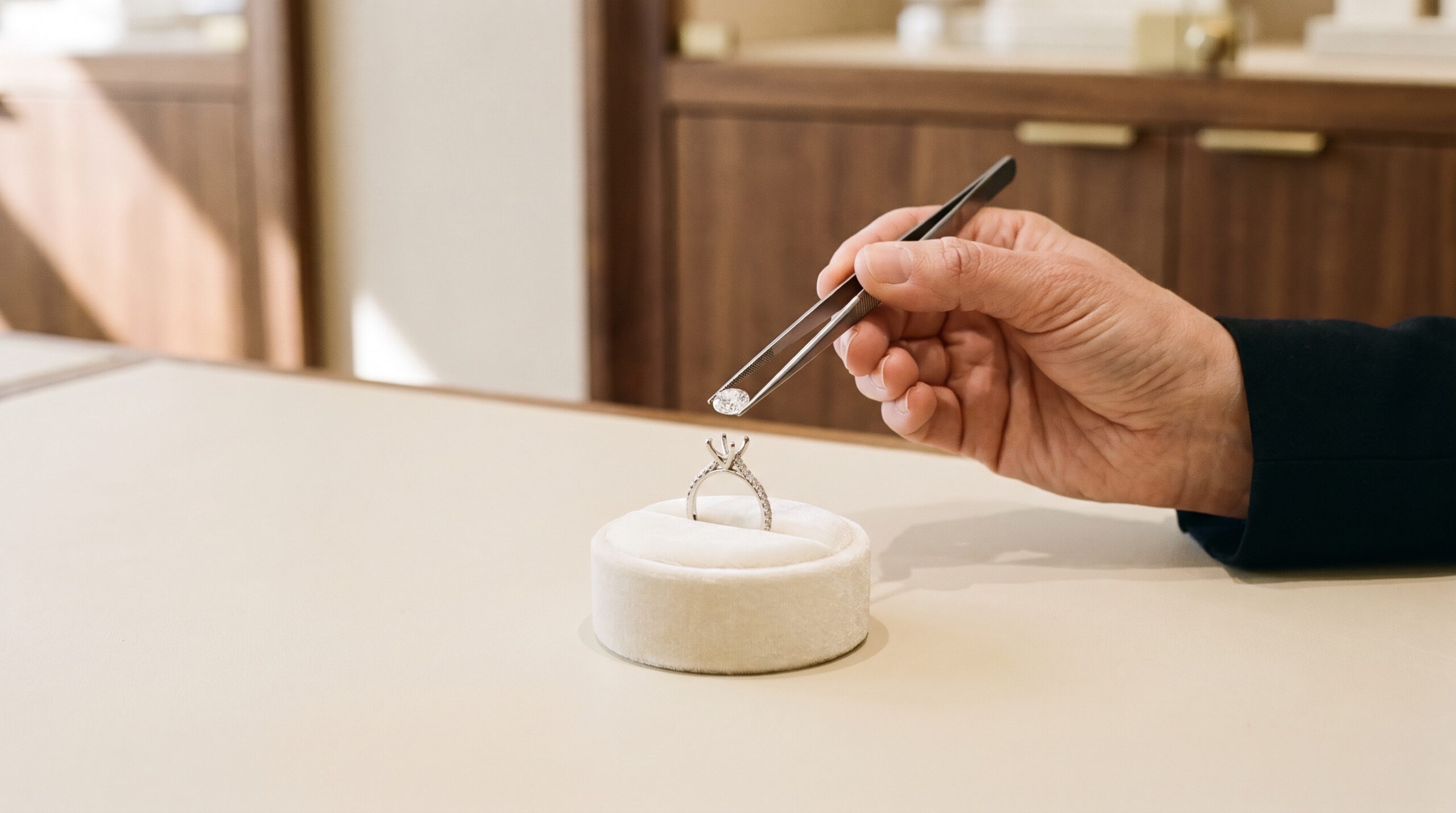
A lab grown diamond and a natural diamond can sit side by side under a jeweler’s loupe and look identical, yet the natural stone might cost two or three times as much. That gap makes some buyers suspicious. If the two stones are the same material, why isn’t the price the same?
The answer has nothing to do with one diamond being fake or fragile. Lab grown diamonds are diamonds: same crystal structure, same hardness, same optical properties as diamonds pulled from the earth. According to the Gemological Institute of America, the two have essentially the same chemical, physical, and optical properties. What differs is how each one came to exist, and that difference in origin drives almost the entire price gap.
The Short Answer: Why Lab Grown Diamonds Cost Less
Natural diamond supply is fixed by geology. A mine produces what its deposit contains, and once that deposit is exhausted, no amount of investment brings more diamonds out of it. Lab grown diamond supply is fixed by manufacturing capacity instead. A producer can install more reactors, run them more efficiently, and grow more rough. That single structural difference explains most of what follows: expandable supply competes on price in a way that finite geological supply does not.
On top of that, production technology keeps improving, multiple manufacturers are competing for the same buyers, older lab grown inventory has to compete with newer and often cheaper stones, and the resale market for lab grown diamonds is thinner than for natural ones. None of that means the stones are inferior. It means the market prices them differently.
A lower price on a lab grown diamond does not mean the stone is fake, that it will chip or scratch more easily, that every lab grown diamond is the same quality, that it cost almost nothing to produce, or that the number on the price tag guarantees good value. Each of those requires looking at the individual stone, not just its origin.
Are Lab Grown Diamonds Cheaper Because They Are Fake?
No. A lab grown diamond is not the same thing as cubic zirconia, moissanite, or glass. Those are simulants: materials that resemble diamond in appearance but have different chemical compositions and different physical properties. A lab grown diamond is carbon crystallized into the same cubic structure as a natural diamond, grown under high pressure and high temperature (HPHT) or through chemical vapor deposition (CVD) rather than formed over a billion years or more beneath the earth’s crust.
It helps to separate five things that get lumped together in casual conversation: what a stone is made of, how it formed, how good that particular stone looks, what the market charges for it, and what matters to the person buying it. Material and origin are settled facts about a given diamond. Quality, price, and personal value are separate judgments, and none of them can be inferred from the others.
Reason 1: Lab Grown Supply Can Expand
Natural diamond supply depends on finding a deposit, developing a mine, and extracting what’s there. That process takes years, requires enormous capital, and eventually runs out. A deposit that produces diamonds today will not produce more once it’s depleted.
Lab grown supply works differently. A producer that wants more output can add HPHT presses or CVD reactors, run larger batches, improve the percentage of successful growths, shorten the time each growth cycle takes, or grow larger rough stones that yield more finished diamonds after cutting. None of that is instant or free. Reactors cost money to buy and operate, facilities need power and staffing, and quality control still has to catch failed or flawed growths before they reach a cutter. But the ceiling on how much can be produced is set by investment and engineering, not by what the ground happens to contain.
That’s the core distinction. A mine has a fixed amount of ore. A factory can build another line.
Reason 2: Production Technology Keeps Improving
Manufacturing tends to get cheaper as producers do more of it and refine the process, and lab grown diamond production has followed that pattern. Growth cycles have gotten faster, color control has improved, and producers have reduced the share of growths that fail or come out unusable. GIA’s own research on the sector notes that lab grown production has grown substantially in scale, size, and quality over the past several years, which is consistent with a manufacturing process that keeps getting more efficient rather than one that has plateaued.
That doesn’t mean every producer operates at the same cost or efficiency. Some reactors are older, some processes are more automated, and yields vary by facility. But as an industry trend, the cost of turning a diamond seed into a finished, saleable stone has been declining, and that decline shows up in wholesale pricing.
Reason 3: Lab Grown Diamonds Do Not Carry a Geological-Rarity Premium
Part of what a buyer pays for in a natural diamond is the fact that it is scarce in a way that has nothing to do with demand. Diamond-bearing deposits are rare, finding and developing them takes decades and significant capital, and every mined diamond represents a resource that cannot be replaced once it’s gone. That scarcity is baked into natural diamond pricing alongside extraction costs, sorting, cutting, and the tradition and marketing that surrounds natural stones.
Lab grown diamonds don’t carry that premium because their supply isn’t limited by what exists underground. Their pricing tracks production cost, available manufacturing capacity, the quality of the individual stone, how much competition exists among sellers, and the cost of cutting, grading, and retail service. It would be an oversimplification to say natural diamond prices are set purely by mining costs; demand, branding, and market conditions all play a role too. But the rarity premium is a real and separate factor, and it’s one that manufactured supply, by definition, doesn’t have.
Think of it as the difference between a manufactured product and a natural artifact. A factory can make another one of the first. Nobody can make another one of the second. That distinction is about scarcity, not about which one looks better on a finger.
Reason 4: Competition Is Strong
Multiple manufacturers, growers, cutters, and wholesalers can all produce lab grown diamonds to similar specifications, and that inventory reaches buyers through wholesalers, virtual-inventory suppliers, online retailers, and local jewelers who are all competing for the same sale. When two stones carry comparable report numbers, a buyer can put them side by side and pick the cheaper one. That kind of direct comparison is harder to do with natural diamonds, where each stone is genuinely one of a kind, but it’s routine with lab grown stones, and it puts steady downward pressure on price.
Reason 5: New Inventory Can Make Older Inventory Harder to Price
When newly manufactured stones come to market at a lower price than last year’s inventory, whoever is holding the older stock has a problem. They can cut the price, accept a thinner margin, bundle the stone into a ring setting to obscure the discount, run a promotion, or just hold onto it and wait. None of that means the older stone is lower quality or that every discount signals outdated inventory. It’s closer to what happens with electronics: a new model arrives offering similar performance for less, and retailers holding the previous model have to adjust. The diamond itself doesn’t degrade sitting in inventory the way a gadget becomes technically obsolete, but the price competition works the same way.
Reason 6: Secondary-Market Demand Is More Limited
A secondhand lab grown diamond has to compete against new stones that come with current documentation, a return policy, a warranty, and the option of a matching new setting. That reduces what a secondary buyer is willing to pay, because the alternative (buying new) carries less risk.
Lab grown diamonds can have resale value, but it isn’t guaranteed, and actual offers depend on the stone’s size, quality, condition, documentation, and who’s buying it. This isn’t unique to lab grown stones, either: natural diamonds shouldn’t be assumed to hold their original retail price on resale. Diamonds in general are a poor vehicle for reliably recovering what you paid at retail, regardless of origin.
Reason 7: Buyers Often Prioritize Appearance and Size
A lot of lab grown shoppers are focused on how the stone looks and how big it appears on the hand rather than on the fact that a natural stone formed underground over an immense span of time. That focus on visible specifications and total ring budget, rather than on origin-based scarcity, pushes lab grown pricing toward direct competition on the numbers that show up on a grading report. Not every buyer weighs these factors the same way, but it’s a common enough pattern that it shapes how sellers price and market lab grown inventory.
What Still Makes Lab Grown Diamonds Expensive to Produce
None of this means growing a diamond is nearly free. The production chain still involves real costs at every stage: growth (running an HPHT press or CVD reactor), rough inspection, treatment where applicable, cutting and polishing, laboratory grading, distribution, setting, and after-sale service.
Specific costs include the equipment itself, electricity to run it, diamond seeds to start each growth, skilled technicians to operate and monitor the process, and the runs that fail or come out too flawed or too small to sell at a profit. After a successful growth, the rough still has to be planned, cut, and polished, then independently graded, shipped, insured, and sold through a retail operation that has to cover its own overhead, returns, and warranty obligations. Those costs create a practical floor under lab grown prices even as growth technology gets more efficient. A stone that took less time and less electricity to grow still passed through the same chain of skilled labor and inspection before it reached a customer.
Current Price Context
Any price figure needs a date and a note about what it actually measures, because “lab grown diamond prices” covers a wide range depending on shape, color, clarity, and where the stone is sold.
As of July 15, 2026, StoneAlgo’s pricing index put the average one-carat lab grown listing at $631, with a broad range running from roughly $299 to $1,627. That figure blends ten shapes and a wide spread of color and clarity grades, so it isn’t a stand-in for what a single, tightly specified diamond costs. It’s a snapshot of a large and varied online inventory.
| Carat weight | Broad listing average | What the figure covers |
| 0.80 carat | $483 | Mixed shapes and specifications |
| 1.00 carat | $631 | Range of roughly $299 to $1,627 |
| 2.00 carats | $1,302 | Loose diamond only, not a finished ring |
| 3.00 carats | $1,846 | Not a standardized comparison across grades |
Separately, wholesale lab grown prices fell 13 percent year over year in the second quarter of 2026, according to Edahn Golan’s market analysis. That’s a wholesale number, meaning it reflects transactions between growers, cutters, and dealers, not what a retail customer paid at a jewelry counter. Retail prices don’t necessarily move by the same percentage, since retailers set their own margins and aren’t obligated to pass wholesale changes through to shoppers dollar for dollar.
The width of that one-carat range, nearly $300 to over $1,600 for stones all labeled “one carat,” is the reason two lab grown diamonds of the same size can carry very different price tags. Carat weight alone tells you almost nothing about what you’re paying for.
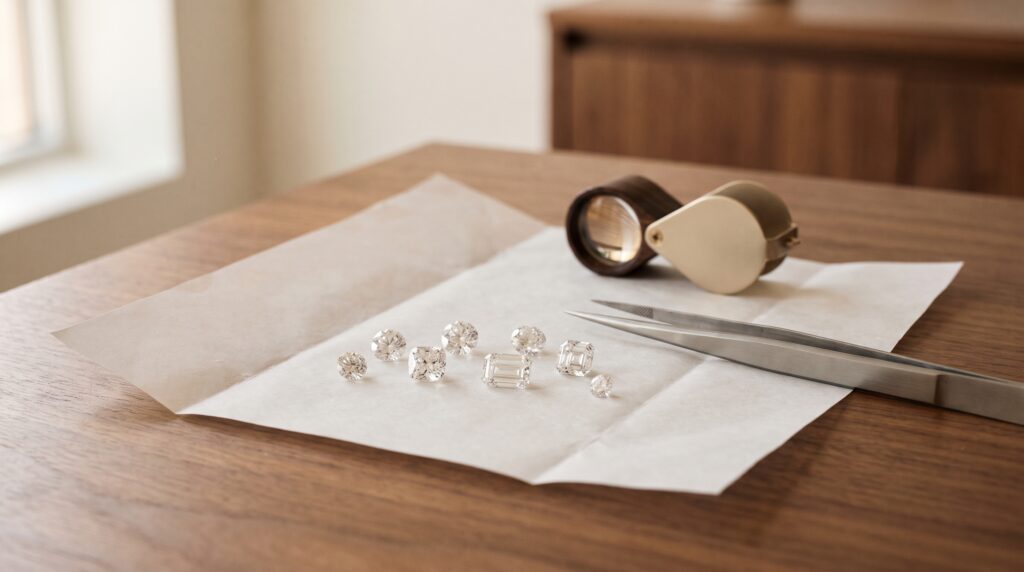
Why Two Lab Grown Diamonds Can Have Different Prices
Cut and proportions determine how the stone handles light, which is the single biggest factor in how bright and lively a diamond looks in person. The GIA’s cut grading system exists because two diamonds with identical carat weight and clarity can look dramatically different depending on how well they’re cut.
Carat weight measures the stone’s mass, not its visible size. Millimeter dimensions, which most grading reports list alongside carat weight, tell you how much space the stone actually occupies on the hand. Two one-carat stones with different proportions can look noticeably different in diameter.
Color grading runs on a scale from colorless to noticeably tinted, and pricing typically rewards colorless and near-colorless grades. Some stones also show a visible undertone, brown, gray, or blue, that can affect how desirable a given color grade actually looks.
Clarity refers to internal and surface characteristics. Above a certain point, called eye-clean, additional clarity upgrades often aren’t visible to the naked eye, even though they carry a price premium on paper.
Shape affects price too. Round brilliants generally command a premium over fancy shapes like ovals or cushions for a given carat weight and quality, though which shape represents better value depends on personal preference, not a fixed rule.
Transparency is a separate issue from clarity grading. Haze, graining, or internal strain can make an otherwise well-graded stone look duller than its report would suggest, which is why viewing an exact-stone video or examining the stone in person matters more than reading a grade off a report.
Finally, the report itself and the seller behind it affect price. A report’s format, along with the seller’s return policy, warranty, and shipping and customer service, all factor into what a retailer charges for what is, on paper, an identical stone.
Does Lower Price Mean Lower Quality?
Sometimes, but not always, and the two aren’t the same question. A lower-priced lab grown diamond might have lower color or clarity grades, less favorable proportions, weaker transparency, a less popular shape, or it might simply be older inventory being sold by a seller with lower overhead and a smaller margin. It might also just be a genuinely competitive price from an efficient seller.
A higher-priced stone might reflect better light performance, premium grading, a recognized brand, documented traceability, stronger customer service, or simply a bigger markup. None of those things are automatically visible from the price tag alone. The only reliable way to judge a specific diamond is to look at its actual grading report, its measurements, and ideally a video of the exact stone, rather than inferring quality from where it falls on a price list.
How to Use the Savings Wisely
Buyers moving from a natural diamond budget to a lab grown one often end up with money left over, and how they spend it matters more than the headline savings figure.
Putting more of the budget into the setting, stronger prong construction, adequate metal thickness, platinum or a preferred gold alloy, a proper custom fit, tends to pay off in everyday durability more than an upgrade from a VS2 to a VS1 clarity grade ever will. Prioritizing a well-cut, transparent stone over marginal improvements in paper grades gets more visible brilliance for the same money. A larger stone becomes more affordable with lab grown diamonds, but bigger isn’t automatically better: finger size, setting height, and how the stone will hold up to daily wear all matter more than raw carat weight. And it’s worth budgeting for the whole purchase, a matching wedding band, engraving, resizing, insurance, rather than assuming all the savings should go into the center stone. There’s also nothing wrong with simply spending less overall. A buyer doesn’t need to reallocate every dollar that a natural diamond would have cost just because a bigger lab grown stone is within reach.
Practical Value Specifications
As a starting point rather than a fixed formula, a value-focused buyer might look for a diamond sized just below a major carat threshold (0.90 carats instead of 1.00, for instance), with strong cut and proportions, near-colorless color, eye-clean clarity, good transparency, and a verifiable independent report.
Higher grades, D to F color or VVS to IF clarity, suit buyers who specifically want the technical specifications for their own sake, but once a stone is set, those upgrades frequently make no visible difference to how the diamond looks on the hand.
Loose Diamond Price vs Complete Ring Price
The price quoted for a loose lab grown diamond is not the price of a finished ring. A lower center-stone cost doesn’t make precious metal, skilled setting labor, or customization any cheaper. The full cost of a ring typically includes the loose diamond, the metal (gold or platinum), any side stones, the labor to set the center stone securely, pavé or halo work if the design calls for it, engraving, custom design fees, resizing, sales tax, shipping, and insurance.
A useful way to frame it: diamond price plus setting plus customization plus taxes plus shipping or duties plus insurance equals what you actually pay. Treating the loose-stone quote as the whole budget is one of the more common ways buyers underestimate what an engagement ring will cost.
Growth Method, Traceability, and Pricing Premiums
Some sellers charge extra for stones described as as-grown (uncut from their original growth environment for display), for Type IIa classification, for stones tied to a named production facility, for renewable-energy documentation, for domestic production, or for third-party sustainability certification. Those features can matter to a buyer for personal reasons, but they don’t automatically make the stone cut better, sparkle more, look more transparent, wear more durably, or hold its value better on resale. If a seller is charging a premium for one of these attributes, it’s reasonable to ask exactly what documentation or benefit that premium buys.
Appraisal Value, Retail Price, and Resale Value
These terms get used interchangeably by shoppers, but they describe different things. Retail price is what the first buyer pays. Appraisal value is an estimated replacement cost for a stated purpose, usually insurance. Trade-in credit is whatever a specific retailer’s program offers toward a future purchase. Resale value is what an independent secondary buyer actually offers. Insurance value is the figure an insurer uses to set coverage.
A high appraisal is not evidence that a diamond was purchased at a good price. Appraisals are typically built around replacement cost at retail, not around what the market would actually pay to buy the stone back, so a high number on an appraisal document doesn’t tell you anything about resale prospects.
Reports and Authenticity
Independent grading documentation is the main tool buyers have for confirming what they’re actually paying for. A report should specify laboratory-grown status, carry a report or assessment number, and list carat weight, measurements, shape, and quality grades, along with any laser inscription on the stone itself, which can usually be verified online against the lab’s database.
IGI issues standard 4Cs reports for lab grown diamonds. GIA currently uses Premium and Standard assessment tiers for eligible colorless to near-colorless lab grown stones, a different format from its traditional natural diamond reports. These formats aren’t directly interchangeable, and a report from one lab shouldn’t be read as equivalent to a report from another without understanding what each one actually measures. It’s also worth remembering that having a report at all says nothing about whether the retail price attached to the stone is competitive; a report verifies the stone’s characteristics, not the fairness of its price.
Setting, Size, and Everyday Wear
Lower lab grown prices make larger center stones accessible in a way they weren’t a decade ago, but a bigger stone comes with practical tradeoffs. It sits higher off the finger, which increases the chance of catching on gloves, clothing, or hair. It can rotate more easily in its setting, needs stronger prongs to stay secure, may require a wider shank for support, can complicate stacking with a wedding band, and benefits from more frequent professional inspection.
Setting style affects all of this. A low-profile solitaire sits closer to the finger and snags less. A high-set solitaire shows off the stone but catches more. A bezel setting wraps the stone in metal, trading some brilliance for security. A six-prong setting holds a larger stone more securely than four prongs at the cost of slightly obscuring the stone’s edges. A halo setting makes the center stone look larger but adds more surfaces that can trap dirt. A pavé band adds sparkle along the shank but introduces small stones that can chip if struck. None of these is objectively correct; the right choice depends on how actively the wearer’s hands are used day to day.
How to Compare Offers Online
A useful sequence for comparing lab grown diamonds across sellers: hold carat, shape, cut, color, and clarity reasonably constant across the stones you’re comparing, then look at millimeter dimensions rather than carat weight alone. Watch an exact-stone video where available rather than relying on stock photography. Check transparency and undertone directly, since these don’t always show up clearly on a grading report. Verify the report number against the issuing lab’s database, and search to make sure the same stone isn’t listed at different prices by different resellers. Confirm whether the quoted price covers the loose stone or a finished ring, then add setting, tax, shipping, and any customization costs before comparing totals. Compare each seller’s return window, resizing policy, and warranty terms, not just the sticker price. Save the listing details, including photos and the report number, before completing a purchase.
Some warning signs are worth watching for: a listing described simply as a “real diamond” without disclosing lab grown origin, a report that can’t be verified against the lab’s own database, a permanent 70 to 90 percent discount presented as a limited-time deal, marketing that frames the diamond as an investment, an appraisal used as proof that the price is a bargain, stock photography or video presented as the exact stone being sold, setting costs that only appear at checkout, unsupported environmental claims, or the absence of a reasonable return window.
Care and Maintenance
A lower purchase price doesn’t change how a diamond needs to be cared for. Clean it with warm water, mild soap, and a soft brush, rinse and dry it carefully, and store it separately from other jewelry to avoid scratching softer metals. Take rings off for heavy manual work, have the setting inspected periodically by a jeweler, and get it checked immediately after any strong impact, even if the stone looks fine. Home ultrasonic and steam cleaners can be too aggressive for certain settings, particularly those with fracture-filled or treated stones, so it’s worth checking with a jeweler before using one. There’s no universal schedule for how often to have a setting inspected; it depends on how the ring is worn, the setting style, and any impacts it’s taken, and a jeweler familiar with the specific ring is better positioned to recommend a schedule than a generic rule of thumb. The GIA’s guidance on diamond care and cleaning is a useful reference: diamond’s hardness protects it from scratching, but it doesn’t protect the setting, and a diamond can still chip if struck at the wrong angle.
Lower price gives buyers more flexibility, in stone size, in ring budget, in how much they set aside for the setting itself, but it doesn’t remove the need to evaluate the individual stone, check its documentation, and choose a setting that fits how it will actually be worn. The diamond’s origin explains why the price is lower. It doesn’t tell you whether the specific stone in front of you is a good one.
Frequently Asked Questions
Are lab grown diamonds cheaper because they are fake?
No. Lab grown diamonds are diamonds, made of carbon crystallized in the same structure as natural diamonds, grown through HPHT or CVD processes rather than formed underground. They are not the same as simulants like cubic zirconia or moissanite, which are different materials entirely. The lower price reflects supply and production economics, not a difference in what the stone is made of.
Does lower price mean lower durability?
No. A diamond’s hardness and durability come from its crystal structure, which is the same whether the stone formed naturally or was grown in a lab. Price is set by supply, demand, and market competition, not by the physical properties of the stone. A lower-priced lab grown diamond will hold up to daily wear the same way a higher-priced one will, assuming both are cut and set properly.
How much less do lab grown diamonds cost?
The gap varies by carat weight, quality, and where the stone is sold, so any single percentage should be treated cautiously. As of mid-July 2026, broad online listing averages for one-carat lab grown diamonds ran around $631, with individual listings ranging from roughly $299 to over $1,600 depending on shape and grade. Comparing a specific lab grown stone against a specific natural stone with matching specifications will give a more accurate picture than relying on a general industry-wide percentage.
Why have lab grown prices declined?
Prices have come down as production technology has improved, more manufacturers have entered the market, and competition among growers, cutters, and retailers has increased. Wholesale lab grown prices fell 13 percent year over year in the second quarter of 2026. That’s a wholesale figure, reflecting transactions between growers and dealers, and it doesn’t automatically translate into an identical percentage drop at the retail counter.
Do they cost almost nothing to manufacture?
No. Growing, cutting, grading, and selling a lab grown diamond still involves real costs: HPHT presses or CVD reactors, electricity, diamond seeds, skilled labor, failed production runs, cutting and polishing, independent grading, shipping, insurance, and retail overhead. Production has become more efficient over time, which has lowered costs, but it hasn’t eliminated them.
Why do similarly graded stones have different prices?
Grading reports capture the major quality categories, cut, color, clarity, and carat weight, but they don’t capture everything that affects how a stone looks or what a seller charges for it. Transparency, undertone, exact proportions, and even the seller’s own overhead, return policy, and service can all differ between two stones with similar report numbers.
Is CVD cheaper than HPHT?
Cost depends more on the specific producer’s equipment, scale, and efficiency than on which growth method is used in general terms. Both methods have their own equipment and operating costs, and improvements in either process can lower the cost of a finished stone. Neither method should be treated as automatically cheaper or higher quality; the individual stone’s grading and price are the better indicators.
Will prices eventually reach zero?
There’s no reliable basis for predicting that lab grown diamond prices will fall to zero or any other specific future level. Production costs, including equipment, energy, skilled labor, cutting, and grading, create a practical floor under prices even as manufacturing efficiency improves. Future price trends depend on production capacity, competition, and demand, all of which can shift in either direction.
Do lab grown diamonds have resale value?
They can, but resale value isn’t guaranteed and depends on the specific stone’s size, quality, condition, documentation, and the buyer making the offer. A secondhand lab grown diamond competes against new inventory that comes with current documentation, warranties, and return rights, which limits what secondary buyers are typically willing to pay. This isn’t unique to lab grown stones; natural diamonds shouldn’t be assumed to hold their full retail price on resale either.
Does an appraisal prove that a diamond is a bargain?
No. An appraisal typically estimates replacement cost for insurance purposes, which is a different figure from what the market would actually pay to buy the stone back. A high appraisal number reflects an estimate of what it would cost to replace the diamond at retail, not evidence that the original purchase price was low relative to the stone’s quality.
Should buyers choose the largest stone they can afford?
Not automatically. A larger stone becomes more affordable with lab grown diamonds, but size affects how the ring wears day to day: a bigger stone sits higher, can catch on clothing or gloves, needs a sturdier setting, and may affect how well it stacks with a wedding band. Finger size, lifestyle, and setting style all factor into whether a larger stone is a practical choice, not just whether the budget allows for it.
Which specifications usually provide visible value?
Cut has the biggest effect on how bright and lively a diamond looks, more than incremental upgrades in clarity or color once a stone reaches an eye-clean, near-colorless range. Transparency also affects visible appearance in ways that don’t always show up clearly on a grading report. Clarity grades above eye-clean and color grades in the very top range often carry a price premium without a corresponding visible difference once the stone is set.