
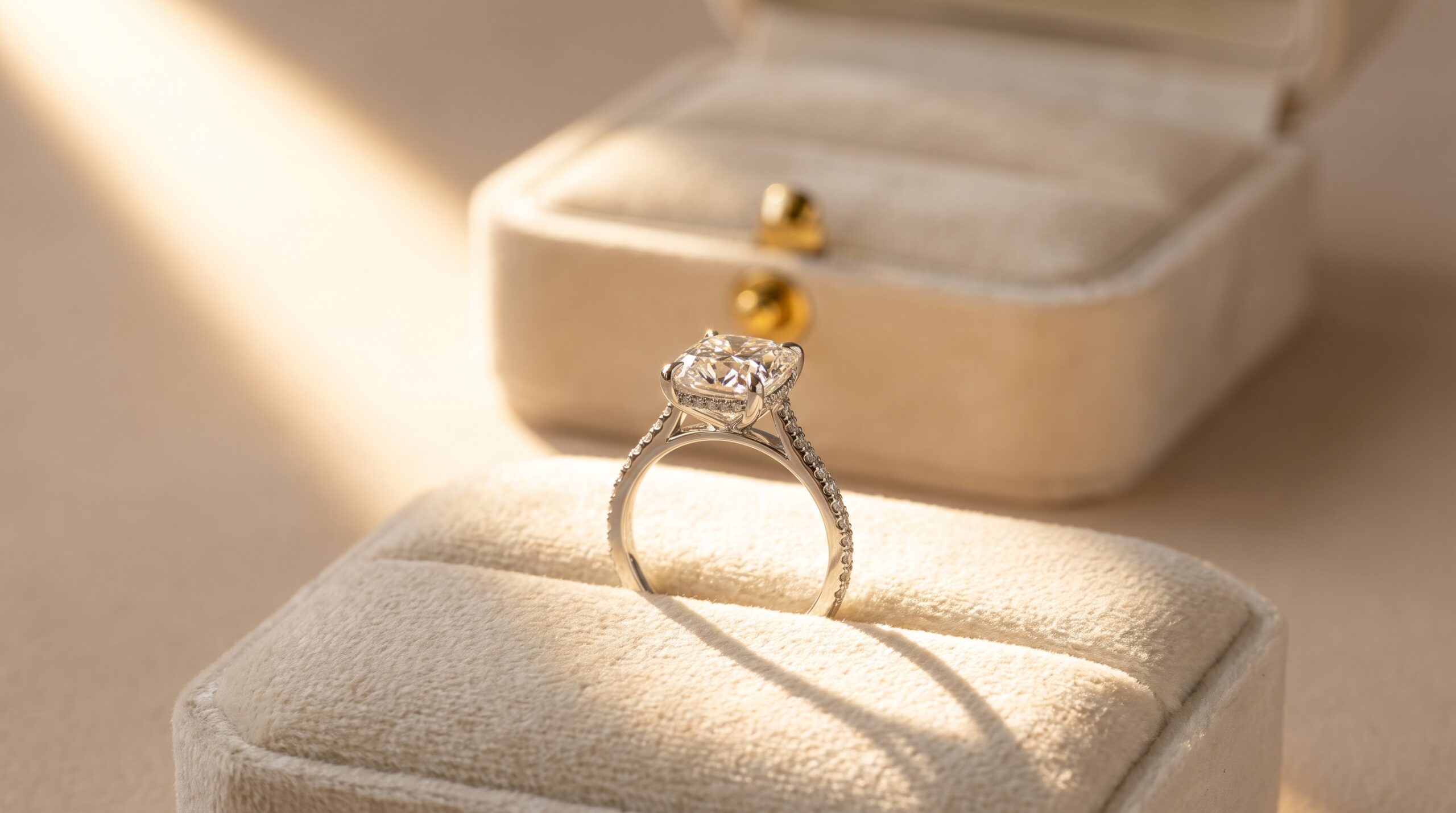
A cushion cut diamond looks like a square or rectangle with the corners rounded off, closer to a pillow than a sharp geometric shape. That softness is exactly why so many buyers gravitate toward it: it reads as vintage without being an antique reproduction, and it throws off a warmer, broader kind of sparkle than a round brilliant does. It’s also one of the more inconsistent shapes to shop for, since two cushion cuts with identical carat weight and grading can look genuinely different depending on facet style and proportions. This guide covers what actually varies between cushion cuts and what to check before buying one.
What Is a Cushion Cut Engagement Ring?
A cushion cut diamond has a square or rectangular outline with rounded corners and gently curved sides, which is why it’s often called a pillow cut. The rounded corners are a structural feature, not just a style choice: they remove the vulnerable sharp points found in shapes like princess or emerald cuts, which makes cushion diamonds naturally more resistant to chipping.
Buyers are typically drawn to cushion cuts for a mix of reasons. The shape has a strong vintage association, since it was one of the dominant diamond cuts before the modern round brilliant was developed. It also produces noticeable fire, meaning colorful flashes of light rather than just bright white sparkle, which gives it a warmer, more animated look than a round diamond in the same lighting. Compared to princess or emerald cuts, a cushion feels softer and less geometric, while still standing apart from the ubiquity of round.
Cushion Brilliant vs Cushion Modified Brilliant
This is the distinction that matters most when comparing cushion cuts, and it’s often left off product listings entirely.
A cushion brilliant cut uses a facet pattern similar to a round brilliant, scaled up to a square or rectangular outline. The facets are larger and fewer, which produces broader, more defined flashes of light. This is the style most associated with the classic, vintage cushion look: big, chunky sparkle rather than a dense shimmer.
A cushion modified brilliant adds extra facets, usually in the pavilion, which breaks up the light return into smaller, more scattered points. This produces what’s commonly called a crushed ice effect: a sparkly, textured appearance with less individual flash definition. It reads as more modern and busier, and some buyers prefer it specifically because it can help mask minor inclusions that would be more visible under a cushion brilliant’s larger, cleaner facets.
A hybrid cushion cut combines elements of both, aiming for a balance between defined flashes and denser sparkle. It’s a reasonable middle option for buyers who’ve looked at both extremes and want something in between, rather than a distinct third category with its own established look.
| Cut style | Look | Best for | Considerations |
| Cushion brilliant | Larger, more defined flashes | Buyers who want a classic, vintage sparkle | Inclusions may be more visible under larger facets |
| Cushion modified brilliant | Crushed ice, scattered shimmer | Buyers who want a denser, more modern look | Can look busier; individual flashes less distinct |
| Hybrid cushion | Blend of defined flash and dense sparkle | Buyers undecided between the two extremes | Less standardized; review the specific stone rather than the label |
None of these is better in an absolute sense. They’re different sparkle personalities, and the only reliable way to know which one you prefer is to look at video or in-person examples of each rather than relying on the certificate.
Square vs Rectangular Cushion Cuts
Cushion cuts also vary by length-to-width ratio, which determines whether the stone reads as square or elongated.
A square cushion generally falls in a ratio range of about 1.00 to 1.05. It looks balanced and compact, and it’s the more classic, traditional cushion silhouette.
A rectangular cushion typically falls between about 1.10 and 1.30. The added length creates a more elongated look and, similar to an oval or emerald cut, can visually lengthen the finger.
Ratios between roughly 1.05 and 1.10 sit in a gray zone: not quite square, not clearly rectangular. Two stones with almost identical ratios in this range can still look different depending on how the cutter shaped the corners and sides, so a ratio number alone isn’t enough to predict the final look. This is one of the clearer cases where seeing the actual stone, or a video of it, matters more than the spec sheet.
How Cushion Cuts Sparkle
Diamond sparkle breaks down into two separate qualities: fire and brilliance. Fire refers to the colorful flashes you see when a diamond catches light, the tiny rainbow-like flickers. Brilliance refers to the white light returned to the eye. Round brilliants are cut specifically to maximize brilliance. Cushion cuts, by contrast, are known for producing strong fire, which is part of why they read as warmer and more animated in person than their grading report alone would suggest.
Facet size drives most of the difference between cut styles here. A cushion brilliant’s larger facets create bigger, more distinct flashes. A cushion modified brilliant’s additional facets break that same light into smaller, more scattered points, producing the crushed ice look instead.
Because GIA does not issue a cut grade for cushion diamonds the way it does for round brilliants, there’s no single number that tells you how a specific cushion will perform. A 360-degree video of the actual stone is the most reliable way to judge sparkle pattern and intensity before buying, since two cushions with the same color, clarity, and carat weight can look meaningfully different once light hits them.
Cushion Cut vs Round, Oval, and Princess
| Shape | Look | Sparkle style | Durability | Best for |
| Cushion | Soft square or rectangle | Fire, warm and romantic | Rounded corners resist chipping | Vintage-inspired buyers |
| Round | Circular | Maximum brilliance, most uniform | Excellent | Buyers who want the brightest possible sparkle |
| Oval | Elongated | Elegant brilliance | Excellent | Buyers who want finger elongation and larger face-up size |
| Princess | Sharp square | Bright, geometric sparkle | Corners are vulnerable and need protective settings | Buyers who want a modern, angular look |
The practical tradeoff against princess is worth calling out specifically, since the two are often shortlisted together: both read as square, but cushion’s rounded corners are inherently sturdier for daily wear, while princess’s sharp corners need a protective setting like a V-tip prong to avoid chipping over time.
Colour, Clarity, and Quality Considerations
Colour
Cushion cuts, particularly the brilliant style with larger facets, can show body colour more noticeably than a round brilliant of the same grade, since the facet pattern doesn’t scatter light in a way that hides warmth as effectively. Buyers setting a cushion in white gold or platinum generally do better sticking to a higher colour grade, since the white metal makes any yellow or brown tint more apparent by contrast. In yellow or rose gold, a slightly warmer colour grade can look intentional rather than off, since the metal tone already leans warm.
Clarity
Cushion cuts, especially modified brilliants with their smaller, denser facet pattern, can sometimes hide inclusions more effectively than a cushion brilliant with larger, cleaner facets. That said, clarity grade alone doesn’t guarantee an eye-clean stone in either style. Reviewing magnified images or video of the actual diamond, rather than relying on the clarity grade in isolation, is the more reliable way to confirm inclusions won’t be visible without magnification.
Cut Quality
As with fancy shapes generally, GIA does not assign an overall cut grade to cushion diamonds. What you do get on a grading report are individual measurements: depth percentage, table percentage, symmetry, and polish. These numbers are useful for comparing two stones on paper, but they don’t replace looking at the stone directly, since cushion proportions interact with facet style in ways a single percentage can’t fully capture.
Before buying, check the length-to-width ratio, the specific cut style (brilliant, modified brilliant, or hybrid), colour grade, clarity grade, table and depth percentages, and a 360-degree video of the actual stone.
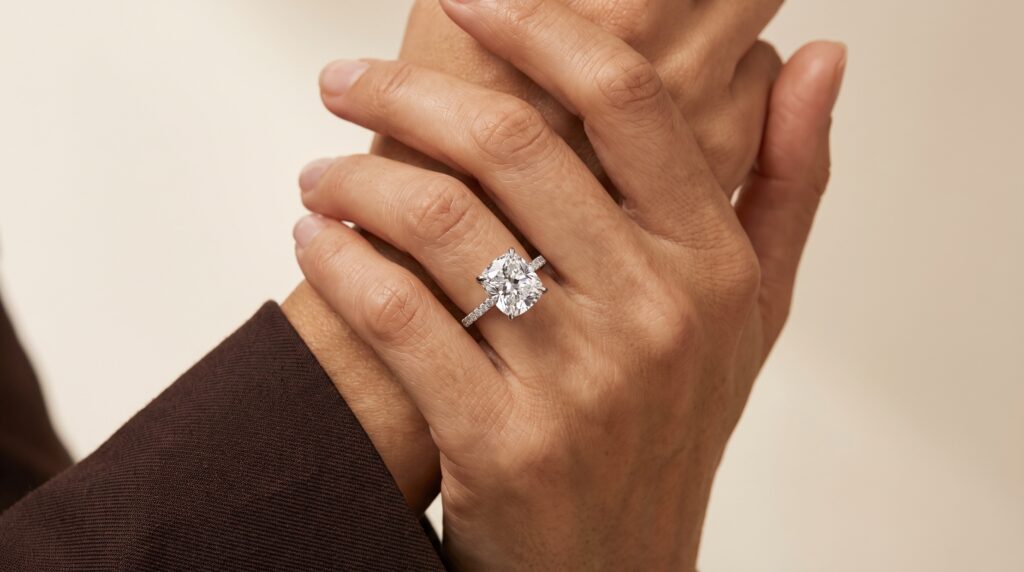
Best Settings for Cushion Cut Engagement Rings
A solitaire setting keeps the focus entirely on the cushion shape and its facet pattern, which suits buyers who chose the cut specifically for its outline and sparkle rather than for added design elements.
A halo setting surrounds the cushion with smaller diamonds, which adds perceived size and leans into the shape’s vintage character. This is a common pairing, since the rounded halo edge complements the cushion’s soft corners.
A three-stone setting adds two side stones, often for symbolic reasons (past, present, future), and gives the ring more visual presence on the hand.
A bezel setting wraps metal around the diamond’s girdle, which protects the stone’s edges and lowers its profile. It’s a practical choice for people who work with their hands often or who simply want less to catch on things.
A pavé band adds small diamonds along the shank for extra sparkle, but it also adds more surfaces that require periodic professional cleaning and prong checks, since each small stone is its own point of potential wear.
Durability, Comfort, and Everyday Wear
Cushion cuts are generally more durable for daily wear than sharp-cornered shapes like princess or emerald cuts, precisely because the rounded corners remove the most chip-prone part of the stone. That doesn’t make cushion cuts indestructible, but it does mean they carry less structural risk than a shape with true 90-degree points.
Snagging on clothing or hair depends more on the setting than the diamond shape itself. A higher-profile prong setting sits further off the finger and catches more than a bezel or low-profile solitaire does, regardless of what shape the stone is cut into.
For buyers who want low daily maintenance, a bezel or low-profile solitaire setting is a more practical choice than an elaborate pavé band, which needs more frequent inspection simply because it has more small stones and prongs that can loosen over time.
Care and Maintenance
Clean a cushion cut ring the same way you’d clean any diamond ring: warm water, a small amount of mild dish soap, and a soft brush (an old, soft toothbrush works well) to reach around the setting, followed by a rinse and a pat dry with a lint-free cloth.
Avoid chlorine and bleach, which can damage certain metal alloys, along with other harsh household chemicals. Skip toothpaste as a cleaning shortcut, since its abrasiveness can scratch softer metals, and avoid rough towels or vigorous brushing that could loosen small pavé stones if your setting includes them.
Have the ring professionally inspected every six to twelve months. This should include checking that prongs are still snug, that the stone hasn’t shifted, and that any pavé stones along the band remain secure. For rings worn daily, this kind of routine check catches a loosening prong before it becomes a lost stone, and it’s a service most jewelers offer at low or no cost after a purchase, per general guidance from Jewelers of America on ring care.
What to Check When Buying Cushion Cut Rings Online
Confirm the following before buying: a 360-degree video of the actual stone, a GIA or IGI grading report, disclosure of the specific cut style (brilliant, modified brilliant, or hybrid), the length-to-width ratio, table and depth percentages, colour and clarity grades, millimeter measurements, side-profile images, the return policy, and the terms for warranty and resizing.
Treat the following as red flags: no video available, no certification from GIA or IGI, missing ratio or millimeter measurements, no description of cut style, vague or unclear return terms, or a price significantly below comparable listings with no explanation for the gap. Retailers are required to disclose accurate information about a diamond’s characteristics and any treatments, and the FTC’s jewelry guidance outlines what sellers must disclose, which is a useful reference if a listing seems incomplete or inconsistent.
A cushion cut is one of the shapes where the certificate genuinely isn’t enough on its own. Ratio, cut style, and facet pattern all affect the final look in ways that don’t show up as a single grade, so video review matters more here than it does for a round brilliant.
Choosing a Cushion Cut
The best cushion cut for a given buyer isn’t the largest one available at a given budget. It’s the one where cut style, ratio, colour, and clarity have all been checked against actual video or in-person viewing, not just the numbers on a certificate. A cushion brilliant and a cushion modified brilliant at the same carat weight and grading can look different enough that one will suit a buyer’s taste and the other won’t, and there’s no way to know which without seeing the stone perform.
Before finalizing a purchase, compare video of a cushion brilliant against a modified brilliant if you haven’t already settled on one, confirm the ratio matches the square or elongated look you want, and choose a setting that matches how the ring will actually be worn day to day.
Frequently Asked Questions
What is a cushion cut diamond?
A cushion cut diamond has a square or rectangular outline with rounded corners and softly curved sides, giving it a pillow-like shape. It’s one of the older diamond cutting styles, predating the modern round brilliant, and it’s known for producing strong fire, meaning colorful flashes of light, in addition to standard brilliance.
Is cushion cut the same as pillow cut?
Yes. Pillow cut is simply another name for the cushion cut, used because the rounded square or rectangular outline resembles a pillow. There’s no technical difference between the two terms; they refer to the same diamond shape.
Do cushion cuts sparkle?
Yes, though the sparkle looks different from a round brilliant’s. Cushion cuts are particularly known for fire, the colorful flashes of light a diamond throws off, rather than pure white brilliance. The specific sparkle pattern also depends heavily on whether the stone is cut as a cushion brilliant, which produces larger, more defined flashes, or a cushion modified brilliant, which produces a denser, more scattered crushed ice effect.
What is the difference between cushion brilliant and cushion modified brilliant?
A cushion brilliant uses larger, fewer facets, similar in structure to a round brilliant cut, which produces bigger, more clearly defined flashes of light and a more classic, vintage look. A cushion modified brilliant adds extra facets, usually in the pavilion, breaking the light into smaller, more scattered points known as the crushed ice effect. The modified brilliant style also tends to hide minor inclusions more effectively than the brilliant style, since its facet pattern is denser and less uniform.
What cushion ratio is best?
There’s no universally best ratio; it depends on whether you want a square or elongated look. A ratio of about 1.00 to 1.05 produces a classic square cushion, while a ratio of about 1.10 to 1.30 produces a more elongated rectangular cushion that can visually lengthen the finger. Ratios between roughly 1.05 and 1.10 fall into a less predictable middle range, where the actual look depends more on the specific stone’s cutting than on the ratio number alone.
Are cushion cuts cheaper than round diamonds?
Cushion cuts are often priced lower per carat than round diamonds of comparable colour, clarity, and carat weight, largely because round diamonds carry higher demand and more cutting waste from the rough stone. The exact price difference varies by retailer, stone quality, and market conditions, so it’s worth comparing specific stones rather than assuming a fixed gap.
Do cushion cuts show colour?
Cushion cuts, especially the brilliant style with larger facets, can show body colour more noticeably than a round brilliant of the same grade. This matters most for the metal setting: a higher colour grade is generally worth prioritizing for white gold or platinum settings, where warmth in the stone contrasts more against the metal, while a slightly warmer colour grade can look intentional in yellow or rose gold.
Are cushion cut diamonds durable?
Yes. The rounded corners on a cushion cut remove the sharp, chip-prone points found in shapes like princess or emerald cuts, which makes cushion diamonds generally more resistant to chipping during daily wear. As with any diamond shape, the setting also plays a role in overall durability and how well the stone is protected from everyday knocks.
What setting is best for cushion cut diamonds?
Solitaire, halo, three-stone, bezel, and pavé settings all work well with cushion cuts, and the right choice depends on lifestyle and style preference rather than any technical requirement of the shape. A halo setting is a common pairing since it adds perceived size and reinforces the vintage character of the cut, while a bezel setting suits buyers who want a lower profile and less maintenance for active daily wear.
What should I check before buying online?
Confirm a 360-degree video of the actual stone, a grading report from GIA or IGI, disclosure of the specific cut style (brilliant, modified brilliant, or hybrid), the length-to-width ratio, table and depth percentages, colour and clarity grades, and millimeter measurements. Also review the retailer’s return policy and any warranty or resizing terms before purchasing, since a cushion cut’s final appearance depends on more variables than a certificate alone can convey.