
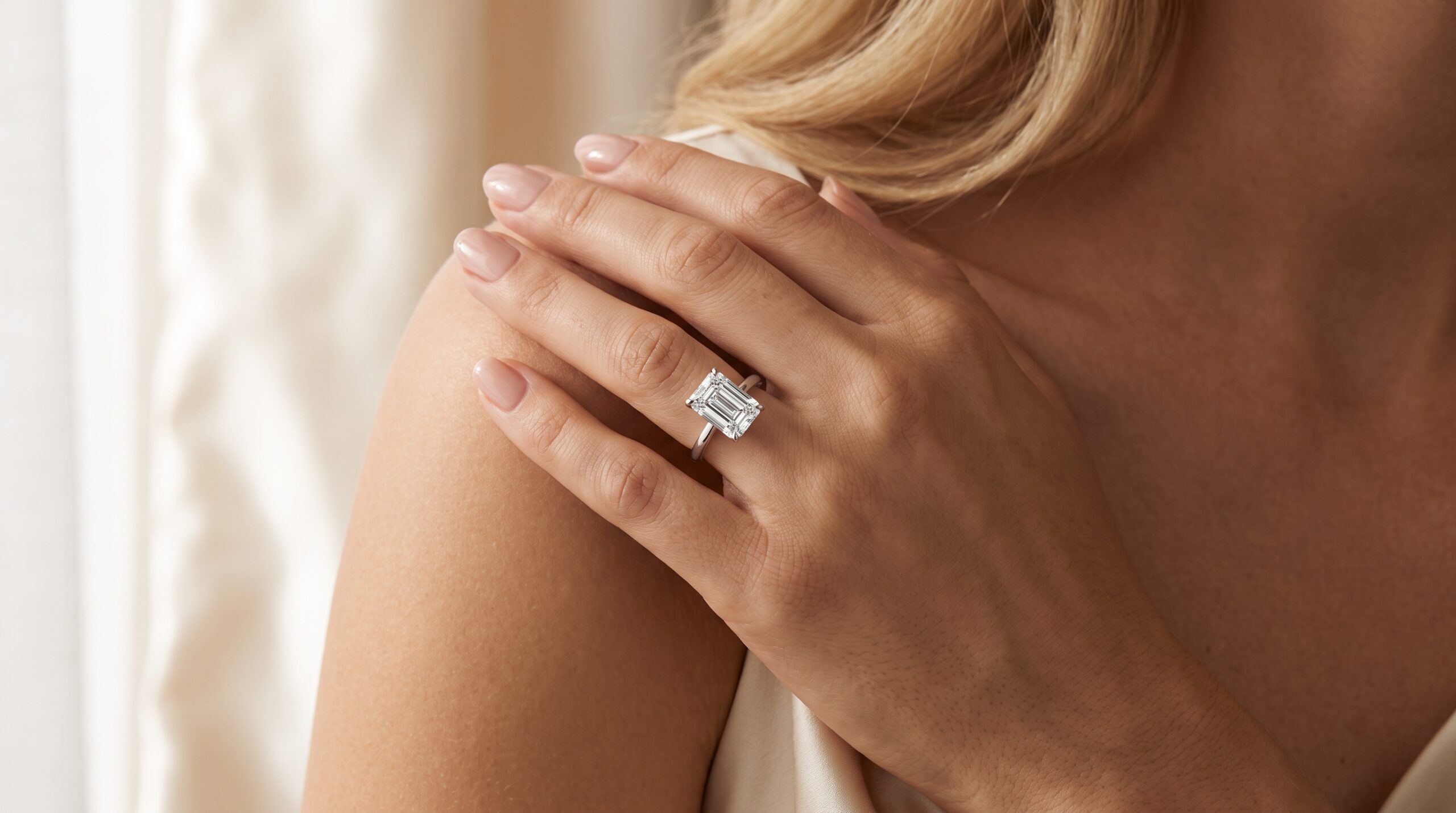
An emerald cut engagement ring looks nothing like a round brilliant, and that difference is usually the first thing that trips up a first-time buyer. The facets are wider and flatter, the sparkle is quieter, and the diamond shows more of its interior through a large open table. None of that makes an emerald cut a worse choice. It makes it a different one, with its own rules for clarity, proportion, and setting design.
This guide walks through what an emerald cut is, how it behaves in light, what to prioritize in the 4Cs, how to read a length-to-width ratio, which settings protect the stone, and what to check before buying, whether that’s in a store or online.
What Is an Emerald Cut Engagement Ring?
An emerald cut is a rectangular diamond with cropped, or beveled, corners. Instead of the triangular and kite-shaped facets that give round brilliants their fire, an emerald cut uses step cuts: long, flat, rectangular facets arranged in parallel rows around the stone, stepping down toward the culet like the layers of a staircase.
The shape gets its name from the way emeralds were traditionally faceted. Emeralds are more prone to fracturing than diamonds, so cutters used a rectangular, corner-cropped style that reduced pressure on the stone’s edges during cutting. When diamond cutters later applied the same faceting style to diamonds, the name carried over.
The large, open table of an emerald cut diamond creates what’s often called a hall of mirrors effect: broad, flat planes of light and dark that shift as the ring moves, rather than the scattered pinpoint sparkle of a brilliant cut. The look is closely associated with Art Deco jewelry from the 1920s and 1930s, when the style’s clean geometry fit the era’s architectural design sensibility.
Why Choose an Emerald Cut Engagement Ring?
Emerald cuts appeal to buyers who want a ring that reads as considered rather than flashy. The rectangular outline also tends to visually elongate the finger, since the eye follows the length of the stone rather than a rounded outline. Paired with baguette side stones or a slim band, that elongating effect becomes more pronounced.
The Art Deco association gives emerald cuts a vintage-adjacent quality even in a newly made ring. Clean lines, symmetry, and geometric side stones can echo that period without the ring actually being an antique.
On price, emerald cut diamonds can sometimes cost less per carat than round brilliants of comparable color and clarity, largely because the cutting process produces less waste from the rough stone. That’s a general tendency in the diamond trade, not a fixed rule, and it depends heavily on the specific stone’s proportions, clarity, and market conditions at the time of purchase. Buyers shouldn’t assume a discount without comparing actual stones.
Pros:
- Understated, architectural look that doesn’t rely on maximum sparkle
- Elongating effect on the finger
- Strong pairing with vintage and Art Deco design details
- Large face-up surface area relative to carat weight
- Can be more cost-efficient per carat than round brilliants of similar quality
Cons:
- Less overall brilliance and fire than round, princess, or radiant cuts
- Inclusions and color are more visible due to the open table
- Cropped corners require setting protection
- No universal cut grade from GIA, which means more manual evaluation
Do Emerald Cut Diamonds Sparkle?
Not the way a round brilliant does, and buyers expecting that level of sparkle are often disappointed if they haven’t seen an emerald cut in person first. Round brilliants are engineered with facets designed to scatter light into small, bright flashes across the whole surface. Step-cut diamonds work differently: their long, flat facets act more like mirrors, producing broader, slower flashes of light and dark contrast rather than a constant sparkle.
That trade-off is the whole point of the shape. An emerald cut’s beauty comes from clarity, symmetry, and the way light moves across it in long sweeps, not from brightness. Buyers who want maximum fire and scintillation are usually better served by a round brilliant or a radiant cut, which combines a rectangular outline with brilliant-style faceting for more sparkle than a true emerald cut.
| Shape | Light behavior | Sparkle level | Best for |
| Round brilliant | Scattered, pinpoint flashes across the whole stone | High | Buyers who want maximum brightness and fire |
| Radiant cut | Brilliant-style faceting in a rectangular or square outline | Medium to high | Buyers who want sparkle with an emerald-like silhouette |
| Emerald cut | Broad, mirror-like flashes from long step-cut facets | Lower, more understated | Buyers who prefer clarity and clean geometry over brightness |
The 4Cs for Emerald Cut Diamonds
The 4Cs, cut, color, clarity, and carat weight, are the standard framework the GIA uses to evaluate diamond quality. For emerald cuts, the relative weight given to each C shifts compared with a round brilliant.
Cut and Proportions
GIA does not currently issue an overall cut grade for fancy shapes, including emerald cuts, the way it does for round brilliants. According to GIA’s own guidance on fancy shape grading, there is no internationally accepted system for visually evaluating the appearance of fancy-cut diamonds in the same standardized way. That means a buyer can’t rely on a single grade to judge how well an emerald cut is proportioned.
Instead, look at the individual measurements on the grading report: table percentage, depth percentage, polish, and symmetry, along with the diamond’s actual photos or video. A well-cut emerald cut has even, symmetrical step facets and corners that are cropped in proportion to the rest of the stone. Uneven step rows or an off-center culet are usually visible even to an untrained eye once you know to look for them.
Clarity
Clarity matters more here than in most other shapes. The open table of an emerald cut acts like a window into the stone, so inclusions that would be hidden by a brilliant cut’s scattered facets can be visible to the naked eye. This effect is sometimes called the “ice” look when it happens in reverse: a stone with too many included characteristics can appear cloudy or crackled rather than clear.
As a general guideline, VS2 clarity or higher is a reasonable starting point for emerald cuts if eye-clean appearance matters to the buyer, though this isn’t a fixed rule. Some SI1 stones are eye-clean depending on where the inclusions sit, and some VS2 stones have a feather or cloud positioned right under the table where it’s more noticeable. The safest approach is to review actual clarity plots and, where possible, video or in-person inspection rather than relying on the grade alone.
Color
Emerald cuts also tend to show body color more than brilliant cuts, particularly in the corners and along the length of the stone. A diamond that would look colorless as a round brilliant might show a faint tint in an emerald cut of the same grade. This is more noticeable in white metal settings like platinum or white gold, where there’s less warm metal color to mask a warm-toned diamond. Buyers who choose yellow or rose gold settings have more flexibility on color grade, since the metal’s warmth can make a near-colorless stone’s slight tint read as intentional rather than as a flaw.
Carat and Face-Up Appearance
Because of their elongated rectangular shape, emerald cuts often look larger than a round diamond of the same carat weight. A round brilliant concentrates its weight in a compact, symmetrical shape, while an emerald cut spreads that same weight across a longer surface area. This is a real optical effect, not a guarantee of a specific size difference, and it varies with the stone’s length-to-width ratio and depth.
| 4C | Priority for emerald cuts | Buyer tip |
| Cut | High, but manually assessed | Check table %, depth %, symmetry, and actual photos rather than relying on a single grade |
| Clarity | High | Prioritize eye-clean appearance; review clarity plots and video where possible |
| Color | Medium to high | Consider how the metal choice affects visible warmth |
| Carat | Medium | Compare face-up size across ratios rather than carat weight alone |
Emerald Cut Length-to-Width Ratio Explained
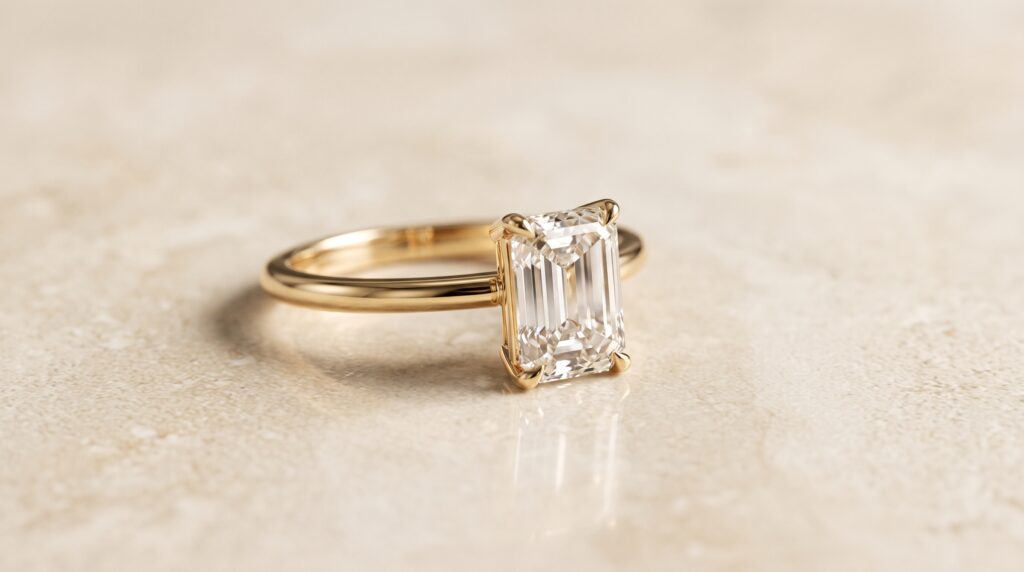
The length-to-width ratio is the measurement that determines whether an emerald cut looks like a balanced rectangle, a square, or an elongated slab. It’s calculated by dividing the stone’s length by its width.
There’s no single correct ratio. It’s a style preference that changes the visual proportions of the stone, similar to choosing a picture frame shape: a ratio closer to square feels compact and classic, while a longer ratio feels more dramatic and elongated.
| Ratio | Appearance | Best for | Style note |
| 1.25–1.35 | Closer to square | Buyers who prefer a more compact, symmetrical look | Reads as understated and traditional |
| 1.30–1.50 | Classic rectangular | Buyers who want a balanced, timeless outline | Considered the standard range for emerald cuts |
| Around 1.40 | Balanced rectangle | Buyers who want proportion without extremes | Often cited as a middle-ground preference |
| 1.50–1.75 | Elongated | Buyers who want a slimming, modern look on the finger | More dramatic, distinctive silhouette |
The Whiteflash diamond education resource on emerald cuts notes that because emerald cuts are a fancy shape, proportions and visual inspection carry more weight in the buying decision than they do for round diamonds, where a cut grade does most of that work automatically.
Best Settings for Emerald Cut Engagement Rings
The setting affects both how the stone looks and how well it holds up to daily wear, particularly at the cropped corners, which are the most vulnerable point on an emerald cut.
Solitaire. A single emerald cut in a simple prong or bezel setting keeps the focus entirely on the stone’s clean lines. It’s the most traditional option and works well for buyers who want the shape to speak for itself.
Three-stone with baguette side stones. Flanking the center stone with baguette-cut diamonds reinforces the rectangular geometry and adds presence without changing the overall style. This combination is closely tied to the Art Deco look.
Halo. A ring of smaller diamonds around the emerald cut adds sparkle that the center stone doesn’t provide on its own, and can make the stone appear larger. It’s a way to compensate for the emerald cut’s lower brilliance if that’s a priority for the wearer.
Bezel. A metal rim wraps around the stone’s edges, including the vulnerable corners. This is the most protective option and suits buyers with active lifestyles or hands-on jobs, though it covers more of the stone’s profile than a prong setting.
East-west. Setting the stone horizontally rather than vertically on the band is a more modern, less traditional take on the shape. It changes how the ring reads on the hand and is a matter of personal style rather than protection or brilliance.
| Setting | Visual effect | Protection level | Best for |
| Solitaire | Clean, minimal, classic | Moderate (depends on prong design) | Buyers who want the stone to be the focus |
| Three-stone | Symmetrical, Art Deco-influenced | Moderate | Buyers who want more visual presence |
| Halo | Larger appearance, added sparkle | Moderate | Buyers who want extra brilliance |
| Bezel | Sleek, low-profile | High | Active lifestyles, hands-on daily wear |
| East-west | Modern, unconventional | Moderate | Buyers who want a distinctive look |
Are Emerald Cut Engagement Rings Durable?
Diamond is the hardest natural material, rated 10 on the Mohs scale, so hardness isn’t the concern with any diamond shape. Durability in daily wear comes down to how the stone is cut and how it’s set.
Emerald cuts have cropped corners specifically because sharp corners are more prone to chipping under impact. That design choice already reduces risk compared with a shape like a princess cut, which has exposed square corners. But cropped corners aren’t immune to damage. A hard knock against a table edge or a doorframe can still chip a corner, particularly if it’s held by thin, widely spaced prongs.
Setting choice makes the practical difference. A bezel setting fully encloses the stone’s edge and offers the most protection for someone who works with their hands, plays sports, or otherwise puts the ring at risk of impact. Prong settings, including four-prong and six-prong designs that specifically cover the corners, offer a middle ground between protection and an open, unobstructed view of the stone. A low, snug-fitting setting generally holds up better day to day than a high-profile one that catches on fabric, hair, or edges.
| Lifestyle | Recommended setting | Reason |
| Desk-based work, low physical activity | Prong or halo | Corners are reasonably protected without sacrificing sparkle or visibility |
| Active daily routine, sports, gym use | Bezel | Full metal coverage protects the corners from impact |
| Manual work, frequent hand use | Bezel or low-profile prong | Reduces snagging and impact risk |
| Occasional wear, special events | Any setting style | Lower exposure to daily wear reduces risk regardless of setting |
Natural vs Lab-Grown Emerald Cut Diamonds
Natural and lab-grown diamonds are chemically identical and are graded using the same clarity, color, and cut criteria. The difference is origin: natural diamonds form over billions of years underground, while lab-grown diamonds are created in controlled environments using high-pressure or vapor deposition methods that replicate the same crystal growth process.
Lab-grown diamonds are generally more affordable than natural diamonds of comparable size and quality, which makes higher clarity and color grades more accessible at a given budget. Natural diamonds tend to appeal to buyers who place value on the stone’s rarity and geological history, and who want to factor in resale considerations tied to the natural diamond market specifically, since lab-grown and natural diamonds are tracked and valued separately in the resale market.
Certification should always state the diamond’s origin clearly. IGI’s lab-grown diamond reports provide grading and authenticity documentation specific to lab-grown stones, distinguishing them from natural diamond reports. A grading report that doesn’t specify origin, or that seems to obscure it, is a reason to ask direct questions before buying.
| Factor | Natural | Lab-grown |
| Price | Higher for comparable size and quality | Generally lower, making higher grades more accessible |
| Origin | Formed geologically over billions of years | Grown in a controlled lab environment |
| Certification | GIA, IGI, and other labs issue natural diamond reports | IGI and other labs issue separate lab-grown reports |
| Resale market | Established resale value tied to natural diamond trading | Distinct and generally lower resale market |
| Best for | Buyers who prioritize rarity and traditional resale value | Buyers who prioritize budget and higher clarity or color at a given price point |
How to Buy an Emerald Cut Engagement Ring Online
Buying an emerald cut diamond online carries more risk than buying a round brilliant, because proportions and visual quality matter more and photos alone don’t always show them clearly.
- Request a 360-degree video of the actual stone, not a stock image. Emerald cuts need to be seen in motion to judge how the step facets catch light and whether the stone reads as eye-clean.
- Confirm the grading report is from a recognized lab such as GIA or IGI, and that the report number matches the stone being sold. IGI’s report lookup explains what details a report should include.
- Check the measurements, including length, width, depth percentage, table percentage, polish, and symmetry, and compare the length-to-width ratio against your style preference.
- Review the clarity plot, which maps the location of inclusions, rather than relying on the clarity grade alone.
- Read the return policy, resizing policy, and warranty before purchasing, and confirm whether shipping includes insurance.
- Be cautious with uncertified stones or listings with vague descriptions that don’t include a report number, exact measurements, or real photography of the specific stone.
How to Care for an Emerald Cut Engagement Ring
The large, flat table of an emerald cut shows oil, lotion, and everyday grime more visibly than a brilliant cut, since there’s less faceting to break up the surface and hide buildup.
GIA’s diamond care guidance recommends cleaning diamond jewelry with warm water, a small amount of mild dish soap, and a soft-bristled brush, then rinsing thoroughly and drying with a lint-free cloth. Avoid chlorine bleach and other harsh chemicals, which can damage certain metal settings, particularly plated or alloyed metals. Ultrasonic cleaners are common in jewelry stores but aren’t always safe for stones with surface-reaching inclusions, so it’s worth asking a jeweler before using one on a specific ring.
Store the ring separately from other jewelry to prevent scratching, since diamond can scratch nearly any other material, including gold and platinum settings on other pieces. Professional inspection every six to twelve months lets a jeweler check that prongs or bezel edges haven’t loosened, which is the most common cause of a stone coming loose or falling out over time.
| Do | Avoid | Reason |
| Clean with warm water, mild soap, and a soft brush | Chlorine bleach and harsh household chemicals | Chemicals can damage or discolor certain metal settings |
| Dry with a lint-free cloth | Abrasive cloths or paper towels | Prevents micro-scratches on the metal |
| Store the ring separately | Storing loose in a jewelry box with other pieces | Diamond can scratch other jewelry and metal settings |
| Schedule inspections every 6 to 12 months | Ignoring loose or worn prongs | Catches setting wear before the stone comes loose |
| Remove the ring for manual work or exercise | Wearing it during activities with impact risk | Reduces the chance of chipping the corners |
The Right Choice Comes Down to Balance
An emerald cut engagement ring rewards buyers who are willing to look past the diamond’s grade report and actually assess proportions, clarity, and how the stone will sit in its setting day to day. The largest or most expensive stone isn’t automatically the best one. A well-proportioned, eye-clean emerald cut in a setting that protects its corners will hold up better and look better on the hand than a larger stone with poor symmetry or visible inclusions.
If maximum sparkle is the priority, a round brilliant or radiant cut will deliver more of it. If the goal is a clean, architectural stone with a distinctive presence, an emerald cut does something brilliant cuts can’t: it shows off the diamond’s clarity and geometry directly, rather than hiding minor flaws behind scattered light.
Frequently Asked Questions
What is an emerald cut diamond?
An emerald cut diamond is a rectangular stone with cropped corners, cut using a step-cut faceting style. Instead of the triangular facets used in round brilliants, emerald cuts have long, flat, parallel facets that create broad flashes of light rather than scattered sparkle. The style originated from the way emeralds were traditionally cut to reduce stress on the stone.
Do emerald cut diamonds sparkle?
Emerald cut diamonds produce less overall sparkle than round brilliants because their step-cut facets reflect light in broad, mirror-like flashes rather than small, scattered points of brightness. Buyers who want maximum sparkle typically prefer round or radiant cuts, while emerald cuts appeal to those who value clarity and clean geometry over brilliance.
What clarity is best for an emerald cut diamond?
Because emerald cuts have a large, open table, inclusions are more visible than in brilliant cuts. VS2 or higher is a reasonable starting point for buyers who want an eye-clean stone, though this isn’t a universal rule. Clarity depends on where inclusions sit within the stone, so reviewing the clarity plot and, where possible, video of the actual diamond is more reliable than relying on the grade alone.
What is the best length-to-width ratio?
There’s no single best ratio. A range of 1.30 to 1.50 is generally considered the classic rectangular look for emerald cuts, with ratios around 1.40 often cited as balanced. Ratios closer to 1.25 appear more square, while ratios above 1.50 create a more elongated, dramatic silhouette. The right choice depends on personal style preference.
Are emerald cut diamonds more expensive than round diamonds?
Emerald cut diamonds can sometimes cost less per carat than round diamonds of comparable color and clarity, largely because the cutting process produces less waste from the rough stone. This isn’t a fixed rule, and actual pricing depends on the specific stone’s proportions, clarity, color, and current market conditions, so it’s worth comparing individual stones rather than assuming a discount.
Are emerald cut rings durable?
Diamond is the hardest natural material, so the stone itself is not fragile. The cropped corners of an emerald cut reduce the risk of chipping compared with sharp-cornered shapes, but they’re still the most vulnerable point on the stone. Setting choice matters more than the shape itself: a bezel setting offers the most protection for daily wear, while prong settings offer more visibility with a slightly higher risk to the corners.
What setting is best for an emerald cut diamond?
The best setting depends on lifestyle and style preference rather than a single correct answer. A bezel setting offers the most protection for the corners and suits active daily wear. A solitaire or three-stone setting with baguette side stones emphasizes the stone’s geometry and suits buyers who prioritize a classic or Art Deco look. A halo setting adds sparkle that the emerald cut doesn’t naturally provide.
Can I buy an emerald cut engagement ring online?
Yes, but it requires more careful checking than buying a round brilliant, since proportions and visual clarity matter more for this shape. Look for a 360-degree video of the actual stone, confirm the grading report matches the specific diamond, review the clarity plot, and check the seller’s return and resizing policies before purchasing.
What is the difference between emerald and Asscher cut?
Both are step-cut shapes with cropped corners, but an Asscher cut is square, while an emerald cut is rectangular. Asscher cuts also typically have a higher crown and more step facets arranged closer together, which can give them slightly more brilliance than an emerald cut of similar quality, though both shapes share the same mirror-like flash pattern rather than scattered sparkle.
How often should I clean an emerald cut ring?
Regular at-home cleaning with warm water, mild soap, and a soft brush helps prevent oil and residue from dulling the stone’s large table, which shows buildup more visibly than a brilliant cut. Beyond routine cleaning, a professional inspection every six to twelve months helps catch loose prongs or worn bezel edges before they lead to a lost stone.