
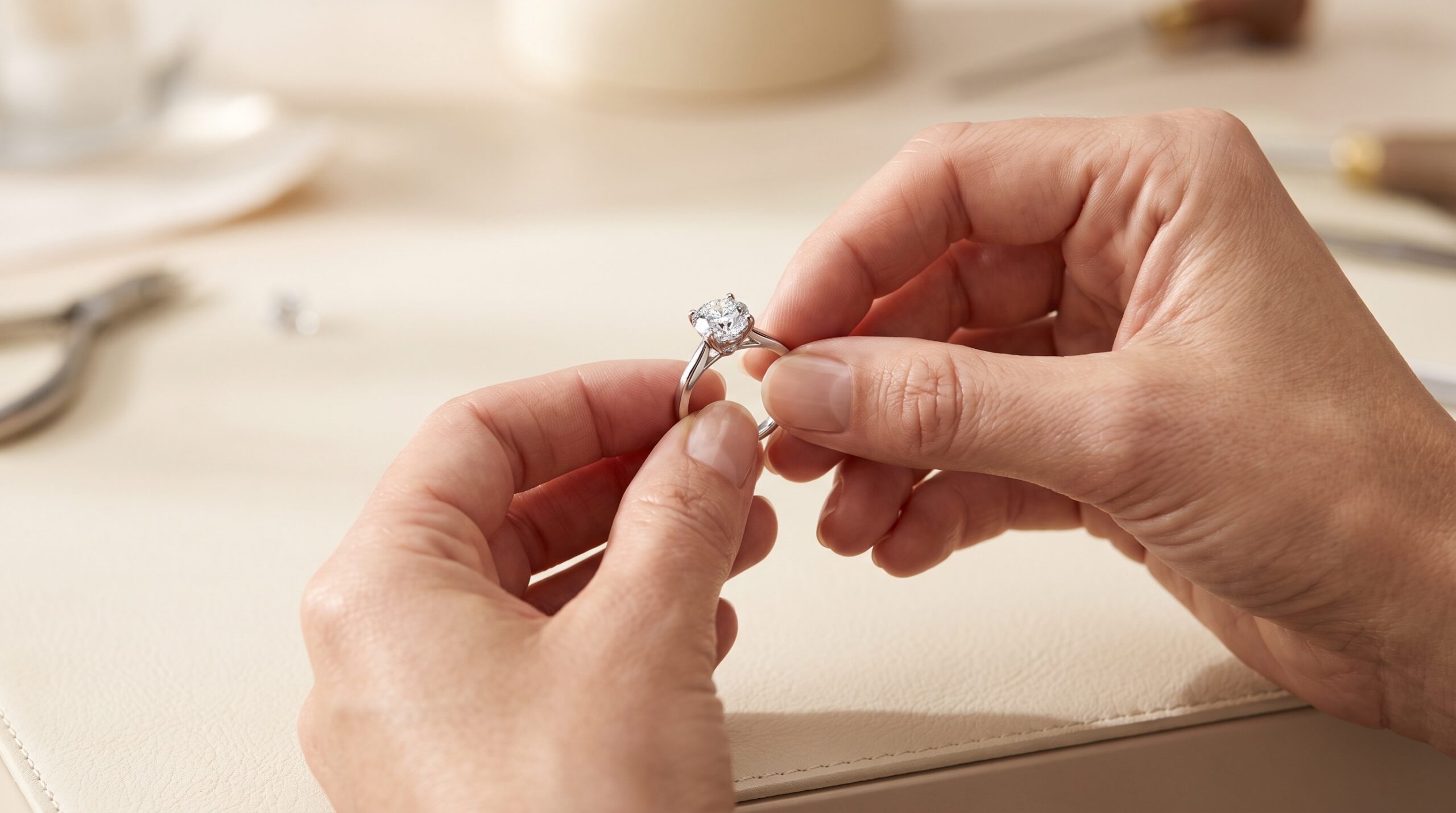
Most engagement ring regrets don’t come from picking an obviously bad ring. They come from small, overlooked details: a size guessed rather than measured, a setting that looked stunning in a photo but snags on everything within a month, a carat weight chosen over a cut quality that actually determines how the diamond looks on the hand. None of these are dramatic mistakes. They’re just the kind that don’t show up until the ring has already been worn for a while.
The good news is that avoiding most of them doesn’t require gemological training. It requires knowing which details actually affect years of daily wear, and which are mostly marketing.
Why Engagement Ring Mistakes Matter More Than People Expect
An engagement ring isn’t a piece worn on special occasions. It’s on the hand during work, cooking, exercise, sleep, and everything in between, which means small design or fit issues compound over years rather than showing up once and getting forgotten.
Buying decisions made in an emotionally charged moment, a proposal deadline, a surprise being planned, excitement about a specific look, tend to skip past practical questions that matter more once the ring is actually being worn every day. That’s not a criticism of buying with emotion involved; it’s just a reason to slow down on the practical checks specifically, since the emotional part of the decision usually takes care of itself.
There’s a real difference between a ring that photographs well the day it’s given and one that still feels right two years into daily wear. The first is about first impressions. The second is about cut quality, setting durability, comfort, and how well the design matches how the wearer actually lives.
Mistake #1: Prioritizing Carat Size Over Overall Beauty
Cut quality affects how much a diamond sparkles more than carat weight does. A diamond’s cut determines how light enters the stone and reflects back out, and a poorly cut stone can look dull and lifeless even at a larger size, while a smaller, well-cut diamond catches and returns light in a way that reads as genuinely brilliant.
This creates a real trade-off that’s worth understanding before shopping: a larger stone with a mediocre cut and a smaller stone with an excellent cut are not simply “more” and “less” of the same thing. They can look noticeably different in person, with the smaller, better-cut stone often appearing more impressive despite weighing less.
The result is that a bigger stone doesn’t automatically look more impressive. A large diamond with poor light performance can actually look flatter and less lively than a smaller one that’s been cut well, which runs counter to the assumption that carat weight is the main lever for visual impact.
| Feature | Large lower-cut stone | Smaller well-cut stone |
| Sparkle | Often muted, light escapes through the bottom rather than reflecting back | Strong, light returns through the top of the stone |
| Visual size | Larger on paper, but can look glassy or flat | Appears more lively despite smaller measurements |
| Value perception | Can feel like more “size for the money” upfront | Often reads as higher quality on closer inspection |
| Long-term satisfaction | Risk of disappointment once the cut quality becomes apparent in daily light | Tends to hold up better under different lighting over time |
Mistake #2: Choosing a Style Without Considering Daily Wear
A high setting shows off a stone dramatically, but it also catches on gloves, sweaters, and hair more than a lower setting does, which becomes a daily annoyance rather than an occasional one once the ring is actually being worn to work, at the gym, or around the house.
Pavé and halo settings, with many small stones arranged closely together, look striking and catch a lot of light, but they also mean more individual settings to keep clean and more small stones that need periodic inspection to make sure none have loosened. This isn’t a reason to avoid these styles, but it is a maintenance commitment worth going into with clear eyes.
Buyers often skip over how the ring will actually interact with their specific daily routine: office work involving a lot of hand-typing or paperwork, an active lifestyle with frequent physical activity, hands-on work like cooking or gardening, a general preference for minimal jewelry, or simply wanting something low-maintenance. None of these rule out any particular style outright, but they should inform which setting height, stone arrangement, and band width actually make sense.
Mistake #3: Guessing Ring Size
Paper strip or string methods for estimating ring size at home are notoriously imprecise, since they depend heavily on how tightly the material is wrapped and how much the finger has swelled or shrunk at the moment of measuring. A size guessed this way can be off by enough to require resizing almost immediately.
Professional sizing, done in person with a jeweler’s sizing tools, accounts for finger shape and knuckle size in a way a strip of paper simply can’t. If an in-person visit isn’t possible without ruining a surprise, a jeweler can often work from a ring the partner already wears on the correct finger instead of guessing from scratch.
Finger size genuinely fluctuates with temperature and time of day: fingers tend to be smaller in the morning or in cold weather, and larger later in the day or in heat. This isn’t a flaw in the sizing process, it’s just something worth accounting for by measuring under typical, comfortable conditions rather than right after a workout or a long flight.
Resizing possibilities also depend on the ring itself. A simple band with no stones along its circumference is usually straightforward to resize within a few sizes in either direction. A ring with pavé stones, an eternity band, or an intricate pattern running the full circumference is often much more limited in how far it can be adjusted, since cutting near set stones risks loosening them. This is worth knowing before falling in love with a specific design if there’s genuine uncertainty about the size.
| Method | Accuracy | Convenience | Risk Level | Recommended Use Case |
| Paper strip or string at home | Low | High | High, easy to misjudge | Rough estimate only, not a final decision |
| Sizing from an existing ring the partner wears | Moderate to high | Moderate | Low to moderate | Good option when an in-person visit isn’t possible |
| Professional in-person sizing | High | Lower, requires an appointment | Low | Best option whenever a surprise isn’t required |
Mistake #4: Ignoring Wedding Band Compatibility
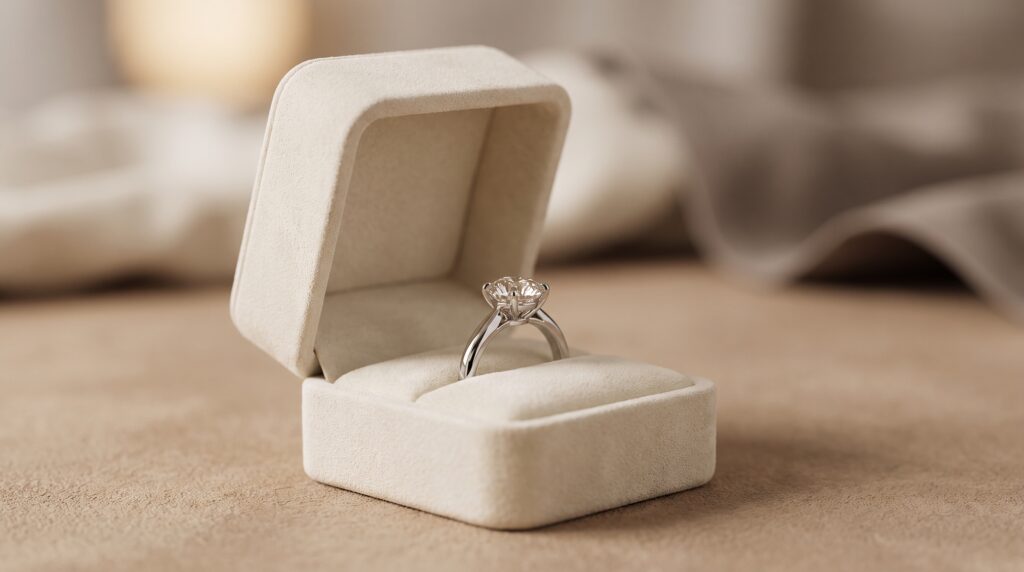
Not every engagement ring sits flush against a straight wedding band. A setting with a raised profile, a curved shank, or stones extending along the band can leave a visible gap or an uncomfortable pressure point once a wedding band is added next to it.
Curved or contoured wedding bands exist specifically to nest against an engagement ring’s shape, but they need to be chosen with the engagement ring’s actual profile in mind, not selected independently. Stacking two rings that weren’t designed with each other in mind is one of the more common sources of post-wedding regret, since it’s not usually apparent until both rings are tried on together.
Thinking about the bridal set together, even loosely, before finalizing the engagement ring avoids this problem later. It doesn’t mean both rings need to be purchased at the same time, just that the engagement ring’s profile should be chosen with an eye toward what it will eventually sit next to.
Mistake #5: Underestimating Maintenance and Long-Term Costs
White gold rings are typically finished with a rhodium plating that gives them their bright white color, and that plating wears down gradually with regular wear, eventually needing to be replated to maintain the original finish. This is a normal, expected part of white gold ownership, not a defect, but it’s a recurring cost that catches some buyers off guard.
Prongs and settings should be checked periodically, since a loosening setting doesn’t usually announce itself before a stone falls out. Rings with more elaborate settings, more stones, more crevices, more prongs, generally need more frequent professional inspection than a simple solitaire.
Cleaning expectations vary by style too. A plain band needs little more than an occasional soak and gentle brushing. A halo or pavé design accumulates residue in more places and takes more time and care to clean thoroughly at home.
Warranty terms are also frequently misunderstood. Many warranties cover manufacturing defects specifically, not the loss, theft, or accidental damage that actually cause most claims. Assuming a “lifetime warranty” covers everything the ring might encounter is one of the more common and costly misunderstandings buyers run into after the fact.
Low-maintenance styles, a solitaire or a bezel setting, generally mean fewer prongs to check, less residue buildup, and lower long-term upkeep. Higher-maintenance styles, halos, pavé bands, and intricate vintage-inspired settings, offer more visual complexity and sparkle in exchange for more frequent cleaning and inspection.
Mistake #6: Buying Without Checking Certification or Policies
For a diamond of meaningful size, a grading report from an established lab documents the stone’s specific characteristics, cut, color, clarity, and carat weight, independent of whatever a seller claims about it. This matters most for verifying that what’s being sold actually matches its description.
Recognized labs, most notably GIA, follow standardized grading criteria that are consistent across the industry, which is what makes a grading report meaningful as a point of comparison between different diamonds. A report from an unfamiliar or unaccredited source carries far less weight.
Return policies and resizing coverage deserve the same scrutiny as the ring itself, especially when buying online without trying the ring on first. A retailer’s willingness to accept returns or handle a free or discounted resize within a defined window says a lot about how confident they are in their own sizing guidance.
Before buying online, it’s worth verifying: whether the diamond or gemstone comes with a grading report from a recognized lab, specific metal details rather than vague descriptions, side-view images that show the setting’s actual profile (not just a straight-on shot), a clearly stated return window, a defined resize policy, what the warranty actually covers, and genuine customer reviews rather than only curated testimonials. The Federal Trade Commission’s jewelry guidance outlines the disclosure standards jewelers are expected to follow when describing metal content and gemstone treatments, which is a useful reference if a listing’s claims seem vague or inconsistent.
Mistake #7: Choosing Trends Without Thinking Long-Term
Trend-forward designs, a specific stone shape or setting style having a visible moment, are appealing precisely because they feel current and distinctive. That’s a legitimate reason to like a design, not something to dismiss.
Timeless styles, a classic solitaire or a simple three-stone setting, remain popular over decades specifically because their appeal doesn’t depend on matching a particular period’s aesthetic. That durability is part of why they keep showing up as recommended defaults, not because they’re inherently superior to more current designs.
The real question isn’t trend versus timeless as a binary choice, it’s how much a specific design’s appeal depends on the moment it was chosen in. A design that would still look intentional and well-chosen a decade from now carries less risk than one whose appeal is tightly tied to what’s popular right now, regardless of which category it technically falls into.
| Style Type | Visual Impact | Longevity | Versatility | Maintenance |
| Trend-driven design | Often high, distinctive and current | Depends heavily on the specific trend | Can be lower if the design is very specific | Varies widely by style |
| Timeless design (solitaire, simple three-stone) | Understated but consistent | Generally high | Generally high, pairs easily with most wedding bands | Often lower, simpler settings |
How to Make a More Confident Engagement Ring Decision
Start with wearability rather than appearance alone. A ring that looks incredible in a photo but doesn’t suit how the wearer actually spends their day is going to create friction that a beautiful setting can’t offset.
Think past the proposal moment specifically. The ring needs to work for years of ordinary days, not just the one it’s presented on, which is a different set of priorities than what makes for a dramatic reveal.
Research at a reasonable pace rather than under deadline pressure. Comparing a few options side by side, checking cut quality against carat weight, testing wedding band pairings, tends to produce a better outcome than a rushed decision made under proposal-timeline stress.
Prioritize quality, comfort, and craftsmanship over chasing every trend or maximizing size. A ring that fits well, wears comfortably, and was well made tends to age better, both in how it looks and in how the wearer feels about it, than one chosen primarily to impress in the moment.
Before finalizing a decision, it’s worth asking directly: does the cut quality match or exceed the carat weight in importance for this specific stone? Does the setting suit the wearer’s actual daily activities? Has the size been professionally confirmed rather than estimated? Has wedding band compatibility been considered? What ongoing maintenance does this specific style require? Does the listing or retailer provide real certification and clear policies?
Conclusion
None of these mistakes require expert-level knowledge to avoid. They require asking a few specific questions before buying: how the cut compares to the carat, how the size was actually determined, what the setting will demand in upkeep, and whether the design will still make sense next to a wedding band and a decade of daily wear. A ring chosen with those questions in mind tends to hold up better, both physically and in how it feels to wear, than one chosen primarily to impress in a single moment.
Frequently Asked Questions
Is a bigger diamond always better?
No. Cut quality has more influence on how a diamond actually looks, its sparkle and light performance, than carat weight does. A larger stone with a poor cut can look duller than a smaller, well-cut one, so size alone isn’t a reliable measure of how impressive or beautiful a diamond will appear in person.
Can every ring be resized?
No. A simple band with no stones along the circumference is usually straightforward to resize within a few sizes. Rings with pavé stones, eternity bands, or intricate patterns running the full band are often much more limited in how far they can be adjusted, since resizing near set stones risks loosening them. It’s worth asking about resizing limits for a specific design before assuming it can be easily adjusted later.
What engagement ring styles require the most maintenance?
Styles with more stones and more settings, halos, pavé bands, and detailed vintage-inspired designs, generally need more frequent cleaning and professional inspection than a simple solitaire or bezel setting. This isn’t a reason to avoid these styles, but it’s worth factoring into the decision if low maintenance is a priority.
How do I know if a ring is durable enough for everyday wear?
Look at the setting height, the number and placement of prongs, and how exposed the stones are to knocks and snagging. A lower setting or a bezel that protects the stone’s edge tends to hold up better to daily activities than a high, exposed setting. A jeweler can also assess a specific design’s durability based on the wearer’s typical activities and hand use.
Should I buy trendy or classic?
Neither is inherently the better choice. What matters more is how much a specific design’s appeal depends on current trends versus a look that would still feel intentional years from now. A distinctive, trend-forward ring can be a great choice if the wearer genuinely loves it regardless of trend cycles, while a classic design offers more built-in longevity by default.
Do I need certification?
For any diamond of meaningful size or value, a grading report from a recognized lab is worth having, since it documents the stone’s actual characteristics independent of what a seller claims. It’s especially useful for verifying quality and value when buying online, where the stone can’t be examined in person before purchase.
How important is wedding band compatibility?
It’s worth considering before finalizing the engagement ring, not after. Some settings don’t sit flush against a straight wedding band, which can mean an uncomfortable gap or fit once both rings are worn together. Thinking about this early, even loosely, avoids having to choose between an engagement ring you love and a wedding band that actually pairs well with it.
What online details matter most?
Certification or a grading report for any significant stone, specific metal details rather than vague descriptions, side-view images showing the setting’s actual profile, a clearly stated return window, a defined resizing policy, and real customer reviews all matter more than how polished the product photography looks. A retailer confident in what they’re selling will typically make these details easy to find rather than requiring buyers to ask.