
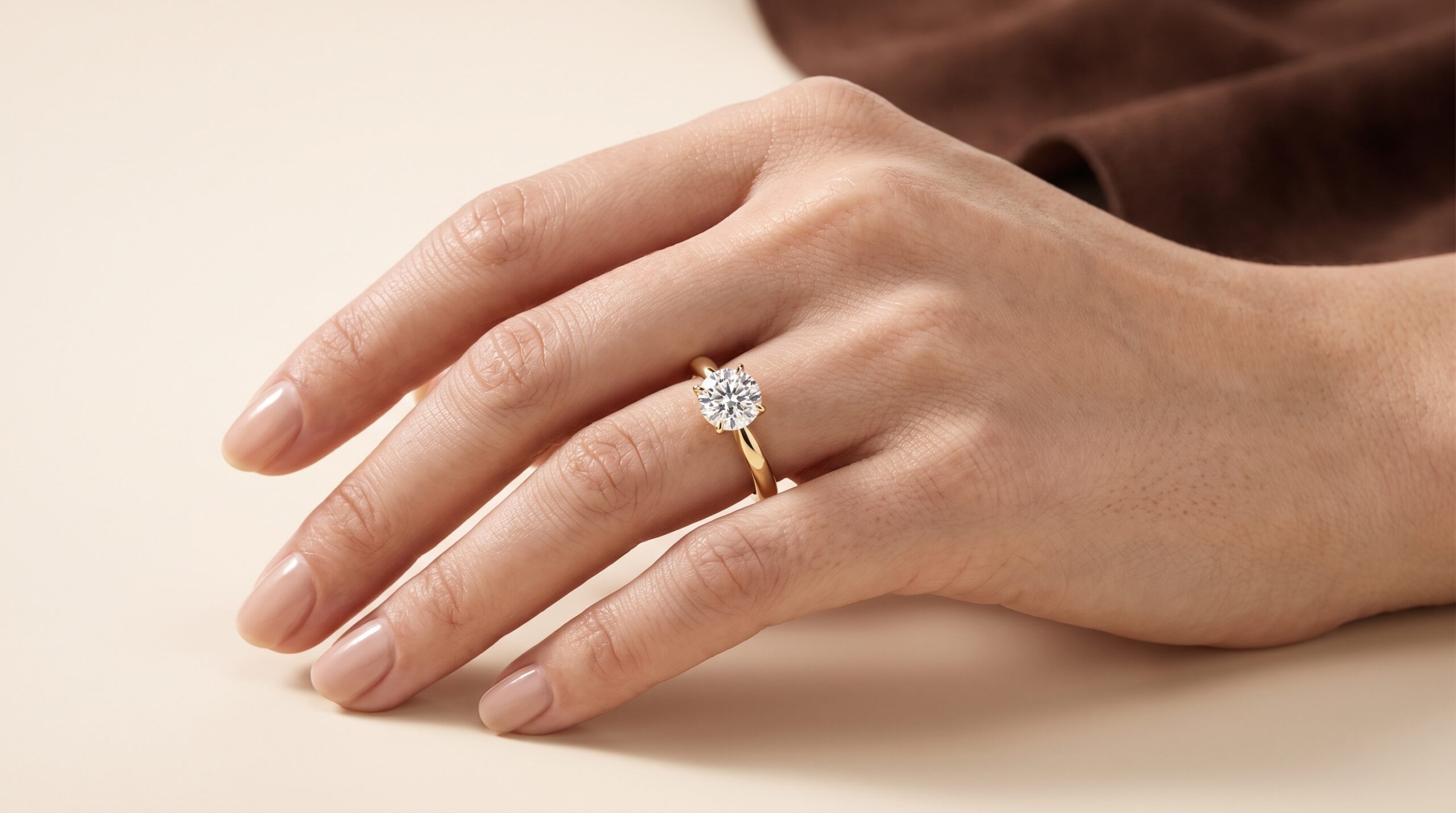
Wanting a ring that’s both beautiful and ethically sourced sounds straightforward until you start reading the actual terminology. Conflict-free, lab-grown, recycled gold, Fairmined, Kimberley Process: each term covers a different part of the supply chain, and none of them alone tells the whole story. This guide breaks down what these terms actually mean, what they do and don’t guarantee, and how to verify a seller’s claims before you buy.
What Is an Ethical Engagement Ring?
An ethical engagement ring generally combines three things: a diamond or gemstone sourced with attention to labor conditions and environmental impact, a metal sourced the same way, and documentation that lets you verify those claims rather than take them on faith.
The terms buyers encounter aren’t interchangeable, even though marketing often uses them as if they were. “Ethical” is a broad umbrella covering labor practices, environmental impact, and community effects across the supply chain. “Sustainable” focuses more narrowly on environmental impact, particularly around mining and resource use. “Conflict-free” refers specifically to diamonds not used to fund armed conflict, a narrower claim than either of the other two. “Traceable” means the origin of a specific stone or metal can be documented and verified, which is a precondition for making any of the other claims credible, though traceability alone doesn’t guarantee good labor or environmental practices.
| Term | What It Actually Covers |
| Ethical | Broad: labor conditions, environmental impact, community effects |
| Sustainable | Narrower: environmental impact specifically |
| Conflict-free | Narrowest: absence of funding for armed conflict |
| Traceable | Documented origin, a precondition for verifying other claims |
Ethical Diamonds: Lab-Grown vs Responsibly Sourced Mined Diamonds
Lab-grown diamonds are grown in controlled laboratory conditions rather than formed underground over geologic time, but they aren’t a different material or a simulant. According to GIA’s comparison of natural and laboratory-grown diamonds, lab-grown diamonds share essentially the same chemical composition, crystal structure, and optical properties as natural diamonds. From an ethical sourcing standpoint, lab-grown diamonds sidestep most mining-related labor and land-use concerns entirely, since there’s no mine involved, though the energy used in the growing process is its own environmental consideration worth asking a seller about.
Responsibly sourced mined diamonds take a different path to the same goal. Rather than avoiding mining, this approach focuses on verifying that a specific stone’s mining and trade followed documented labor, environmental, and community standards. This usually means sourcing from mines or trade programs certified by bodies like the Responsible Jewellery Council, discussed further below, and often carries additional value for buyers who want a diamond with a natural geologic origin and a verifiable, responsible supply chain behind it.
Neither path is more ethical than the other by default. A lab-grown diamond guarantees no mining-related sourcing issues but doesn’t inherently address the energy source used in production. A mined diamond with strong certification can meet high labor and environmental standards but requires more documentation to verify than a lab-grown stone does. The right choice depends on which specific concerns, mining impact, energy use, natural origin, matter most to you.
| Lab-Grown Diamonds | Responsibly Sourced Mined Diamonds | |
| Origin | Grown in controlled lab conditions | Extracted from certified or documented mining operations |
| Main ethical advantage | No mining-related labor or land-use impact | Verifiable adherence to labor and environmental standards |
| Main consideration | Energy source used in production varies by producer | Requires more documentation to verify sourcing claims |
| Best for | Buyers prioritizing avoidance of mining impact | Buyers prioritizing natural origin with verified sourcing |
What Does Conflict-Free Really Mean?
The Kimberley Process is an international certification scheme created to prevent “blood diamonds,” rough diamonds sold to finance armed conflict against governments, from entering the legitimate diamond trade. According to the European Commission’s overview of the Kimberley Process, the scheme now covers more than 99% of global rough diamond production and trade, making it the dominant framework for conflict-free certification worldwide.
That coverage is significant, but the certification has real limits worth understanding before treating “conflict-free” as a complete ethical guarantee. The Kimberley Process defines conflict diamonds narrowly, specifically diamonds funding rebel movements against recognized governments, which means it doesn’t directly address broader labor conditions, environmental practices, or community impact at a given mine. A diamond can be fully Kimberley Process certified while the mine it came from still has separate, unaddressed labor or environmental concerns.
This isn’t a reason to dismiss the certification. It remains a meaningful baseline that virtually all diamonds in legitimate trade channels meet. It’s simply not, on its own, a complete answer to every ethical sourcing question a buyer might have, which is why additional certifications and documentation (covered next) matter for buyers wanting a fuller picture.
Ethical Metal Choices
Recycled gold is existing gold, from old jewelry, industrial sources, or electronics, refined and reused rather than newly mined. The material itself is identical to newly mined gold once refined; the ethical benefit comes entirely from reducing demand for new mining, not from any difference in the metal’s quality or properties.
Fairmined gold comes from small-scale and artisanal mines certified under the Fairmined Standard, which covers responsible mining practices, environmental protection, safe labor conditions, and traceability, along with a premium paid to the certified mining communities. This is a more involved certification than simply sourcing gold responsibly in a general sense; it ties a specific batch of gold to a specific certified mine and community.
Fairtrade gold operates on a related but distinct model, focused specifically on improving working conditions and market access for artisanal and small-scale miners. According to Fairtrade’s gold standard documentation, the standard addresses fair pricing, safer working conditions, and reduced use of hazardous materials like mercury in small-scale mining operations.
Platinum and other metals can also carry responsible sourcing certifications through bodies like the Responsible Jewellery Council, discussed in the next section, though the specific Fairmined and Fairtrade programs are most established for gold.
| Metal/Source | Ethical Benefit | Trade-off | Best For |
| Recycled gold | Reduces demand for new mining | Doesn’t directly support small-scale mining communities | Buyers prioritizing reduced mining impact |
| Fairmined gold | Certified responsible mining, labor, environment, community premium | Typically costs more; limited availability compared to conventional gold | Buyers wanting direct support for certified mining communities |
| Fairtrade gold | Improved conditions and fair pricing for artisanal miners | Similar availability and cost considerations as Fairmined | Buyers prioritizing artisanal miner welfare specifically |
Certifications and Documentation to Look For
A GIA grading report documents a diamond’s clarity, color, cut, and carat weight using standardized, internationally recognized criteria, giving buyers an objective way to verify a stone’s quality claims regardless of where they’re shopping.
An IGI report serves a similar function specifically for lab-grown diamonds. According to IGI’s lab-grown diamond report documentation, these reports provide the same 4Cs assessment as natural diamond reports while explicitly identifying the stone’s laboratory origin, which matters for both quality verification and origin transparency.
The Responsible Jewellery Council sets industry-wide standards for ethical practices across the jewelry supply chain. Its Code of Practices and Chain of Custody standards cover human rights, labor conditions, environmental impact, and mining practices, and Chain of Custody certification specifically tracks materials through each stage of processing, giving buyers a way to verify sourcing claims beyond the mine itself.
Fairmined and Fairtrade documentation, as covered above, verify specific gold sourcing claims tied to certified mining operations, and should come with a certificate number a buyer can look up rather than just a general label on a product page.
For any of these certifications, ask for the specific certificate or report number rather than accepting a general claim. A legitimate certification can be independently verified through the issuing body’s own database; a claim without a checkable number can’t be confirmed one way or the other.
How to Choose the Right Ethical Ring for Your Priorities
Start by deciding your ethical priority, since “ethical” covers several distinct concerns and few buyers care equally about all of them. Some prioritize avoiding mining impact entirely; others prioritize supporting certified responsible mining communities; others focus mainly on conflict-free sourcing as a baseline and don’t feel strongly beyond that.
From there, choose the diamond or gemstone type that matches that priority: lab-grown if avoiding mining impact matters most, a certified responsibly sourced mined diamond if supporting verified ethical mining matters more than avoiding mining altogether.
Choose a metal source next, weighing recycled gold, Fairmined, or Fairtrade gold against your budget and which specific issue (reducing new mining demand versus directly supporting certified mining communities) matters more to you.
Review the certification for both the stone and the metal, checking that certificate numbers are provided and verifiable rather than just referenced vaguely in a product description.
Consider lifestyle and setting durability alongside the ethical sourcing decisions, since a ring that doesn’t hold up to daily wear creates its own kind of waste and dissatisfaction regardless of how responsibly its materials were sourced.
Finally, confirm return, resizing, and warranty policies before completing the purchase, the same practical checks that matter for any engagement ring purchase, ethical sourcing aside.
Online Buying Checklist
Request the specific certificate number for both the diamond and any certified metal sourcing, and verify it independently through the issuing body’s database rather than trusting a product page description alone.
Check the return policy, including the window for returns and whether it’s a full refund or store credit, before finalizing a purchase you can’t physically inspect first.
Confirm the resizing policy, including cost and timeline, since a ring purchased before a proposal often needs adjustment afterward.
Look for real, high-resolution photos and video of the actual piece rather than only stock or rendered images, which don’t reliably represent the specific ring you’d receive.
Ask for documentation on metal sourcing specifically, not just the diamond, since a seller can be transparent about diamond origin while remaining vague about where the gold or platinum came from.
Review the warranty terms, understanding what’s covered, for how long, and whether normal maintenance like rhodium replating (for white gold) is included or billed separately.
Confirm you can reach customer service with specific sourcing questions and get a substantive answer, not a generic response, before completing a purchase.
| What to Check | Why It Matters | Red Flag |
| Certificate number | Lets you verify claims independently | No number provided, or number doesn’t verify |
| Return policy | Protects against dissatisfaction with an unseen purchase | Vague, restrictive, or absent return terms |
| Resizing policy | Rings often need adjustment after a proposal | No mention of resizing cost or timeline |
| Real product photos/video | Confirms what you’ll actually receive | Only stock or rendered images |
| Metal sourcing documentation | Verifies ethical claims beyond the stone | Sourcing details only cover the diamond, not the metal |
| Warranty terms | Sets expectations for coverage and maintenance | Warranty terms not clearly stated |
Ethical Engagement Ring Red Flags
A few patterns are worth treating as reasons to pause and ask more questions rather than proceed:
- “Ethical” or “sustainable” used as a label with no supporting documentation or certificate number
- No grading report for the diamond, or a report from an unfamiliar lab with no clear verification process
- No clearly stated return policy, or one that’s unusually restrictive for the price point
- Prices significantly below typical market range with no explanation for the discount
- No specific information about metal sourcing beyond a general claim
- High-pressure sales language urging an immediate decision, which tends to discourage the kind of careful verification ethical claims actually require
None of these automatically means a seller is acting in bad faith, but any of them is a reasonable basis for asking direct follow-up questions before purchasing.
Care and Long-Term Wear
An ethically sourced ring still needs the same ongoing care as any engagement ring. Clean it every one to two weeks with warm water, mild soap, and a soft brush, paying attention to the underside of the setting where oils and lotion collect.
Schedule a professional inspection roughly once a year, checking prong tightness and overall wear, to catch a loosening stone or thinning band before it becomes a more serious problem.
If the ring is set in white gold, plan for periodic rhodium replating, typically every one to three years depending on how much daily wear the ring sees, to maintain its bright white finish.
Store the ring separately from other jewelry, ideally in a soft-lined box, to avoid scratches from harder stones or metal edges it might otherwise contact.
None of this changes based on how the diamond or metal was sourced. A responsibly sourced ring that isn’t properly cared for will show wear just as quickly as any other ring, so the sourcing decision and the maintenance routine are separate parts of the same long-term ownership picture.
Frequently Asked Questions
What makes an engagement ring ethical?
An ethical engagement ring generally combines a responsibly sourced diamond or gemstone, a responsibly sourced metal, and documentation that lets a buyer verify both claims rather than take them on faith. There’s no single certification that covers everything at once, so most ethically sourced rings involve checking a few different types of documentation: a diamond grading report, metal sourcing certification like Fairmined or recycled gold verification, and, where applicable, broader supply chain standards like those from the Responsible Jewellery Council.
Are lab-grown diamonds more ethical?
They avoid most mining-related labor and land-use concerns entirely, since no mine is involved in their production, which is a genuine ethical advantage for buyers specifically concerned about mining impact. That said, “more ethical” depends on what you’re weighing it against. A responsibly sourced, certified mined diamond can also meet high labor and environmental standards, and lab-grown diamonds have their own environmental consideration in the energy used during production, which varies by producer.
Is Kimberley Process certification enough?
It’s a meaningful baseline that covers the vast majority of the global rough diamond trade, but it addresses one specific issue: diamonds funding armed conflict. It doesn’t directly address broader labor conditions, environmental practices, or community impact at a given mine, so buyers wanting a fuller ethical picture typically look for additional certification, such as Responsible Jewellery Council standards, alongside Kimberley Process compliance rather than treating it as the complete answer on its own.
Is recycled gold lower quality?
No. Recycled gold goes through the same refining process as newly mined gold before being used in jewelry, and the resulting metal is chemically identical regardless of its source. The ethical benefit of choosing recycled gold comes entirely from reducing demand for new mining, not from any difference in the metal’s purity, durability, or appearance.
What certification should I ask for?
For the diamond, ask for a grading report from a recognized lab like GIA, with IGI reports being standard for lab-grown stones specifically. For the metal, ask whether it’s recycled, Fairmined, or Fairtrade certified, and request the specific certificate number for any of these claims so you can verify it independently rather than relying on the seller’s description alone.
Are ethical engagement rings more expensive?
It depends on the specific choices involved. Lab-grown diamonds typically cost less than natural diamonds of comparable quality, while Fairmined or Fairtrade certified gold often costs more than conventional gold due to the added certification and community premium built into the sourcing. Recycled gold generally costs about the same as newly mined gold. There’s no single price direction across all ethical choices; it depends on which specific combination of stone and metal sourcing you choose.
Can ethical engagement rings be resized?
Yes, resizing works the same way regardless of how the ring’s materials were sourced. The factors that affect resizing, such as whether the setting includes stones or detailing extending down the band, are about the design itself, not the ethical sourcing of the diamond or metal.
What are red flags when buying online?
Watch for vague ethical claims with no certificate number or documentation, missing or unfamiliar diamond grading reports, unclear or restrictive return policies, prices well below typical market range without explanation, sourcing information that covers the diamond but not the metal, and high-pressure sales tactics that discourage the kind of careful verification legitimate ethical claims should be able to withstand.