
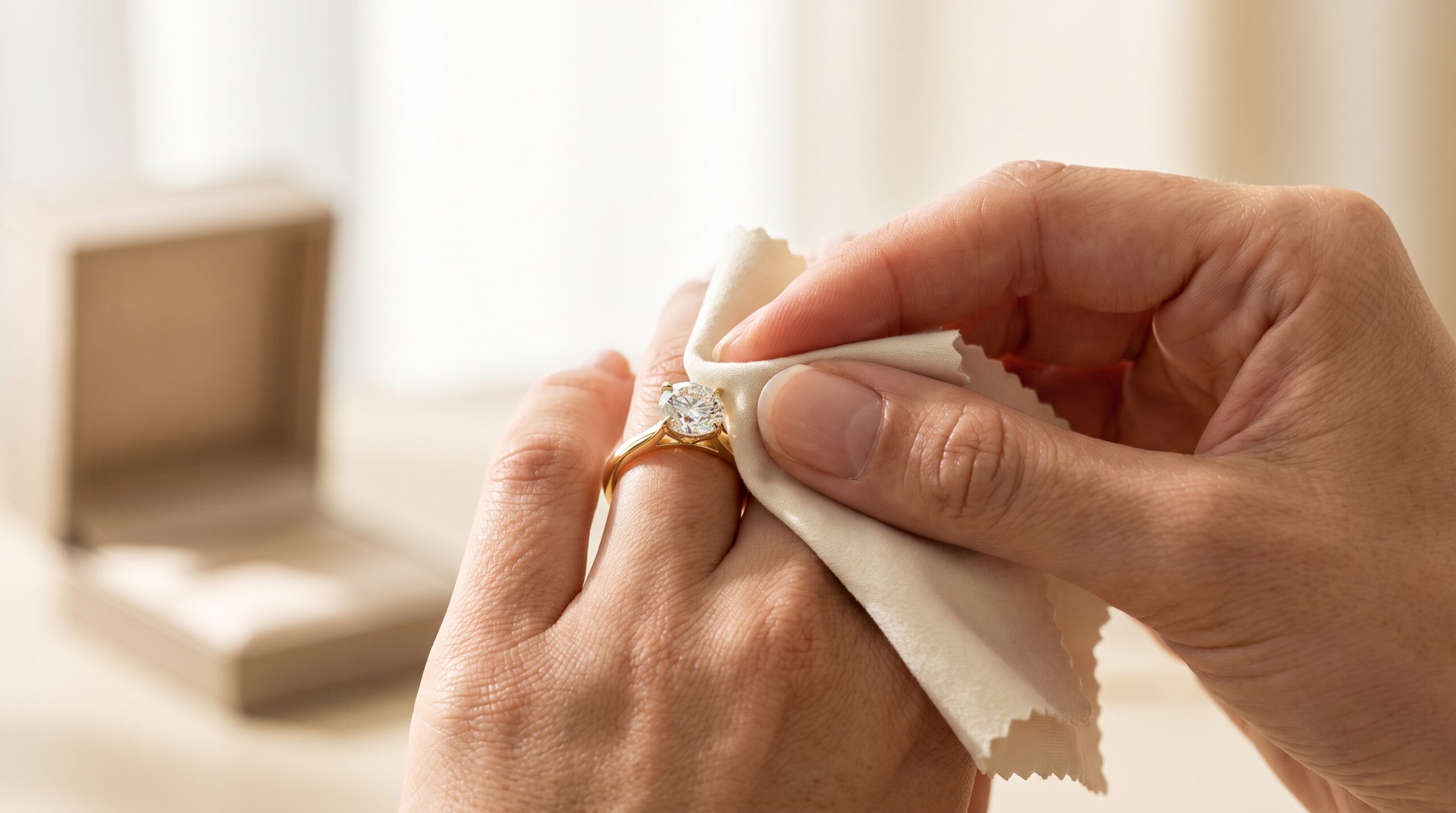
A diamond is hard enough to scratch almost anything else on your hand, but that toughness doesn’t extend to the rest of the ring. The metal band can bend. Prongs wear down and loosen. Pavé stones can work free of their settings. An engagement ring worn every day is exposed to soap residue, lotion, gym equipment, garden soil, and a hundred small impacts a year, and none of that is stopped by the hardness of the center stone. Care means protecting the whole ring, not just keeping the diamond shiny.
None of this requires a complicated routine. It requires a few consistent habits: cleaning it regularly, knowing when to take it off, and having a jeweler check the setting on a schedule rather than waiting for something to feel wrong.
Why Engagement Ring Care Matters
Daily wear leaves a residue. Hand lotion, soap, cooking oil, and ordinary dust settle into the underside of a stone and around the prongs, and that buildup is what makes a ring look dull even though the diamond itself hasn’t changed. This is a cosmetic issue, and it’s the easiest one to fix: a few minutes of cleaning restores the sparkle.
The other kind of wear is structural, and it’s the one that matters more. Prongs that hold the stone can bend or thin from repeated knocks against doorframes, countertops, and steering wheels. A setting can loosen gradually, to the point where a stone that seemed perfectly secure starts to move. This doesn’t show up as dullness. It shows up as a stone that feels loose, or a prong that catches on fabric, and it’s the reason routine inspection matters as much as routine cleaning.
How Often Should You Clean Your Engagement Ring?
A ring worn daily benefits from a quick clean about once a week, or whenever it starts to look filmy rather than sparkling. That’s a home task: warm water, mild soap, a soft brush, done in a few minutes.
Professional cleaning and inspection are a separate matter and don’t need to happen as often. Once every six months to a year is a reasonable interval for a ring worn daily, since that’s often enough for a jeweler to check the prongs and settings before a small problem becomes a lost stone.
| Care Task | Suggested Frequency | Why It Matters |
| At-home cleaning | Weekly, or when the ring looks dull | Removes lotion, soap, and dust buildup that dulls sparkle |
| Professional cleaning and inspection | Every six months to a year | Checks prong and setting security, not just appearance |
| Appraisal update | Every few years, or before insurance renewal | Keeps insured value aligned with current replacement cost |
The Safest Way to Clean an Engagement Ring at Home
For most diamond rings in a standard setting, gentle home cleaning is enough to maintain the sparkle between professional visits. You’ll need warm water, a small bowl, a few drops of mild dish soap, a soft-bristled toothbrush, and a lint-free cloth. If you’re rinsing near a sink, close the drain first or use a stopper. It’s an easy step to skip and the one most likely to end with a ring rolling out of reach.
- Fill a small bowl with warm water and a few drops of mild dish soap.
- Let the ring soak for 20 to 30 minutes to loosen buildup.
- Use the soft toothbrush to gently brush around the stone, under the setting, and along the band.
- Rinse the ring under running water, with the drain closed or a stopper in place.
- Pat dry with a lint-free cloth, and let it air dry fully before storing or wearing it again.
Avoid bleach, chlorine, and any cleaner with strong chemicals, since these can weaken certain metal alloys and degrade some gemstone treatments. Skip abrasive toothpaste and hard scrubbing too. Toothpaste often contains mild abrasives meant for enamel, not polished metal, and scrubbing hard enough to feel productive is usually hard enough to add fine scratches.
Cleaning Methods Compared
Mild soap and water is the standard everyday method for most diamond rings and involves the least risk. It won’t damage metal or a well-set diamond, and it’s gentle enough to use weekly.
A soft brush, used during that same soak, gets into the places a cloth can’t reach: under the center stone, around the prongs, and inside a halo setting where residue tends to collect. It’s a supplement to the soap-and-water soak, not a separate method.
Professional cleaning goes further because it comes paired with inspection. A jeweler cleans the ring using tools not practical for home use and checks the setting at the same time, which is the main reason it’s worth doing periodically even if the ring looks fine.
Ultrasonic cleaners use high-frequency vibration to shake loose dirt, and they can be effective on sturdy diamond rings in solid settings. But the same vibration that loosens grime can also loosen an already-weak prong or stress a fracture-filled or heavily included stone, so it isn’t a safe default for every ring. A jeweler can tell you whether your specific ring is a good candidate.
| Method | Best For | Benefits | Cautions |
| Mild soap and water | Most diamond rings, weekly use | Low risk, gentle, effective on everyday buildup | Won’t remove buildup in tight crevices without a brush |
| Soft brush | Prongs, baskets, and under the center stone | Reaches spots a cloth or soak alone won’t clean | Use gentle pressure only, never scrub hard |
| Professional cleaning | Deep cleaning paired with inspection | Combines cleaning with a structural check | Requires an appointment, not a daily option |
| Ultrasonic cleaning | Sturdy diamond rings in solid settings | Effective on ingrained dirt | Not suitable for loose settings, some gemstones, or treated stones |
When to Remove Your Engagement Ring
Certain activities put the ring at meaningfully higher risk, and removing it takes a few seconds. Exercise and heavy lifting can chip a stone or bend a prong against equipment. Swimming exposes the metal to chlorine, which can damage certain alloys over time, and cold water can also cause fingers to shrink slightly, raising the odds the ring slips off underwater without you noticing. Household cleaning exposes the ring to the same chemicals you’re trying to avoid using directly on it, and gardening adds dirt and grit into the setting along with real risk of impact against tools or rocks. Cooking, especially anything involving raw meat or dough, works grease and residue into crevices that then require extra cleaning. Applying lotion, sunscreen, or other beauty products leaves a film on the ring almost immediately.
None of this means the ring needs to come off for every errand. It means recognizing which activities involve chemicals, impact, or a real chance the ring could slip off unnoticed, and treating those as the moments to set it aside.
How Ring Style Affects Care
A classic solitaire, with a single stone held by a small number of prongs, is generally the easiest style to clean and inspect. There’s one stone to check and no small crevices collecting residue.
Halo and pavé settings surround the center stone, or run along the band, with many small stones set close together. That design catches more light, but it also means more places for soap residue and lotion to collect, and more individual prongs that need checking. A missing pavé stone is often harder to notice than a missing center stone simply because it’s smaller and surrounded by others.
Vintage and antique-inspired rings, or reproductions in that style, sometimes use older-style settings, filigree work, or gemstones that were common decades ago but are now understood to need gentler handling. These benefit from professional guidance before any at-home cleaning, since a technique safe for a modern setting isn’t automatically safe for an older one.
High-set rings, where the stone sits well above the band, catch more light and also catch on more things: gloves, sweaters, hair. That raises the odds of a knock loosening a prong over time. Low-profile rings, where the stone sits closer to the finger, tend to be more practical for daily wear and hands-on work, simply because there’s less of the setting exposed to impact.
| Ring Style | Care Level | Common Concern | Best Habit |
| Solitaire | Lower | Single stone security | Check prongs during routine cleaning |
| Halo or pavé | Higher | Residue buildup, small stone loss | Use a soft brush around every stone, not just the center |
| Vintage or antique-inspired | Higher | Age-appropriate cleaning methods | Ask a jeweler before using any method beyond soap and water |
| High-set | Higher | Snagging and knocks | Remove before activities involving gloves, fabric, or impact |
| Low-profile | Lower | Less exposed, but still needs checks | Still schedule regular inspection despite lower daily risk |
Metal and Gemstone Care Considerations
Gold and platinum are both durable choices for a ring worn daily, though they age differently. Platinum develops a soft surface patina over time that some owners prefer and others have polished away. Gold, depending on its karat and alloy, can show scratches more readily but generally responds well to the same mild soap cleaning routine.
White gold is typically plated with rhodium, a hard, bright white metal, to achieve its color. That plating wears down gradually with daily contact, and the ring may start to show a warmer, slightly yellow tone underneath as the rhodium thins. Replating restores the original white finish and is a normal part of white gold ownership rather than a sign anything went wrong.
Diamond cleaning advice doesn’t automatically apply to every gemstone. Diamonds are extremely hard and largely unaffected by mild soap and water. Softer or more porous stones, such as certain colored gemstones, opals, or emeralds (many of which are treated to improve clarity), can react differently to the same cleaning approach, sometimes losing color, developing cloudiness, or reacting poorly to temperature changes or soaking. The GIA Gem Encyclopedia is a useful reference for understanding the specific care needs of individual gemstones before applying a general cleaning method to one.
Always check what’s actually in the ring, center stone and accent stones both, before assuming a cleaning method safe for diamonds is safe for everything set alongside them.
How to Store Your Engagement Ring Safely
A soft-lined box or a fabric pouch protects the ring when it’s not being worn, since a bare drawer or a bathroom counter exposes it to scratches from other objects and to temperature or humidity swings.
Store it separately from other jewelry. Diamonds can scratch other jewelry, including other diamonds, and metal-on-metal contact in a shared box or bag leads to fine scratches and tangled chains over time.
Pick one consistent place for the ring when it’s off, whether that’s a bedside dish or a dedicated jewelry box, and use it every time. Misplacement is one of the more common ways rings end up lost, and a fixed habit removes the guesswork.
Signs Your Ring Needs Professional Attention
Book a jeweler visit if you notice any of the following:
- The stone moves or rattles slightly when you tap the ring
- A prong feels sharp, bent, or catches on fabric more than it used to
- The ring snags on clothing or hair more often than before
- The band looks visibly thin or worn in one spot
- The stone sits unevenly compared to how it originally looked
- Pavé or accent stones look missing, or the setting looks uneven
Any one of these is worth a prompt visit rather than waiting for the next scheduled inspection, since a loose stone can fall out between now and then.
What Documents Should You Keep With Your Ring?
Keep the original receipt, any warranty card, an appraisal, and a grading report if the diamond has one, ideally from a lab such as GIA. Add service records each time the ring is cleaned, inspected, resized, or repaired, along with clear photos from a few angles.
This isn’t paperwork for its own sake. A jeweler doing a repair benefits from knowing the ring’s history. An insurer processing a claim needs the appraisal to confirm value. And photos or a grading report can help identify the ring if it’s ever lost or recovered. Keeping these together, physically or digitally, means they’re ready when actually needed rather than something to track down under pressure.
Conclusion
Ring care comes down to two separate habits that are easy to conflate: keeping it clean, which is mostly cosmetic, and keeping the setting checked, which is structural. A weekly soak and brush handles the first. A jeweler visit every six months to a year handles the second, and it’s the one that actually prevents a lost stone.
If your ring has a style that adds complexity, pavé accents, a vintage setting, stones other than diamond, treat the general advice here as a starting point and confirm the specifics with a jeweler who can look at the actual piece. A quick conversation at your next inspection costs nothing and settles any doubt about what’s safe for that particular ring.
Frequently Asked Questions
How often should I clean my engagement ring?
A weekly soak in warm water and mild soap, followed by a gentle brush around the setting, is enough for most diamond rings worn daily. Clean it sooner if it starts to look visibly dull or filmy, since that’s usually a sign of lotion or soap buildup rather than anything requiring a jeweler.
Can I clean my engagement ring with dish soap?
Yes, for most diamond rings a few drops of mild dish soap in warm water is a standard and safe cleaning method. Avoid dish soaps with added moisturizers or strong fragrances, and skip anything containing bleach or harsh degreasers, since those can affect certain metals and gemstone treatments.
Is ultrasonic cleaning safe?
It depends on the ring. Ultrasonic cleaners can be effective on sturdy diamond rings with solid, well-maintained settings, but the vibration involved can loosen an already-weakened prong or stress certain gemstones, particularly those with internal fractures or specific treatments. A jeweler can tell you whether your ring is a reasonable candidate before you try it, whether at home or through a professional service.
Should I wear my ring in the shower?
It’s generally better to take it off. Soap and shampoo leave residue in the setting, and some formulas contain ingredients that aren’t ideal for certain metals or gemstone treatments over repeated exposure. It’s a small habit that avoids a category of buildup entirely.
Should I sleep with my engagement ring on?
Many people do, and it’s not inherently damaging in the way chemical exposure or a hard impact would be. That said, a ring can catch on bedding or snag while you move, and some people find it more comfortable to remove it at night. This comes down to personal preference rather than a firm rule.
How often should prongs be checked?
Every six months to a year is a reasonable interval for a ring worn daily, timed to coincide with a professional cleaning and inspection. If you notice a prong feels sharp, bent, or catches on fabric before that scheduled visit, don’t wait, get it checked promptly.
Does white gold need special care?
White gold rings are typically finished with a rhodium plating that gives them their bright white color, and that plating wears down gradually with daily wear. Over time the ring may develop a warmer tone as the plating thins, and a jeweler can replate it to restore the original finish. This is a normal, expected part of owning white gold rather than a defect.
Can all gemstones be cleaned the same way?
No. Diamonds are hard and generally tolerate mild soap and water well, but the same isn’t true for every gemstone. Softer or treated stones can be sensitive to soaking, temperature changes, or certain chemicals in ways diamonds aren’t. If your ring includes a colored gemstone or an antique stone, confirm the safe cleaning approach for that specific stone rather than assuming diamond care applies.
What should I do if my ring feels loose?
Stop wearing it and schedule a jeweler visit as soon as you can. A stone that moves or rattles, even slightly, is at risk of falling out, and this isn’t something to address at the next routine cleaning if it’s already noticeable. A jeweler can tighten or rebuild the setting before the stone is actually lost.
What is the safest way to clean a ring over a sink?
Close the drain or use a stopper before you start, since an open drain is one of the more common ways a ring is lost during an otherwise routine cleaning. Clean the ring over a towel or a bowl of water rather than directly under a running tap, and only rinse over an open sink once the drain is confirmed closed.