
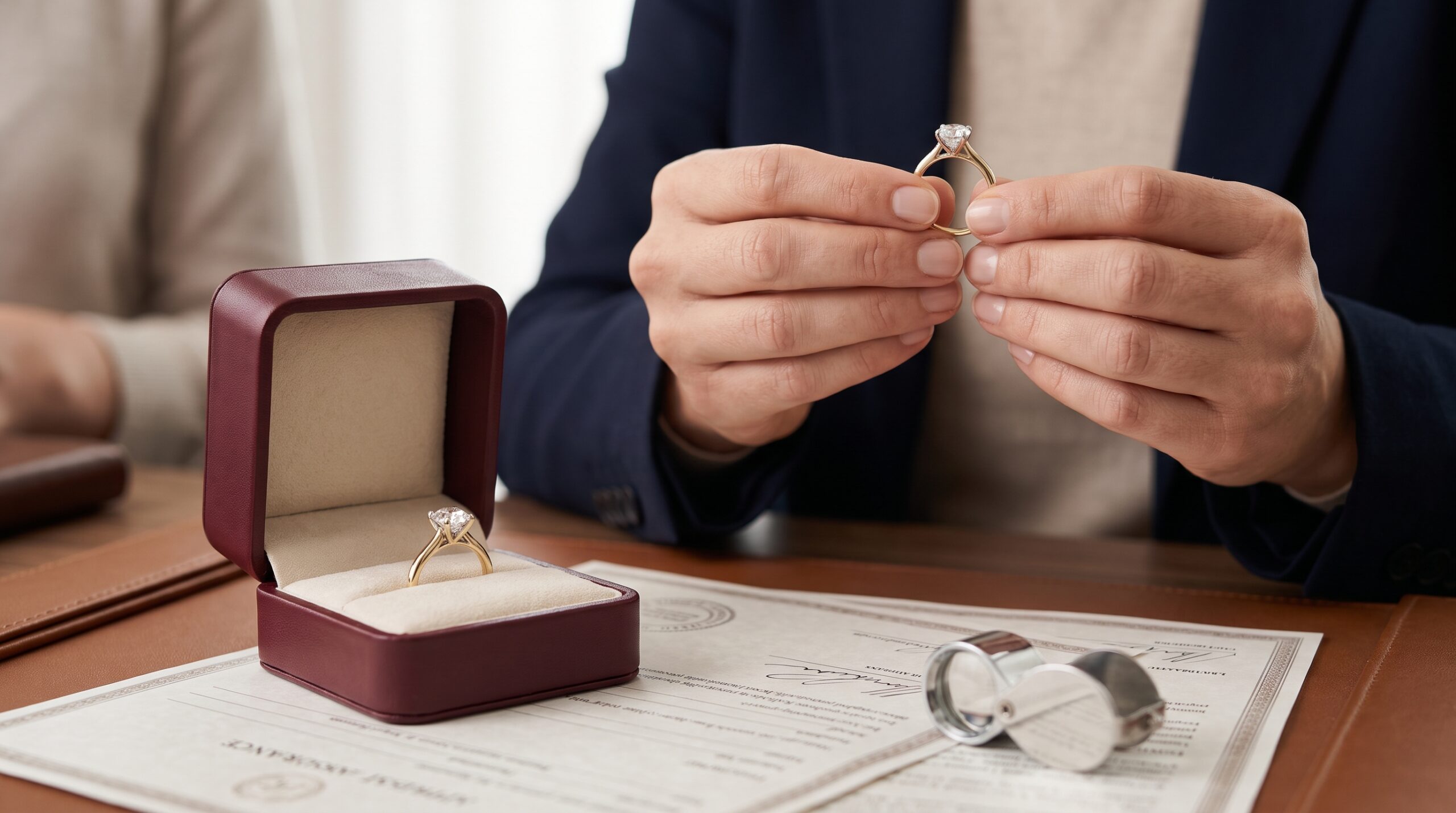
An engagement ring is usually one of the most expensive things a person owns outright, and one of the few they wear every day. That combination is exactly why insurance matters here in a way it doesn’t for most other belongings. A ring gets knocked against countertops, worn in the shower before anyone remembers not to, taken on flights, and set down on hotel nightstands. The risk of loss or damage isn’t hypothetical; it’s built into how the ring is used.
Many buyers assume their homeowners or renters policy already handles this. Often it doesn’t, or it only handles part of it. This guide walks through how ring insurance works, what it typically covers, what it costs, and what to do before you buy a policy.
What Is Engagement Ring Insurance
Engagement ring insurance is coverage, either as part of a homeowners or renters policy or as a separate jewelry policy, that pays to repair or replace a ring if something covered happens to it. Depending on the policy, that can include theft, loss, accidental damage, and what insurers call “mysterious disappearance,” meaning the ring is gone and there’s no clear account of how.
Rings need this kind of attention for reasons that don’t apply to most possessions. They’re worn constantly, so they’re exposed to more wear, more travel, and more accidental contact than a piece of jewelry kept in a drawer. They also tend to carry high value relative to their size, which makes them easy to lose and expensive to replace. None of that means a ring will be lost or damaged. It means the odds of an incident happening at some point over years of daily wear are higher than for most other items in the home.
Is Your Ring Already Covered by Homeowners or Renters Insurance
Standard homeowners and renters policies usually include some coverage for personal property, including jewelry, but that coverage is capped. Insurers set a jewelry sublimit, a maximum dollar amount the policy will pay out for all jewelry combined, regardless of what an individual piece is worth. That sublimit is often a few thousand dollars, which can fall well short of what an engagement ring costs to replace.
There’s also a difference between what triggers a payout. A standard homeowners policy typically pays for jewelry losses tied to named perils like fire or theft, but it may not cover a ring that simply disappears with no evidence of a break-in, and it usually won’t cover accidental damage like a chipped stone or a bent prong.
If the ring’s value exceeds the jewelry sublimit, or if the policy’s covered perils don’t match the kind of risks a ring actually faces, the owner needs additional coverage. That comes in the form of a scheduled item, sometimes called a rider, endorsement, or floater, added to the existing policy, or a standalone jewelry policy purchased separately.
| Term | What It Means |
| Sublimit | The maximum a standard policy will pay for jewelry as a category, no matter the value of any one piece |
| Rider / Endorsement | An addition to an existing homeowners or renters policy that covers a specific item at its own value |
| Floater | Another name for a rider; it “floats” coverage to a particular item regardless of where it’s located |
| Scheduled Personal Property | The formal insurance term for listing a specific item, like a ring, on the policy with its own coverage amount |
Standalone Jewelry Insurance vs. an Insurance Rider
Once a ring’s value exceeds what a standard policy will pay, there are two main paths: add a rider to the existing homeowners or renters policy, or buy a standalone jewelry policy from a specialty insurer.
A rider is often the simpler choice because it works through an insurer the owner already has a relationship with, and it can usually be added with a single phone call or online request. The tradeoff is that a rider is still governed by the terms of the base policy, which can mean narrower coverage for things like mysterious disappearance or travel.
A standalone jewelry policy is written specifically for the item. These policies tend to include broader protection, such as coverage for mysterious disappearance and worldwide travel as standard rather than optional, and they don’t share a deductible or claims history with the rest of the homeowner’s policy. The tradeoff is an additional policy to manage, with its own premium, renewal, and paperwork, separate from the home insurer.
| Option | Best For | Pros | Cons | Documentation Needed |
| Homeowners or renters rider | Owners who want minimal setup and already trust their home insurer | Fast to add, one insurer to deal with | Coverage terms tied to the base policy, may exclude mysterious disappearance | Receipt or appraisal, sometimes photos |
| Standalone jewelry policy | Higher-value rings, custom pieces, or owners who travel frequently | Broader coverage, often includes worldwide travel and disappearance | Separate policy and premium to manage | Appraisal, grading report, photos, receipt |
Neither option is objectively better. A ring purchased recently for a moderate amount, insured through a home policy that already covers mysterious disappearance, may be adequately protected with a simple rider. A custom or heirloom ring with significant value, or an owner who travels often, is usually better served by a standalone policy built around jewelry-specific risks.
What Does Engagement Ring Insurance Usually Cover
Coverage varies by insurer and policy type, but most ring policies are built around the same core risks: theft, loss, accidental damage such as a cracked stone or broken prong, and mysterious disappearance. Some policies extend that coverage to travel, so a ring lost or stolen on a trip is treated the same as one lost at home; others limit or exclude travel-related claims, so it’s worth confirming before assuming it’s included.
What most policies exclude is just as important to understand. Wear and tear from years of daily use isn’t a covered loss; it’s expected maintenance. Intentional damage isn’t covered. Routine upkeep like cleaning, polishing, or resizing isn’t a claim, it’s a service. And claims without any supporting account of what happened, particularly for high-value items, can be denied or delayed if the insurer can’t verify the loss.
| Situation | Commonly Covered | Notes to Check |
| Theft | Yes | May require a police report |
| Loss with no explanation | Often, under mysterious disappearance | Not all policies include this; confirm before buying |
| Accidental damage | Often | Some policies require an itemized appraisal first |
| Travel-related loss | Varies | Worldwide coverage is common in standalone policies, less so in riders |
| Wear and tear | No | Treated as routine maintenance, not a loss |
| Resizing or cleaning damage | Usually no | Ask if damage during a jeweler’s service is covered separately |
How Much Does Engagement Ring Insurance Cost
Ring insurance premiums are often estimated at roughly 1 to 2 percent of the ring’s appraised value per year. On a $5,000 ring, that works out to somewhere between $50 and $100 annually. This is a general industry estimate, not a fixed rate, and actual quotes vary by insurer.
Several factors move the premium within that range: the ring’s value, where the owner lives, the size of the deductible, whether the policy is a rider or standalone, whether travel coverage is included, and how the insurer handles replacement (cash payout versus replacement through a specific jeweler).
| Ring Value | Estimated Annual Cost at 1% | Estimated Annual Cost at 2% |
| $2,000 | $20 | $40 |
| $5,000 | $50 | $100 |
| $10,000 | $100 | $200 |
| $20,000 | $200 | $400 |
These figures are a starting point for comparison, not a quote. The only way to know the actual premium is to get one from an insurer based on the ring’s appraised value and the specific policy terms.
Do You Need an Appraisal
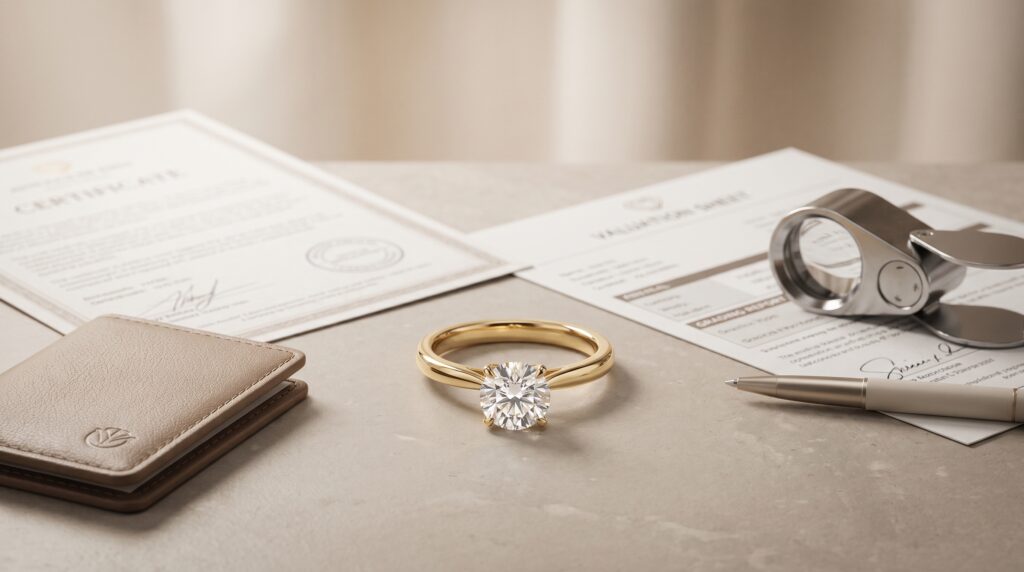
For a recently purchased ring, the original sales receipt is often sufficient to establish value for insurance purposes, especially if the ring hasn’t been altered since purchase. For heirloom rings, custom designs, or pieces without a clear purchase record, an appraisal is usually necessary because there’s no recent transaction price to point to.
An appraisal and a grading report are not the same document, and insurers rely on them for different purposes. A grading report, most commonly issued by the Gemological Institute of America, describes the diamond itself: its cut, color, clarity, and carat weight, based on standardized criteria. It doesn’t assign a dollar value. An appraisal takes that information, along with the metal, setting, and market conditions, and estimates what it would cost to replace the ring today. Insurers use the appraisal to set the coverage amount, not the grading report alone.
Appraisals aren’t permanent. Market prices for precious metals and diamonds shift, so an appraisal from several years ago may no longer reflect current replacement cost. Updating it periodically, particularly before a policy renewal, keeps the coverage amount aligned with what the ring would actually cost to replace.
What Documents Should You Keep
Insurers ask for documentation both when setting up a policy and when processing a claim. Keeping these organized in one place, physical or digital, makes both steps faster:
- Purchase receipt
- Appraisal, updated periodically
- Grading report from GIA or a similar laboratory, if available
- Clear photos of the ring from multiple angles
- Stone measurements and metal details from the appraisal or original invoice
- Policy documents, including the declarations page showing the insured amount
- Records of any professional inspections or servicing
How to Choose the Right Policy
Before signing up for a rider or a standalone policy, it helps to get specific answers to a short list of questions rather than assuming the coverage matches expectations:
- Does the policy cover loss with no explanation (mysterious disappearance), or only theft and named perils?
- Is coverage worldwide, or limited to loss within the home country?
- What’s the deductible, and how does it apply to a claim?
- If the ring needs to be replaced, can you choose your own jeweler, or does the insurer require a specific vendor?
- Is a claim paid as cash, as a replacement ring, or as a repair, and who decides which?
- How often does the insurer expect the appraisal to be updated?
Getting these answers in writing, rather than relying on a verbal summary from an agent, avoids disputes later if a claim needs to be filed.
Caring for Your Ring After It Is Insured
Insurance covers loss and damage after the fact. It doesn’t reduce the chance that damage happens in the first place. Regular care still matters:
Store the ring in a secure, designated place when it’s not being worn, rather than leaving it on a sink edge or nightstand. Remove it during activities with a higher risk of damage or loss, such as heavy manual work, swimming, or contact sports. Schedule periodic inspections with a jeweler to check that prongs and settings are holding the stone securely, since loose settings are one of the more common causes of a lost stone. And keep the appraisal and photos current, since an outdated valuation can leave the ring underinsured even with an active policy.
An insurer that requires proof of regular maintenance for certain claims will also expect these records, so keeping them isn’t just good practice for the ring itself, it can matter directly to how a claim is handled.
Conclusion
The right coverage for an engagement ring depends on its value, how it’s worn, and how much of that risk the owner wants to hold personally versus transfer to an insurer. A ring purchased recently for a modest amount may be adequately covered by adding a rider to an existing homeowners policy. A custom or heirloom piece with significant value, or an owner who travels frequently, is usually better matched to a standalone jewelry policy with broader terms.
Before choosing either option, get the ring appraised if it doesn’t already have a recent, accurate valuation, gather the receipt, appraisal, and grading report in one place, and ask the insurer directly whether mysterious disappearance and worldwide travel are included. Those three steps determine more about how well the ring is actually protected than the price of the policy itself.
Frequently Asked Questions
Do I need engagement ring insurance if I have homeowners insurance?
It depends on the ring’s value and what the homeowners policy covers. Most homeowners and renters policies include a jewelry sublimit, a cap on how much they’ll pay out for jewelry as a category, which is often lower than what an engagement ring costs to replace. Even when the sublimit is high enough, the base policy may not cover mysterious disappearance or accidental damage, only named perils like theft or fire. Checking the policy’s jewelry sublimit and covered perils is the first step in figuring out whether additional coverage is needed.
What does engagement ring insurance cover?
Most ring-specific policies, whether a rider or a standalone policy, cover theft, loss, accidental damage, and mysterious disappearance, meaning the ring is gone with no clear account of what happened to it. Coverage details vary by insurer, so it’s worth confirming which of these are included rather than assuming all four are automatically covered.
Does ring insurance cover loss while traveling?
Some policies do, and some don’t. Standalone jewelry policies more commonly include worldwide coverage as a standard feature, while riders attached to a homeowners policy may limit coverage to loss within the home or may exclude travel-related claims entirely. This is one of the details worth confirming directly with the insurer before assuming a policy applies away from home.
How much does engagement ring insurance cost?
A common estimate is 1 to 2 percent of the ring’s appraised value per year. A $5,000 ring would fall somewhere between $50 and $100 annually under that range. Actual premiums vary based on the ring’s value, the owner’s location, the deductible chosen, and whether the policy is a rider or a standalone policy.
Do I need an appraisal for engagement ring insurance?
For a recently purchased ring, the original sales receipt may be enough to establish its value. For an heirloom, a custom design, or any ring without a clear recent purchase price, an appraisal is generally needed to set the insured value. Insurers use the appraisal, not the diamond grading report, to determine the coverage amount.
What is mysterious disappearance coverage?
Mysterious disappearance refers to a loss where the ring is simply gone and there’s no clear explanation, no theft witnessed, no break-in, nothing to point to. Not every policy includes this. Standard homeowners insurance often doesn’t, which is one of the main reasons buyers add a rider or standalone jewelry policy in the first place.
Does insurance cover resizing or cleaning?
Generally no. Resizing, cleaning, and other routine jeweler services are treated as maintenance rather than a covered loss. If damage occurs during one of those services, whether that’s covered depends on the specific policy and sometimes on whether the service was performed by an insurer-approved jeweler, so it’s worth asking directly.
How often should I update my appraisal?
There’s no universal rule, but appraisals lose accuracy over time as metal and diamond prices shift. Updating the appraisal every few years, or before a policy renewal if the ring’s value may have changed, keeps the insured amount aligned with actual replacement cost.
Can heirloom rings be insured?
Yes. Heirloom rings can be insured the same way as newly purchased rings, though they typically require a current appraisal since there’s no recent purchase receipt to establish value. A grading report for the stone, if one can be obtained, supports that appraisal with standardized detail about the diamond itself, following criteria set by organizations such as the GIA and the American Gem Society.
What documents should I keep?
Keep the purchase receipt, a current appraisal, a grading report if available, clear photos of the ring from multiple angles, the policy documents showing the insured amount, and records of any professional inspections. Having these organized before a claim is needed makes the process faster and reduces the chance of a dispute over the ring’s value. Buyers evaluating metal purity claims can also review the FTC’s jewelry guides, which set standards for how precious metal content must be described.