
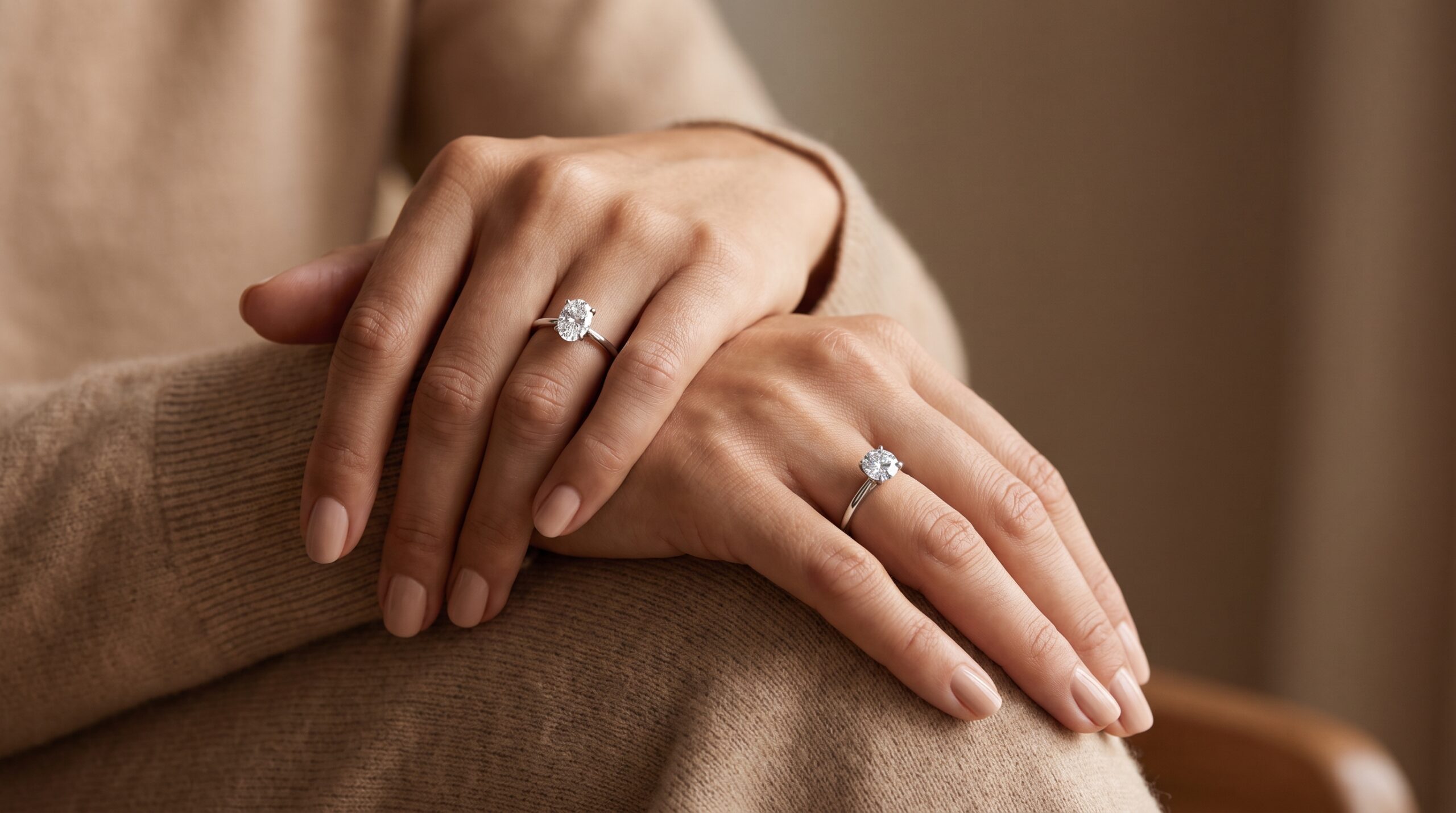
Most engagement ring searches eventually narrow down to two shapes: round and oval. Round is the shape most people picture when they hear “diamond ring.” Oval has become the shape couples choose when they want something that still reads as classic but looks a little different on the hand. Neither is the correct answer by default. The right one depends on what you’re optimizing for: maximum sparkle, a bigger-looking stone for the same budget, a specific finger shape, or a certain style era you want the ring to sit in for decades.
This comparison walks through how the two shapes actually differ, not just in marketing language but in cut, price, proportion, and daily wear.
What Is the Difference Between Oval and Round Engagement Rings?
Round Brilliant Explained
The round brilliant cut has a circular outline and 57 or 58 facets, arranged specifically to bounce light back out through the top of the stone. It’s the most researched diamond shape in the industry: the GIA cut grading scale was built largely around perfecting this cut, and it’s the only shape for which GIA issues a formal cut grade on a diamond grading report. That’s a direct result of a century of data on how proportions affect brightness, fire, and scintillation in a circular stone.
Oval Diamond Explained
The oval is a modified brilliant cut, an elongated version of the same faceting pattern used in a round stone, stretched into an oval outline. It shares most of the same fire and brilliance mechanics as a round diamond but distributes that sparkle across a longer, narrower surface. Because the shape isn’t symmetrical in every direction the way a circle is, an oval’s appearance depends more on its individual proportions and cutting choices than a round diamond’s does.
Oval vs Round at a Glance
| Feature | Oval | Round |
| Sparkle | Strong brilliance, broader light pattern | Maximum brilliance, most uniform pattern |
| Face-up size | Appears larger for the same carat weight | Appears smaller per carat |
| Price per carat | Generally lower | Generally highest |
| Finger effect | Elongates the finger | Balanced, classic proportions |
| Bow-tie effect | Present in some degree in every stone | Not applicable |
| GIA cut grade | Not issued | Issued |
| Overall character | Distinctive, still widely worn | The most traditional choice |
Which Shape Sparkles More?
Round wins this comparison on paper. Its symmetry lets light enter and exit the stone in a highly predictable way, which is exactly why GIA can assign round diamonds a formal cut grade and can’t do the same for fancy shapes like oval, pear, or marquise. Learn more about how this grading works through GIA’s education on diamond cut.
Oval diamonds still deliver strong brilliance, since they share the round brilliant’s basic facet structure. The sparkle just looks different: broader, less uniform, and more spread out across the length of the stone rather than concentrated evenly across a circle. Whether that reads as “better” or “worse” is a matter of preference, not a technical shortcoming.
Oval diamonds also come with a characteristic called the bow-tie effect: a dark, shadow-like area across the center of the stone, caused by the way the facets in an elongated brilliant cut interact with light and with the viewer’s own reflection blocking part of the stone. Every oval diamond has some degree of bow-tie. It becomes a real concern only when it’s severe enough to dominate the stone visually, which usually happens with poorly cut stones or unusually long length-to-width ratios. A mild bow-tie is normal and, in well-cut ovals, can even read as a design feature rather than a flaw.
Which Shape Looks Bigger?
Oval diamonds generally look larger than round diamonds of the same carat weight. Carat weight measures mass, not visible surface area, and an oval’s elongated outline spreads that weight across more face-up surface than a compact circle does. A 1.5-carat oval will typically look larger, and cover more of the finger, than a 1.5-carat round.
Round diamonds concentrate more of their weight below the surface, in the pavilion, which keeps the stone visually smaller relative to its weight. This is part of why some buyers who want the largest possible look for a given budget lean toward oval, and it’s a legitimate reason, not just a workaround for a smaller stone.
Finger coverage also differs by shape. An oval’s length adds visual coverage along the finger, which can make fingers look longer and slimmer. A round diamond sits more centrally and reads as classic and balanced rather than elongating.
Oval vs Round Price Comparison
Round diamonds typically cost more per carat than oval diamonds of comparable quality. Two factors drive this. First, demand: round is the most requested shape, and higher demand supports higher prices. Second, cutting waste: cutting a round brilliant from a rough diamond crystal wastes more of the original stone than cutting an oval does, since ovals can often be cut to follow the natural elongated shape of the rough more efficiently. That extra waste in round cutting gets priced into the finished stone.
Oval diamonds are generally priced lower per carat for comparable color, clarity, and cut quality, and buyers often describe getting more visual size for the same budget as a result. The exact gap varies by market conditions, stone quality, and supplier, so treat any specific percentage as a general pattern rather than a fixed rule.
Lab-grown diamonds add another variable to this comparison. Lab-grown stones in both shapes are typically priced lower than natural diamonds of similar quality, and that gap has been narrowing supply over the past several years. Certification matters just as much here: lab-grown diamonds are commonly graded by IGI rather than GIA, and buyers should confirm which lab issued the report and what grading standards it used before comparing prices across sellers.
Style and Aesthetic Differences
Round is the shape most associated with classic engagement ring style. It’s been the standard for generations, works with essentially every setting style, and doesn’t read as trend-driven at any point in time. Choosing round isn’t a default because it’s unoriginal; it’s a legitimate choice for buyers who want a ring that will look the same in 30 years as it does today.
Oval carries a slightly more distinctive silhouette while still fitting comfortably into the “classic” category rather than the “trend” category. The elongated shape reads as elegant and a little more unusual without needing an unconventional setting to make a statement.
Both shapes work well in solitaire, halo, hidden halo, three-stone, bezel, and pavé settings. The setting choice affects the overall look more than most buyers expect: a bezel-set oval reads modern and low-profile, while a halo around the same stone reads more traditional and adds perceived size.
Which Shape Is Better for Different Finger Types?
An oval’s elongating effect makes it a common choice for buyers with shorter or wider fingers, since the vertical length of the stone visually stretches the finger beneath it. Round diamonds don’t elongate in the same way, but their balanced, symmetrical shape works well across nearly all hand and finger proportions, which is part of why it remains the most universally recommended shape.
For ovals, the length-to-width ratio changes this effect significantly. A more rounded oval (closer to a 1.30 ratio) will elongate less than a more stretched oval (closer to 1.50). Buyers choosing oval specifically for the finger-lengthening effect should pay attention to ratio, not just carat weight, since two ovals of the same weight can look meaningfully different on the hand.
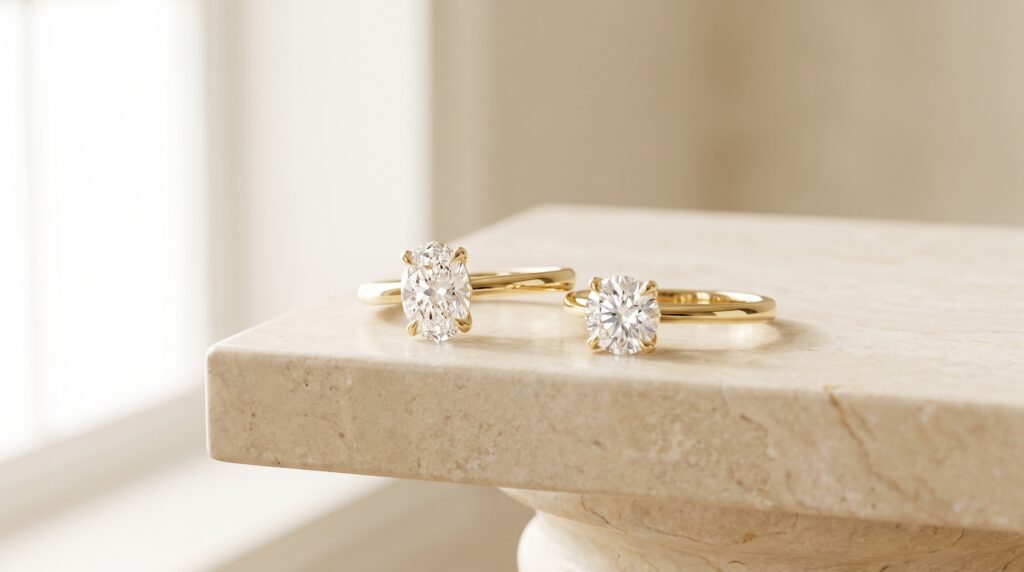
What to Look for When Buying an Oval Diamond
Length-to-Width Ratio
Oval diamonds are commonly described by their length-to-width ratio. A ratio in the 1.30 to 1.40 range looks softer and more rounded, closer to an elongated cushion than a traditional oval. A ratio of 1.41 to 1.50 is generally considered the traditional, more elongated oval look most buyers picture. Ratios outside this range exist but shift the stone toward a noticeably different silhouette, and very high ratios tend to intensify the bow-tie effect.
Symmetry
Symmetry affects how evenly light moves through the stone and how the bow-tie effect presents itself. Diamond reports typically rate symmetry on a scale that includes Excellent, Very Good, Good, and lower grades. For a fancy shape like oval, symmetry grade is one of the few objective data points available on paper, since there’s no overall cut grade to rely on the way there is with round.
Bow-Tie Inspection
Because bow-tie severity isn’t captured on a standard grading report, the most reliable way to judge it is to look at the actual stone, ideally through a 360-degree video from the retailer, rather than relying on the certificate alone. A mild, even shadow across the center is normal and often unnoticeable in everyday lighting. A dark, heavy shadow that dominates the stone’s center is the version worth avoiding.
A Practical Checklist
Before buying an oval diamond, check the length-to-width ratio against your intended look, confirm symmetry grade on the report, review a 360-degree video for bow-tie severity, look for uneven color concentration near the pointed tips, and confirm the certifying lab (GIA or IGI) and report number.
Everyday Wear, Comfort, and Durability
Both round and oval diamonds are cut without sharp corners, which makes them comparably durable and well-suited to daily wear. Diamond hardness itself doesn’t change with shape; a diamond is a diamond regardless of how it’s cut, and the GIA’s overview of diamond durability applies equally to both.
Snagging on clothing or hair has more to do with the setting than the shape itself. That said, an oval’s pointed ends can sit slightly more exposed in some prong configurations than a round’s uniformly curved edge, which is a setting consideration rather than a reason to rule the shape out. Buyers with active hands, or jobs that involve frequent hand use, often do better with a low-profile solitaire or bezel setting in either shape, since the setting height affects snagging risk more than the stone outline does.
Care, Cleaning, and Maintenance
Cleaning routines are the same for both shapes: warm water, a small amount of mild dish soap, and a soft brush (an old, soft toothbrush works) to clean around the setting and under the stone, followed by a rinse and dry with a lint-free cloth.
Avoid chlorine, which can damage certain metal alloys used in ring settings, along with harsh household chemicals and abrasive cleaning materials that can scratch softer metals like gold. Jewelers of America’s care guidance covers this in more detail for different metal types.
Have the ring professionally inspected every six to twelve months. This includes checking that prongs haven’t loosened, that the stone hasn’t shifted in its setting, and that any pavé stones remain secure. Catching a loose prong early is far less costly than replacing a stone that’s fallen out.
Certification and Online Buying Confidence
Natural diamonds are most commonly graded by GIA, while lab-grown diamonds are frequently graded by IGI, though GIA also grades lab-grown stones. Confirm which lab issued the certificate before comparing two diamonds by their report numbers alone, since grading standards and strictness can vary between labs.
Round diamonds are the easier of the two shapes to evaluate from a certificate alone, since GIA’s cut grade folds proportion, symmetry, and polish into a single, well-tested rating. Oval diamonds require more direct visual review, since ratio, symmetry, and bow-tie severity all affect the final look in ways a certificate doesn’t fully capture on its own.
When buying either shape online, request or look for a 360-degree video of the actual stone rather than a stock image, confirm the millimeter measurements and ratio (for ovals), review side and top-down views, and check the retailer’s return policy and any warranty terms before finalizing a purchase. The FTC’s jewelry guidance outlines what sellers are required to disclose about gemstone treatments and metal content, which is worth knowing before you buy from any retailer.
Choosing Between Them
Round diamonds offer the most tested, most predictable brilliance available in any shape, backed by a grading system built specifically around them. Oval diamonds trade some of that predictability for a larger visual footprint per carat, a lower price per carat, and a more elongated look that can complement certain hand and finger proportions.
Neither shape is more “correct” for an engagement ring. The decision comes down to what matters most to you: if consistent, maximum brilliance and the most extensively documented cut quality are the priority, round is the safer, more measurable choice. If getting more visible size for your budget, or an elongating effect on the finger, matters more, oval is a reasonable and well-established alternative rather than a compromise.
Before buying, compare the two shapes in person if possible, or review high-quality video of the specific stone if buying online. Check the certificate from GIA or IGI, and weigh proportions and cut quality ahead of carat weight alone.
Frequently Asked Questions
Which sparkles more, oval or round?
Round diamonds generally produce more brilliance and a more uniform sparkle pattern, largely because their symmetry allows for the precise cut optimization that GIA’s cut grading system is built around. Oval diamonds still sparkle strongly, since they share the same basic facet structure as a round brilliant, but the light pattern is broader and less uniform, and it varies more from stone to stone based on the specific cutting choices made for that oval.
Does oval look bigger than round?
Yes, in most cases. An oval diamond spreads its carat weight across a larger face-up surface area than a round diamond of the same weight, since round diamonds concentrate more weight in the pavilion below the surface. This means an oval will typically appear larger and cover more of the finger than a round diamond of identical carat weight.
Why are round diamonds more expensive?
Round diamonds cost more per carat than most other shapes, including oval, largely due to higher demand and greater cutting waste. Cutting a round brilliant from a rough diamond crystal typically wastes more of the original stone than cutting an oval, since oval outlines can often follow the rough stone’s natural shape more efficiently. Both factors get reflected in the final price.
What is the bow-tie effect?
The bow-tie effect is a dark, shadow-like area that appears across the center of an oval diamond (and other elongated shapes), caused by the way light interacts with the stone’s facets and the viewer’s own reflection blocking part of the light path. Every oval diamond shows some degree of bow-tie. It’s only a concern when it’s severe enough to visually dominate the stone, which is more likely in poorly cut stones or those with an unusually elongated ratio.
Which shape is more timeless?
Round is generally considered the more timeless of the two, since it has remained the standard engagement ring shape for the longest period and isn’t tied to any particular style era. Oval is also a long-established shape rather than a passing trend, but it carries a slightly more distinctive character that leans toward elegant rather than strictly traditional.
Which shape flatters shorter fingers?
Oval diamonds are commonly chosen by buyers with shorter or wider fingers because the elongated shape visually stretches the finger beneath it. The strength of this effect depends on the diamond’s length-to-width ratio: a more elongated ratio (closer to 1.50) creates a stronger lengthening effect than a rounder oval (closer to 1.30).
What ratio is best for oval diamonds?
There’s no single “best” ratio; it depends on the look you want. A ratio between 1.30 and 1.40 produces a softer, more rounded oval silhouette, while a ratio between 1.41 and 1.50 produces the more elongated look most buyers associate with a traditional oval. Ratios outside this range are less common and shift the stone toward a noticeably different shape.
Which shape is easier to buy online?
Round diamonds are easier to evaluate online because GIA issues a formal cut grade for round stones, which summarizes proportion, symmetry, and polish into one rating. Oval diamonds require more hands-on review, since there’s no equivalent cut grade for fancy shapes. Reviewing a 360-degree video of the actual stone is the most reliable way to judge an oval’s proportions and bow-tie severity before buying online.
Are oval diamonds durable?
Yes. Diamond hardness doesn’t change based on how the stone is cut, so oval diamonds are just as durable as round diamonds for everyday wear. The more practical consideration is the setting: an oval’s pointed ends can be slightly more exposed in certain prong configurations than a round diamond’s evenly curved edge, so setting choice matters more than the shape itself for long-term wear.
What settings work best for oval diamonds?
Oval diamonds work well in solitaire, halo, hidden halo, three-stone, bezel, and pavé settings. A halo setting adds perceived size and a more traditional look, while a bezel setting offers a lower profile that suits active daily wear. The right setting depends on the wearer’s lifestyle and how much protection the stone’s tips need day to day.