
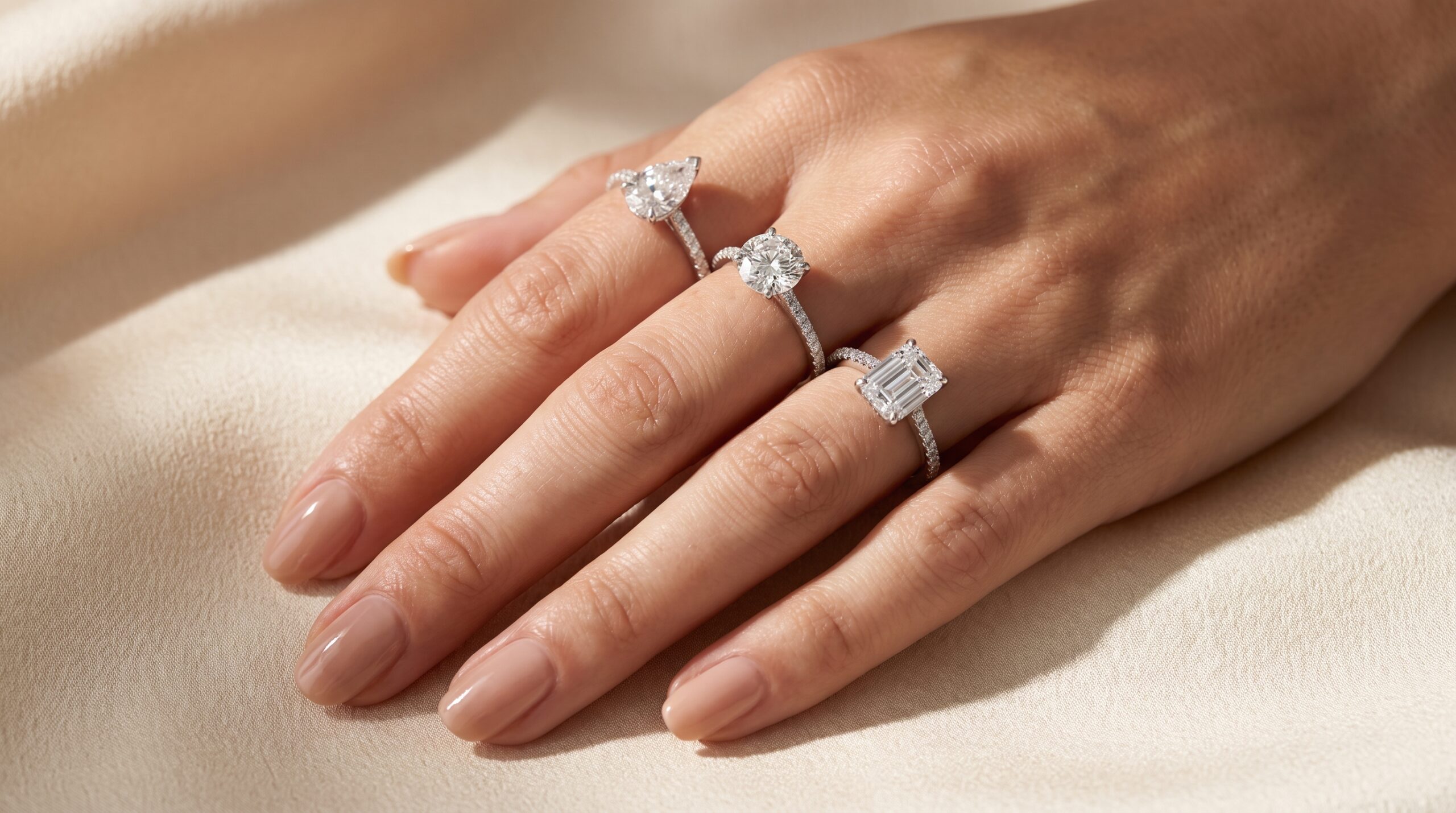
A pavé ring catches light differently than a plain band. Instead of one diamond doing all the work, dozens of small stones set close together create a surface that sparkles from almost any angle. That’s the appeal. The question most buyers actually have is whether that extra sparkle comes with extra hassle: will the stones fall out, is the ring hard to clean, can it even be resized later.
Those are reasonable questions, and the answers depend on which kind of pavé you’re looking at. Not all pavé rings behave the same way over years of wear. This guide covers what the term means, how the common styles differ, and what to check before buying one, especially online.
What Is a Pavé Engagement Ring?
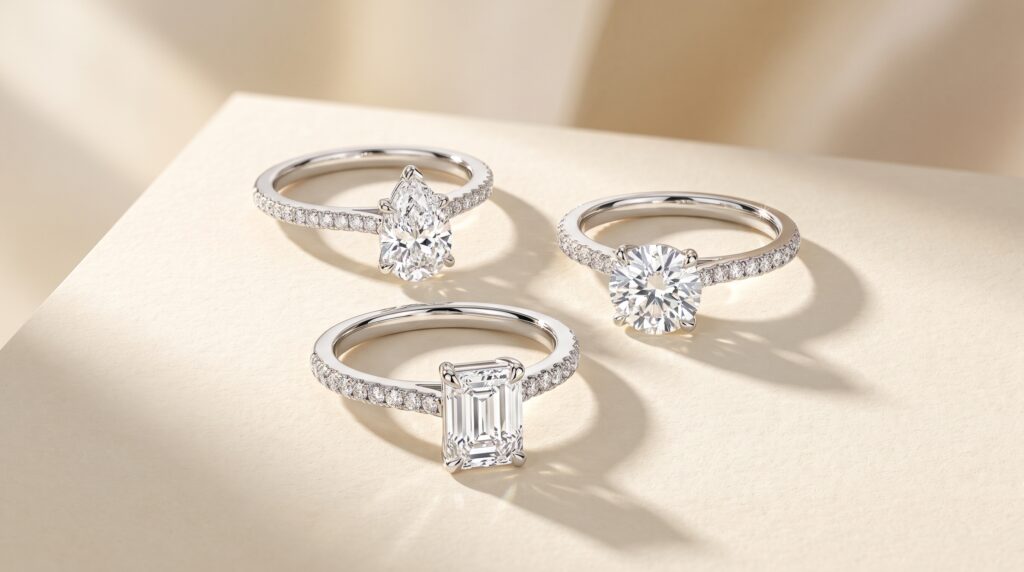
Pavé comes from the French word for “paved,” and the name describes the technique fairly literally: small diamonds or gemstones are set edge to edge along the band, held in place by tiny beads or prongs of metal, so the surface looks paved with stones rather than showing bare metal between them.
On a ring, this usually means the shank (the band itself) carries a line of small stones rather than staying plain. The effect is a continuous glitter along the ring rather than a single point of light from the center diamond.
What pavé adds to a ring, compared to a plain band:
- More overall sparkle, since light catches many small facets instead of one
- Finer visual detail along the band itself
- A more ornate, decorative look
- A brighter frame around the center stone, since the eye picks up movement from the smaller diamonds nearby
None of this changes what the center stone is. A pavé setting is about the band and, often, the area immediately around the main diamond. The center stone’s cut, color, and clarity are evaluated the same way they would be on any other ring, following the standard diamond quality criteria outlined by the Gemological Institute of America’s 4Cs education.
Key Pavé Terms Buyers Should Know
A few terms come up constantly in pavé ring listings, and jewelers assume buyers already know them. They usually don’t need explaining once, not repeated definitions scattered across a listing.
Melee diamonds are the small diamonds used in pavé and other accent settings. The term just refers to size, not quality. Melee stones can range from very good to mediocre cut quality, and a listing that doesn’t specify anything about them is worth asking about directly.
Accent stones is the broader term for any diamonds or gemstones that support the design without being the main attraction. In a pavé ring, the melee diamonds are the accent stones.
Micro-pavé uses noticeably smaller stones and finer metalwork than standard pavé. The stones sit closer together, the metal beads holding them are smaller, and the visual result is a more delicate texture. It also means less metal is holding each stone in place, which is why setting quality matters more with micro-pavé than with larger stone settings.
Half pavé refers to stones set only on the top portion of the band, typically the upper half or two-thirds, with plain metal underneath. Full pavé extends the stones further around the band, sometimes all the way to the bottom.
Pavé versus halo trips people up because both add small stones near the center diamond. Pavé refers to stones set along the band. A halo is a ring of small stones that surrounds the center stone itself. Many rings combine both: a halo around the center diamond and pavé continuing down the band.
Pavé Engagement Ring Styles Compared
| Style | What It Means | Best For | Considerations |
| Half pavé | Stones on the top portion of the band only | Daily wearers who want sparkle without giving up easy resizing | Easier to resize than full pavé, since the bottom stays plain metal |
| Full pavé | Stones continue further around the band, sometimes all the way around | Maximum sparkle from every angle | More maintenance since more stones need checking; resizing is limited |
| Micro-pavé | Very small stones with fine setting work | A delicate, refined look rather than large visible stones | Setting quality matters more, since less metal secures each stone |
| Pavé with halo | Pavé band plus a ring of stones around the center diamond | Maximum brilliance and a larger visual presence | More total stones to maintain and inspect over time |
| Pavé solitaire | A standard solitaire setting with a pavé band | Sparkle without an overly decorative look | A middle ground between a plain solitaire and a fully decorated ring |
Pavé vs Solitaire: Which Is Better?
Neither is objectively better. They trade off differently.
A solitaire is a single center stone with no accent diamonds, usually held by four or six prongs. It’s the simplest setting to maintain: fewer parts, nothing to snag, and resizing is usually straightforward since there’s no pattern of stones to preserve.
Pavé adds sparkle and visual detail that a solitaire doesn’t have, but that comes from additional stones and additional labor, which is part of why pavé settings often cost more than an equivalent plain band. The stones themselves are typically small and inexpensive individually, but setting dozens of them securely takes more bench time than mounting a single stone.
| Factor | Pavé Ring | Solitaire Ring |
| Sparkle | Distributed across the band | Concentrated in the center stone |
| Maintenance | Higher, more surfaces to clean and inspect | Lower, fewer settings to check |
| Resizing | Can be limited, especially with full pavé | Usually straightforward |
| Style | Decorative | Minimal |
| Durability | Depends heavily on setting craftsmanship | Generally simpler to keep secure over time |
If you want the lowest-maintenance option, a solitaire wins. If sparkle and detail matter more to you than minimizing upkeep, pavé is worth the tradeoff, as long as you go in aware of what that upkeep looks like.
Is Pavé Durable Enough for Everyday Wear?
Durability in a pavé ring comes down mostly to craftsmanship, not the concept of pavé itself. A well-set pavé ring from a jeweler who does careful bead or prong work can hold up to daily wear for years. A poorly set one, regardless of price, is more likely to lose stones or wear down at the setting points.
A few practical factors affect how a pavé ring holds up:
Lifestyle and hand use. Gym work, gardening, frequent hand-washing, and manual tasks all put more stress on any ring, but pavé settings have more individual points that can catch or wear compared to a smooth solitaire band. This doesn’t mean pavé can’t be worn daily, it means it’s worth taking the ring off for tasks that involve gripping tools, weights, or abrasive surfaces, the same precaution jewelers generally recommend for any diamond ring.
Band thickness. Very thin pavé bands look elegant but have less metal supporting each stone. Thinner bands can wear down faster at the setting points than a slightly thicker band with the same stone pattern. This is a real tradeoff between how delicate a ring looks and how long the settings stay tight without needing repair.
None of this means pavé should be treated as fragile. It means the setting quality and band thickness matter more than they would on a plain solitaire, and it’s worth asking a jeweler directly how a specific ring is set before assuming it will perform the same as any other pavé ring you’ve seen.
Pavé Ring Care and Maintenance
Pavé rings need more regular attention than plain bands simply because there are more surfaces and more small gaps where dirt and oil collect.
Cleaning at home:
- Use mild soap and warm water, not harsh chemical cleaners
- A soft brush, like a baby toothbrush, gets into the gaps between stones
- Dry gently rather than rubbing, to avoid catching a brush or cloth on a loose prong
Professional inspection. Jewelers generally recommend having pavé rings checked periodically, since a jeweler can spot a loosening stone before it falls out and catch prong wear that isn’t visible to the eye. The Jewelers of America consumer guidance covers routine care and when to bring a ring in for a professional look. Rings worn daily benefit from more frequent checks than rings worn occasionally.
Warning signs that a pavé ring needs attention:
- A stone that feels loose or moves slightly when touched
- A missing stone, even a small one
- Rough or snagging edges on the band
- Dirt buildup between stones that doesn’t clear with a home cleaning
- A dull or hazy look across the pavé, which usually means residue has built up rather than the diamonds losing brilliance
Catching these early matters. According to jeweler repair guidance from Revolution Jewelry Works, loose or missing stones and worn prongs are common early signs that a ring needs repair, and addressing them before the ring is worn further reduces the risk of losing additional stones.
Can Pavé Rings Be Resized?
Yes, but the amount of pavé on the band affects how easily.
Full pavé covers most or all of the band with stones, which limits where a jeweler can cut and rejoin the metal without disturbing the setting. Resizing a full pavé ring, especially by more than half a size, sometimes isn’t possible without redoing part of the stone pattern, which adds cost and risk.
Half pavé leaves plain metal at the bottom of the band. That plain section gives a jeweler room to cut and adjust the ring size without touching any of the set stones, which is why half pavé is generally the more practical choice for anyone who expects to resize the ring down the road, including after weight changes over time.
Before buying, especially online, it’s worth asking:
- Is resizing available through the seller or will you need an independent jeweler?
- Are there size limits on how much the ring can be adjusted?
- Does resizing void or affect the warranty?
- Is there plain metal at the bottom of the band, or does the pavé pattern go all the way around?
None of this rules out full pavé as a choice. It just means going in with the expectation that resizing is more constrained, and confirming that upfront rather than discovering it after the ring doesn’t fit.
What to Check When Buying a Pavé Engagement Ring Online
Pavé is harder to evaluate from photos than a solitaire, since the quality lives in the setting work itself, not just the stone. A checklist helps here more than general advice does.
Look for:
- Top, side, and angled photos, not just one flattering angle
- Close-up images clear enough to see individual stones and how they’re set
- Band width in millimeters, since “thin” and “wide” mean different things to different sellers
- Setting height, which affects both how the ring looks and how it wears against the hand
- Whether the pavé is described as half, full, or micro
- Metal type and purity
- Certification for the center diamond specifically, since certification standards like those from the GIA apply to individual stones, not to a batch of small pavé melee
- Return policy terms
- Resizing terms, including any limits
- Warranty coverage and what triggers a repair versus a replacement
Red flags worth taking seriously:
- No side-profile images, which often means the setting has something to hide
- No resizing information anywhere in the listing
- Vague descriptions of stone count or size, like “pavé diamonds” with no specifics
- No warranty details at all
- No close-up view of the actual pavé work
Center diamonds are commonly certified by an independent gem lab. Pavé accent stones almost never are, since certifying dozens of tiny melee diamonds individually isn’t standard practice in the industry. That’s normal and not itself a red flag, but it does mean the seller’s reputation and the clarity of their photos carry more weight for the accent stones than a certificate would.
Frequently Asked Questions
What is a pavé engagement ring?
A pavé engagement ring is a ring where small diamonds or gemstones are set closely together along the band, creating a continuous line of sparkle rather than leaving the metal bare between the center stone and the shank. The term comes from the French word for “paved,” describing how the small stones cover the surface.
Is pavé more expensive than a solitaire?
Pavé settings typically cost more than an equivalent solitaire because of the additional stones and the labor involved in setting dozens of small diamonds securely, rather than mounting a single stone. The exact difference depends on the number and size of the melee stones, the metal, and the jeweler’s setting work, so it varies by ring rather than following a fixed rule.
Does pavé make a ring look bigger?
Pavé can make a ring look brighter and busier, which some people perceive as making the center stone look larger by comparison, particularly in halo-pavé combinations where the small stones frame the center diamond. This is a visual effect rather than an actual change in carat weight.
Is pavé good for everyday wear?
Pavé can hold up well to daily wear when the setting is done carefully, but it depends more on craftsmanship and band thickness than on pavé being inherently more fragile than other styles. Removing the ring for activities involving heavy hand use, like weightlifting or manual work, reduces wear on any ring, pavé or otherwise.
What is the difference between half pavé and full pavé?
Half pavé sets stones only on the top portion of the band, leaving plain metal underneath, while full pavé extends the stones further around the band, sometimes all the way around. Half pavé is generally easier to resize since the plain metal gives a jeweler room to work, while full pavé offers more sparkle at the cost of some resizing flexibility.
Can pavé rings be resized?
Yes, though full pavé rings are more limited than half pavé rings, since resizing requires cutting and adjusting the band, which is harder to do without disturbing a stone pattern that covers the whole shank. Half pavé, with its section of plain metal, is usually easier to resize by a moderate amount.
Do pavé diamonds fall out?
Stones can loosen or fall out over time if the setting wears down or if the ring takes repeated impact, which is true of any set diamond, not unique to pavé. Regular inspection by a jeweler catches loosening stones before they’re lost, which is why periodic checks matter more for pavé rings than for simpler settings with fewer stones to monitor.
Are pavé accent diamonds certified?
Center diamonds are commonly certified by an independent gem lab, but the small melee diamonds used in pavé settings are generally not certified individually, since certifying each tiny stone in a pavé pattern isn’t standard practice. This is normal for the industry and not a sign of lower quality on its own, though it does mean seller transparency about stone quality matters more for the accent stones than a certificate would.
How should I clean a pavé ring?
Mild soap, warm water, and a soft brush, like a baby toothbrush, work for routine cleaning at home, followed by gentle drying rather than rubbing. Beyond home cleaning, periodic professional inspection helps catch loose stones or worn prongs that aren’t visible during a quick look at home.
What should I check before buying pavé online?
Look for clear photos from multiple angles, including close-ups of the pavé work itself, along with specific details on band width, setting height, and whether the pavé is half, full, or micro. Confirm the resizing policy, warranty terms, and return policy before purchasing, since these vary significantly between sellers and are harder to correct after the fact than to check upfront.