
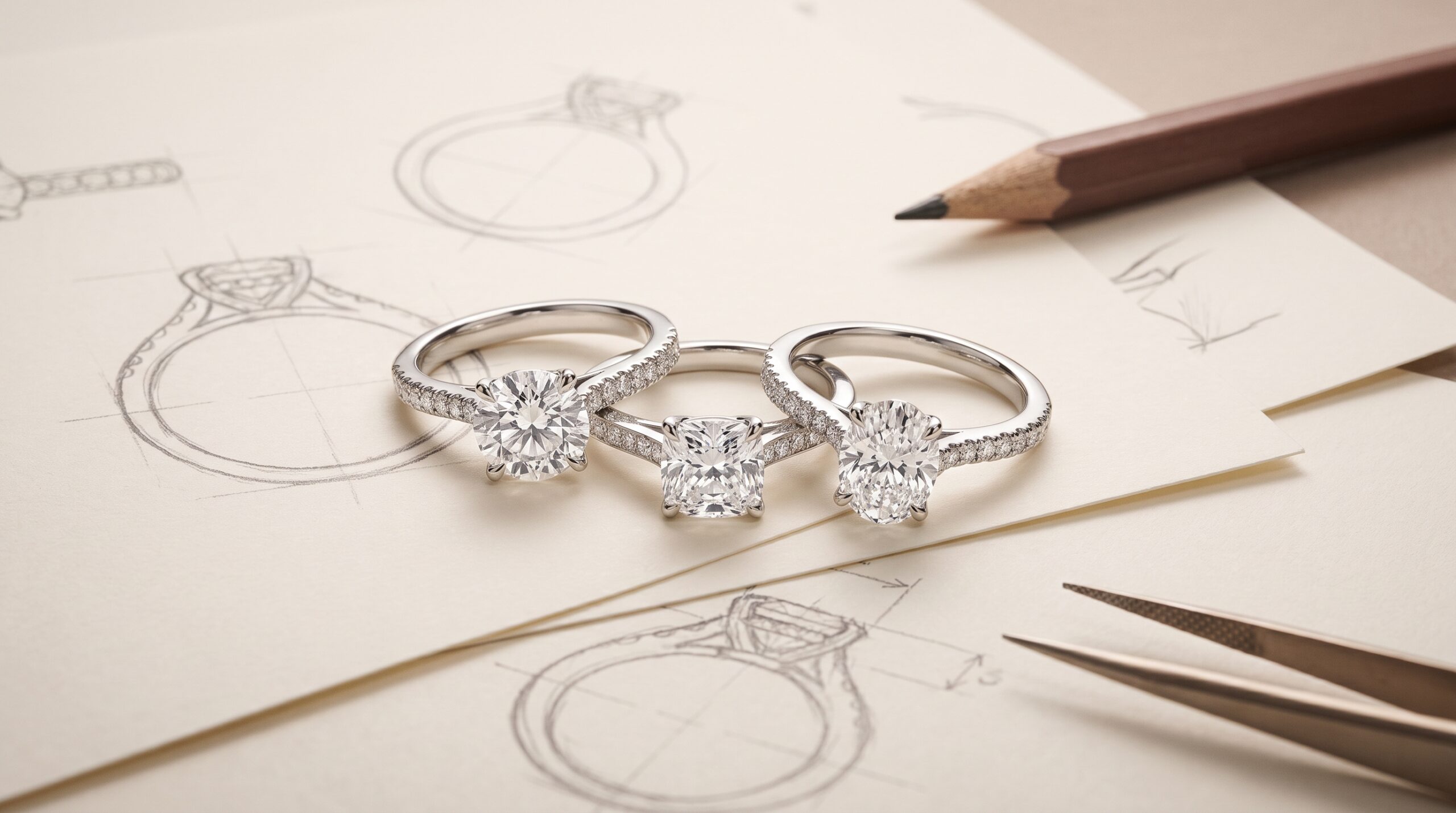
Guessing your partner’s engagement ring style is one of the riskiest parts of planning a proposal. Get the setting wrong, the metal wrong, or the stone shape wrong, and the ring meant to symbolize a lifetime decision might sit in a drawer within a year, quietly replaced. A lot of people solve this by skipping the ring entirely and proposing with just the question, but that gives up the moment of presenting something. A proposal ring is the middle path: something to kneel down with, without betting on a final design you’re not sure about.
This isn’t a lesser version of a real proposal. It’s a different decision about timing: propose now, with something meaningful, and choose the permanent ring together once you both actually know what she wants to wear for the next fifty years.
What Is a Proposal Ring?
A proposal ring is whatever ring is used in the moment of the proposal itself. It’s a separate thing from the engagement ring the couple ultimately settles on, which might be chosen together afterward, custom designed, or built around a stone that hasn’t been set yet.
People use proposal rings for a specific set of practical reasons: keeping the proposal a surprise without guessing a ring size in advance, avoiding a guess at a style or setting that might not match the partner’s actual taste, wanting the partner directly involved in choosing the final design, waiting on a custom or made-to-order piece that isn’t ready yet, or wanting to propose with something symbolic rather than a full engagement ring purchase upfront.
A proposal ring isn’t a workaround for indecision. It’s a way to separate two different moments, the proposal itself and the selection of a ring meant to be worn every day for decades, so that neither one has to be rushed or guessed at.
Best Proposal Ring Ideas
A simple band, in a plain metal with no stone or a small accent stone, works as a minimal, low-pressure choice. It doesn’t try to look like a finished engagement ring, which makes it clear from the start that something more is coming, and it keeps the initial cost modest since it’s not meant to be the final piece.
A placeholder engagement ring looks more like a traditional engagement ring, often with a center stone (real or simulated) and a recognizable setting style, but it’s understood between the couple as a stand-in rather than the permanent choice. This suits a proposal where the visual moment matters, a ring on the finger that reads clearly as an engagement ring, without locking in the actual design yet.
A symbolic token ring is chosen for its meaning rather than its resemblance to a bridal ring at all: a family piece, a ring with personal significance, or something chosen specifically because of what it represents rather than how it photographs. This works well for couples who care more about the sentiment of the moment than presenting something conventional.
A temporary stone in a holding mount is the option for someone who has already selected or inherited a diamond or gemstone but hasn’t finalized the setting. The stone gets a simple, secure temporary mounting for the proposal itself, and the couple designs the actual setting together afterward. This keeps the meaningful stone at the center of the moment without rushing the design decision around it.
Skipping a ring at the proposal and moving straight to a made-to-order engagement ring afterward is also a legitimate option. The proposal happens with the question alone, or with a ring box that’s intentionally empty or holds a note, and the couple starts the design process for the real ring together once the answer is yes.
| Option | Best For | Pros | Considerations |
| Simple band | Low pressure, budget-conscious proposals | Inexpensive, doesn’t try to be the final ring | Some partners may want more visual presence at the moment |
| Placeholder engagement ring | Wanting a traditional-looking proposal moment | Looks and feels like a real proposal | Needs to be clearly understood as temporary between the couple |
| Symbolic token ring | Meaning over bridal convention | Deeply personal, no pressure around design guessing | May not read as an engagement ring to others |
| Holding mount for an existing stone | Couples with an inherited or pre-selected stone | Keeps the meaningful stone central to the moment | Setting still needs to be designed afterward |
| No ring, design together after | Couples who want full input on every decision | Removes all guesswork from the final design | The proposal moment doesn’t include a ring to present |
How to Choose the Right Proposal Ring
Start by deciding its actual purpose: is it for the proposal moment only, meant for short-term wear over the following weeks or months, intended as a keepsake regardless of what happens next, a ring durable enough to travel or wear casually, or something that could later become a stackable piece or pendant. That answer shapes almost every other decision, since a ring worn for a single afternoon has very different requirements than one worn daily for six months while a custom piece is being made.
Formality is a separate axis. A traditional-looking temporary ring signals “engagement” clearly and suits a proposal where that visual read matters, in front of family, at an event, in photos meant to look conventional. A symbolic or minimalist option suits a proposal built more around personal meaning than presentation, where the couple isn’t concerned with whether it looks like a typical engagement ring to anyone else.
Price doesn’t determine how thoughtful the gesture feels. A modest band chosen with real intention, or a family piece with actual history, often carries more weight than an expensive placeholder bought quickly to look impressive. The budget question is really about matching spend to purpose: a ring worn once needs less investment than one worn for months, and neither has to compete with what the eventual engagement ring will cost.
Choose a simple band if the relationship’s understanding of the proposal centers on the moment and the question, not the ring itself. Choose a placeholder ring if you want the proposal to look and feel traditional while still leaving the final design open. Choose a holding mount if a stone has already been chosen or inherited and just needs a temporary setting. Choose a symbolic ring if personal meaning matters more than resembling a conventional engagement ring at all.
Proposal Ring vs Placeholder Ring vs Temporary Engagement Ring
Proposal ring is the broadest term, covering any ring used specifically for the proposal moment, regardless of style, cost, or whether it’s meant to be worn afterward.
Placeholder ring narrows that down to a ring specifically understood as a temporary stand-in before the final, permanent ring is chosen or made. It’s explicitly not meant to be the long-term piece.
Temporary engagement ring is often used for a ring that’s a bit more polished than a basic placeholder and may actually be worn for an extended period, weeks or months, while a custom or made-to-order permanent ring is being designed and built. The distinction from a placeholder is mostly about how long it’s expected to be worn and how much it resembles the eventual final ring.
| Term | Meaning | Intended Use | Long-Term Wear? |
| Proposal ring | Any ring used at the proposal itself | The moment of proposing | Not necessarily |
| Placeholder ring | A temporary stand-in before the final ring | Bridging the gap until a permanent ring is chosen | Usually brief |
| Temporary engagement ring | A more polished ring worn while a custom piece is made | Extended wear during the design and production period | Often, for weeks or months |
How Much Should You Spend on a Proposal Ring?
Match the budget to the purpose established earlier. A ring worn for one afternoon and then set aside as a keepsake can reasonably be simpler and less expensive than one that’s going to sit on a hand every day for the several months a custom ring takes to design and produce.
Overinvesting in something explicitly temporary is a common and avoidable mistake. If the ring’s whole purpose is to hold the moment until a real decision gets made together, spending as though it’s the final ring undercuts the point of using a temporary one in the first place.
The opposite mistake matters too. If the ring will actually be worn daily for months while waiting on a custom piece, underinvesting in durability or comfort creates a different problem: a ring that scratches easily, irritates the skin, or doesn’t hold up to normal wear isn’t doing its job even if it was cheap.
| Use Case | Suggested Priority | Buyer Note |
| Proposal moment only, set aside afterward | Keep cost modest | Meaning matters more than material investment here |
| Worn for a few weeks while deciding on the final ring | Moderate priority on comfort | Doesn’t need heavy durability, but should be comfortable |
| Worn for months during custom ring production | Prioritize durability and comfort | Treat it closer to how you’d treat a ring meant for daily wear |
Sizing and Fit for Proposal Rings
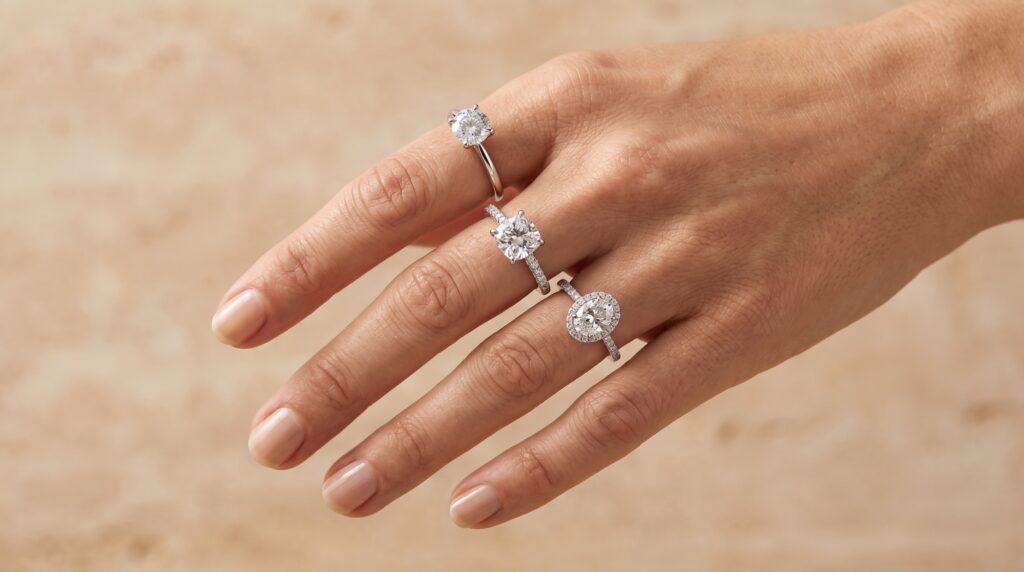
Size still matters even for a ring that isn’t permanent. A ring that’s visibly too loose or too tight photographs poorly and can be awkward to slide on in the moment itself, which is the opposite of what a well-planned proposal is going for.
If you genuinely don’t know your partner’s ring size, a few strategies reduce the risk. A simple band is easier to size roughly and exchange later than a fitted design with a stone. Sizing slightly larger rather than smaller is generally the safer guess, since a loose ring is more comfortable and less noticeable than a tight one. Checking the retailer’s return or resizing policy before buying gives you a way to correct course without much hassle. And avoiding highly fitted or unusually wide designs reduces the odds of an uncomfortable surprise.
Width plays into fit more than people expect. A wider band covers more of the finger’s surface and tends to feel snugger than a narrow band labeled the same size, so a wide statement ring is a riskier guess than a slim one if you’re not certain of the size. Finger size can also shift slightly with temperature and time of day, which is worth keeping in mind if the proposal happens somewhere notably warm or cold.
Can a Proposal Ring Be Worn After the Proposal?
As a keepsake, the proposal ring can simply be kept, stored, and revisited later as a physical piece of the story, regardless of whether it’s ever worn again.
As a travel ring, a durable proposal ring can continue being useful for situations where wearing the actual engagement ring feels riskier, on a trip, at the gym, or during activities with a higher chance of loss or damage.
As a stackable ring, a simple band from the proposal can later sit alongside the permanent engagement ring and wedding band, becoming part of an evolving ring stack rather than a piece that’s retired once its original job is done.
As a pendant or another sentimental piece, a proposal ring that doesn’t get worn on the hand afterward can be reset into a necklace or another form entirely, keeping the object in active use even if its original shape doesn’t fit into daily life anymore.
What Materials Work Best for Proposal Rings?
Gold, platinum, or sterling silver are reasonable choices depending on the ring’s intended lifespan and budget. Gold and platinum make sense for a ring that might see extended wear or become a keepsake. Sterling silver is a lower-cost option that still looks intentional, suited to a ring meant mainly for the proposal moment itself rather than months of daily wear.
Non-permanent or costume materials are appropriate only when the ring is clearly understood between the couple as symbolic or explicitly short-term. Presenting a costume piece as though it were fine jewelry, without that context being clear, risks reading as a lesser gesture rather than an intentional choice.
Whether to include a stone, and what kind, is its own decision. A plain band skips the question entirely. A simulant stone (a lab-made stone or a diamond alternative) gives visual presence without the cost of a genuine diamond, appropriate for something explicitly temporary. An actual gemstone or diamond makes sense specifically for the holding-mount scenario, where a real stone has already been chosen and just needs a temporary setting before its permanent one is built.
| Material | Best For | Durability | Buyer Note |
| Gold or platinum | Rings that may see extended wear or become keepsakes | High | Reasonable investment even for a temporary piece |
| Sterling silver | Proposal-moment-only rings on a modest budget | Moderate | Tarnishes over time with extended daily wear |
| Costume or non-permanent materials | Explicitly symbolic, short-term use only | Low | Only appropriate when both partners understand its temporary nature |
Buying a Proposal Ring Online
Look for clear photos from multiple angles, a sense of scale (on a hand, not just against a plain background), side views showing the setting’s profile, specific material details rather than vague descriptions, a real sizing guide, a stated return or exchange policy, a clear delivery timeline, and an explicit statement of whether the piece is intended for temporary or long-term wear.
Vague phrasing like “engagement-style” without further detail is worth treating cautiously, since it can describe almost anything. Also watch for missing material specifics, no sizing information, no return policy, no mention of how durable the piece actually is, and no clear timeline if the piece is described as custom or made-to-order. Any of these gaps makes it harder to know what you’re actually buying before the proposal itself.
Conclusion
The proposal and the permanent ring don’t have to happen on the same day, and treating them as separate decisions usually produces a better outcome for both. A simple band, a placeholder ring, a family piece, or a temporary setting for a stone already chosen: any of these can carry the weight of the moment without forcing a guess on a decision that deserves both people’s input.
Decide first what the ring’s actual job is, the proposal itself, a few months of wear, or a keepsake regardless, and let that answer guide the budget, the material, and the sizing approach. Once the answer is yes, there’s no rush on the final ring. Take the time to choose it together.
Frequently Asked Questions
What is a proposal ring?
A proposal ring is whatever ring is used at the moment of proposing, whether that’s a simple band, a symbolic piece, a placeholder that resembles a traditional engagement ring, or a temporary setting for a diamond that’s already been chosen. It’s distinct from the final engagement ring, which the couple may design or select together after the proposal itself.
Is a proposal ring the same as an engagement ring?
Not necessarily. A proposal ring is specifically the ring used in the proposal moment, and it can be temporary, symbolic, or a stand-in rather than the ring the couple intends to keep long-term. The engagement ring is whatever piece ultimately becomes the permanent one, which might be the same ring used at the proposal, or something chosen and made afterward.
Is it okay to propose with a placeholder ring?
Yes. A placeholder ring lets the proposal happen on the couple’s own timeline without forcing a guess at the final style, size, or budget for the permanent ring. It’s a common and practical choice, not a lesser version of a proposal, as long as both people understand it’s a temporary piece rather than the final decision.
How much should I spend on a proposal ring?
That depends on how the ring will actually be used afterward. A ring meant only for the proposal moment and then set aside can reasonably be modest in cost. A ring that will be worn daily for months while a custom engagement ring is designed and made deserves more attention to comfort and durability, even if it’s still not meant to be the final piece.
Can a proposal ring be worn after the proposal?
Often, yes. Depending on the ring, it can be kept as a keepsake, worn as a travel ring for situations where the permanent ring feels riskier to bring along, added to a future ring stack alongside the engagement and wedding rings, or reset into a different piece like a pendant if it doesn’t fit into daily wear as a ring.
What is the best proposal ring for a surprise?
There isn’t a single best option, since it depends on what the proposal is meant to look and feel like. A placeholder ring suits a proposal meant to look traditional. A simple band or symbolic piece suits one built more around personal meaning than presentation. A holding mount works specifically when a stone has already been selected and just needs a temporary setting for the moment itself.
Should I buy a real ring or a temporary ring?
This comes down to purpose rather than a fixed rule. If you already know the style, size, and stone your partner wants, buying the actual final ring for the proposal makes sense. If any of that is uncertain, or if you want your partner directly involved in designing the permanent ring, a temporary or placeholder ring avoids locking in a guess neither of you can easily undo.
Can a proposal ring be resized?
Simple bands are usually the easiest to resize or exchange if the fit turns out to be off. More detailed placeholder rings, particularly those with a stone or intricate setting, may have more limited resizing options, so it’s worth checking the retailer’s resizing or exchange policy before buying if you’re not certain of your partner’s ring size.
What materials are best for a temporary ring?
Gold, platinum, or sterling silver all work depending on how long the ring will actually be worn and the budget involved. Sterling silver is a reasonable lower-cost option for something used mainly at the proposal itself. Non-permanent or costume materials are only appropriate when both partners clearly understand the ring is symbolic and short-term, since presenting one as though it were fine jewelry without that shared understanding can read the wrong way.
Can the final engagement ring be chosen together later?
Yes, and this is one of the main reasons people use a proposal ring in the first place. Proposing with a temporary or symbolic ring keeps the moment intact while leaving the actual design, whether that’s a custom piece, a specific stone, or a particular setting, open for both people to decide on once there’s no pressure to keep it a surprise anymore.