
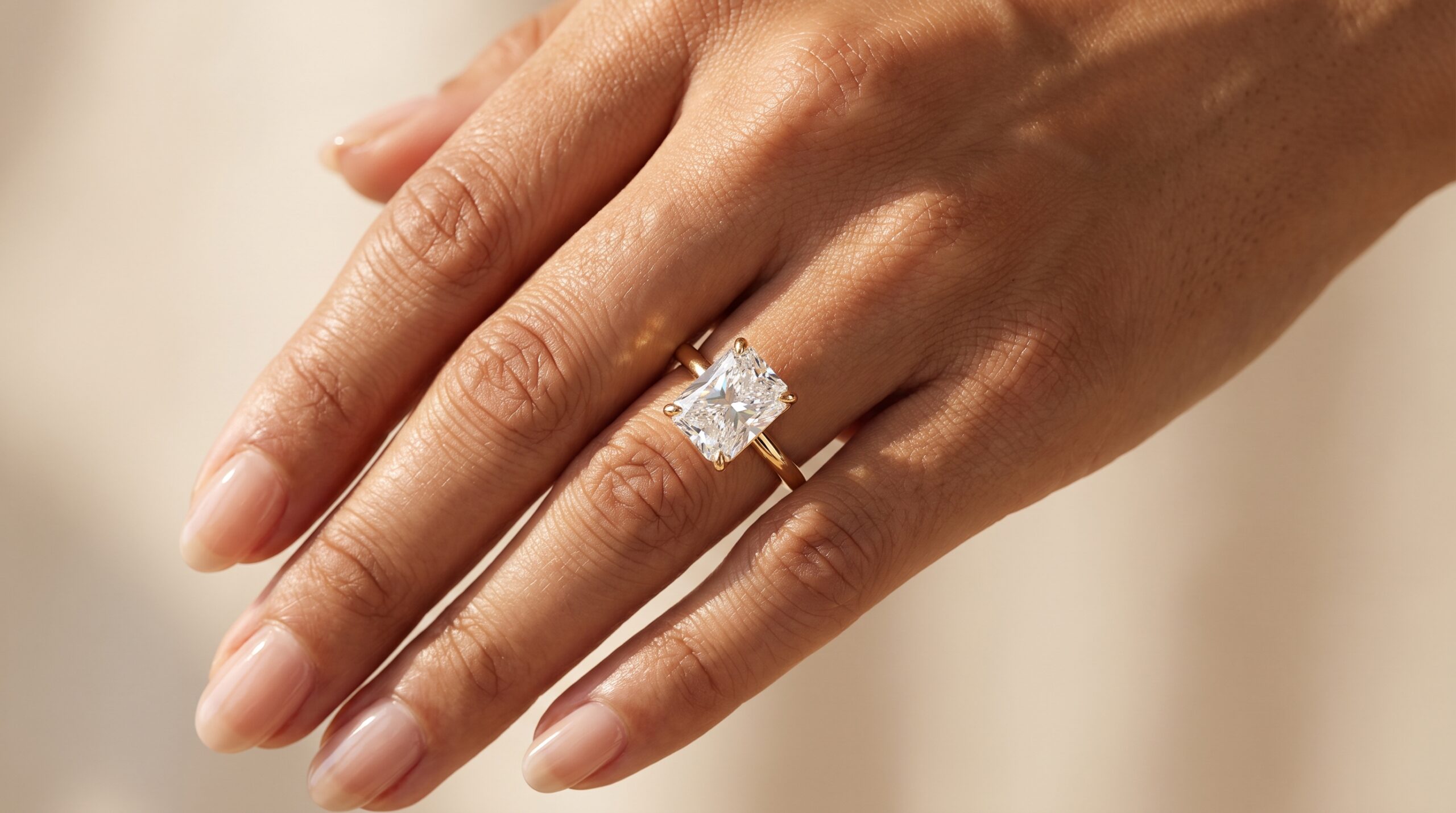
Round diamonds sparkle, but they don’t always feel distinctive. A radiant cut solves that specific problem: it keeps most of the brilliance of a round or princess cut while adding the clean, geometric outline of a step cut like emerald or Asscher. Buyers who want both sparkle and a more architectural shape tend to land here, and then run into a different problem, figuring out what actually makes one radiant cut better than another. Ratios, clarity tradeoffs, and setting choices matter more for this shape than most people expect going in.
What Is a Radiant Cut Engagement Ring?
A radiant cut is a rectangular or square diamond with cropped corners and a faceting pattern that mixes brilliant-cut and step-cut styles. It was developed in the 1970s by cutter Henry Grossbard, who wanted a shape that combined the fire of a round brilliant with the crisp lines of an emerald cut. That hybrid design is what separates it from both parent shapes: a pure emerald cut uses only step-cut facets and shows broad, flashing planes of light, while a pure round brilliant uses only brilliant-cut facets and scatters light into many small points of sparkle. A radiant cut typically has 70 facets, more than either shape alone, arranged to blend both effects.
The cropped corners aren’t just decorative. They reduce the risk of chipping compared to a sharp-cornered shape like a true square princess cut, since a diagonal edge is structurally sturdier than a 90-degree point. This is one of the more practical advantages of choosing a radiant over a princess cut for a ring that will see daily wear.
Radiant cuts come in two general proportions: square (closer to a 1:1 ratio) and rectangular (longer relative to width). Both use the same faceting approach, but they read very differently on the hand, which is worth understanding before comparing specific stones.
Compared to an emerald cut, a radiant cut has noticeably more sparkle and tends to hide inclusions better, since the brilliant-cut facets break up the visual field the way they do in a round diamond. Compared to a princess cut, a radiant is more forgiving to wear daily because of the clipped corners, though a well-made princess cut in a protective setting can hold up fine too. The GIA’s guide to selecting a radiant cut diamond describes the shape’s hybrid faceting as the reason it developed a reputation for combining brightness with geometric structure.
What Makes Radiant Cut Diamonds Unique?
The mixed faceting is the core of it. A radiant cut’s crown (the top portion above the widest point) uses brilliant-style triangular and kite facets, while the pavilion (the bottom portion) often incorporates step-cut style facets running in parallel rows. The result is a stone that flashes more broadly than a round brilliant in some lighting but still scatters light more actively than an emerald cut.
That combination has a practical side effect: radiant cuts tend to hide inclusions and light color tinting better than pure step cuts do, because the more numerous, smaller facets break up the visual field the same way they do in a round brilliant. A step cut like emerald or Asscher shows flaws through broad, clear facets that work almost like windows into the stone; a radiant cut’s busier faceting makes that kind of flaw less obvious to the naked eye.
The clipped corners matter structurally more than stylistically. A princess cut’s sharp 90-degree corners are the most vulnerable point on any common diamond shape, prone to chipping from a direct hit at the corner. A radiant cut’s 45-degree clipped corners spread that same impact force across a wider edge, which reduces (though doesn’t eliminate) the risk.
Radiant cuts also tend to look proportionally at home on a range of hand and finger shapes. A round diamond can look slightly small and dot-like on a larger hand, while an elongated shape like an oval or marquise draws the eye up and down the finger; a radiant sits between these effects depending on which ratio you choose, which is why the square-versus-rectangular decision matters as much as it does.
Square vs Rectangular Radiant Cuts
The length-to-width ratio is the single biggest factor in how a radiant cut actually looks once it’s set. A ratio close to 1.00 to 1.05 reads as square. Anything from about 1.20 to 1.50 reads as a clearly rectangular radiant, with 1.30 to 1.40 being the most commonly chosen range for a balanced, “not too long, not too short” look.
A square radiant has a fuller, more compact presence and tends to suit buyers who want the shape’s brilliance without a strong elongating effect. A rectangular radiant, by contrast, visually lengthens the finger the same way an emerald or oval cut does, and it tends to show a bit more of that mixed brilliant-and-step sparkle across a larger surface area.
Neither ratio is more correct. The choice comes down to whether you want the ring to read as compact and geometric or long and dramatic, and there’s no rule that one suits smaller or larger hands better; personal preference carries more weight here than any hand-shape formula.
| Ratio Range | Appearance | Visual Effect on Finger | Best For |
| 1.00–1.05 | Square | Compact, balanced | Buyers wanting a fuller, more geometric look |
| 1.10–1.20 | Slightly rectangular | Mild elongation | Buyers wanting a subtle length without a dramatic shift |
| 1.30–1.40 | Classic rectangular | Noticeably elongating | The most commonly chosen range for a “textbook” radiant |
| 1.45–1.50 | Long rectangular | Strong elongation | Buyers wanting a more dramatic, slimming silhouette |
If you prefer a fuller, rounder look: stay closer to a 1.00 to 1.10 ratio. If you prefer an elongated, finger-lengthening look: look toward 1.30 and above. If you’re unsure: the 1.20 to 1.30 range is a reasonable middle ground that reads as clearly radiant without leaning hard into either extreme.
How Radiant Cuts Compare to Other Diamond Shapes
Against a round brilliant, a radiant cut trades a small amount of raw brilliance for a more distinctive silhouette. Round diamonds are cut specifically to maximize light return, and they remain the benchmark for sparkle. A radiant comes close but not identical, since the mixed faceting isn’t optimized purely for brightness the way a round brilliant’s 57 or 58 facets are.
Against an emerald cut, the radiant is the more forgiving choice on clarity, since its brilliant-cut elements hide inclusions better than the emerald’s broad step-cut facets. The tradeoff is that an emerald cut has a cleaner, more minimal look that some buyers prefer specifically because it doesn’t scatter light as actively.
Against a princess cut, a radiant offers similar brilliance with better corner durability, thanks to the clipped corners versus the princess cut’s sharp points. Princess cuts can look slightly more uniform and “crisp” in their square shape, since they lack the corner clipping, but that comes with a higher chip risk at the corners if the setting doesn’t protect them well.
Against an oval, the comparison is more about silhouette than sparkle, since both shapes can achieve strong brilliance. An oval has no corners at all and a continuously curved outline, giving it a softer look, while a rectangular radiant keeps a more structured, architectural feel even at a similar length-to-width ratio.
| Shape | Sparkle | Durability | Visual Style | Typical Buyer Preference |
| Radiant | High, mixed brilliant and step-cut flash | Good; clipped corners reduce chip risk | Geometric with strong brilliance | Buyers wanting sparkle and structure together |
| Round brilliant | Highest | Very good; no vulnerable corners | Classic, versatile | Buyers prioritizing maximum sparkle |
| Emerald | Moderate; broad flashes, less scatter | Good; clipped corners, but flaws more visible | Clean, minimal, architectural | Buyers wanting understated elegance |
| Princess | High | Moderate; sharp corners need protection | Crisp, modern square | Buyers wanting a sharp, uniform square look |
| Oval | High | Very good; no corners | Soft, elongating | Buyers wanting an elongated, curved silhouette |
Choosing the Right Setting for a Radiant Cut
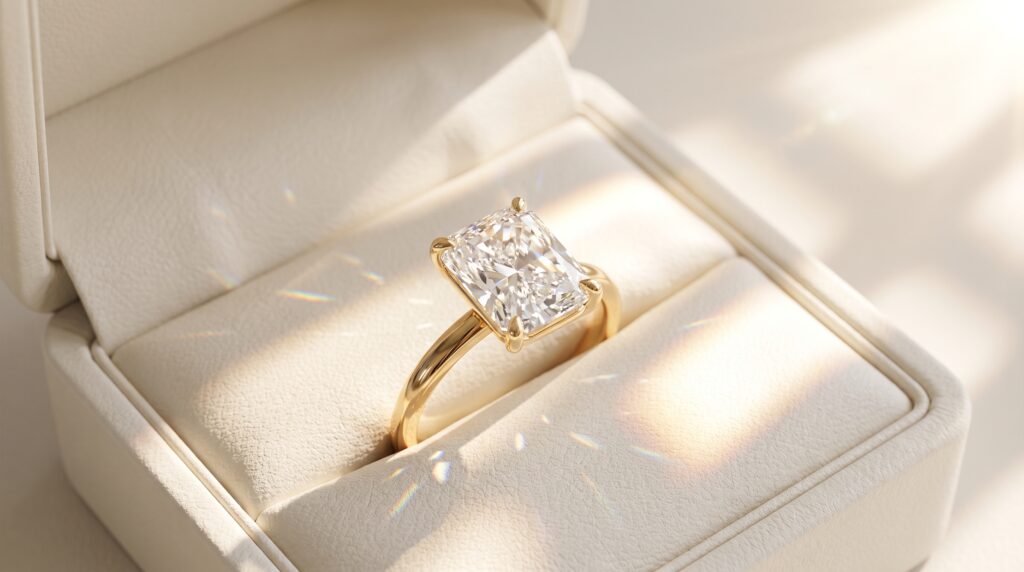
A 4-prong setting, with one prong at each corner, is the standard choice for a radiant cut and works well for most buyers. It shows more of the stone’s surface area than a 6-prong setting but offers slightly less security at the corners specifically.
A 6-prong setting adds two additional prongs along the longer sides (typical for rectangular radiants), which increases security without fully enclosing the stone. This is a reasonable middle ground for buyers who want more protection than a 4-prong offers but aren’t ready to commit to a bezel’s fully enclosed look.
A bezel setting wraps a thin band of metal around the entire perimeter, corners included, and offers the highest protection at the cost of some light entering the sides of the stone, which slightly reduces sparkle compared to an open prong setting.
A halo setting surrounds the center stone with a ring of smaller diamonds, which increases apparent size and adds brightness that complements a radiant’s already-active sparkle, though it also means more small stones and more surfaces to clean.
A solitaire setting, without a halo or side stones, lets the radiant’s own faceting stand on its own, which some buyers prefer specifically because it doesn’t compete with the center stone’s geometry.
A pavé band lines the shank with small diamonds for added sparkle along the ring itself, which pairs well with a radiant’s brilliance but adds more surfaces that need regular cleaning and periodic prong checks.
A low-profile setting sits closer to the finger, reducing how much the ring catches on clothing, hair, or gloves, which matters more for people with physically active routines than for someone with a mostly low-impact daily schedule.
| Setting Type | Protection Level | Sparkle Visibility | Maintenance Needs | Best Lifestyle Fit |
| 4-prong | Moderate | High | Regular prong checks | General everyday wear |
| 6-prong | Moderate to high | High | Regular prong checks | Buyers wanting extra security without a bezel |
| Bezel | Highest | Slightly reduced | Low; easy to clean, no prongs | Active or hands-on lifestyles |
| Halo | High (stone is set low and protected) | Very high | More surfaces to clean | Buyers wanting more brightness and size |
| Solitaire | Moderate | High | Regular prong checks | Buyers wanting the stone to stand alone |
| Pavé band | Depends on center setting | Very high | Higher; more small stones to maintain | Buyers prioritizing overall ring sparkle |
What to Look for When Buying a Radiant Cut Diamond
Length-to-width ratio comes first, since it determines whether the stone reads as square or rectangular before anything else about quality even factors in. Decide on a ratio range before comparing specific stones, since it narrows the field considerably.
Cut quality matters more than a single grade number can capture for a fancy shape like radiant, because, as with other non-round cuts, there’s no single standardized cut grade the way there is for round brilliants. Buyers need to look at actual proportions, symmetry, and light performance through photos or video rather than relying on a grade alone.
The bowtie effect, a shadow that can appear across the center of elongated fancy cuts, shows up in radiant cuts less often than in ovals or pears, but it’s still worth checking in video under different angles. A faint bowtie is normal; a dark, fixed one across the center suggests uneven proportions.
Clarity can be more flexible in a radiant cut than in a step cut, since the brilliant-cut facets hide inclusions more effectively. SI1 or better is a reasonable starting point for most buyers, with VS2 or better recommended if the stone has a larger table or lower crown angle that could expose the center more.
Color follows a similar logic. G to H color often looks eye-clean in a radiant cut, particularly in a rectangular shape where more of the stone’s surface area breaks up any warm tint, though buyers with a strong preference for icy white stones may still want F or better.
Face-up size perception is worth checking against actual measurements rather than carat weight alone, since a deeper-cut radiant carries more of its weight below the surface and can look smaller than a shallower-cut stone of the same carat.
Certification from a recognized grading lab is the final check, confirming that the clarity, color, and measurements match what’s advertised rather than relying on a seller’s description alone.
A simple sequence for narrowing choices: settle on a shape preference, decide square versus rectangular, set a budget, decide whether sparkle or size matters more to you, review clarity and color against that priority, compare setting options, and confirm certification before finalizing.
Natural vs Lab-Grown Radiant Diamonds
Natural and lab-grown radiant diamonds are optically and chemically identical; a lab-grown diamond is still a diamond, formed through a controlled process rather than underground over geologic time. The practical differences are price, resale expectations, and, for some buyers, a preference around origin.
Lab-grown diamonds typically cost 30 to 40 percent less per carat than natural ones, which lets buyers choose a larger stone or a better clarity and color grade within the same budget. That price gap has been narrowing slightly over time as lab-grown production scales, but it remains substantial enough to influence most budget-conscious decisions.
Resale value differs meaningfully between the two. Natural diamonds have a more established secondary market, while lab-grown resale values are generally lower and the market for them is still developing. This matters more for buyers thinking about long-term investment value and less for buyers who see the ring purely as a personal purchase rather than an asset.
Sustainability narratives exist on both sides. Lab-grown diamonds avoid the land disruption associated with mining, while some natural diamond sourcing today follows established environmental and labor standards through certification programs. Neither claim is universally true across every retailer or mine, so buyers who care about this should ask for specifics rather than relying on general marketing language.
| Feature | Natural Diamond | Lab-Grown Diamond |
| Price per carat | Higher | Lower, typically 30–40% less |
| Optical and physical properties | Identical to lab-grown | Identical to natural |
| Resale market | More established | Still developing, generally lower resale value |
| Sustainability considerations | Varies by mine and certification | Avoids mining-related land disruption; energy use varies by producer |
| Best suited for | Buyers prioritizing resale value or traditional origin | Buyers prioritizing size, clarity, or budget flexibility |
Wearability and Everyday Comfort
The clipped corners give a radiant cut a durability advantage over a princess cut, but they’re still the most vulnerable part of the stone and benefit from a setting that secures them directly, whether through prongs positioned at each corner or a full bezel.
Buyers with physically active routines, manual work, frequent hand-washing, or regular gym use tend to do better with a bezel or low-profile 4-prong setting, since both reduce snagging and impact exposure compared to a raised halo or cathedral-style mount.
Band width affects comfort more than people expect before wearing a ring daily. A narrower band (around 1.5 to 2mm) feels less noticeable but can dig in more under pressure; a wider band (2.5mm and up) distributes pressure more evenly and tends to hold up better against everyday knocks, though it’s a more substantial visual presence on the hand.
Stacking with a wedding band works most easily with a straight-shanked setting, since a radiant cut’s rectangular or square outline pairs cleanly with a straight band edge. A curved or contoured wedding band can also work but may need to be custom-fitted to nest properly against the engagement ring’s shank, which is worth discussing with a jeweler before purchasing either piece separately.
Low-profile settings, where the stone sits closer to the finger, reduce the ring’s overall height and make it less likely to catch on gloves, hair, or clothing, a small but meaningful factor for anyone who removes and puts the ring back on multiple times a day.
| Lifestyle | Recommended Setting | Recommended Metal | Suggested Band Width |
| Desk-based, low activity | 4-prong or 6-prong solitaire | Platinum or 14k/18k gold | 1.5–2mm |
| Manual work, frequent hand use | Bezel | Platinum (higher scratch resistance under daily contact) | 2–2.5mm |
| Active sports or gym-heavy routine | Bezel or low-profile 4-prong | Platinum | 2–2.5mm |
| Frequent stacking with a wedding band | Straight-shank solitaire | Matched metal to wedding band | 1.5–2mm |
Caring for a Radiant Cut Engagement Ring
Clean the ring every one to two weeks with warm water, a small amount of mild dish soap, and a soft-bristled brush, paying attention to the underside of the stone where lotion and oils tend to collect.
Avoid chlorine and harsh household chemicals, which can damage certain metal alloys over time, particularly gold blends that include more reactive base metals.
Schedule a professional inspection every six to twelve months so a jeweler can check prong tightness and catch early wear before it results in a loose or lost stone.
Store the ring separately from other jewelry, ideally in a fabric-lined box or pouch, to prevent the diamond’s hard surface from scratching softer metals or gemstones it might otherwise sit against in a drawer.
Remove the ring during activities with a real risk of a direct impact or chemical exposure: heavy lifting, contact sports, cleaning with bleach-based products, or swimming in chlorinated water.
Watch for early signs of prong wear, such as a stone that feels slightly loose when gently pressed, and get it checked before wear becomes more serious. Catching a loosening prong early is far less costly than replacing a lost stone.
Common Mistakes Buyers Make
Ignoring the length-to-width ratio is one of the more common regrets, since photos of an isolated stone rarely convey how a specific ratio will actually look on a hand. Reviewing video or in-person comparisons of a few different ratios before deciding avoids this.
Accepting a strong bowtie effect without checking video from multiple angles is another one. A single flattering photo can hide a dark, fixed shadow that becomes obvious the moment the stone moves under different light.
Prioritizing carat weight over proportions leads some buyers to choose a heavier but poorly cut stone that actually looks smaller and less bright than a slightly lighter, better-proportioned one. Carat weight alone doesn’t predict face-up appearance.
Buying without certification removes the only objective way to confirm a stone’s actual clarity, color, and measurements match what’s advertised, which matters even more for a fancy shape without a standardized cut grade.
Choosing a setting that doesn’t match daily habits, like a raised halo for someone doing frequent manual work, leads to more snagging, more wear, and a higher chance of a chipped stone over time. Matching the setting to how the ring will actually be worn avoids most of this.
None of these are difficult to avoid once you know to check for them, and none require an expert eye. They mostly come down to reviewing video instead of photos, checking ratios before quality grades, and being honest about how the ring will actually be worn day to day.
Frequently Asked Questions
Are radiant cuts durable?
Yes, generally more so than a princess cut, because the clipped corners spread impact force across a wider edge instead of concentrating it at a sharp 90-degree point. The stone itself is also diamond, the hardest natural material, so scratching isn’t a concern. The main durability factor is setting choice: a bezel or well-secured prong setting protects the corners better than an open, minimal setting would.
Do radiant cuts sparkle more than emerald cuts?
Yes. A radiant cut mixes brilliant-cut and step-cut faceting, which produces more scattered sparkle than an emerald cut’s purely step-cut facets. An emerald cut shows broader, flashier planes of light and shadow, while a radiant cut shows more small, active points of brilliance across the stone.
What ratio is best for a radiant cut?
There’s no universally best ratio. A range close to 1.00 to 1.05 produces a square look, while 1.30 to 1.40 is the most commonly chosen rectangular range, producing a more elongated, finger-lengthening appearance. The right choice depends on whether you prefer a compact or elongated silhouette.
Does radiant cut look smaller than round?
It can, depending on the specific stone’s depth and cut proportions. A deeper-cut radiant carries more of its carat weight below the surface, which can make it look smaller face-up than a round diamond of the same weight. Checking the actual measurements listed on a grading report gives a more reliable sense of face-up size than carat weight alone.
What clarity grade should I choose?
SI1 or better is a reasonable starting point for most buyers, since a radiant cut’s brilliant-cut facets tend to hide inclusions more effectively than a pure step cut would. VS2 or better is worth considering for stones with a larger table or lower crown angle, which can expose the center of the stone more directly.
Are radiant cuts expensive?
Pricing depends on the same factors as any diamond shape: carat weight, clarity, color, and cut quality. Radiant cuts don’t carry a significant price premium or discount compared to similarly sized round or princess cuts, though the flexibility to choose slightly lower clarity grades without visible flaws can help stretch a budget further.
What setting protects radiant cuts best?
A bezel setting offers the most protection because it encloses the entire perimeter, including the vulnerable corners, in metal. A 6-prong setting is the next most secure option for buyers who want more visible stone surface than a bezel allows while still adding protection beyond a standard 4-prong mount.
Can radiant cuts stack with wedding bands?
Yes, and a straight-shanked radiant cut setting generally stacks more easily than a curved one, since the rectangular or square outline pairs cleanly with a straight band edge. A curved or contoured wedding band can still work but may need custom fitting to sit properly against the engagement ring.
Are lab-grown radiant diamonds worth it?
They’re a reasonable option for buyers who want a larger stone or higher clarity and color grade within a set budget, since lab-grown diamonds typically cost 30 to 40 percent less per carat than natural ones while being optically and chemically identical. The tradeoff is a less established resale market, which matters more to buyers thinking about long-term value than to those focused on the ring itself.
How do I avoid a strong bowtie effect?
Review a 360-degree video of the specific stone under different lighting and angles rather than relying on static photos, which can hide a dark, fixed shadow across the center. A subtle bowtie is normal in most radiant cuts and isn’t a flaw on its own; a wide, dark, or asymmetrical one usually points to shallow or uneven cutting proportions and is worth avoiding.