
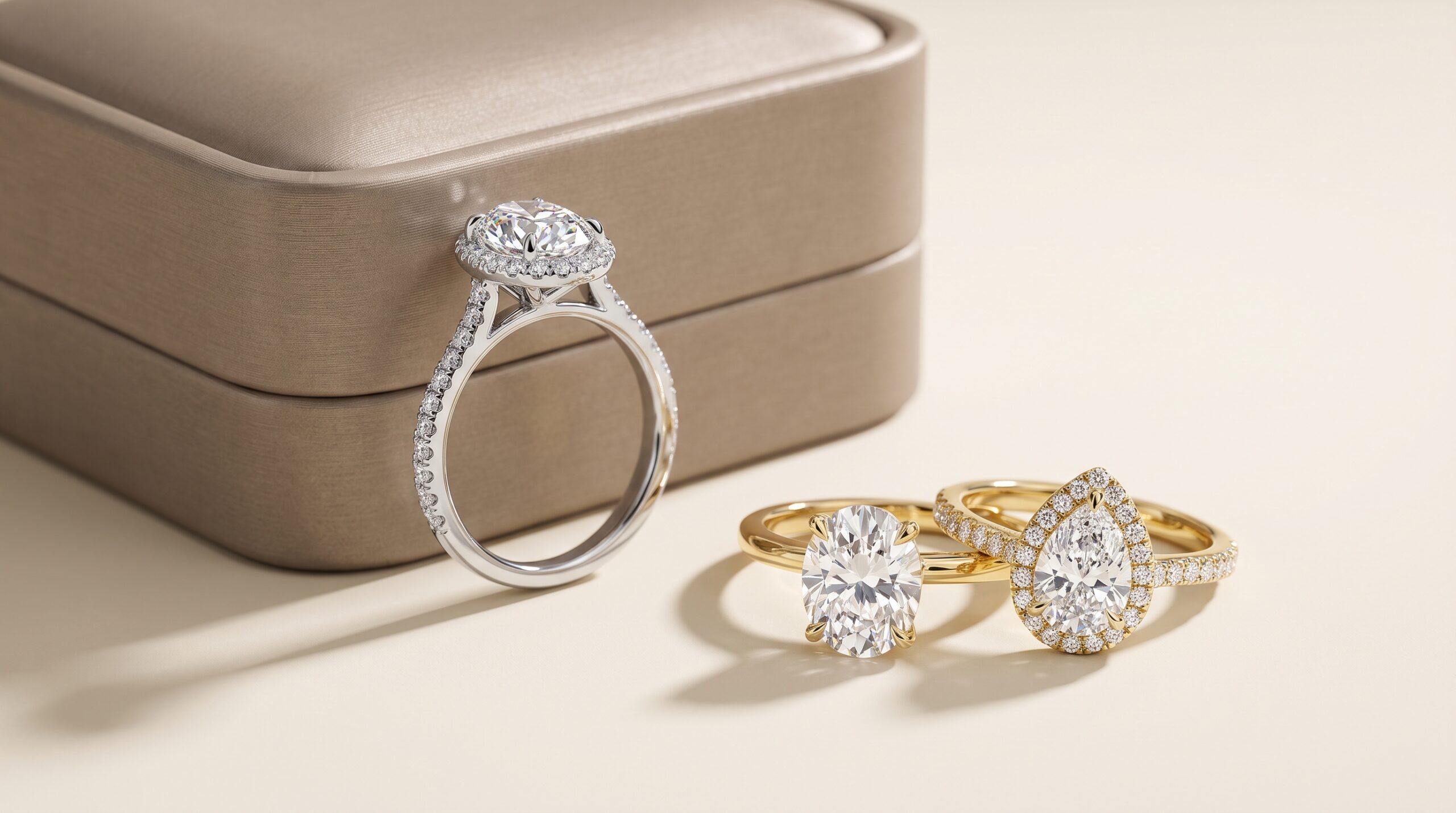
Choosing between a solitaire and a halo setting comes down to a handful of real tradeoffs: how much sparkle you want, how the ring will hold up to daily wear, how much you’re comfortable spending, and how it will pair with a wedding band later on. Neither style is the better choice in general. One is better for a specific buyer, and figuring out which one you are is more useful than picking whichever style shows up more often on social media.
What Is a Solitaire Engagement Ring?
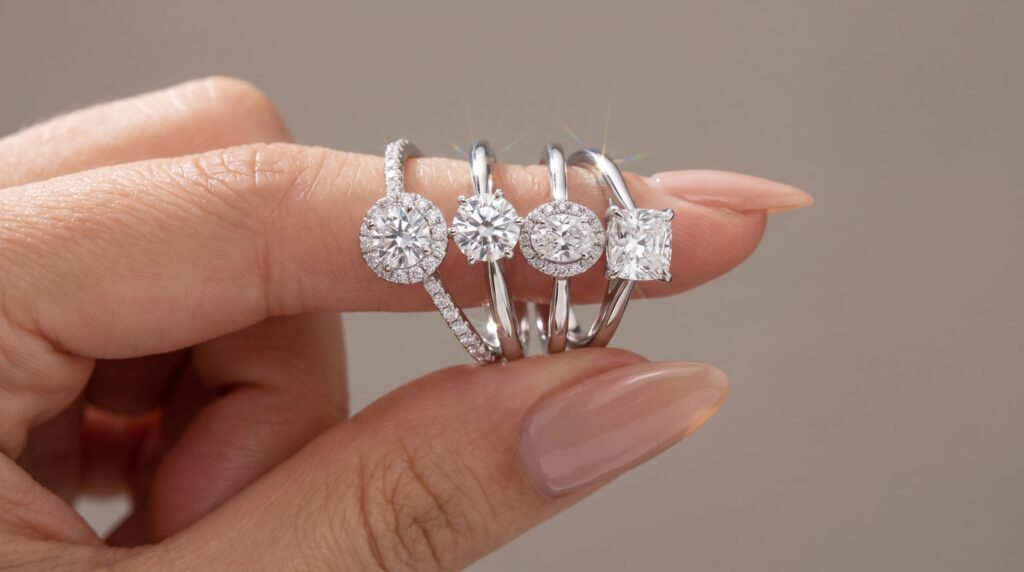
A solitaire ring features a single center stone set on a plain or lightly detailed band, with little or no additional stones surrounding it. The design puts the full visual weight on the center diamond or gemstone rather than splitting attention across multiple elements.
| Feature | Solitaire Ring Characteristics |
| Stone count | One center stone, typically no accents |
| Band style | Plain metal band, sometimes with a thin pavé detail |
| Visual focus | Entirely on the center stone’s cut, shape, and clarity |
| Design longevity | Classic silhouette that has remained popular across decades |
Because there’s nothing to distract from the center stone, the quality of that stone, especially its cut, carries more of the visual impact than it would in a more detailed setting.
What Is a Halo Engagement Ring?
A halo ring surrounds the center stone with a ring of smaller accent stones, usually diamonds, set close together to frame it. The accents add sparkle around the perimeter and can make the center stone appear larger than its actual carat weight would suggest on its own.
Halo settings come in a few variations. A single halo places one row of accent stones around the center. A double halo adds a second row for a larger, more layered look. A hidden halo places the accent stones beneath the center stone rather than around its visible edge, giving a subtler boost of sparkle without changing the ring’s overall silhouette from a straight-on view.
| Halo Type | Look | Best For |
| Single halo | One ring of accent stones, moderate size increase | Buyers who want noticeably more sparkle without an oversized look |
| Double halo | Two rings of accent stones, larger and more layered | Buyers who want maximum visual size and detail |
| Hidden halo | Accent stones tucked underneath the center stone | Buyers who want extra sparkle from certain angles while keeping a cleaner top-down view |
Solitaire vs Halo: Main Differences at a Glance
| Factor | Solitaire | Halo |
| Style | Classic and minimal | Detailed and sparkly |
| Visual size | Shows the true size of the center stone | Can make the center stone look larger |
| Maintenance | Fewer stones to clean and check | More stones mean more regular cleaning and prong checks |
| Cost | Usually lower for a comparable center stone | Usually higher due to accent stones and setting labor |
| Wedding band pairing | Generally easier to match with a straight band | May need a curved or contoured band depending on the halo’s shape |
| Best for | Buyers who want a timeless, low-maintenance design | Buyers who want more sparkle and visual presence |
Which Ring Style Looks More Timeless?
Why Solitaires Feel Classic
A solitaire’s design hasn’t changed much in decades, because there isn’t much to change. One stone, one band, minimal ornamentation. That simplicity is part of why it continues to look current regardless of what’s trending in jewelry design at any given moment.
When Halos Still Feel Timeless
A well-proportioned halo, where the accent stones are sized appropriately to the center stone rather than oversized for effect, can look just as enduring as a solitaire. The styles that tend to feel more tied to a specific era are the ones with heavier ornamentation: double halos paired with elaborate pavé bands, or unusual accent stone shapes. A single, proportionate halo doesn’t carry the same risk.
Which Style Looks Bigger or More Sparkly?
A halo adds visual width around the center stone and introduces extra light reflection from the accent diamonds, which is why halo rings often read as larger and more sparkly at a glance, even when the center stone is the same carat weight as a comparable solitaire. A solitaire concentrates all of that visual attention on the center stone alone, so its sparkle depends more heavily on that one stone’s cut quality.
Cut quality affects brilliance more than any other factor in either setting, according to GIA’s diamond grading standards. A poorly cut center stone will look dull in a solitaire and only marginally better in a halo, since the accent stones can’t compensate for weak light performance in the stone they’re framing.
| Buyer Goal | Better Fit | Why |
| Maximum apparent size for the price | Halo | Accent stones add visual width without requiring a larger center carat |
| Focus entirely on one stone’s brilliance | Solitaire | No competing sparkle from surrounding stones |
| Balanced sparkle without extra maintenance | Single halo | Adds noticeable sparkle without the upkeep of a double halo |
Which Is Better for Everyday Wear?
Solitaires generally involve less daily maintenance simply because there are fewer stones and prongs to check. A ring with one center stone has one setting point to monitor for wear. A halo ring, particularly a double halo, has considerably more, and each accent stone’s prongs need periodic inspection to make sure nothing has loosened.
Setting height matters in both styles. A high-set solitaire or halo is more likely to catch on clothing, hair, or gloves than a low-profile version of either style. Buyers with active jobs, frequent handwashing, or sports in their routine tend to do better with a lower-profile setting regardless of which style they choose.
Best for low maintenance: a solitaire with a low or medium setting height. Best for sparkle: a halo, ideally a single halo if daily wear is a concern. Best for active lifestyles: a low-profile version of either style, avoiding high prongs and delicate detail work that snags easily.
Which Costs More: Solitaire or Halo?
Solitaires typically cost less than halos with an equivalent center stone, because the halo setting requires additional diamonds and more labor to set them securely. A halo can also be used strategically to create the visual impression of a larger stone without paying for the carat weight that impression would otherwise require, which is one reason some buyers choose a halo specifically to manage cost.
| Cost Factor | Solitaire | Halo |
| Center stone | Same price regardless of setting choice | Same price regardless of setting choice |
| Accent stones | None or minimal | Adds cost proportional to the number and size of accent stones |
| Setting labor | Simpler construction, lower labor cost | More intricate construction, higher labor cost |
| Perceived size per dollar | Lower, since size comes entirely from the center stone | Higher, since accent stones add visual size without raising center carat |
The comparison that matters isn’t center stone against center stone. It’s total ring cost against total ring cost, since a halo’s added stones and labor can close the price gap with a solitaire that has a larger center stone.
Which Pairs Better with a Wedding Band?
Solitaires generally sit flush against a straight wedding band, since there’s no surrounding setting to create a gap. Halo rings, especially those with a raised or wide accent ring, can leave a small gap between the engagement ring and a straight band, which some buyers find visually distracting and others don’t notice at all.
| Engagement Ring Style | Wedding Band Fit Consideration |
| Solitaire | Typically pairs cleanly with a straight or slightly curved band |
| Single halo | May sit flush or leave a small gap depending on the halo’s width and height |
| Double halo | More likely to require a curved or contoured band to sit flush |
If band pairing matters to you, it’s worth trying the engagement ring and a prospective wedding band together before finalizing either purchase, since fit varies by the specific designs involved rather than by style category alone.
Pros and Cons of Solitaire Engagement Rings
| Pros | Cons |
| Timeless design that doesn’t tie to a specific trend | Less overall sparkle than a setting with accent stones |
| Fewer stones to clean and monitor | All visual impact rests on the center stone’s quality |
| Usually more affordable for a comparable center stone | May feel too minimal for buyers who want a more detailed look |
| Generally easier to pair with a range of wedding bands | A smaller center stone will look smaller, with no accent stones to add visual presence |
Pros and Cons of Halo Engagement Rings
| Pros | Cons |
| Adds sparkle beyond what the center stone provides alone | Requires more frequent cleaning and prong checks |
| Can make the center stone look larger than its actual carat weight | Usually costs more than a solitaire with the same center stone |
| Detailed, layered look for buyers who want more visual presence | More prongs and small stones mean more points of potential wear |
| Can be styled from subtle (single or hidden halo) to bold (double halo) | May require a curved or contoured wedding band to sit flush |
How to Choose Between Solitaire and Halo
Start with the wearer’s personal style. Someone who gravitates toward simple, classic jewelry day to day will likely be happiest with a solitaire, while someone who prefers more detailed, statement pieces may prefer a halo’s added sparkle.
Consider daily lifestyle and maintenance tolerance next. If the ring will be worn during manual work, frequent handwashing, or sports, a lower-maintenance solitaire or a low-profile single halo will hold up with less upkeep than a more elaborate double halo.
Decide whether sparkle or simplicity matters more to the wearer specifically, not in the abstract. Compare total cost, not just the center stone’s price, since a halo’s accent stones and setting labor can add a meaningful amount to the final number. Check wedding band compatibility before finalizing either ring, particularly if a specific wedding band is already planned. Finally, if buying online, review images, videos, and measurements closely, and confirm the return policy before checkout.
| If You Want… | Choose… |
| Timeless simplicity and easy care | Solitaire |
| Maximum sparkle and visual size | Double halo |
| A middle ground between the two | Single halo or hidden halo |
| Low maintenance with a boost of sparkle | Low-profile single halo |
Frequently Asked Questions
Is solitaire or halo more popular?
Popularity varies by year and by market, and neither style has a fixed, permanent lead over the other. Both remain widely chosen options at most jewelers, and popularity trends are a weaker guide to the right choice than the wearer’s own style and daily habits.
Does a halo make the diamond look bigger?
Yes, in terms of visual presence. The accent stones surrounding the center diamond add width and additional sparkle, which makes the overall ring read as larger even though the center stone’s actual carat weight hasn’t changed. This is a genuine visual effect, not just a marketing claim, and it’s one of the main reasons buyers choose a halo over a solitaire when working with a smaller center stone.
Is a halo more expensive than a solitaire?
Usually, yes, when comparing a halo and a solitaire with the same center stone. The added accent diamonds and the more detailed setting work both increase cost. A halo can still work out to be a similar total price to a solitaire with a larger center stone, since the halo lets you achieve more visual size without paying for additional carat weight in the center diamond itself.
Which style is easier to clean?
A solitaire is easier to clean and maintain, since there’s one stone and typically four to six prongs to check rather than a full ring of small accent stones. Halo rings accumulate more dust and residue in the gaps between accent stones and require more frequent attention to keep looking bright, along with more regular prong checks to catch any accent stones that may have loosened.
Which is better for active lifestyles?
A low-profile setting works best for active wear, whether it’s a solitaire or a halo. What matters most is setting height rather than style category alone. A high-set solitaire can snag just as easily as a high-set halo, while a low-set single halo can hold up reasonably well to daily activity. If your lifestyle is especially demanding, ask about setting height specifically rather than assuming a solitaire is automatically the safer choice.
Can a halo ring be resized?
Yes, halo rings can typically be resized, though the process can be more involved than resizing a plain solitaire band, particularly if the halo setting extends down the sides of the ring (a style sometimes called a cathedral or split-shank setting). It’s worth asking a jeweler about resizing limits for a specific halo design before purchasing, especially if the ring size isn’t confirmed yet.
Do solitaire rings look too simple?
Whether a solitaire looks simple in a way that feels intentional or in a way that feels underwhelming depends entirely on personal taste. Many buyers choose a solitaire precisely because its simplicity is the point: it keeps attention on the stone itself and avoids dating the design to a particular style era. Buyers who want more visual detail may prefer a halo, but that’s a matter of preference rather than the solitaire being an objectively lesser choice.
Which style pairs better with wedding bands?
Solitaires generally pair more easily with a wider range of wedding bands, since there’s no surrounding setting that could create a gap against a straight band. Halo rings, especially double halos, sometimes need a curved or contoured wedding band to sit flush. This isn’t a reason to avoid a halo if you love the look, but it’s worth trying the two rings together before buying either one if a seamless fit matters to you.