
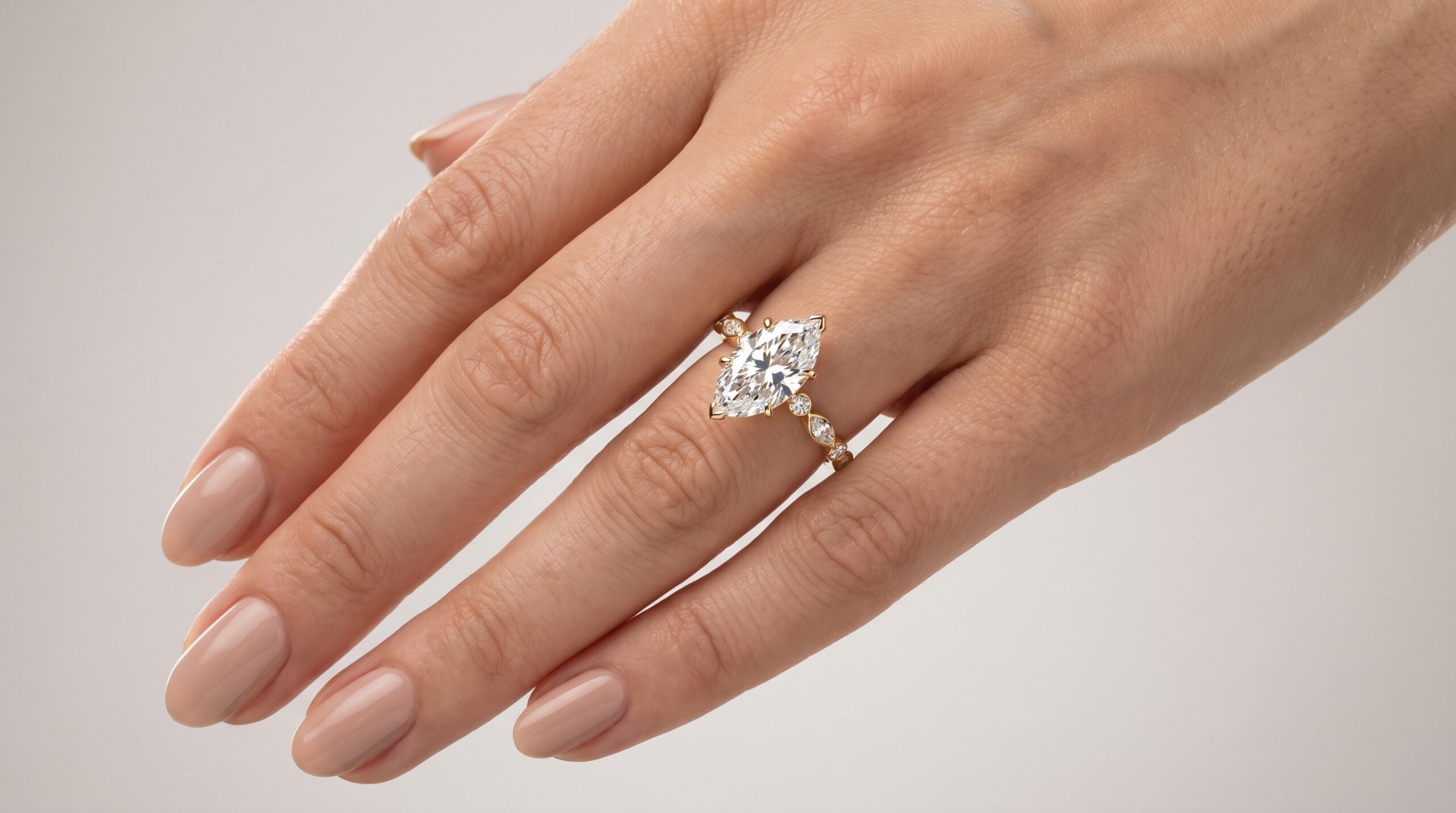
Wanting an engagement ring that feels memorable usually starts with a specific look in mind, and then runs into a longer list of decisions than expected: which setting actually creates that visual impact, whether it’ll hold up to daily wear, and whether “bold” ages well or starts to feel dated in a few years. Those are separate questions from carat size, and worth answering before falling for a specific photo.
What Is a Statement Engagement Ring?
A statement engagement ring is defined by visual impact, not by size alone. That impact can come from a distinctive shape, a setting that amplifies sparkle or apparent size, bold proportions, or a design that draws the eye through structure rather than sheer carat weight. A large, simple round solitaire can actually read as less “statement” than a smaller fancy-shaped stone in a halo setting with strong finger coverage.
Statement doesn’t require oversized. Shape and setting influence perception as much as, or more than, raw dimensions do. A well-proportioned design where every element (stone, setting, band) works together to draw attention creates more visual presence than an unbalanced ring that’s simply larger without that same cohesion. Proportion and design balance are what separate a statement ring that looks intentional from one that looks like it’s just trying to be big.
Design Features That Create Visual Impact
A halo setting surrounds the center stone with a ring of smaller accent diamonds, which increases the ring’s overall visual footprint and adds brightness that complements the center stone’s own sparkle. This is one of the most direct ways to create a larger-looking ring without increasing the center stone’s actual carat weight, since the halo itself contributes meaningfully to the ring’s total visible surface area. The tradeoff is more surfaces to clean and more prongs to check over time, since a halo introduces several additional small stones beyond the center one.
A pavé band lines the shank with small diamonds set closely together, adding brilliance along the entire band rather than concentrating sparkle only at the center. This creates a more glamorous, continuously sparkling appearance, but with a real maintenance tradeoff: more stones means more prongs, more surfaces prone to catching lotion or debris, and a higher chance that at least one small stone will eventually need attention. Pavé settings can also present more snagging risk than a smooth band, since the surface isn’t flat.
A three-stone design flanks the center stone with two additional stones, often smaller round or trapezoid cuts, creating balanced visual weight across a wider span of the finger. Beyond the visual effect, three-stone rings often carry symbolic associations (commonly interpreted as past, present, and future) that some buyers find meaningful, though this framing isn’t essential to the design’s appeal.
Fancy-shaped center stones, oval, pear, marquise, emerald, and cushion among the most common, create a statement look simply by breaking from the expected round silhouette. Beyond novelty, several of these shapes have a practical advantage: they spread more surface area per carat than a round brilliant, meaning they can look larger face-up at the same carat weight.
| Feature | Visual Effect | Maintenance Level | Best For |
| Halo | Larger apparent size, added brightness | Moderate to high | Buyers wanting more visual size without a larger center stone |
| Pavé band | Continuous sparkle along the band | High | Buyers prioritizing maximum brilliance over low maintenance |
| Three-stone | Balanced visual weight, wider finger coverage | Moderate | Buyers wanting symbolic meaning and visual balance |
| Fancy-shaped center stone | Distinctive silhouette, often larger face-up per carat | Varies by shape and setting | Buyers wanting a shape-driven statement look |
Choosing a Statement Ring That Fits Your Lifestyle
A high-profile setting, one that raises the stone further off the finger, shows off more brilliance and creates a more dramatic presence, but it also catches more easily on gloves, hair, and fabric during normal daily movement. A low-profile setting sits closer to the finger, trading some of that dramatic elevation for reduced snagging and a lower overall impact risk.
Active lifestyles, manual work, frequent hand-washing, regular exercise, generally do better with a bezel setting or a low-profile mount rather than a tall halo or elaborate pavé design, since both reduce exposed surface area and the number of small components that could catch or loosen during physical activity. Secure prongs matter regardless of setting height; a well-constructed six-prong mount, for instance, offers more redundancy than a standard four-prong if one prong is ever damaged.
Comfort and weight interact in ways that aren’t always obvious before wearing a ring daily. Wider bands, often chosen for statement designs to support pavé detailing or a substantial profile, can actually feel tighter than a narrow band of the same ring size, since more metal surface contacts the finger. Heavier rings, common in statement designs with more metal and more stones, can also feel different in daily wear than a lighter, simpler ring, something worth trying on rather than assuming from a product photo alone.
Best styles by priority:
- Active lifestyles: bezel settings, low-profile mounts, secure multi-prong designs
- Office or desk-based wear: higher-profile settings are more practical here than in hands-on environments, since snagging risk is lower
- Minimal maintenance: solitaire or three-stone designs with fewer total stones and prongs to check
- Maximum sparkle: halo or pavé designs, accepting the added maintenance that comes with more stones
- Stackable styling: straight-shank designs that sit flush against a wedding band
Understanding Metal Choices for Statement Rings
Platinum offers strong durability and density, giving statement rings with substantial detailing a solid, premium feel on the hand. It’s naturally white and doesn’t require plating, though it costs more upfront than gold and develops a soft patina over years of wear rather than staying mirror-bright without periodic polishing.
White gold achieves a similarly bright white appearance at a lower initial cost, but typically needs rhodium replating every one to three years to maintain that brightness as the plating gradually wears down. For a statement ring with many small stones or intricate detailing, this replating involves the whole setting, not just the band, which is worth factoring into long-term maintenance expectations.
Yellow gold creates a warm contrast against diamonds, a look closely associated with vintage-inspired statement designs. It doesn’t require replating, making it comparatively lower maintenance than white gold despite carrying a similarly rich, dramatic presence in bolder settings.
Rose gold offers a romantic, softer visual effect, often paired with vintage-style statement settings like halos or three-stone designs where its warm pink tone complements rather than competes with the design’s detailing.
| Metal | Appearance | Durability | Maintenance | Best For |
| Platinum | Naturally white, develops a patina | High | Low; no replating, occasional polishing | Buyers wanting a substantial feel and minimal upkeep |
| White gold | Bright white when freshly plated | Good | Moderate; periodic rhodium replating | Buyers wanting platinum’s look at a lower cost |
| Yellow gold | Warm, rich contrast | Good | Low | Vintage-inspired statement designs |
| Rose gold | Soft, romantic pink tone | Good | Low | Statement designs with a softer aesthetic |
How Shape and Setting Affect Size Perception
Oval, marquise, pear, and emerald shapes all tend to spread more surface area per carat than round brilliant, since round diamonds carry more of their weight in depth to maintain their light performance. This means these shapes can appear larger face-up than a round diamond of identical carat weight, a genuinely useful consideration for buyers wanting more visual size within a set budget.
Carat weight alone can mislead buyers because it measures weight, not visible dimensions. Two diamonds of the same carat weight can look meaningfully different in size depending on their cut proportions, shape, and how much of that weight sits below the surface versus spread across the top. Finger coverage, meaning how much of the finger’s width the stone and setting actually occupy, is a more reliable way to judge apparent size than carat weight in isolation. Setting choice compounds this further: a halo can make a smaller center stone look substantially larger by adding surrounding sparkle and surface area.
Sparkle style also varies by cut family. Brilliant cuts, including round, oval, and cushion, use faceting optimized to scatter light into many small flashes, producing an active, lively sparkle. Step cuts, including emerald and Asscher, use broader, flatter facets that produce fewer but larger flashes of light and shadow, a cleaner, more architectural look that some buyers prefer specifically because it reads as more restrained even within an otherwise bold design.
| Shape | Visual Spread | Sparkle Style | Best For |
| Oval | Larger than round per carat | Brilliant, active sparkle | Buyers wanting an elongating, high-brilliance statement shape |
| Marquise | Largest spread per carat among common shapes | Brilliant, active sparkle | Buyers wanting maximum visual size and a dramatic silhouette |
| Pear | Larger than round per carat | Brilliant, active sparkle | Buyers wanting a distinctive, graceful statement shape |
| Emerald | Larger than round per carat | Step-cut, broad flashes | Buyers wanting a cleaner, more architectural statement look |
Practical Buying Considerations Before You Purchase
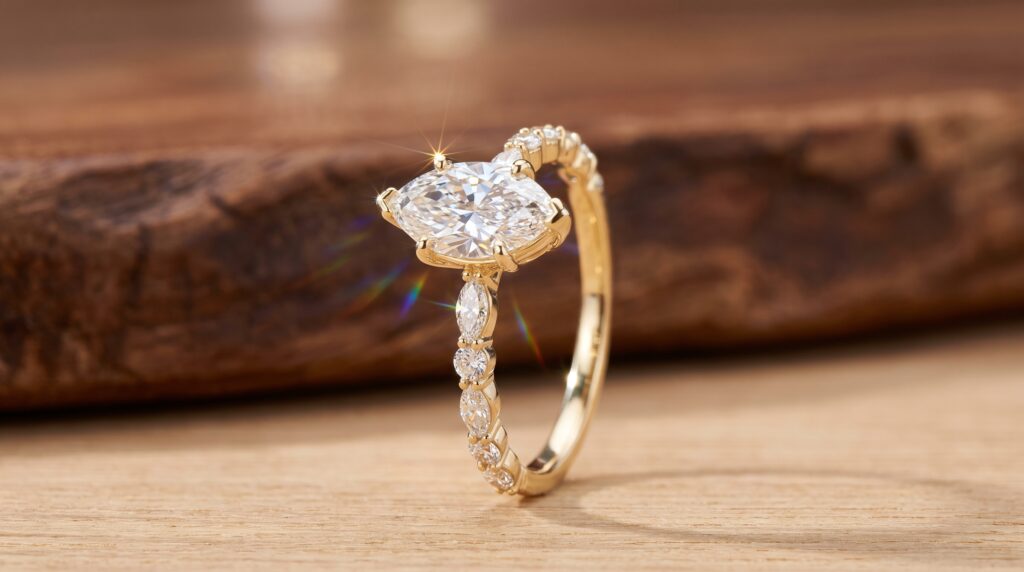
Side-profile photos matter as much as top-down views, since setting height and overall proportions are far easier to judge from the side. A ring can look proportionate from directly above and still sit much taller, or shorter, than expected once seen from the side.
Resizing limitations are worth understanding before purchasing a statement design specifically, since many bold styles involve more restrictions than a simple solitaire. Eternity bands, with stones set all the way around the shank, generally can’t be resized beyond a very limited range without disrupting the stones set into the resized section. Complex settings with pavé detailing extending far down the band face similar restrictions, so it’s worth asking directly about resizing limits for any elaborate design before committing to it.
Certification and authenticity matter regardless of how bold or simple the design is. For diamonds, request a grading report from a recognized lab, GIA and AGS are the two most widely referenced. Metal stamps, commonly “PT950” for platinum or “585”/”750″ for 14K/18K gold, should also be clearly visible and match what’s described in the listing.
When buying online, check stone measurements against the certificate, confirm the setting height listed (or estimate it from side-profile photos if not directly stated), review the return policy and its timeline, check warranty terms, and ask specifically whether routine cleaning or inspection services are included as part of the purchase.
Online Shopping Confidence Checklist:
- Side-profile photos showing true setting height
- Stone measurements matching the certificate
- Clear listing of resizing limitations, if any
- Certification from a recognized lab (GIA, AGS, or similar)
- Metal stamp matching the listed purity
- Return policy timeline and conditions
- Warranty coverage details
- Whether cleaning or inspection services are included
Caring for a Statement Engagement Ring
Clean the ring weekly at home using warm water, a small amount of mild dish soap, and a soft-bristled brush, paying particular attention to halo and pavé settings where small stones and tight spaces accumulate lotion and debris more readily than a simple solitaire does.
Schedule professional inspections more frequently for statement rings with many small stones than you might for a simpler design, since more prongs and more stones mean more opportunities for something to loosen over time. Every six months is a reasonable interval for a heavily detailed ring, compared to the standard annual recommendation for simpler styles.
Accent stones and prongs in halo, pavé, and three-stone designs are the most common source of wear issues in statement rings, simply because there are more of them than in a solitaire. A missing or loose accent stone is often less noticeable day to day than a loose center stone, which makes regular inspection more important, not less, for catching these issues before a stone is lost entirely.
Remove the ring during sports, heavy manual work, or activities involving harsh chemicals, and store it separately from other jewelry in a soft-lined box to avoid scratches from harder stones or metal edges it might otherwise contact.
| Style | Cleaning Frequency | Common Wear Issues | Professional Care Needs |
| Solitaire | Weekly | Prong wear over years | Annual inspection |
| Halo | Weekly, more attention to small stones | Accent stone loosening | Inspection every 6 months |
| Pavé band | Weekly, more attention to band surface | Accent stone loosening, band wear | Inspection every 6 months |
| Three-stone | Weekly | Side stone prong wear | Inspection every 6 to 12 months |
Frequently Asked Questions
What makes a ring a statement engagement ring?
A statement engagement ring is defined by visual impact rather than size alone, created through distinctive shapes, settings that amplify sparkle or apparent size (like a halo), bold proportions, or a design where every element works together to draw attention. A ring doesn’t need an oversized center stone to qualify; a well-proportioned, distinctive design can create as much visual presence as a larger, simpler one.
Are statement rings harder to maintain?
Generally, yes, particularly designs with more small stones like halo, pavé, or three-stone settings. More stones and prongs mean more surfaces that collect debris and more components that need periodic checking. A simple solitaire, even a large one, is typically easier to maintain than a heavily detailed statement design, since there’s simply less to check and clean.
Which engagement ring shape looks biggest?
Marquise, oval, pear, and emerald shapes all tend to spread more visible surface area per carat than round brilliant, since round diamonds carry more of their weight in depth. Among these, marquise typically shows the largest spread per carat due to its elongated, narrow silhouette, though the exact visual size also depends on the specific stone’s cut proportions and the setting it’s placed in.
Are statement rings practical for everyday wear?
They can be, with the right setting choices. A bezel or low-profile mount reduces snagging and impact risk compared to a tall halo or elaborate pavé design, making bold styles more practical for active daily routines. The main practical tradeoff isn’t really about whether a statement ring can be worn daily, but how much maintenance it requires compared to a simpler design.
What setting creates the most sparkle?
A halo setting typically creates the most overall sparkle, since it adds a ring of smaller diamonds around the center stone, increasing both brightness and apparent size. A pavé band adds continuous sparkle along the shank itself, complementing a halo or working on its own with a solitaire center stone for a different kind of all-over brilliance.
What should I consider before buying online?
Review side-profile photos to judge true setting height, confirm stone measurements against the certification, check for any resizing limitations tied to the specific design (eternity bands and heavy pavé work are the most restrictive), verify certification from a recognized lab, and read the return, warranty, and cleaning service terms before completing a purchase.
Are statement rings timeless?
It depends more on proportion and craftsmanship than on the general category of “statement.” A well-balanced halo or fancy-shaped design with good proportions can remain elegant for decades, while an unbalanced or overly ornate design chasing a specific short-lived trend may feel more dated sooner. The distinction isn’t bold versus simple; it’s whether the specific design was built with lasting proportion and quality in mind.
What styles require the most maintenance?
Pavé bands and elaborate halo settings generally require the most maintenance, since both involve many small stones and prongs that need regular checking and cleaning. Three-stone designs fall in the middle, with more components than a solitaire but fewer than a full pavé or halo design.
Which settings are best for active lifestyles?
Bezel settings offer the most protection for active lifestyles, since they enclose the stone’s edge entirely in metal with no raised prongs to catch or take a direct hit. Low-profile mounts more broadly, whether bezel or prong-based, reduce snagging risk compared to high-profile settings that raise the stone further off the finger.
Can bold rings still feel elegant?
Yes. Elegance in a statement ring comes from proportion, balance, and craftsmanship, not from restraint alone. A well-designed halo or fancy-shaped ring where the setting, stone, and band work together cohesively can feel just as refined as a minimalist solitaire; the difference is in execution and balance, not in how much visual presence the design has.