
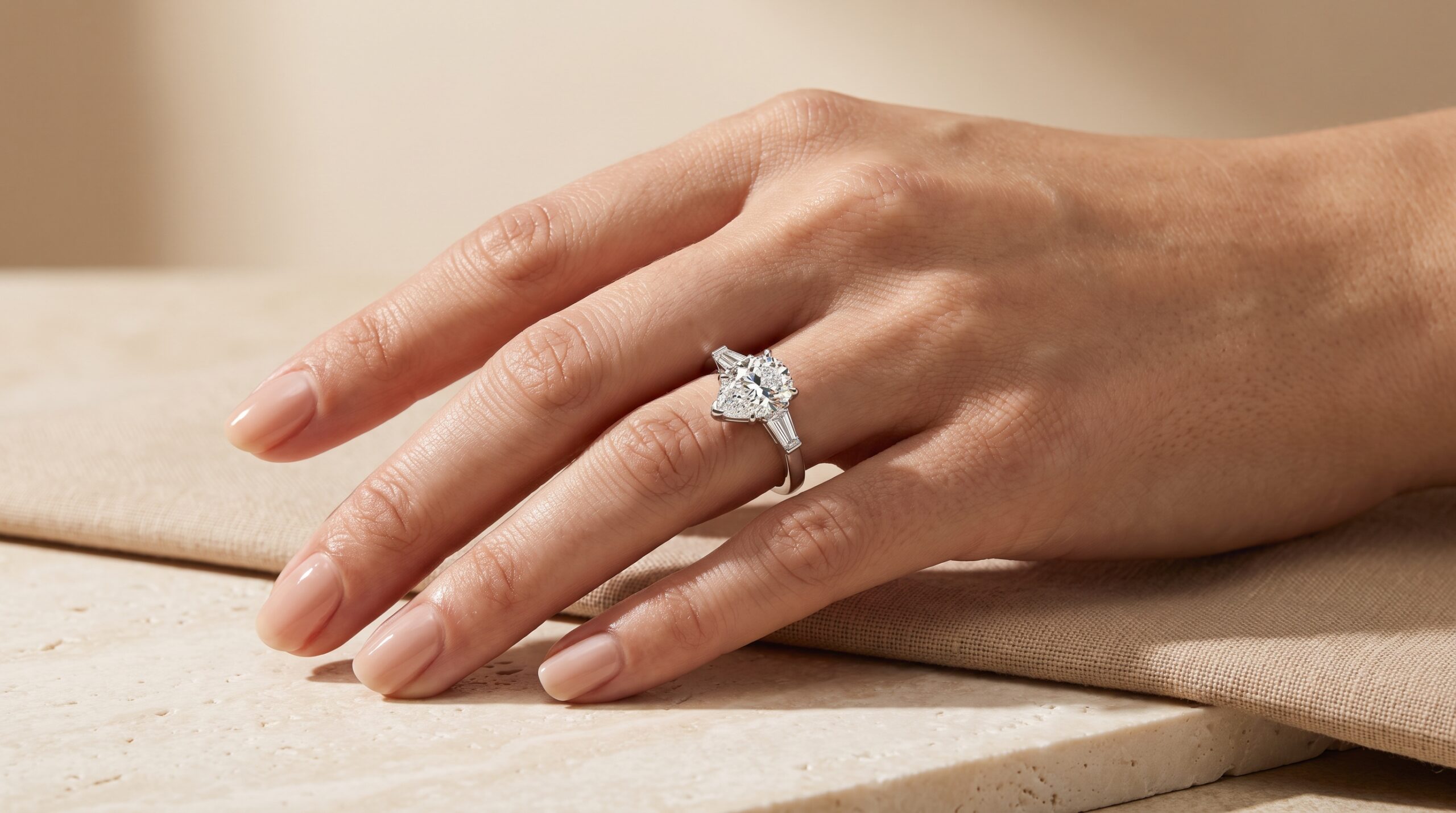
Some engagement rings get chosen for how they look. A three stone ring usually gets chosen for both how it looks and what it’s meant to say. The design, a center stone flanked by two side stones, has carried symbolic weight for generations, most commonly as a representation of a couple’s past, present, and future. That meaning is part of what draws buyers to the style in the first place, alongside the fact that three stones simply create more visual presence than one.
This guide covers what three stone rings symbolize, how the common style variations differ, and what to check for comfort, fit, and quality before buying one.
What Is a Three Stone Engagement Ring?
A three stone engagement ring pairs a center stone with two side stones set on either side of it. The style also goes by trilogy ring or trinity ring, terms used interchangeably with “three stone” in most jewelry listings and worth recognizing if you’re comparing options across different retailers.
The three stones don’t have to be diamonds. Side stones are commonly diamonds, but they can also be colored gemstones, and some designs mix stone shapes between the center and the sides for a more custom look.
Buyers choose this style for a few reasons that tend to reinforce each other:
- Symbolic meaning, which gives the ring a story beyond its appearance
- A fuller look across the finger compared to a single center stone
- More overall sparkle, since light catches three stones instead of one
- Room for customization through stone shape, color, and size choices
What Do Three Stone Engagement Rings Symbolize?
The most recognized meaning is past, present, and future: the two side stones represent the history a couple has already built and the future ahead of them, while the center stone represents the present moment of the engagement itself. This is the interpretation most buyers encounter first, and it’s the one referenced most often in bridal jewelry marketing and by jewelers describing the style.
It’s not the only meaning attached to the design, though, and no single interpretation is more correct than another. Three stone rings are also described as representing friendship, love, and fidelity, a slightly different framing of the same three-part structure that emphasizes the qualities of the relationship rather than its timeline.
Some buyers choose personal or family meanings instead. Birthstones for each partner (or for children, in an anniversary version of the ring), an heirloom stone reset alongside two new ones, or colored side stones chosen for a specific shared memory all shift the symbolism toward something specific to that couple rather than a general concept. There’s no requirement to pick one interpretation over another, and plenty of buyers simply like the way three stones look without assigning any particular meaning to them at all.
Three Stone Engagement Ring Styles Compared
| Style | Description | Best For | Considerations |
| Matching three stones | Side stones share the same shape and are closely matched to the center | Buyers who want a traditional, symmetrical look | Reads as more classic, less distinctive |
| Graduated stones | Side stones are noticeably smaller than the center stone | Buyers who want the center stone to stay the visual focus | Side stones read as a frame rather than an equal element |
| Diamond side stones | All three stones are diamonds | Buyers who want consistent brilliance across the ring | Typically the higher end of the price range for this style |
| Colored gemstone side stones | Side stones are a colored gem rather than diamonds | Buyers adding personal or symbolic meaning through color | Color matching between the gemstone and the center stone’s setting needs attention |
| Mixed-shape stones | Side stones differ in shape from the center stone, such as tapered baguettes beside a round center | Buyers wanting a custom, less conventional look | Proportions need to be balanced carefully so the design doesn’t look mismatched |
Three Stone vs Solitaire Engagement Rings
A solitaire is a single stone with no side stones, and it remains the simplest and often the easiest setting to size, clean, and maintain. A three stone ring trades some of that simplicity for symbolism and additional sparkle, and the tradeoffs are worth naming directly rather than assuming one style is generally superior.
| Factor | Three Stone Ring | Solitaire Ring |
| Meaning | Carries built-in symbolism tied to the number of stones | Meaning comes from the stone and choice itself, not the structure |
| Sparkle | More overall brilliance from three stones | Concentrated in a single center stone |
| Cost | Often higher, due to additional stones and setting labor | Often simpler to price, since there’s one stone to evaluate |
| Maintenance | More prongs and settings to inspect over time | Lower maintenance, fewer settings |
| Finger coverage | Wider look across the hand | More minimal, sits closer to a single point |
Cost is worth being specific about. A three stone ring isn’t automatically more expensive because of symbolism; it costs more, when it does, because it uses more total carat weight and requires setting three stones securely rather than one. Two rings with the same total diamond weight, one solitaire and one three stone, will price differently mainly based on the setting work involved, not the meaning behind the design.
How to Choose Stone Shapes and Proportions
Matching the center and side stones in the same shape, like three round diamonds or three cushion cuts, produces a look most people would call classic. It’s a safe, symmetrical choice and one that’s been standard in bridal jewelry for a long time.
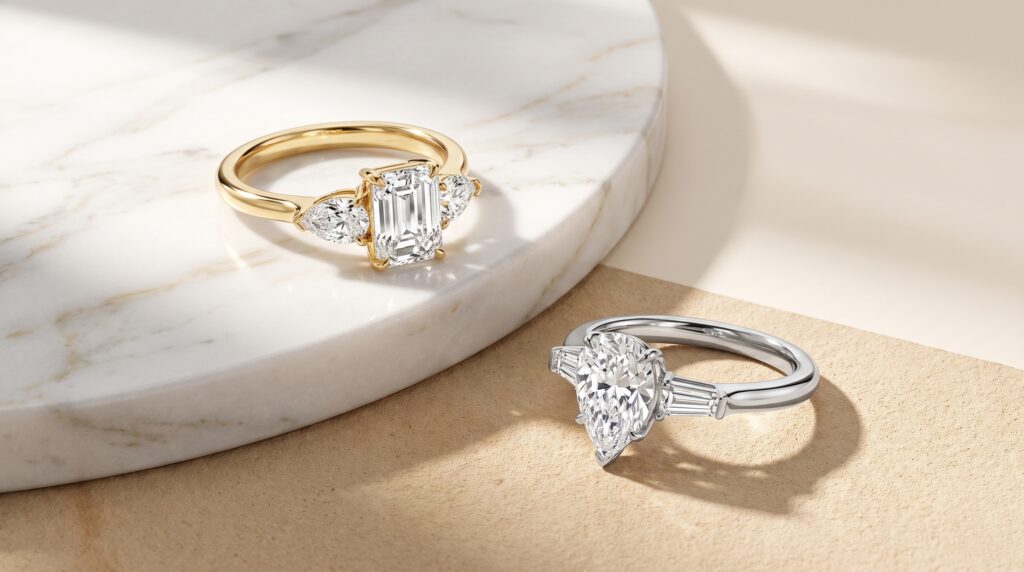
Mixed shapes, such as an oval center with pear-shaped side stones, or an emerald-cut center with tapered baguettes, create a more custom look. The tradeoff is that mixed shapes require more careful proportioning: a side stone shape that’s too large, too small, or too differently angled from the center can throw off the balance of the whole design rather than complementing it.
Graduated side stones, meaning stones noticeably smaller than the center, direct attention toward the center stone rather than competing with it. This works well if you want the ring to still read primarily as “one main stone” with supporting detail, rather than three stones of roughly equal visual weight.
Finger coverage is a separate consideration from stone shape. A three stone ring generally occupies more visual space across the finger than a solitaire, since there are three stones set side by side instead of one. Whether that reads as substantial or as too wide is a matter of personal preference and hand size, not something with a universal right answer. Common shape pairings include round centers with round side stones, oval centers with pear-shaped sides, emerald-cut centers with tapered baguettes, and cushion centers with round side stones, though none of these pairings is required and jewelers can work from other combinations depending on what the buyer wants.
Comfort, Fit, and Wedding Band Pairing
Three stone rings tend to sit wider across the finger than solitaires, simply because there are three stones set in a row rather than one. That width affects how the ring feels during the day and how it looks on the hand, both a matter of personal comfort rather than a design flaw.
Wedding band fit follows a similar logic to other multi-stone settings. Side stones and their prongs can sit close enough to the top of the band that a straight wedding band leaves a gap on one or both sides, particularly with graduated or mixed-shape designs where the side stones extend further down the shank. A curved, contoured, or custom-shaped wedding band, built to follow the specific profile of the engagement ring, solves this in most cases, but it does mean buyers should check compatibility rather than assume any wedding band will pair cleanly.
Everyday wear comes down to profile height and how exposed the side stones are. A three stone ring with a low setting and well-secured prongs behaves similarly to other well-made rings during daily activity. A taller setting, or one where the side stones sit prominently above the band, has more surface area that can catch on gloves, clothing, or hair, the same consideration that applies to any raised or multi-stone setting.
Care and Maintenance
Three stone rings need regular checks for a straightforward reason: three stones means three sets of prongs, and each prong is a point that can loosen over time. More setting points doesn’t mean the ring is fragile, but it does mean there’s more to monitor than on a solitaire.
Home cleaning follows the same routine recommended for most fine jewelry: mild soap, warm water, a soft brush to reach between stones, and careful drying rather than rubbing, which could catch a brush or cloth on a loose prong.
Beyond home care, periodic professional inspection is worth scheduling, particularly for a ring worn daily. A jeweler checking a three stone ring will typically look at all three sets of prongs, the condition of each side stone, and the structure of the gallery beneath the center stone. Repair guidance from Revolution Jewelry Works notes that loose or missing stones and worn prongs are among the earliest signs a ring needs professional attention, and catching those signs early reduces the risk of losing a stone entirely.
Certification, Authenticity, and Quality Checks
Certification usually matters most for the center stone. A diamond graded by an independent lab, following criteria like those from the GIA, comes with documentation of its cut, color, clarity, and carat weight, and that certificate is specific to that one stone.
Side stones are a different matter. Smaller side stones in a three stone ring are frequently not certified individually, since certifying each small stone separately isn’t standard practice across the industry. This is normal, not a sign of lower quality, but it does mean that assessing side stone quality relies more on the seller’s disclosure and photos than on paperwork. Ask specifically whether side stones are natural or lab-grown diamonds, and how their color and clarity were matched to the center stone, since sellers vary in how much of this information they volunteer upfront.
Beyond the stones themselves, check the metal stamp for purity (14k, 18k, platinum, and so on), look for visual symmetry between the two side stones, and look closely at the setting work itself. Uneven prong spacing or a visibly crooked side stone in photos is worth asking about before buying, not something to assume will look better in person.
What to Check When Buying a Three Stone Ring Online
Photos and specifications matter more for a three stone ring than for a solitaire, since there’s more going on structurally: three stones to evaluate for size and match, plus the setting work holding all of them in place.
Before buying, look for:
- Center stone size and grading report
- Side stone sizes listed in millimeters, not just described as “diamond accents”
- Whether the stones are matched or intentionally graduated in size
- Top, side, and angled photos showing all three stones clearly
- Width across the finger
- Band width
- Wedding band compatibility information
- Return policy
- Resizing terms
- Warranty and repair support
Red flags include a listing with no side-view photos, no millimeter measurements for the side stones, vague language like “diamond accents” with no further detail, no disclosure of whether stones are natural or lab-grown, and no warranty or resizing information at all. A seller who provides exact measurements and clear photos from multiple angles is giving you what you need to judge proportion and quality before the ring arrives, which matters more here than on a single-stone ring where there’s less to assess.
Frequently Asked Questions
What does a three stone engagement ring symbolize?
The most common symbolism is past, present, and future, with the two side stones representing the relationship’s history and future and the center stone representing the present moment of the engagement. Other common interpretations include friendship, love, and fidelity, and many buyers choose the style for personal reasons, such as birthstones or an heirloom stone, rather than following one fixed meaning.
Are three stone rings only for engagement?
No. While the style is closely associated with engagement rings, three stone designs are also popular as anniversary rings, sometimes reworked to include birthstones representing children or specific milestones in a relationship. The three-stone structure works for any piece meant to mark a story with multiple parts, not only an engagement.
Are three stone rings more expensive than solitaires?
Often, yes, mainly because they use more total carat weight and require setting three stones securely rather than one, which adds labor cost. This isn’t a fixed rule: the price difference depends on the size and quality of the stones involved rather than the three stone format itself carrying an automatic premium.
Can side stones be different from the center stone?
Yes. Side stones can differ from the center stone in shape, such as pairing an oval center with pear-shaped sides, and they don’t have to be diamonds at all. Colored gemstones are a common choice for side stones, often selected for personal or symbolic reasons like birthstones or a color with specific meaning to the couple.
Are three stone rings good for everyday wear?
They can be, and everyday comfort depends more on setting height and how securely the stones are held than on the three stone format itself. A low-profile three stone ring with well-secured prongs wears similarly to other well-made rings, while a taller or more exposed setting has more surface area that can catch on gloves or clothing, a consideration that applies to raised settings generally rather than being unique to three stone rings.
Do three stone rings fit with wedding bands?
They can, but fit depends on the specific setting rather than being guaranteed. Side stones and prongs sometimes sit close enough to the top of the band that a straight wedding band leaves a small gap, particularly with graduated or mixed-shape designs, so a curved or custom-shaped band built to match the engagement ring’s profile is often the more reliable option.
Are all three stones certified?
Usually not. The center stone is commonly certified by an independent gem lab, but the two side stones are frequently not certified individually, since certifying smaller stones separately isn’t standard practice in the industry. This doesn’t indicate lower quality on its own, but it does mean asking the seller directly about side stone quality and origin is worth doing before purchase.
Can three stone rings be customized?
Yes, and this is one of the style’s main appeals. Buyers can choose matching or mixed stone shapes, diamond or colored gemstone side stones, graduated or equal-sized stones, and specific gemstones chosen for personal meaning, all within the same basic three stone structure.
What is the most traditional three stone style?
The most traditional version pairs a center stone with two matching diamond side stones of the same shape, most often round or a shape that mirrors the center stone. This symmetrical, all-diamond approach is the version most associated with the classic past, present, and future symbolism, though it’s a convention rather than a requirement.