
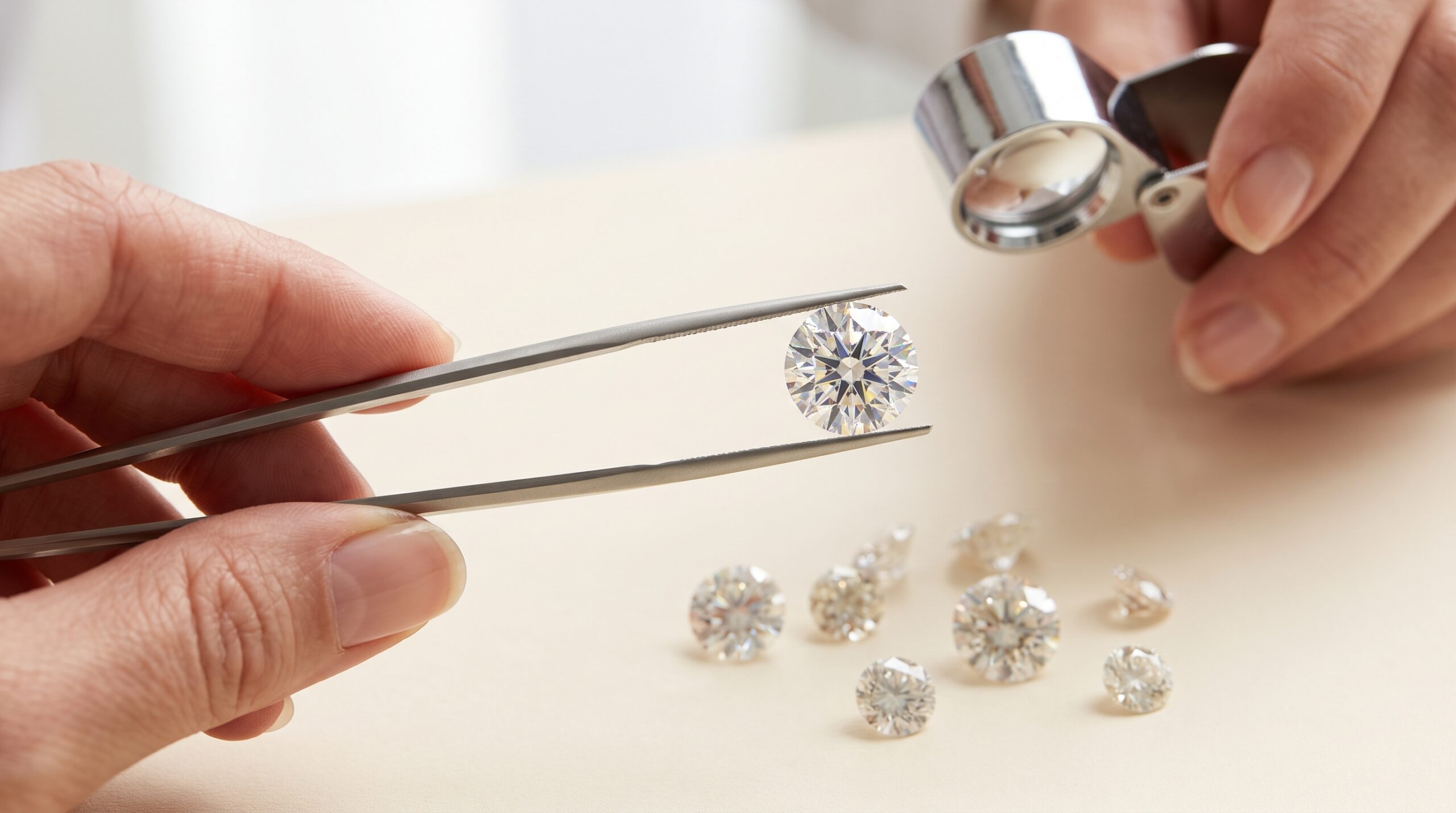
A diamond grading report lists four separate scores, and it’s tempting to assume the diamond with the highest numbers across the board is the best choice. It usually isn’t. Cut, color, clarity, and carat each affect a diamond differently, and treating them as equally important is one of the fastest ways to overspend on qualities you won’t notice and underspend on the one that actually shapes how the stone looks in daylight.
The 4 Cs exist to give buyers and sellers a shared vocabulary for diamond quality. They don’t rank diamonds on a single scale of “better” to “worse.” A diamond can score lower on color and still look brighter than a colorless stone with a poor cut. This guide walks through what each C measures, which ones matter most for how a diamond actually looks, and how to weigh them against each other when you’re working with a budget.
What Are the 4 Cs of Diamonds?
The 4 Cs, developed by the Gemological Institute of America, are the standard framework used to describe diamond quality: cut, color, clarity, and carat weight. Cut measures how well a diamond’s proportions and finish allow it to interact with light. Color measures the presence or absence of a yellow or brown tint. Clarity measures internal and surface characteristics called inclusions and blemishes. Carat measures weight, not physical dimensions.
Reputable jewelers and independent labs use these four factors together on a grading report to document what a specific diamond is, so buyers aren’t relying on a seller’s description alone. The GIA’s 4Cs education page is the reference most labs and jewelers point back to when explaining how the system works.
| C | What It Means | What It Affects Most |
| Cut | Proportions, angles, polish, and symmetry | Sparkle and brilliance |
| Color | Presence of yellow or brown tint | Whiteness, especially in white metal settings |
| Clarity | Internal inclusions and surface blemishes | Whether flaws are visible to the naked eye |
| Carat | Weight of the diamond | Price and, indirectly, apparent size |
Cut: The C That Affects Sparkle Most
What Diamond Cut Means
Cut refers to how a diamond’s facets are proportioned and finished, not the outline you see when you look at it from above. A diamond can be cut too deep or too shallow, and either mistake lets light leak out the bottom or sides instead of reflecting back to the eye. Cut quality also includes polish and symmetry, which affect how cleanly light travels through the stone.
Cut vs Shape
Buyers frequently confuse these two terms, and the confusion leads to real buying mistakes.
Shape is the diamond’s outline: round, oval, cushion, emerald, pear, and so on. Cut is a measure of how well the diamond was faceted and proportioned to reflect light, regardless of shape. A round diamond can have an excellent cut or a poor one. So can an emerald cut. Choosing a shape is a matter of personal preference. Choosing a cut grade is a matter of light performance, and it applies within every shape category.
Common Cut Grades
The GIA and most labs use a scale that runs from Excellent (or Ideal, a term used by some labs and retailers) down to Poor:
- Excellent or Ideal
- Very Good
- Good
- Fair
- Poor
| Cut Grade | Appearance | Buyer Consideration |
| Excellent/Ideal | Maximum brilliance and light return | Best light performance, typically the highest price for the grade |
| Very Good | Strong brilliance, close to Excellent | Often the best balance of appearance and cost |
| Good | Noticeably less sparkle in some lighting | Acceptable for smaller stones or tighter budgets |
| Fair/Poor | Visibly dull or glassy in places | Generally worth avoiding regardless of the other three Cs |
Cut is the one C that most directly determines whether a diamond looks alive or flat, according to GIA’s grading standards. Because of that, it’s usually the factor to prioritize first, even ahead of color or clarity, when a budget requires tradeoffs.
Color: How White the Diamond Appears
The Diamond Color Scale
The GIA color scale runs from D to Z, with D representing a diamond with no detectable color and Z representing a diamond with a noticeable yellow or brown tint. The scale was designed to remove ambiguous terms like “flawless white” that were common before standardized grading existed, according to GIA’s color grading resources.
Colorless vs Near-Colorless
The scale breaks down into ranges that are useful for buyers comparing options:
| Color Range | Appearance | Best For |
| D to F | Colorless, no visible tint | Buyers prioritizing maximum whiteness, often paired with white metal settings |
| G to J | Near-colorless, tint is difficult to detect without side-by-side comparison | Most buyers, especially in yellow or rose gold settings |
| K and below | Faint to noticeable warmth | Buyers who prefer a warmer tone or are working with a strict budget |
Many diamonds in the G to J range appear white to the naked eye once mounted, particularly next to a colored metal, according to Blue Nile’s engagement ring education. The difference between a G and a D is usually only visible when the two stones are placed face-down and compared under controlled lighting, which isn’t how most people will ever see the ring.
How Setting Metal Affects Color
Yellow gold and rose gold settings reflect warm tones back into the diamond, which can make a G or H color diamond look whiter than it would in a white metal setting. Platinum and white gold settings show color more honestly, so buyers set on a colorless look in a white metal setting may want to stay in the D to F range, while buyers using warmer metals have more room to save money in the G to J range without a visible tradeoff.
Clarity: Understanding Inclusions and Eye-Clean Diamonds
What Clarity Means
Clarity measures two things: inclusions, which are internal characteristics, and blemishes, which are surface characteristics. Almost every natural diamond has at least some of one or the other, formed by the pressure and heat involved in its formation. Clarity grading, as defined by GIA, is based on the number, size, relief, and position of these characteristics under 10x magnification.
Why Flawless Is Not Always Necessary
The word “flawless” describes a specific, rare grade, not a baseline expectation. Most inclusions that separate an SI1 from a VVS1 are only visible under a jeweler’s loupe, not to someone looking at a ring across a dinner table. Paying a premium to move from a clarity grade that already looks clean to a technically higher grade often buys invisible improvement rather than visible improvement.
What “Eye-Clean” Means
“Eye-clean” describes a diamond where no inclusions are visible without magnification, regardless of its exact grade on the scale. Diamonds graded VS2 through SI1 frequently qualify as eye-clean, which makes this range a common target for buyers who want a clean-looking stone without paying for grades whose extra clarity is invisible to anyone but a grader.
| Clarity Grade | What It Means | Buyer Tip |
| FL/IF | No inclusions visible under 10x magnification | Rare and priced accordingly; the difference from VVS is not visible to the eye |
| VVS1/VVS2 | Inclusions extremely difficult to see even under magnification | Strong choice if budget allows, but not necessary for an eye-clean look |
| VS1/VS2 | Minor inclusions, typically not visible to the naked eye | Often the sweet spot for value |
| SI1/SI2 | Inclusions may be visible without magnification depending on placement | Worth inspecting in person or via high-resolution imagery before buying |
| I1 to I3 | Inclusions usually visible to the naked eye | Can affect durability in some cases, not just appearance |
Carat: Diamond Weight, Size, and Visual Presence
What Carat Really Measures
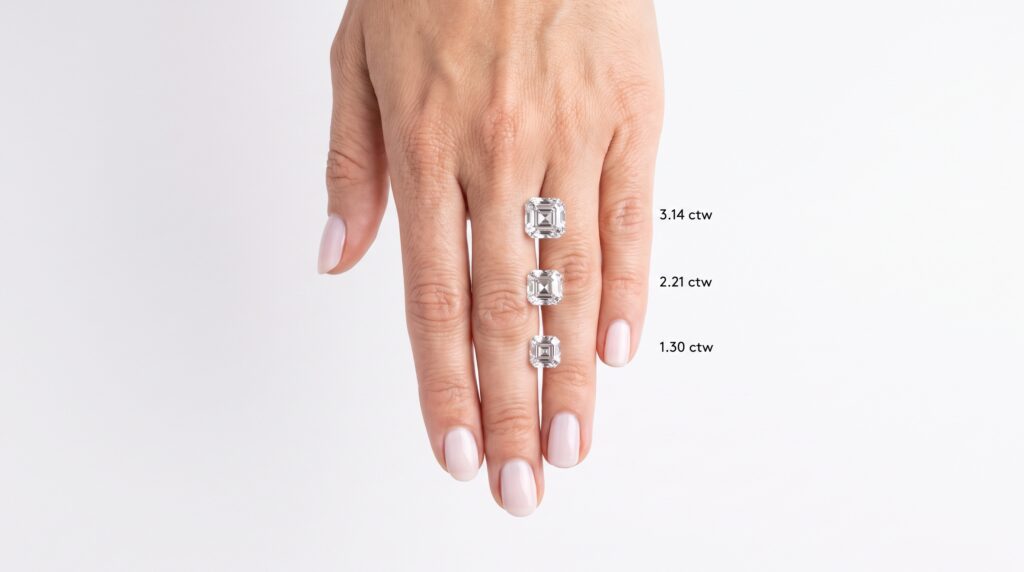
A carat is a unit of weight, equal to 200 milligrams, as defined by GIA’s carat weight standards. It doesn’t describe diameter, and two diamonds of the same carat weight can look different sizes depending on how they’re cut.
Why Two Diamonds with the Same Carat Can Look Different
A diamond cut too deep concentrates more of its weight below the widest point of the stone, where it’s hidden by the setting. That diamond will weigh the same as a well-proportioned diamond of the same carat but will look smaller from above, because less of its weight contributes to visible surface area. This is one reason cut and carat can’t be evaluated independently: a diamond with excellent proportions typically shows more face-up size per carat than one with a deep or shallow cut, even at an identical weight.
Understanding “Magic Sizes”
Diamond prices tend to jump at round-number weights such as 0.50, 0.70, 1.00, and 1.50 carats, because these sizes carry demand and marketing weight independent of the stone’s other qualities. A diamond weighing 0.95 carats can look essentially identical to one weighing 1.00 carat but cost meaningfully less, simply because it falls just under the threshold. Buyers working with a firm budget often get more diamond, in terms of cut and clarity, by choosing a weight just below one of these markers.
| Carat Strategy | Why It Helps | Best For |
| Target a weight just under a magic size | Avoids the price premium tied to round numbers | Budget-conscious buyers who don’t need an exact weight |
| Prioritize well-cut proportions over raw carat | Improves face-up size and brilliance per carat | Buyers who want a stone that reads larger than its weight |
| Choose carat last, after cut, color, and clarity are set | Keeps the visual-quality factors from being sacrificed for size | Most first-time buyers |
How the 4 Cs Work Together
None of the 4 Cs should be evaluated on its own. A diamond with a top color grade and a poor cut will look duller than a diamond with a mid-range color grade and an excellent cut, because cut determines how much light the stone returns in the first place. Color and clarity can often be adjusted downward together, since near-colorless and eye-clean grades both rely on the same idea: the flaw exists on paper but not to the eye. Carat should be the last variable adjusted, fit to what the setting and budget can support once cut, color, and clarity are already at levels the buyer is satisfied with.
| Buyer Priority | Recommended 4C Focus |
| Maximum sparkle | Prioritize Excellent or Very Good cut above all else |
| Best overall value | G to H color, VS2 to SI1 clarity, Very Good or better cut |
| Larger visual presence on a budget | Carat weight just under a magic size, paired with strong cut proportions |
| Highest possible grades across the board | D to F color, VVS clarity, Excellent cut, accepting the price premium that comes with it |
Common 4 Cs Mistakes to Avoid
| Mistake | Better Approach |
| Choosing carat weight first, then fitting the other three Cs to what’s left of the budget | Set a target for cut, color, and clarity, then find the largest carat weight that fits |
| Assuming a lower cut grade won’t be noticeable | Compare cut grades in person or through high-resolution video; the difference in sparkle is often obvious |
| Paying for flawless or near-flawless clarity without a reason to | Choose the lowest clarity grade that still looks eye-clean, and put the savings toward cut or carat |
| Assuming D color is always necessary | Consider G to H color, especially in yellow or rose gold settings, where the difference is harder to see |
| Confusing cut grade with diamond shape | Treat shape as a style choice and cut grade as a quality choice; they’re independent decisions |
| Buying without an independent grading report | Confirm the seller’s claims against a report from a lab such as GIA before finalizing a purchase |
How to Read a Diamond Grading Report
A grading report from a lab such as GIA documents the diamond’s cut, color, clarity, and carat weight, along with measurements, polish, symmetry, and sometimes fluorescence. It exists to verify what the seller is telling you, rather than to add complexity to the purchase. The GIA’s report checking service lets buyers confirm that a report number matches the lab’s records for that specific stone.
Fluorescence describes how a diamond reacts under ultraviolet light, and it’s listed on most reports as a comment rather than a grade. Faint or medium fluorescence has little to no visible effect on most diamonds, though strong fluorescence can occasionally give a diamond a slightly hazy appearance in certain lighting. It’s worth asking a jeweler to explain the fluorescence note on a specific report rather than treating it as a red flag on its own.
Buyers don’t need to master every technical detail on a report to use it well. The four grades (cut, color, clarity, carat) are the core of the document, and confirming those four numbers against the seller’s listing is usually enough to buy with confidence.
Frequently Asked Questions
Which of the 4 Cs matters most?
Cut generally has the largest effect on how a diamond looks, because it determines how much light the stone reflects back to the eye. A diamond with a high color and clarity grade but a poor cut will often look less brilliant than a diamond with more moderate color and clarity but an excellent cut. That said, “most important” depends on what a buyer is optimizing for. A buyer focused purely on size per dollar may weigh carat more heavily, while a buyer set on a completely colorless look in a white metal setting may prioritize color.
Is cut more important than carat?
For visual brilliance, yes. A larger diamond with a poor cut can look duller and even smaller face-up than a smaller diamond with an excellent cut, because so much of a diamond’s visual impact comes from light performance rather than raw size. Carat still matters for buyers who want a specific size, but it’s worth treating as a budget variable to adjust after cut, color, and clarity are set, not the first decision to make.
What does eye-clean mean?
Eye-clean describes a diamond where no inclusions are visible to the naked eye under normal lighting, regardless of its exact clarity grade. Diamonds in the VS2 to SI1 range frequently meet this standard, which makes that range a common target for buyers who want a clean appearance without paying for clarity improvements that are only visible under magnification.
Is D color worth it?
It depends on the setting and the buyer’s priorities. D color diamonds are genuinely colorless and show no tint even in white metal settings, which matters to buyers who want that exact look. For most buyers, especially those using yellow or rose gold settings, a G to H diamond will appear equally white in everyday viewing, and the savings can be put toward a better cut grade or a larger carat weight instead.
What clarity grade is best for value?
VS2 and SI1 are commonly cited as strong value grades because diamonds at these levels are frequently eye-clean while costing meaningfully less than VVS or flawless grades. Individual stones vary, since clarity grading also accounts for the position of inclusions, not just their size or number. A diamond graded SI1 with an inclusion near the edge, under the setting’s prongs, may be less visible than one with an inclusion in the center of the table.
Does carat mean size?
Carat measures weight, not diameter or surface area. Two diamonds with the same carat weight can appear different sizes depending on their proportions. A diamond cut too deep hides more of its weight below the girdle, where the setting covers it, and looks smaller from above than a well-proportioned diamond of the same weight. This is why cut and carat need to be considered together rather than as separate decisions.
Do lab-grown diamonds use the same 4 Cs?
Yes. Lab-grown diamonds are graded using the same cut, color, clarity, and carat framework as natural diamonds, since the chemical and physical properties of the stone are the same. Reports for lab-grown diamonds typically note their origin explicitly, which is one of the disclosures covered under the FTC’s jewelry guidance on marketing man-made stones.
Do I need a diamond certificate?
A grading report from an independent lab, commonly called a certificate, isn’t legally required to buy a diamond, but it gives buyers a way to confirm the seller’s claims about cut, color, clarity, and carat weight instead of relying on the listing alone. For any purchase involving a meaningful budget, a report from a recognized lab such as GIA is a reasonable expectation, and its absence is worth asking about directly.