
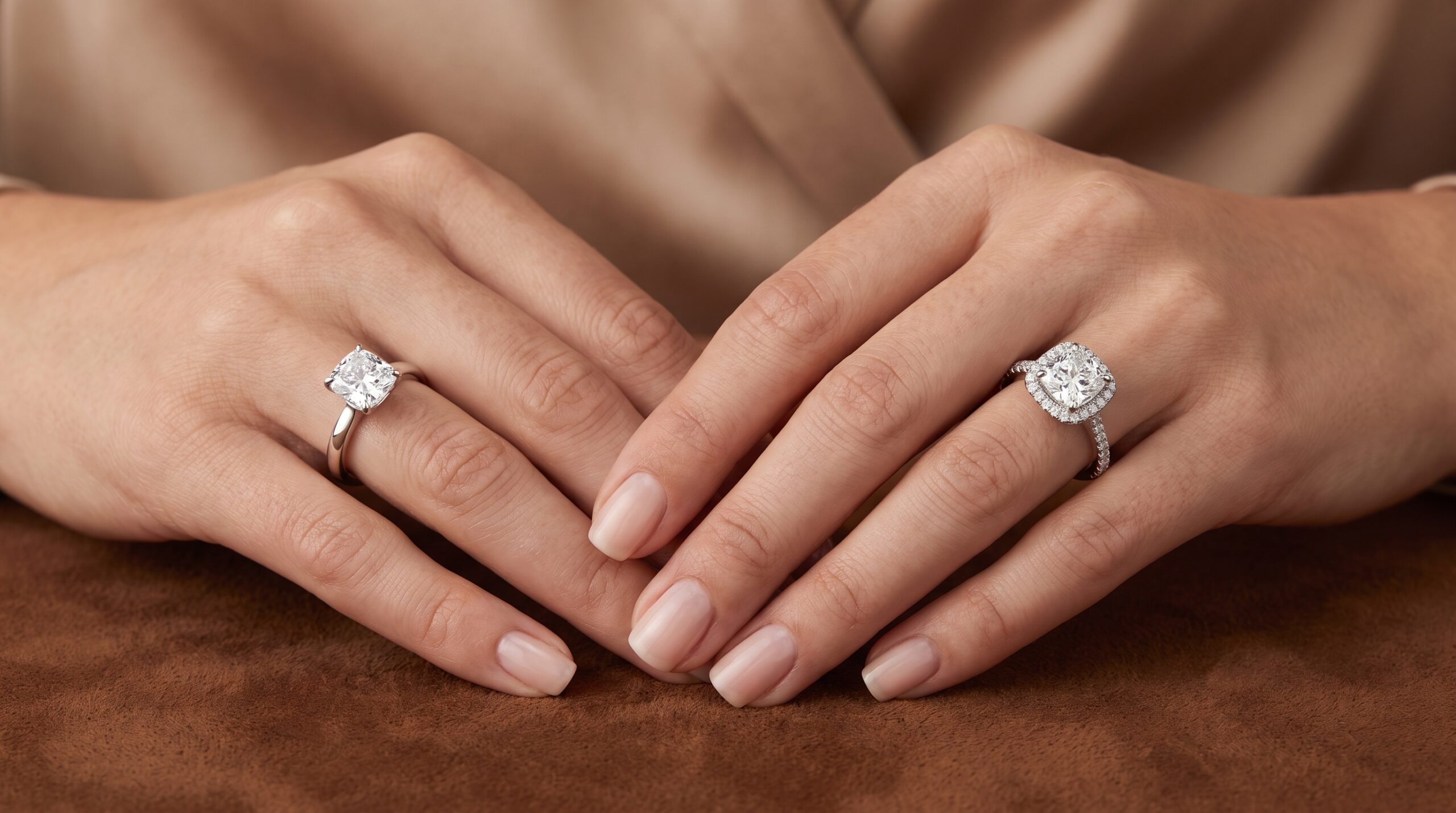
Wanting a different ring than the one you said yes to isn’t a betrayal of what that ring meant. Style changes over a decade of marriage. A setting that felt exciting at 25 can feel impractical at 40, especially if it snags on everything or sits too high to wear comfortably at work. An anniversary is a natural point to reconsider what the ring actually looks like day to day, and wanting more presence, more comfort, or a design that fits who you are now doesn’t erase what the original ring represented.
The confusion isn’t usually about whether to upgrade. It’s about which path actually makes sense: replacing the center stone, resetting the one you have, redesigning the ring from scratch, or leaving it alone and adding something new beside it. Each of those is a different decision with different costs and different amounts of the original ring left intact.
What Does It Mean to Upgrade an Engagement Ring?
People upgrade for a range of reasons that have little to do with dissatisfaction: an anniversary or another milestone, a shift in personal style since the original ring was chosen, wanting a larger center stone, needing a setting that holds up better to daily wear, improving comfort, or simply modernizing a design that felt dated years after the fact.
An upgrade doesn’t require starting over. It can be as small as adding a diamond band that sits beside the original ring, or as involved as a full redesign that uses the existing stones and metal in an entirely new piece. The scope of the change is a choice, not a fixed requirement of the word “upgrade.”
The Main Ways to Upgrade an Engagement Ring
A center-stone trade-up replaces the main diamond, usually through a jeweler’s trade-in program that credits the value of the original stone toward a new one. This path makes sense when the goal is specifically a larger or higher-quality stone. It’s worth knowing upfront that most trade-up programs apply only to the diamond, not the setting, so the original mounting is often not part of the deal and may need to be replaced or repurposed separately.
Resetting keeps the original center stone and moves it into a new mounting. This is the option for someone who has no interest in a different diamond but wants an updated look, a more secure setting, or a design that better matches current style. The stone’s identity and history stay the same. Only the frame around it changes.
A full redesign goes further, using the original stones, metal, or general design as a starting point for something built from scratch, sometimes combining new elements with old ones. This offers the most creative range but also tends to cost more and take longer, since it usually involves custom design work rather than selecting from existing settings.
Adding an anniversary band leaves the original ring completely untouched and places a second band, often lined with smaller diamonds, alongside it. This is the lowest-disruption option: no cutting, no resetting, nothing removed from the original piece. It adds sparkle and visual presence without altering anything about the ring that already exists.
| Upgrade Option | What Changes | Pros | Considerations | Best For |
| Center-stone trade-up | The diamond is replaced; the setting usually isn’t included | Larger or higher-quality stone becomes possible | Original setting is often not part of the trade-in credit | Buyers focused specifically on stone size or quality |
| Reset | The setting changes; the original stone stays | Keeps the exact stone that was originally chosen | Doesn’t address dissatisfaction with the stone itself | Buyers who love their diamond but want a new look |
| Full redesign | Stones, metal, or design elements are rebuilt into something new | Most creative flexibility, can blend old and new | Typically the most expensive and time-intensive option | Heirlooms or highly personal custom updates |
| Anniversary band | Nothing about the original ring changes; a new band is added | No disruption to the original ring at all | Doesn’t change the original ring’s style or fit | Buyers who want more presence without altering what they have |
How to Choose the Right Upgrade Path
If more sparkle is the goal, a larger center stone through a trade-up, a halo or hidden halo added around the existing stone through a reset, a pavé setting, or simply an anniversary band worn alongside the original ring can all add visual presence without requiring the same level of change.
If a more modern look is the priority, resetting or redesigning are the paths that actually address it, since a trade-up changes the stone but not necessarily the style, and an anniversary band doesn’t touch the original ring’s design at all.
If preserving the original sentiment matters most, resetting the original stone, reusing old metal where practical, or keeping specific design details from the original ring in a redesign all maintain a direct link to the piece as it was. A trade-up is the path that breaks that link most completely, since the original stone itself is what typically leaves.
If everyday comfort and durability are the concern, options like a lower-profile setting, a bezel setting that protects the stone’s edges, or a smoother band profile that stacks better with a wedding ring are worth prioritizing over stone size, and these changes usually come through a reset or redesign rather than a straightforward trade-up.
Trade-In vs Reset vs Redesign
A trade-in makes the most sense for someone whose priority is genuinely the stone itself, size, clarity, or overall quality, more than the design surrounding it. The tradeoff is that the original diamond is typically gone once the trade is complete, and the setting is usually a separate consideration.
A reset makes sense for someone who has no complaints about their diamond and wants a different setting around it. It preserves the exact stone while changing everything else about how it’s presented, and it’s generally less expensive and less involved than either a trade-in or a full redesign.
A redesign is the right call for heirloom pieces or highly personal projects where off-the-shelf settings don’t capture what the owner wants. It offers the most flexibility to combine old and new elements deliberately, but it also asks for the most time, the most back-and-forth with a jeweler or designer, and generally the highest cost of the three paths.
| Path | Keeps Original Stone? | Changes Setting? | Cost Level | Sentimental Impact |
| Trade-in | Usually not | Often, since the setting is typically separate | Depends on the new stone chosen | Highest impact, since the original stone is usually replaced |
| Reset | Yes | Yes | Generally lower than a full redesign | Low impact, since the original stone remains |
| Redesign | Optional, depending on the design | Yes, comprehensively | Generally the highest of the three | Depends on how much original material is reused |
Budget and Value Considerations
Costs to plan for depend on the path chosen but commonly include a new center stone if trading up, a new setting, labor for resetting or redesign work, custom design fees for a full redesign, metal costs, any new accent stones, an updated appraisal, and any insurance adjustments after the value changes.
The original ring rarely covers most of the cost of an upgrade. Trade-in programs generally credit the value of the diamond itself, not the setting, and the setting’s resale or trade-in value tends to be modest since it was priced to include retail markup and labor that doesn’t transfer into a trade-in credit. Anyone budgeting for an upgrade should expect the original ring to offset part of the cost, not most of it.
Given that, it helps to be clear about what actually matters most before shopping: a larger stone, more sparkle overall, better daily comfort, preserving sentiment, or a specific design direction. Trying to maximize all of these at once tends to blow past a reasonable budget. Picking one or two as the real priority makes it much easier to choose between a trade-up, a reset, and a redesign.
How to Preserve Sentimental Value
Keeping the original center stone, through a reset rather than a trade-up, is the most direct way to preserve continuity with the ring as it was originally chosen. The stone itself carries the history, not just the setting around it.
Where practical, reusing side stones or original metal in a new design keeps a physical link to the original piece even when the overall look changes substantially. A jeweler working on a redesign can usually advise on what’s feasible to carry forward.
Leaving the original ring completely intact and adding an anniversary band or a right-hand ring sidesteps the question of sentimental loss entirely, since nothing about the original piece changes.
Documenting the process, before-and-after photos, notes on what was kept versus changed, and why, turns the upgrade itself into part of the ring’s story rather than something that erases what came before it.
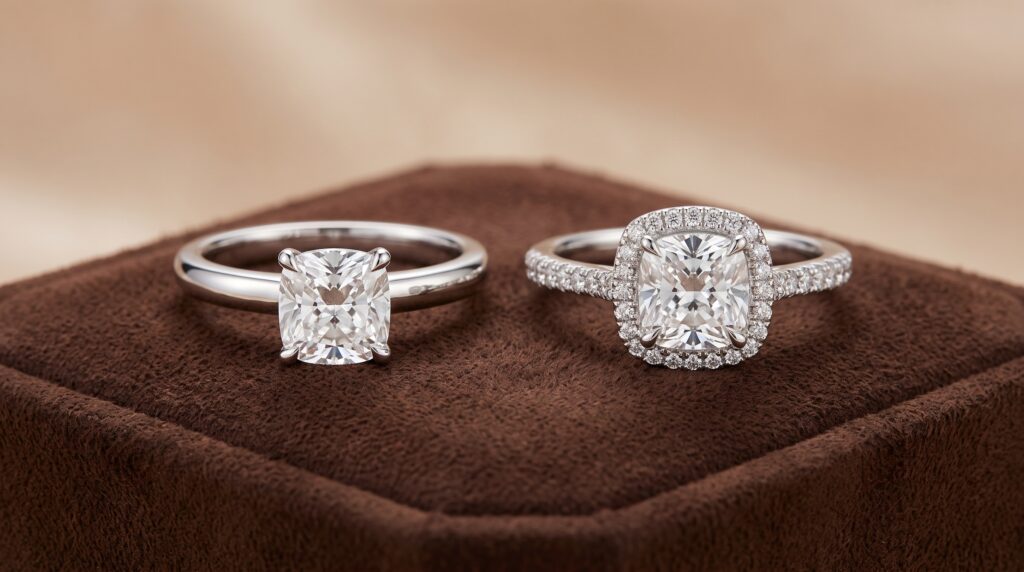
Fit, Comfort, and Wearability After an Upgrade
Setting height matters more for daily wear than it often gets credit for. A high setting shows off a stone dramatically but catches on gloves, sweaters, and hair more than a lower profile does, and that’s worth weighing against how the ring is actually going to be worn day to day, not just how it photographs.
Stacking with a wedding band is worth testing before finalizing a new design. Some new settings are shaped to sit flush against a straight wedding band, while others are intentionally designed with a slight gap or curved profile. Neither is wrong, but a mismatch between the new ring and an existing wedding band can leave an uncomfortable gap or a band that won’t sit flat.
A larger or wider design changes how the ring feels on the hand, not just how it looks. More metal and more stones typically mean more weight, and a wider band covers more of the finger’s surface, which can feel different even at the same ring size.
| Design Feature | Comfort Impact | Maintenance Impact | Buyer Note |
| High setting | Can catch on fabric and hair during daily wear | More exposed to knocks, may need more frequent inspection | Weigh against how often the ring is worn during hands-on activities |
| Bezel setting | Smoother profile, less snagging | Generally easier to keep clean, fewer prongs to check | A practical option for active daily wear |
| Wider band | Covers more finger surface, can feel different at the same size | No significant maintenance difference | Try the ring on before finalizing width |
| Pavé or halo details | No direct comfort impact | More small stones to inspect over time | Factor in future maintenance, not just initial appearance |
Documentation, Appraisal, and Insurance
A new appraisal is generally needed after a new center stone, a new setting with different materials or stone counts, or a full redesign, since any of these change what the ring is actually worth to replace.
If the center stone changes, a diamond grading report from a lab such as GIA documents its specific characteristics, cut, color, clarity, and carat weight, and supports both the appraisal and any future insurance claim. The American Gem Society also maintains standards for diamond grading and quality documentation that jewelers and appraisers reference.
Insurance coverage tied to the ring’s previous appraised value won’t automatically reflect a higher or different value after an upgrade. Updating the policy, or the appraisal on file with the insurer, after any change in the ring’s value is a separate step that’s easy to overlook once the excitement of the new design has settled.
Questions to Ask Before Upgrading
Before committing to any upgrade path, it’s worth getting clear answers to a short set of questions:
- What parts of the original ring, if any, can be reused in the new piece?
- Does the trade-in program include the setting, or only the center stone?
- Will the finished ring need a new appraisal, and who provides it?
- Can the upgraded ring be resized later if needed?
- How does the new design affect ongoing maintenance and inspection needs?
- What happens to the original metal or stones that aren’t reused?
- Does a warranty apply to the new work, and what does it cover?
- Is the final design confirmed in writing, including stone specifications and metal type, before work begins?
Conclusion
The path that fits best depends on what’s actually driving the desire to upgrade. Wanting a bigger or better stone points toward a trade-up. Loving the diamond but wanting a different setting points toward a reset. Wanting something built specifically around the ring’s history points toward a redesign. And wanting more sparkle without touching what already exists points toward an anniversary band.
Whichever path fits, get the new appraisal and any insurance updates handled as part of the process, not as an afterthought once the ring is back on your hand. That single step protects the upgrade the same way the original documentation protected the ring you started with.
Frequently Asked Questions
What counts as an engagement ring upgrade?
An upgrade is any intentional change that improves the ring’s style, stone, comfort, or presence. That can mean trading the center stone for a larger or higher-quality diamond, resetting the original stone into a new mounting, redesigning the ring more substantially, or adding a separate anniversary band beside the original piece without altering it at all. There’s no single definition of how much has to change for something to count as an upgrade.
Is it better to trade in or reset my ring?
It depends on how you feel about the diamond itself. A trade-in makes sense if the goal is genuinely a different stone, larger, higher quality, or both, since most trade-in programs credit the value of the existing diamond toward a new one. A reset makes more sense if you have no complaints about the stone you have and simply want a different setting around it. Neither option is inherently better; they solve different problems.
Can I keep my original diamond?
Yes, through a reset or a redesign that specifically preserves the center stone. A trade-up is the option where the original stone typically doesn’t stay with you, since it’s usually exchanged as credit toward a new one. If keeping the exact diamond matters, make that clear to the jeweler before choosing a path, since it rules out trade-up programs by definition.
Do trade-up programs include the setting?
Usually not. Most trade-in and trade-up programs are structured around the center stone specifically, and the original setting is typically not part of the credited value. That means the setting either needs to be sold, repurposed, or replaced separately, which is worth factoring into the overall cost before assuming the whole ring’s value applies toward the new one.
Does upgrading affect insurance?
It can. If the ring’s value changes after an upgrade, whether from a larger stone, additional accent diamonds, or a different metal, the insurance policy or appraisal on file may no longer reflect what the ring is actually worth to replace. Updating that documentation after the upgrade is a separate step from the upgrade itself and shouldn’t be skipped just because the ring already had coverage before.
Can I upgrade an heirloom ring?
Yes, and a full redesign is often the path suited to heirlooms specifically, since it allows a jeweler to work with the original stones, metal, or design details rather than replacing them wholesale. This kind of work usually takes more time and conversation with a jeweler than a standard reset, since the goal is typically to preserve specific elements rather than start from a blank design.
Is adding an anniversary band considered an upgrade?
Yes. It’s the upgrade path that changes the least about the original ring, since nothing about the existing piece is altered, cut, or reset. An anniversary band adds sparkle and visual presence on its own, worn alongside the original ring, which makes it a reasonable choice for anyone who wants more without touching what they already have.
Will a redesign make the ring harder to maintain?
It depends entirely on the new design. A redesign that adds more small stones, a pavé band, or an intricate setting will generally need more frequent inspection than a simpler original design did. A redesign that simplifies the ring, lowering the setting or reducing the number of small stones, can actually reduce maintenance needs compared to the original. The design itself determines the answer, not the fact that a redesign happened.
Do I need a new appraisal after upgrading?
Generally yes, if the center stone, setting, or overall design changed enough to affect the ring’s value. A minor adjustment might not require an entirely new appraisal, but any trade-up, reset with new accent stones, or redesign typically does, since the previous appraisal no longer reflects what the current ring would cost to replace.
How do I preserve sentimental value?
The most direct way is keeping the original center stone through a reset rather than trading it away. Beyond that, reusing original metal or side stones where practical, or leaving the original ring untouched and adding an anniversary band instead, both maintain a physical connection to the ring as it was. Documenting the change, photos, notes on what was kept, and the reasoning behind the update, also helps the upgrade feel like a continuation of the ring’s story rather than a replacement of it.