
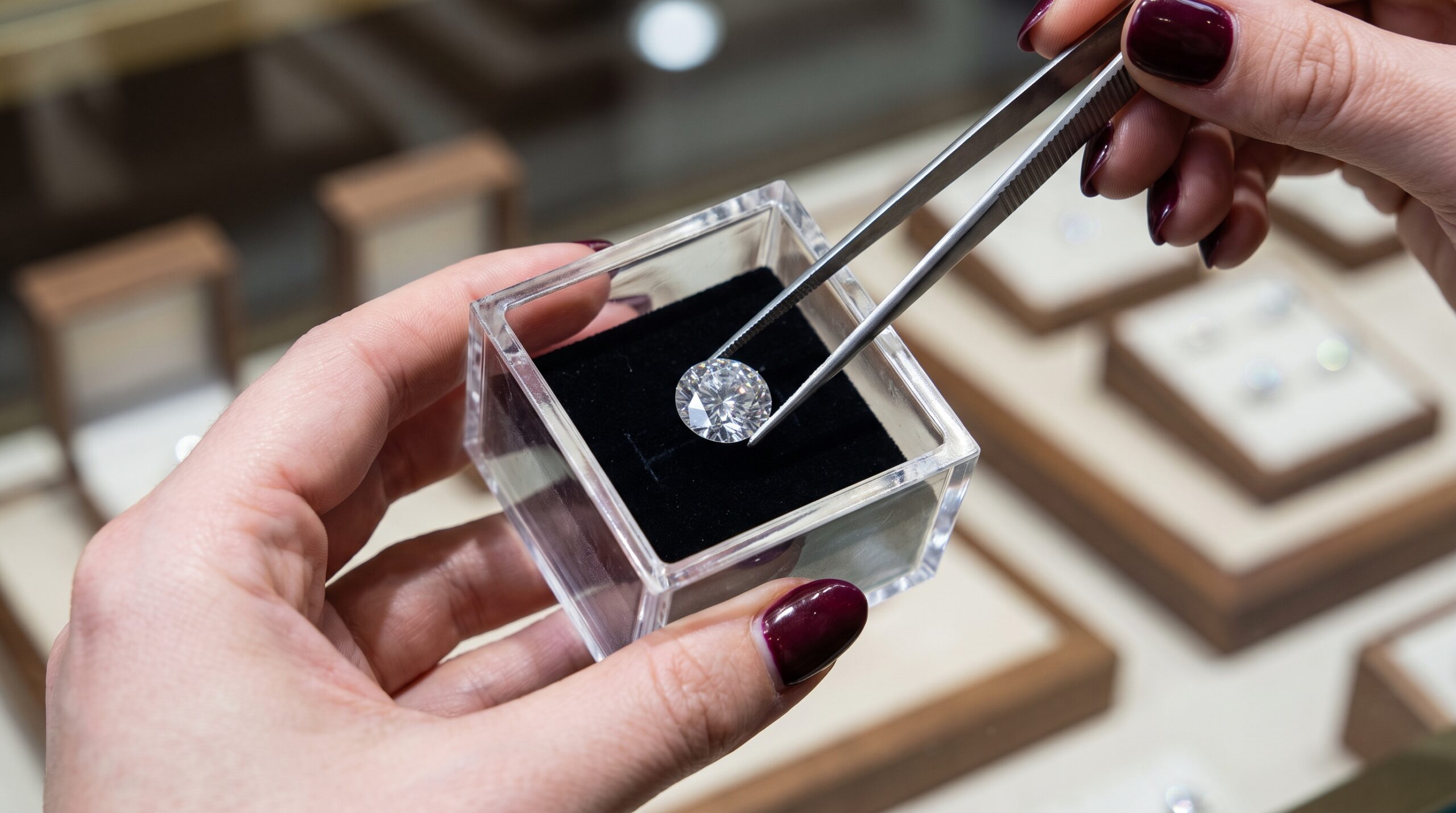
If a diamond was grown in a laboratory instead of formed underground, is it still a diamond? Yes. Lab grown diamonds have the same carbon crystal structure as natural diamonds, and the same chemical, physical, and optical properties, according to the Gemological Institute of America. The confusion people run into usually comes from mixing up two separate ideas: what a diamond is made of, and where it came from.
That distinction matters most when the stone is going into an engagement ring or a wedding band, something meant to be worn for decades. Buyers want to know that the material is genuine, that it will hold up to daily wear, and that they understand what they’re actually paying for. This article covers what makes a diamond a diamond, how lab grown stones differ from natural ones and from simulants like moissanite, how they’re made, what determines their quality, and what to check before buying one online.
The Short Answer: Yes, Lab Grown Diamonds Are Real Diamonds
A lab grown diamond is diamond material. It has the same crystal lattice, the same hardness, the same refractive index, and the same fire and brilliance as a diamond pulled from the earth. The GIA’s comparison of natural and laboratory-grown diamonds confirms the two are essentially identical at the material level. What separates them is how they formed: one crystallized over a long period underground, the other crystallized inside a machine over a period of weeks.
Lab grown diamonds are diamonds created through technology. Natural diamonds are diamonds formed through geological processes. Simulants like moissanite and cubic zirconia resemble diamond visually but are made of entirely different materials.
“Real diamond” describes the substance. “Natural” describes where that substance came from. Those are two different questions, and a lab grown stone answers the first one the same way a natural stone does.
What Does “Real Diamond” Actually Mean?
When someone asks whether a lab grown diamond is real, they’re usually asking one of several different things at once: is it genuine diamond material, did it form naturally underground, is it valuable, does it come with paperwork, and will it last. Those questions have different answers, and collapsing them into one is where most of the confusion starts.
Diamond Material vs Diamond Origin
Material is what the stone actually is at the atomic level. Origin is how and where it formed. Quality is how a specific stone looks and performs once it’s cut and set. Value is what buyers and the market are willing to pay for it. Meaning is what the piece represents to the person wearing it.
A lab grown diamond and a natural diamond can be identical on the first point and different on the rest. None of those differences make the lab grown stone fake.
Lab Grown Diamonds vs Diamond Simulants
A simulant is a different story. It looks like a diamond to the eye, but it isn’t chemically or structurally the same material. Moissanite and cubic zirconia are the two simulants buyers run into most often, and neither one is a type of diamond.
Is Moissanite a Lab Grown Diamond?
No. Moissanite is silicon carbide, a separate gemstone with its own optical signature. It tends to throw more colored flashes of light than a diamond does, which is one reason trained buyers can sometimes tell the two apart at a glance, according to GIA’s overview of diamond simulants.
Is Cubic Zirconia a Diamond?
No. Cubic zirconia is manufactured from zirconium dioxide. It’s softer than diamond and wears down faster with everyday use, which is why it shows up more in costume jewelry than in pieces meant for daily wear over years.
| Factor | Lab Grown Diamond | Natural Diamond | Moissanite | Cubic Zirconia |
| Diamond material | Yes | Yes | No | No |
| Origin | Laboratory | Geological | Usually laboratory-created | Manufactured |
| Appearance | Diamond appearance | Diamond appearance | Diamond-like, different light behavior | Diamond-like |
| Everyday durability | Suitable for daily jewelry | Suitable for daily jewelry | Durable, but a different material | Less resistant to long-term wear |
| Disclosure needed | Laboratory-grown origin | Natural origin, where relevant | Identified as moissanite | Identified as cubic zirconia |
How Are Lab Grown Diamonds Made?
Growers use one of two processes, both of which start with a small diamond seed and build outward from it.
HPHT
High pressure, high temperature growth places a diamond seed in a chamber and subjects it to conditions that mimic the pressure and heat found deep in the earth’s mantle. Carbon source material dissolves and then crystallizes onto the seed, layer by layer, according to GIA’s explanation of the HPHT and CVD growth processes.
CVD
Chemical vapor deposition works differently. A diamond seed sits in a sealed chamber filled with carbon-rich gas. The gas is heated until the carbon atoms separate and settle onto the seed, building the crystal one atomic layer at a time.
Does the Growth Method Determine Quality?
Not on its own. Both methods can produce diamonds ranging from included and off-color to clean and colorless. Once cut and polished, the growth method has little bearing on how a finished stone looks. What buyers should actually look at is the cut and proportions of the finished diamond, its visible color, its eye-visible clarity, its measurements, whether it has been treated after growth, and what the laboratory documentation says. Neither HPHT nor CVD is the better method across the board; each producer’s execution matters more than which chamber the stone came out of.
Do Lab Grown Diamonds Look Like Natural Diamonds?
Two stones of comparable cut, color, and clarity can look nearly indistinguishable side by side, whether one is natural and one is lab grown. Brightness, fire, sparkle, shape, color, and face-up size all come down to the individual stone’s proportions and finish, not its origin.
Origin usually can’t be confirmed by eye. GIA notes that specialized instruments and testing are often needed to determine whether a colorless to near-colorless diamond formed naturally or in a lab, since the visual differences are too subtle for casual inspection, and sometimes for jeweler inspection without equipment.
What Determines Visible Beauty?
The cut and its proportions do more to determine sparkle than any other single factor, since they control how light enters and exits the stone. After that, the face-up measurements, the visible body color, whether inclusions are visible without magnification, the design of the setting, and the lighting and cleanliness of the stone all shape how it actually looks on a hand. A lab grown origin doesn’t guarantee any of this. A poorly cut lab grown diamond will look flat and lifeless in the same way a poorly cut natural diamond does.
Are Lab Grown Diamonds as Durable as Natural Diamonds?
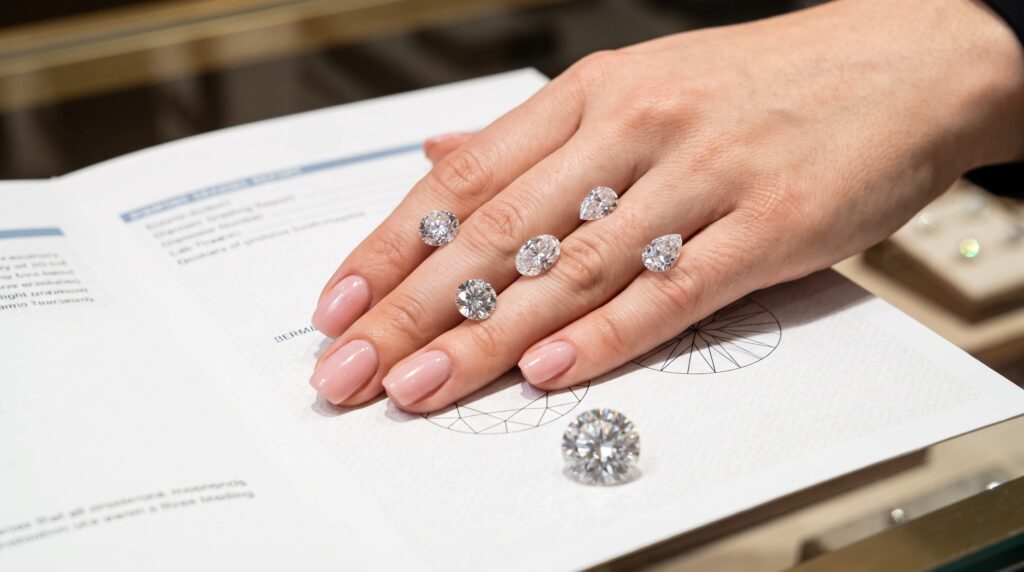
Material durability is essentially the same between the two, since both are the same substance at the crystal level. That means a lab grown diamond is just as suitable for a ring worn every day as a natural one.
Hardness isn’t the same thing as indestructibility, though. Diamond resists scratching from almost everything except another diamond, but it can still chip if it takes a hard direct hit, particularly at an exposed corner or point. Damage to a ring more often comes from a bent or worn prong, a loose setting, or an impact during heavy manual work than from the stone itself failing.
Are They Suitable for Engagement Rings?
Yes. Whether a specific ring holds up well over years of wear depends on the whole piece, not just the stone: how high the setting sits, how well the prongs protect the edges of the diamond, whether it’s a bezel, halo, or open prong design, how thick the band is, what metal was used, and how carefully it was constructed. A wearer’s job and habits matter too. Someone who works with their hands regularly needs a more protective setting than someone who doesn’t, regardless of whether the center stone is natural or lab grown.
What About Diamond Wedding Bands?
Pavé, shared-prong, channel-set, and full eternity bands each come with their own maintenance and resizing considerations. A channel-set band, for example, protects the stones from the sides but can be harder to resize than a plain band. These differences come from how the band is built, not from where the diamonds in it were grown.
How Is Lab Grown Diamond Quality Evaluated?
The 4Cs, cut, color, clarity, and carat, still apply to lab grown diamonds the same way they apply to natural ones. What has changed recently is how the major labs report on them.
Cut
Cut refers to how well a diamond’s proportions and finish allow it to handle light, not the shape of the stone (round, oval, cushion, and so on are shapes, not cut grades). A well-cut diamond returns more brightness and fire regardless of size.
Color
Color grading describes how much body color, typically a faint yellow or brown tint, is visible in a colorless to near-colorless stone. The best way to judge color for a specific piece is to look at the diamond in the metal and setting it will actually sit in, since white metal tends to make body color more noticeable than yellow gold does.
Clarity
Clarity measures inclusions (internal characteristics) and blemishes (surface characteristics). A higher clarity grade doesn’t necessarily look any different from a lower one at arm’s length. Many buyers are better served by a diamond that’s eye-clean at normal viewing distance than by paying more for a grade improvement no one will notice without a loupe.
Carat and Measurements
Carat measures weight, not size. Two diamonds of the same carat weight can look different sizes face-up depending on how they’re cut; a shallow cut can spread a stone’s diameter wider for its weight, while a deep cut hides weight below the band. Millimeter measurements are a more direct indicator of how large a stone will actually look from above.
Understanding Laboratory Reports
Report formats aren’t standardized across labs, and buyers who assume otherwise can end up comparing two documents that aren’t measuring the same thing. IGI issues laboratory-grown diamond reports that document the 4Cs in a format similar to its natural diamond reports. GIA changed its approach: since October 1, 2025, it has classified eligible colorless to near-colorless lab grown diamonds as Premium or Standard rather than issuing a full grading report with individual color and clarity grades. Neither approach is wrong, but they aren’t interchangeable, and a buyer comparing two stones needs to know which system produced each document.
Before relying on any report, check the issuing laboratory, the report or assessment number, whether it explicitly states laboratory-grown origin, the shape and measurements listed, the quality information provided, the growth method if it’s reported, any post-growth treatment noted, and whether there’s a laser inscription that matches the report number. Not every stone has an inscription, and its absence isn’t automatically a problem, but if one is claimed, it should match.
Why Are Lab Grown Diamonds Less Expensive?
Lower price doesn’t mean lower authenticity. It reflects production and market conditions: lab grown diamonds can be produced in controlled facilities at increasing volume, supply has expanded significantly in recent years, and the stones don’t carry the geological scarcity premium built into natural diamond pricing. Retail and wholesale pricing for lab grown stones has also moved substantially as production capacity has grown, a trend tracked in wholesale market reporting from Edahn Golan, so any specific savings figure quoted today may not hold a year from now.
What Can Buyers Prioritize With the Price Difference?
The money saved relative to a comparable natural diamond can go toward a larger face-up appearance, a better cut or set of proportions, a more protective setting, higher-quality metalwork, a matching band, customization, or simply toward other costs of the wedding or the relationship. None of these are automatic; they’re choices a buyer can make with the difference.
What About Resale Value?
Neither lab grown nor natural diamonds should be treated as an investment that’s expected to appreciate. Lab grown diamond prices have shifted considerably as supply has grown, and natural diamonds generally have a more established secondary market, though that market varies by stone quality and by dealer. Retail price, insurance appraisal value, trade-in credit, and an actual resale offer from a buyer are four different numbers, and a high appraisal doesn’t translate into a high resale price. Anyone concerned about resale should ask a retailer directly about written buyback or upgrade policies rather than relying on general assumptions about either category of diamond.
How Can Buyers Verify a Lab Grown Diamond?
Advanced laboratory equipment, not casual inspection, is what confirms whether a diamond is natural or lab grown. As a buyer, that means the burden of verification falls on documentation rather than on your own eyes.
Look for clear language stating the diamond is laboratory-grown, a report or quality assessment from a recognized laboratory, a report number you can verify independently, a laser inscription that matches the report if one is claimed, measurements that line up with what the document states, and seller documentation that’s specific rather than vague. IGI reports, for instance, can be verified directly on IGI’s website using the report number.
The word “certified” gets used loosely in jewelry marketing. It isn’t meaningful on its own. Ask which laboratory issued the document and what, specifically, it confirms, since a report and a simple appraisal are not the same thing.
How to Buy a Lab Grown Diamond Online
Start by confirming the listing explicitly states the stone is laboratory-grown; under FTC disclosure guidance, sellers in the United States are required to make this clear rather than letting “diamond” stand alone. From there, identify the issuing gemological laboratory, verify the report or assessment number directly with that lab, compare the listed measurements and carat weight, review actual photos and video of the stone rather than stock images, check the cut and proportion information, and look at the setting height and construction, since that affects both how the stone wears and how it looks. Read the return and inspection policy before buying, confirm what resizing or customization the piece allows, and check the warranty, repair, and shipping insurance terms.
Some signs are worth treating as warnings: a listing that uses the word “diamond” without saying whether it’s natural or lab grown, language that blurs the line between laboratory-grown and simulated stones, missing or unverifiable report information, only stock photography with no actual images of the stone, resale promises that aren’t backed by a written policy, broad sustainability claims with no supporting evidence, or no reasonable return and inspection window.
Fit, Comfort, and Everyday Wear
Where a diamond formed has no bearing on how a ring fits. Fit comes down to band width, the interior profile of the band, setting height, the dimensions of the stone itself, where the prongs sit, whether the ring needs to sit flush against a wedding band, and how much a finger’s size changes over time.
A wider band tends to feel tighter than a narrow one at the same measured size. Stacking rings together often requires extra room that a single ring wouldn’t need. A high setting can catch on gloves or clothing during the day. A full eternity band, set with stones all the way around, is harder to resize than a band with a plain back. Someone with an active job or lifestyle is often better served by a lower-profile setting, regardless of what the center stone is.
Care and Maintenance
Lab grown and natural diamond jewelry are cleaned the same way. Warm water, a mild soap, and a soft brush handle most everyday buildup. Rinse thoroughly and dry with a lint-free cloth rather than letting the piece air dry, which can leave spots on the metal. Store the ring separately from other jewelry so nothing scratches the metal or the stone’s girdle. Take it off for heavy manual work and contact sports, and have a jeweler check the prongs and setting periodically, since a loose prong is the more common cause of a lost stone, not a failure of the diamond itself. GIA recommends caution with home ultrasonic or steam cleaners if there’s any chance the setting is already loose, since the vibration can worsen the problem.
The setting and the metal generally need more attention over the life of a ring than the diamond does, since diamond is close to the hardest natural material there is, but gold and platinum both wear down and prongs both loosen with enough years of contact.
Buying a lab grown diamond comes down to the same checks that apply to any diamond purchase: confirm the origin is stated plainly, verify the report against the issuing lab, look closely at the stone’s actual cut and measurements rather than assuming a grade tells the whole story, and check the setting as carefully as the stone. Origin, rarity, price, and personal meaning are separate factors a buyer weighs against each other, not proof points for or against the material itself.
Frequently Asked Questions
Are lab grown diamonds genuine diamonds?
Yes. They have the same carbon crystal structure and the same chemical, physical, and optical properties as natural diamonds. The difference is that they crystallize in a controlled laboratory setting over a period of weeks rather than underground over geological time.
Are lab grown diamonds considered fake?
No. “Fake” describes a simulant, a different material made to resemble diamond, like moissanite or cubic zirconia. A lab grown diamond is diamond material, just formed through a different process than a natural one.
Is moissanite a lab grown diamond?
No. Moissanite is silicon carbide, a separate gemstone with its own hardness and optical characteristics. It’s often more affordable than diamond and tends to show more colored flashes of light, which is one way a trained eye can sometimes distinguish it from diamond.
Can a jeweler identify a lab grown diamond by looking?
Not reliably in most cases. A comparable lab grown and natural diamond can look nearly identical to the eye. Confirming origin generally requires specialized equipment and testing rather than visual inspection alone.
Do lab grown diamonds become cloudy?
No. Diamond, whether natural or lab grown, doesn’t cloud over with normal wear. Any dulled appearance over time is almost always the result of oil, lotion, or everyday grime building up on the surface, which regular cleaning resolves.
Are lab grown diamonds durable enough for engagement rings?
Yes. Their material hardness matches natural diamond, which makes them suitable for a ring worn daily. How well a specific ring holds up over years still depends on the setting design, the metal, and how carefully the piece was made, the same factors that apply to a natural diamond ring.
Why do lab grown diamonds cost less than natural diamonds?
Production conditions and supply, not lower quality. Lab grown diamonds are grown in controlled facilities where supply can expand, while natural diamonds carry a geological scarcity premium that lab grown stones don’t. Pricing for lab grown diamonds has also shifted considerably in recent years as production capacity has increased, so the size of the gap changes over time.
Do lab grown diamonds have grading reports?
Yes, though the format varies by laboratory. IGI issues laboratory-grown diamond reports that document the 4Cs. GIA, since October 2025, assesses eligible colorless to near-colorless lab grown diamonds as Premium or Standard rather than issuing a full individual grading report. Buyers comparing stones from different sellers should check which system produced each document before assuming the numbers mean the same thing.
Do lab grown diamonds have resale value?
Some, but neither lab grown nor natural diamonds should be treated as an investment expected to appreciate. Lab grown diamond prices have moved substantially with expanding supply, and the secondary market for them is less established than the one for natural diamonds. Retail price, appraisal value, and an actual resale offer are different numbers, and buyers who care about resale should ask a retailer for a written buyback or upgrade policy rather than relying on assumptions.
Can lab grown diamonds become family heirlooms?
Yes. A piece becomes an heirloom through the people who wore it, the events it was part of, and the care it received, not through its geological origin. A well-made, well-documented lab grown diamond can be passed down the same way a natural diamond can.