
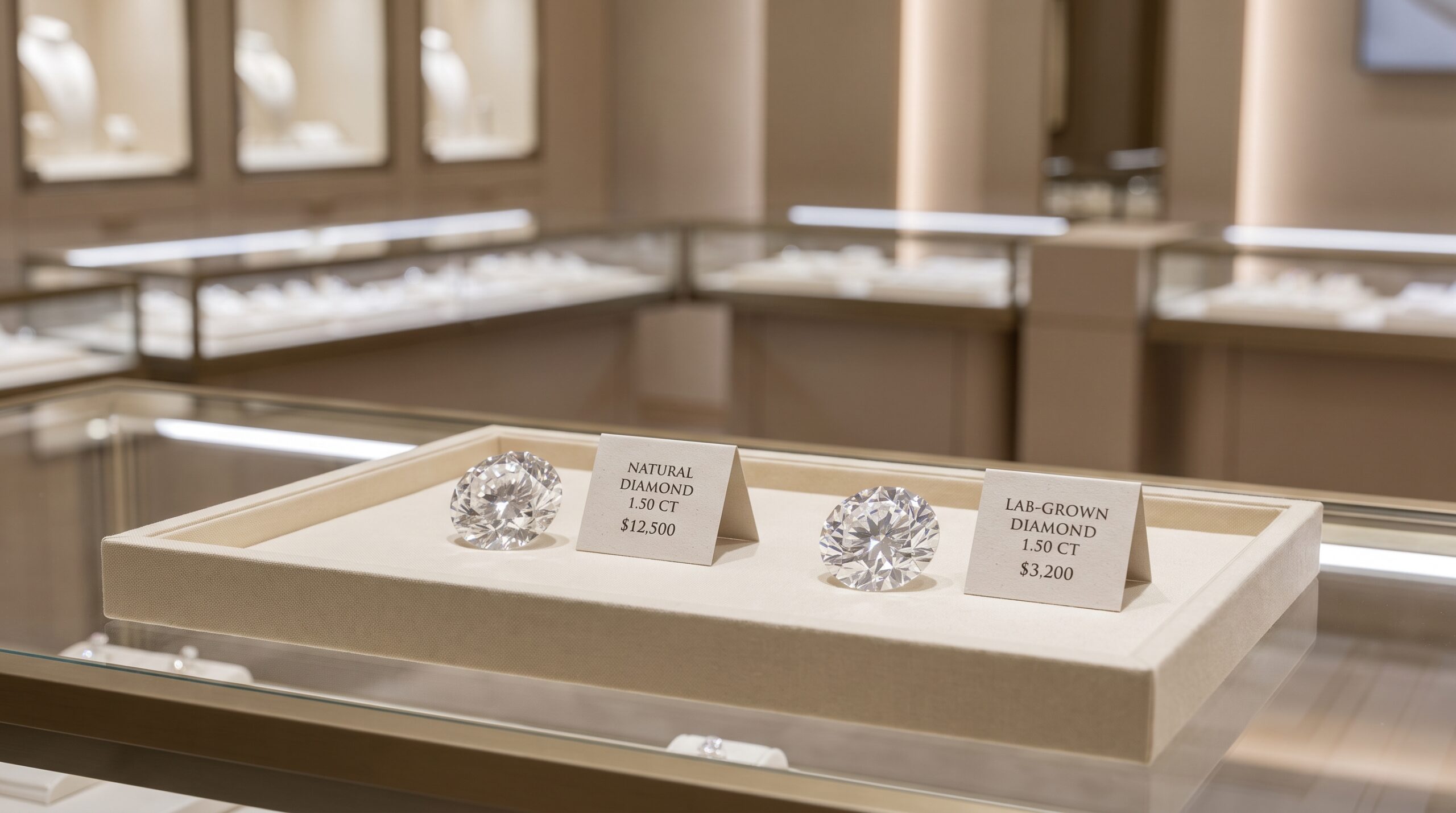
Two diamonds can sit side by side, both well cut, both a carat, both graded eye clean, and look essentially identical. One formed underground over a billion years. The other formed in a lab over a few weeks. The hard part of this decision isn’t figuring out which one looks like a diamond. It’s deciding which origin, price, and meaning fit what you actually want from the ring.
This isn’t a real-versus-fake comparison. Lab grown and natural diamonds are both diamond, chemically and physically. Simulants like moissanite and cubic zirconia are a separate category entirely, made from different materials. What follows is a side-by-side look at appearance, quality, durability, price, resale, documentation, and everyday wear, so you can weigh the tradeoffs instead of guessing.
Lab Grown vs Natural Diamonds at a Glance
| Factor | Lab grown diamond | Natural diamond |
| Origin | Crystallized in a controlled facility over weeks to months | Formed in the earth over geological time, then mined |
| Material properties | Same carbon crystal structure as natural diamond | Same carbon crystal structure as lab grown diamond |
| Appearance | Comparable across the same range of cut, color, and clarity | Comparable across the same range of cut, color, and clarity |
| Durability | Same hardness and wear resistance | Same hardness and wear resistance |
| Availability | Production can scale with demand | Limited by what can be mined |
| Typical price positioning | Generally lower cost per carat | Generally higher cost per carat |
| Geological rarity | Not applicable | Product of a finite natural process |
| Quality documentation | Reports vary by laboratory; format differs from natural diamond reports | Reports typically use the 4Cs |
| Identification | Requires specialized lab equipment to confirm origin | Requires specialized lab equipment to confirm origin |
| Symbolic appeal | Modern production, budget flexibility | Natural history, established tradition |
| Resale considerations | More established secondary market for natural diamonds; resale for lab grown still developing | More established secondary market, though still below retail |
Neither column produces a more beautiful diamond by default. According to GIA, lab grown and natural diamonds share essentially the same chemical, physical, and optical properties. GIA on natural versus lab grown diamonds The visible quality of any individual stone comes down to how well it’s cut and graded, not which column it belongs to.
What Is the Difference Between Lab Grown and Natural Diamonds?
Natural Diamonds
A natural diamond forms in the earth’s mantle under extreme heat and pressure, then gets carried to the surface through volcanic activity over the course of geological time, meaning hundreds of millions to billions of years. It’s then located, mined, and cut. That process is why natural diamonds have long been tied to engagement and heirloom jewelry: each one is a product of a natural process that can’t be replicated on demand.
Lab Grown Diamonds
A lab grown diamond forms the same way chemically, as pure carbon crystallizing into a diamond structure, but the process happens inside a facility using one of two production methods, HPHT (High Pressure High Temperature) or Chemical Vapor Deposition (CVD). GIA on HPHT and CVD growth The result is available faster and in larger volumes, which is the main reason production has scaled up and prices have moved over the past several years. Reputable sellers disclose lab grown origin clearly rather than burying it in a listing.
What Is a Diamond Simulant?
Moissanite and cubic zirconia are not lab grown diamonds. They’re different materials made to resemble diamond visually, but they don’t share diamond’s crystal structure, hardness, or thermal behavior, and a gemologist can usually distinguish them with standard testing equipment. GIA on diamond simulants Lumping simulants in with lab grown diamonds is the single most common source of confusion in this comparison, and it’s worth keeping the two separate in your own mind before you start shopping.
Natural diamond: Formed geologically over vast timescales, then mined.
Laboratory-grown diamond: Same carbon crystal structure, produced through HPHT or CVD technology in a controlled facility.
Diamond simulant: A different material, such as moissanite or cubic zirconia, that resembles diamond but isn’t diamond.
Do Lab Grown and Natural Diamonds Look Different?
Not in any way you’d notice across the room, or usually even up close. A lab grown and a natural diamond with matching cut, color, clarity, and carat weight will produce the same sparkle, the same brightness, and the same face-up size. Origin isn’t a visible property. It’s a manufacturing history that requires laboratory analysis of growth patterns and trace elements to confirm. GIA on identifying lab grown diamonds A jeweler’s loupe or a home test kit for diamond hardness won’t settle the question, because both stones pass those tests the same way.
Why Cut Matters More Than Origin for Visible Sparkle
If you’re chasing brightness and fire, cut quality is where to spend your attention, not origin. A poorly proportioned stone, whether lab grown or natural, will look duller than a well-cut one even at a higher carat weight or color grade. Buyers often overspend on a color or clarity upgrade that isn’t visible at arm’s length while underspending on cut, which is visible from across a room. If you have to choose where to compromise, compromise on clarity before you compromise on cut.
Comparing Quality Using the 4Cs
Once you’ve settled on origin, the diamond still needs to be judged on its own specifics, the same specifics that apply to any diamond purchase.
Cut determines how a diamond handles light: its brightness, contrast, and overall visual life. It’s a measure of proportions and craftsmanship, not the same thing as shape. A round brilliant and a cushion cut are shapes; cut quality is how well that particular stone, in that shape, was proportioned and polished.
Color grading measures how much body tint a diamond carries, from colorless down through visibly tinted. The difference between two adjacent grades is often hard to see with the naked eye, and it becomes even harder to see once the stone is set, especially in yellow or rose gold, which can mask a faint tint.
Clarity refers to inclusions (internal features) and blemishes (surface features). A diamond graded as eye clean has no inclusions visible without magnification, even if a jeweler’s loupe would reveal some. Paying up for a clarity grade above eye clean buys you something a magnifying glass can see, not something a viewer at a dinner table can.
Carat measures weight, not size. Two stones of identical carat weight can have different face-up diameters depending on how they’re cut, since a shallow cut can preserve weight at the expense of visible spread. Ask for actual millimeter measurements when comparing options, not just the carat number.
Report Format Differences
Grading reports for lab grown and natural diamonds aren’t standardized across laboratories, and that matters more here than in most jewelry categories.
Since October 1, 2025, GIA has used overall Premium and Standard classifications for eligible colorless to near-colorless lab grown diamonds, rather than the individual 4Cs breakdown it uses for natural stones. GIA’s updated lab grown diamond services IGI takes a different approach, continuing to document the 4Cs individually on its lab grown diamond reports. IGI lab grown diamond report A GIA “Premium” lab grown diamond and an IGI report listing a specific color and clarity grade aren’t directly comparable line by line. You need to know what each laboratory’s format is actually telling you before you put two stones side by side.
Report-reading checklist:
| Detail to check | Why it matters | Where to verify |
| Issuing laboratory | Formats and terminology differ by lab | Confirm which grading system that lab currently uses |
| Origin statement | Confirms natural or lab grown, plus growth method if disclosed | Should be explicit, not implied |
| Report number | Ties the document to the specific stone | Check through the laboratory’s own verification tool |
| Measurements | Actual millimeter dimensions, not just carat | Compare against carat weight for proportion |
| Quality assessment | 4Cs detail or overall classification, depending on lab | Understand the format before comparing stones |
| Treatment disclosure | Any post-growth treatment applied | Report should state “as grown” or name the treatment |
| Inscription | Laser-etched report number on the girdle, when present | Ask the seller to confirm or show it |
Why Do Lab Grown and Natural Diamonds Cost Different Amounts?
Natural diamonds cost more per carat, in general, because they’re a finite resource pulled from the ground through a mining process with real geological constraints on supply. Lab grown diamonds cost less because production capacity has expanded significantly in recent years, and a controlled facility can scale output in a way a mine cannot.
That price gap isn’t a fixed percentage, and quoting one would be misleading, since the actual gap shifts with carat size, quality specifications, the laboratory grading the stone, the seller, and current market conditions. Both categories also carry costs beyond the raw stone: cutting, setting craftsmanship, brand service, and warranty coverage all factor into the final retail price, which is why identical specifications can be priced differently from one jeweler to another.
What a Lab Grown Budget Can Prioritize
The lower per-carat cost of a lab grown diamond gives some buyers room to redirect their budget: toward a larger face-up size, a more detailed setting, better cut and proportions, a higher metal grade, a matching wedding band purchased at the same time, or simply money left over for other wedding costs. None of that changes the stone’s quality on its own. It changes what else the same total budget can cover.
What Buyers Pay for With a Natural Diamond
A higher price for a natural diamond isn’t buying superior beauty, since a well-cut lab grown stone will outshine a poorly cut natural one every time. It’s buying geological origin itself: the fact that the stone formed over an immense span of time and was recovered rather than manufactured. For buyers who place weight on that history, or on the established tradition of natural stones in engagement jewelry, that’s what the premium represents.
Which Has Better Resale Value?
Handle any resale claim with skepticism, including ones you read in this article. Natural diamonds have a more established secondary market simply because they’ve been traded for longer, but “more established” doesn’t mean strong. Resale offers for diamond jewelry, lab grown or natural, are commonly well below the original retail price. Retail pricing includes markup, craftsmanship, and service that a resale buyer isn’t paying for, so the drop from retail to resale is normal, not a sign that something went wrong with your purchase.
Lab grown diamond wholesale prices specifically have shifted substantially as production capacity has expanded, according to diamond market research. Edahn Golan on lab grown diamond wholesale prices That’s a market condition, not a verdict on the stone’s worth to you as jewelry.
Three different numbers get conflated here and shouldn’t be: the retail price you pay, the insurance appraisal value (often close to or above retail, meant to cover replacement cost), and the actual resale offer you’d get from a buyer or dealer (frequently well below both). If resale matters to you, don’t rely on general assumptions about either category. Ask the specific seller about written trade-in programs, upgrade policies, buyback terms, and whether any warranty is transferable, and treat current secondary-market offers as the real benchmark rather than the original price tag.
Rarity, Tradition, and Personal Meaning
Specifications don’t capture why someone chooses one stone over the other. A natural diamond’s appeal for many buyers rests on the fact that it’s a naturally occurring, geologically rare object, formed by processes no factory replicates. A lab grown diamond’s appeal rests on different ground: modern production, a shorter and more traceable supply chain, and the ability to get more visible stone for the money. Both are legitimate reasons to choose one over the other, and neither buyer owes the other an explanation.
What Does “Heirloom” Really Mean?
Heirloom status isn’t a property of the diamond’s origin. It comes from the setting holding up over decades, the design still feeling wearable a generation later, and the fact that the piece carries family memory. A well-made lab grown diamond ring, properly maintained, can be passed down exactly the way a natural diamond ring can. What makes a ring worth keeping is durability and meaning, not which process produced the center stone.
Are Both Types Equally Durable?
Yes, on the material level. Lab grown and natural diamonds share the same hardness and resistance to scratching, since they’re the same substance. That hardness doesn’t make the finished ring indestructible, though. Diamond resists scratches extremely well but can still chip from a sharp, direct blow, and the metal holding it in place is far more vulnerable than the stone itself.
Prongs bend and wear thin over years of daily wear. Higher settings expose the stone to more knocks against doorframes, gym equipment, and countertops. Pavé and shared-prong designs, where small stones sit close together, need closer periodic inspection than a simple four-prong solitaire, because a single loose prong in a pavé band can let a stone fall out unnoticed.
Lab grown diamonds
Potential advantages: lower cost per carat, more visible size or higher grade within a set budget, faster availability, generally shorter supply chain.
Potential tradeoffs: less established resale market, price history that’s moved more than natural diamond pricing in recent years, less traditional appeal for buyers who value natural origin specifically.
Natural diamonds
Potential advantages: geological rarity, longer-established secondary market, traditional association with engagement jewelry.
Potential tradeoffs: higher cost per carat, less visible size or lower grade for the same budget, supply tied to mining rather than production capacity.
Ring Design, Fit, and Everyday Wear
Diamond origin has no bearing on ring size, comfort, or how the ring fits your hand. What determines everyday wearability is the complete design: the center stone’s actual dimensions, the setting height, whether prongs or a bezel hold the stone, band width, and how the ring stacks against a wedding band.
A low setting sits closer to the finger and catches on less; a high setting shows more of the stone but snags more easily on fabric and hair. A bezel setting wraps the stone in metal for more protection at a slight cost to how much light enters from the sides, compared to an open prong setting. Band width affects both comfort and long-term durability, since thinner bands are more prone to bending. If you plan to wear an engagement ring and wedding band together, check whether the two are designed to sit flush or whether you’ll need a contoured band to avoid a gap. Some intricate settings also limit how much a ring can later be resized, so ask before you buy if resizing down the line is a real possibility.
Fitting and stacking checklist:
- Confirm the setting height and how exposed the stone is day to day
- Check whether prongs, bezel, or channel setting suits your activity level
- Ask whether the engagement ring and any wedding band are designed to sit flush
- Confirm the ring’s resizing range given its specific design
- Consider band width against your comfort preference and lifestyle
Reports, Inscriptions, and Authenticity
A handful of related but distinct documents come up when buying a diamond, and it’s worth knowing what each one actually does. A grading report identifies and describes the stone: its origin, measurements, and quality characteristics. A laser inscription, etched onto the girdle of the stone, ties it physically to that report number, though not every diamond carries one. An insurance appraisal estimates replacement cost for coverage purposes and is often higher than what you paid at retail. A retail warranty covers specific repair or replacement terms from the seller, separate from both the report and the appraisal.
None of these documents guarantees craftsmanship, a fair retail price, future resale value, how securely the stone is set, or any particular environmental or labor standard. A report confirms what the stone is. It doesn’t confirm whether the ring was worth what you paid, or whether the prongs will hold up in five years. Treat each document for what it actually verifies, and don’t assume one implies the others.
How to Compare Diamonds Online
Buying without handling the stone in person means the documentation and seller policies carry more of the weight.
- Confirm whether the diamond is described as natural or laboratory-grown, explicitly.
- Identify the issuing gemological laboratory.
- Verify the report number through that laboratory’s own system, not just the seller’s word.
- Compare millimeter measurements, not carat weight alone.
- Review the cut grade and proportions.
- Look at video of the stone under more than one lighting condition.
- Check setting height, prong design, and band dimensions.
- Review the return window, resizing policy, and warranty terms in writing.
- Confirm the shipment is insured and that you have a real inspection period.
- Save copies of the listing and every document the seller provides.
Red flags worth walking away from: a listing that just says “diamond” with no origin stated, a report number you can’t independently verify, only stock photography with no actual measurements, no return or inspection window, and vague resale or sustainability promises with nothing specific behind them. On sustainability specifically, the Federal Trade Commission’s guidance requires environmental marketing claims to be specific and substantiated rather than used as general branding language. FTC Green Guides A seller claiming either category is “the sustainable choice” should be able to name what backs that up. In the U.S., sellers are also required to disclose laboratory-created origin clearly under federal jewelry guidance. eCFR jewelry guides, laboratory-created disclosure
Lab Grown or Natural: Which Should You Choose?
Lab grown tends to suit buyers who prioritize more visible size within a set budget, higher listed specifications, a more detailed setting or matching band, or simply a lower initial price. Natural tends to suit buyers who prioritize geological origin, natural rarity, traditional symbolism, or the somewhat more established secondary market.
Work through these questions in order, since later ones depend on the earlier answers:
- How important is natural origin to you, specifically, apart from price?
- What’s your complete ring budget, including the setting?
- Which visible qualities matter most: size, brightness, color, or a specific shape?
- How will the ring actually be worn day to day?
- Do resale or upgrade policies matter enough to factor into the decision?
- Is the origin and quality independently documented by a laboratory you can verify?
- Does the finished ring feel right, apart from the specifications on paper?
Care and Maintenance
Lab grown and natural diamonds need the same care, because they’re the same material. Clean the ring with warm water, a small amount of mild soap, and a soft brush, then rinse thoroughly and dry with a lint-free cloth rather than letting it air-dry, which tends to leave spots. Store it separately from other jewelry so it doesn’t scratch or get scratched. Remove it for heavy manual work, contact sports, and exposure to harsh chemicals like chlorine or bleach. GIA recommends this basic soap-and-water routine as a safe standard for diamond jewelry. GIA on diamond care and cleaning
Have the setting checked periodically by a jeweler if you wear the ring daily, since prongs loosen gradually and often without any visible warning sign. Be cautious with home ultrasonic or steam cleaners, particularly if a setting might already be loose, since vibration or heat can make a weak setting worse. Maintenance needs come down to the setting and metal you chose, not whether the center stone is lab grown or natural.
Frequently Asked Questions
Are lab grown diamonds real diamonds?
Yes. A lab grown diamond has the same chemical composition and crystal structure as a natural diamond, according to GIA. The only difference is how it formed: one crystallizes in a controlled facility, the other forms underground over geological time. Both are diamond in the material sense.
Can you see a difference between lab grown and natural diamonds?
Not typically, and not without specialized equipment. A lab grown and a natural diamond with matching cut, color, clarity, and carat weight look the same to the eye. Confirming origin requires laboratory analysis of growth patterns and trace elements that aren’t visible under a standard jeweler’s loupe.
Are lab grown diamonds as durable as natural diamonds?
Yes. Both share the same hardness and resistance to scratching, since they’re chemically identical. Neither is immune to chipping from a hard direct impact, and in both cases, the metal setting is usually the more vulnerable part of the ring over time, not the stone.
Why are lab grown diamonds less expensive?
Production has scaled up significantly in recent years, increasing supply, and lab grown diamonds don’t carry the geological rarity premium tied to a mined, finite resource. The actual size of the price gap varies by carat, quality, laboratory, and seller, so it’s worth comparing specific listings rather than assuming a fixed discount.
Which type has better resale value?
Natural diamonds have a more established secondary market, but that doesn’t mean strong resale value in absolute terms. Resale offers for diamond jewelry, lab grown or natural, typically fall well below the original retail price. Lab grown diamond wholesale prices in particular have shifted substantially as production has expanded, so if resale matters to you, ask the seller directly about trade-in or buyback terms rather than relying on assumptions about either category.
Is a lab grown diamond suitable for an engagement ring?
Yes. It has the same durability as a natural diamond and is widely used in engagement rings. Suitability comes down to your priorities around origin, budget, and what the ring means to you personally, not any difference in how the stone performs day to day.
Do both types use the 4Cs?
Not identically. IGI documents the 4Cs individually for lab grown diamonds, similar to its natural diamond reports. GIA currently uses overall Premium and Standard classifications for eligible colorless to near-colorless lab grown diamonds rather than listing each of the 4Cs separately, while it continues to grade natural diamonds using the full 4Cs system. Check which laboratory issued a given report before comparing two stones directly.
What report should accompany a diamond?
Look for a report from a recognized gemological laboratory that states the origin (natural or laboratory-grown) explicitly, includes a verifiable report number, and documents measurements and quality information in a format you understand. Beyond that, the “right” laboratory can depend on what the seller works with, but the report should always let you independently verify it through that lab’s own system.
Is one type more sustainable?
Neither category should be assumed automatically more sustainable without specific evidence. Environmental impact varies by individual producer, energy source, and mining or manufacturing practices. The FTC’s guidance on environmental marketing requires that sustainability claims be specific and substantiated, not treated as a general selling point for an entire category.
Can both become family heirlooms?
Yes. Heirloom status depends on the setting’s durability, the design’s lasting wearability, and the meaning attached to the piece through ownership and memory, not on whether the center stone formed underground or in a lab. A well-made, well-maintained ring in either category can be passed down.