
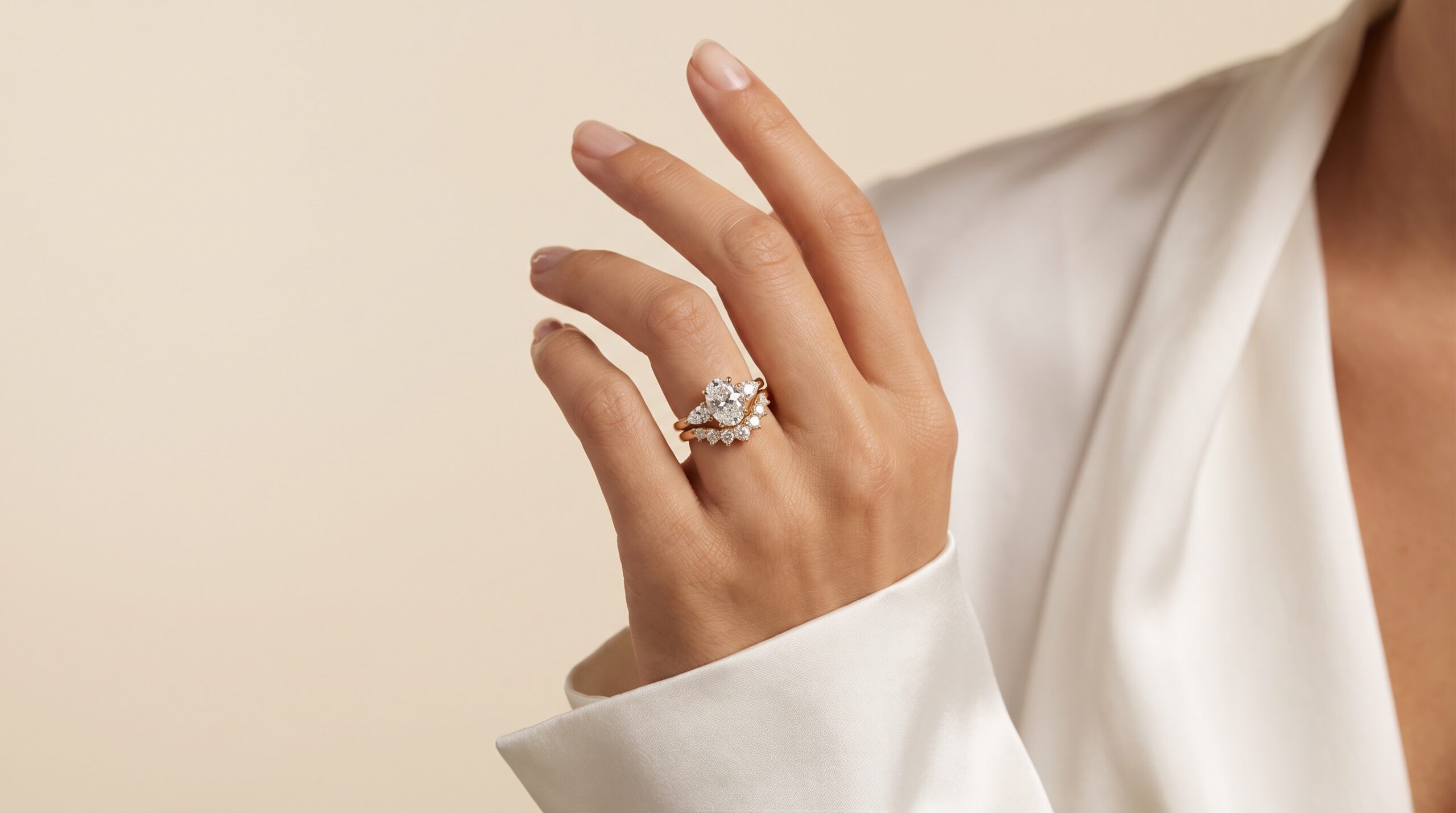
A straight wedding band sitting beside a halo or a low-set solitaire often leaves a visible gap at the base of the stone. That gap isn’t a sign of the wrong ring or the wrong band. It’s usually a sign that the engagement ring’s setting needs a band shaped to follow it, rather than a band that assumes a flat profile on both sides.
This guide covers what curved wedding bands are, which engagement ring settings tend to need one, how to judge fit before buying, and when a straight band is still the simpler, equally valid choice.
What Is a Curved Wedding Band?
Curved Wedding Bands Explained
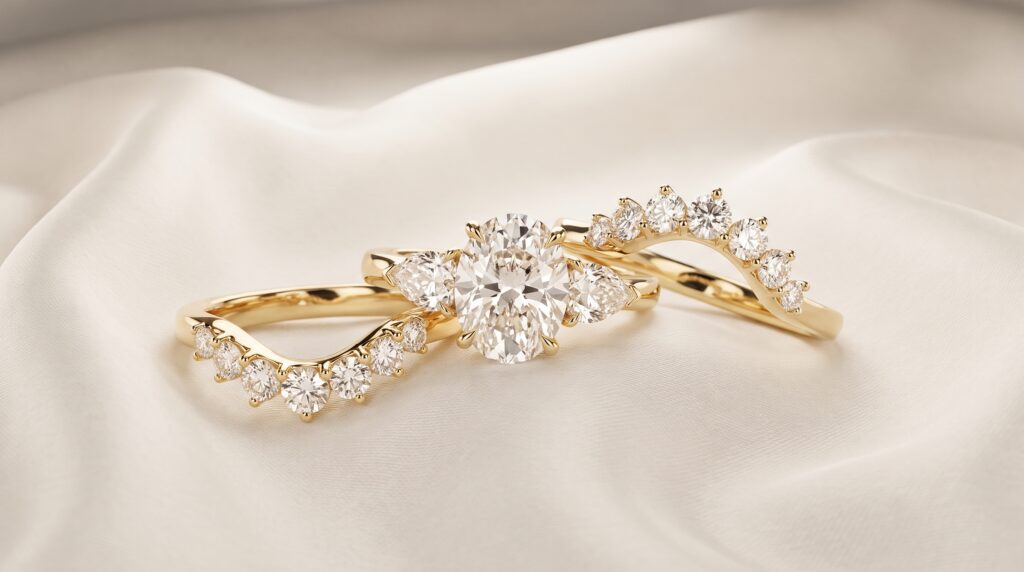
A curved wedding band is shaped with a contour, a shallow arc or notch built into the shank, so it can sit closer to an engagement ring instead of lying flat against it. The contour isn’t decorative in the way a stone setting is. It exists to solve a fit problem: an engagement ring with any raised element at its base will push a straight band away, and the curve is what closes that space.
Why Some Engagement Rings Need a Curved Band
Halo settings, cathedral-style shanks, and low-set solitaires all place metal or stones close to where a wedding band would normally rest. A straight band can’t follow that shape, so it either sits at an angle or leaves a gap wide enough to see daylight through. The problem isn’t the engagement ring’s design. It’s a mismatch between two rings that weren’t built with each other’s profile in mind.
Curved vs Contour Wedding Bands
In practice, jewelers use “curved” and “contour” to describe the same idea: a band shaped to follow another ring. “Contour” is sometimes used more specifically to describe the depth or degree of that shaping, which is why product listings often reference contour depth as a measurement rather than just calling a band curved.
Curved vs Straight Wedding Bands
Neither option is automatically better. A straight band is simpler to size, easier to find in a wide range of widths and metals, and typically costs less because it doesn’t require custom shaping. A curved band solves a specific fit problem but narrows the pool of engagement rings it will pair with, since a curve built for one setting won’t necessarily suit another.
| Feature | Curved Band | Straight Band | Buyer Consideration |
| Fit with engagement ring | Closer, follows the setting’s profile | May leave a gap with raised or low-set stones | Depends entirely on the specific engagement ring |
| Visual appearance | Flush, more unified stack | Can look separated from the engagement ring | Curved bands read as more intentional pairing |
| Cost | Typically higher due to shaping and fitting | Typically lower, simpler to produce | Budget for extra work if the setting needs a curve |
| Versatility | Matched to a specific ring shape | Works with most flat-profile settings | Straight bands are easier to wear alone or restyle |
| Best for | Halo, low-set, or cathedral engagement rings | Flat-profile or higher-set solitaires | Match the choice to the actual ring, not personal preference alone |
The decision comes down to what the specific engagement ring requires. A high-set solitaire with a plain shank often pairs fine with a straight band. A halo ring almost never does.
Types of Curved Wedding Bands
Single-Curve Bands
A single-curve band has one gentle arc, enough to follow the base of a solitaire without a deep notch. This is the most common and least expensive curved style, and it works well when the engagement ring’s setting is raised but not surrounded by additional stones or metal.
Double-Curve Bands
A double-curve band has two arcs, typically shaped to wrap around a halo or a setting with more width at its base. Because halo rings extend further out than a plain solitaire, a single curve usually isn’t deep enough to close the gap, which is why double-curve designs exist as a distinct category rather than a stronger version of the single curve.
Notched or Chevron Bands
A chevron band comes to a V-shaped point, which works for engagement rings with a strong horizontal or elongated profile, such as an east-west set stone or a wide cathedral shank. The notch isn’t just visual. It gives the band somewhere to sit even when the engagement ring’s silhouette doesn’t leave room for a rounded curve.
Straight Band Alternative
Not every buyer needs a curve. If the engagement ring has a low-profile setting with no halo and a plain shank, a straight band can sit flush without any shaping, and there’s no fit advantage to paying more for a contour that isn’t solving a real gap.
Curved Wedding Band Types
| Type | Shape | Best Engagement Ring Pairing | Pros | Considerations |
| Single-curve | One gentle arc | Solitaires with a moderately raised setting | Subtle, affordable, widely available | May not close larger gaps around halos |
| Double-curve | Two arcs | Halo rings, wider settings | Follows more complex profiles | Usually needs to be matched to the specific ring |
| Chevron/notched | V-shaped point | Pear, oval, east-west, or cathedral settings | Works with elongated or angular silhouettes | Can look more dramatic than needed for simpler rings |
| Straight | Flat, no contour | Low-profile or plain-shank solitaires | Lower cost, more universal fit | Won’t close a gap if the setting is raised or haloed |
Which Engagement Rings Pair Best With Curved Bands?
Halo Engagement Rings
The ring of accent stones around a halo center stone extends the setting’s footprint well beyond the center stone itself. A straight band can’t follow that outline, which is why halo rings are one of the more common reasons buyers look for a curved or double-curve option in the first place.
Low-Set Solitaires
A solitaire mounted close to the shank, rather than raised on a tall prong setting, still creates enough of a lip at its base to push a flat band away. A single-curve band is usually enough here, since the gap tends to be smaller than what a halo creates.
Pear and Oval Engagement Rings
Elongated stone shapes don’t sit symmetrically the way a round solitaire does, so a curve designed for a round stone may not follow a pear or oval outline correctly. A chevron or ring-specific contour tends to work better for these shapes than a generic curved band.
Cathedral and East-West Settings
Cathedral shanks, where the metal arches up toward the stone, and east-west settings, where the stone is oriented sideways, both create silhouettes that a simple curve wasn’t designed for. These usually call for a custom or semi-custom contour rather than an off-the-shelf curved band.
How to Choose the Right Curve
Contour Depth
Contour depth refers to how far the curve or notch cuts into the band. A shallow contour works for subtle gaps, while a deeper one is needed for halos or wider settings. Buying based on depth measurements, when they’re available, is more reliable than buying based on a product photo alone, since photos don’t convey how far the curve actually extends.
Stone Height and Setting Profile
The band needs to match the actual engagement ring, not just a general stone shape. Two oval rings can have very different setting heights and shank widths, and a curved band built for one won’t necessarily sit flush with the other. This is the main reason generic “curved band” listings without ring-specific guidance are hard to shop with confidence.
Shank Thickness
A very thin shank, particularly one under roughly 2.5mm, has less metal to work with when a contour is cut into it, which can make the band more prone to bending or distorting under regular wear. Thicker shanks tolerate contouring with less risk, which is worth factoring in in when the curve needs to be deep.
Stack Trial
Trying the band on with the actual engagement ring, in person or through a return-eligible online order, remains the most reliable way to confirm fit. Photos and product descriptions help narrow the choice, but they can’t fully substitute for seeing how the two rings sit together on the finger.
Curved Band Fit Checklist
- Does the band sit close to the engagement ring without a visible gap?
- Is there any rubbing or friction between the two rings when worn together?
- Does the curve look too shallow or too deep for the setting?
- Does the stack feel stable, without one ring pushing the other out of alignment?
- Is the combined stack comfortable at the knuckle and the base of the finger?
Custom vs Ready-Made Curved Wedding Bands
Ready-made curved bands are built to standard contour shapes and work well for common engagement ring profiles, such as a moderate halo or a typical solitaire setting. Semi-custom options allow small adjustments, like depth or width changes, without a full custom build. Fully custom bands are made to match a specific engagement ring’s measurements and are the most reliable option for unusual settings, east-west stones, or a buyer who wants an exact flush fit.
| Option | Best For | Fit Accuracy | Cost Level | Timeline Consideration |
| Ready-made | Common halo or solitaire shapes | Moderate, based on standard contours | Lower | Fastest, often in stock |
| Semi-custom | Rings needing minor depth or width changes | Higher than ready-made | Moderate | Some production lead time |
| Fully custom | Unusual settings, exact flush fit | Highest, built to the specific ring | Highest | Longest, requires design and casting time |
Are Curved Wedding Bands Durable?
A curved shape doesn’t automatically weaken a band. Durability comes down to metal choice, shank thickness, casting quality, and whether the contour was engineered correctly for the metal being used. A well-made curved band in a durable metal holds up the same way a well-made straight band does.
Why Shank Thickness Matters
Thin shanks carry the most risk when a contour is added, since there’s less material distributed around the curve to resist bending. A jeweler working with a thin profile may need to reinforce the contoured area or recommend a slightly thicker shank than the buyer initially wanted, which is a tradeoff worth discussing before ordering rather than after.
Annual Inspection
The contoured section of a band, where the metal is thinnest or most shaped, is a reasonable place to check for stress or wear during a routine jewelry inspection. This isn’t unique to curved bands, but the contour area is worth specific attention compared to a flat, uniform shank.
Sizing and Comfort for Curved Wedding Bands
Size While Stacked
A curved band should be sized while worn with the engagement ring, not measured against a bare finger. The contour changes how the band sits, and a size that feels right alone can feel different once it’s resting against another ring’s profile.
Comfort and Rotation
A band that follows the engagement ring’s shape has less room to rotate independently, since the contour is doing some of the work a matched profile would do in a straight-band stack. This isn’t a guarantee against spinning, but a well-matched curve tends to hold its position better than a straight band forced against an uneven setting.
Daily Wear Feel
Once properly fitted, a curved band doesn’t feel meaningfully different from a plain band in daily wear. The contour is only noticeable where it meets the engagement ring, not across the rest of the shank.
Cost Considerations
Why Curved Bands Can Cost More
Curved bands typically involve more design and production work than a straight band: CAD modeling to match a specific contour, more precise casting to hold that shape accurately, and, for double-curve or chevron designs, more complex tooling. Each of those steps adds labor and time that a straight band doesn’t require.
When the Added Cost May Be Worth It
The added cost is worth weighing against what a straight band would actually look and feel like on the same engagement ring. If a straight band would leave a noticeable gap or sit at an angle, the extra cost of a curved band is buying a specific, functional fit rather than a stylistic upgrade. If the engagement ring’s setting is already low and flat, that same spending wouldn’t solve a problem that doesn’t exist.
How to Buy a Curved Wedding Band Online
A curved band is harder to judge from a photo than a straight one, since fit depends on measurements that don’t always show up clearly in a product image. Look for contour depth stated in millimeters, a list of compatible setting types, photos showing the band stacked against an engagement ring rather than alone, profile cross-sections, and CAD previews if the retailer offers custom or semi-custom work. A listing should also be clear about whether the curve is a universal shape or built for a specific ring profile.
Red flags include “universal curve” claims with no supporting measurements, no illustration of how the band closes a gap, no CAD preview for custom orders, no guidance on which settings the band is compatible with, and no profile or cross-section image.
Care and Maintenance for Curved Wedding Bands
Clean Like Other Fine Jewelry
Curved bands don’t need different cleaning methods than any other fine jewelry. Warm water, mild soap, and a soft brush handle most day-to-day buildup, and the same cautions around harsh chemicals and abrasives that apply to any ring apply here too.
Store Separately
Storing the curved band apart from the engagement ring when it’s not being worn reduces the contact that causes scratching between the two pieces. The GIA recommends against leaving jewelry loose in a drawer, suggesting individually padded slots or soft pouches instead, which applies directly to rings that are otherwise stored touching each other.
Inspect the Contour Area
The curved or notched section of the band is a reasonable focus point during a periodic check, since it’s the area doing the most work to maintain contact with the engagement ring. The GIA suggests having jewelry checked by a professional roughly every six months, which is a reasonable baseline for a contoured band worn daily.
Conclusion
A curved wedding band solves a specific problem: a straight band that won’t sit flush against a particular engagement ring setting. The right choice depends on that ring’s actual profile, not on the general shape of the center stone. Check contour depth, shank thickness, and setting compatibility before buying, and try the two rings together whenever possible rather than relying on how a curved band looks in isolation.
Frequently Asked Questions
What is a curved wedding band?
A curved wedding band is a ring shaped with a contour, an arc or notch built into the shank, so it can sit closer to an engagement ring instead of lying flat against it. The shaping exists to close the gap that a raised setting, such as a halo or cathedral shank, would otherwise leave between the two rings.
Do I need a curved band for my engagement ring?
It depends on the engagement ring’s setting. Halo rings, low-set solitaires, and cathedral shanks tend to leave a visible gap with a straight band, which usually means a curved option fits better. A high-set solitaire with a plain shank often pairs fine with a straight band, so a curve isn’t a universal requirement, only a solution for settings that actually create a gap.
Are curved wedding bands only for halo rings?
No. Halo rings are one of the more common reasons buyers look for a curved band, but low-set solitaires, pear and oval shapes, and cathedral or east-west settings can all benefit from some degree of contouring. The specific curve type, single-curve, double-curve, or chevron, depends on which setting is involved.
Can a straight band work instead?
Yes, if the engagement ring’s setting doesn’t create much of a gap in the first place. A flat-profile solitaire or a lower setting without a halo often sits fine next to a straight band, and there’s no fit advantage to paying for a contour that isn’t solving a real problem.
Are curved wedding bands durable?
A curved shape doesn’t automatically make a band weaker. Durability depends on the metal, the shank thickness, and how well the contour was engineered and cast. Very thin shanks are more vulnerable to bending once a contour is added, which is why thicker shanks are often recommended when a deeper curve is needed.
Can curved wedding bands be resized?
Resizing a curved band is generally more involved than resizing a straight one, since the contour has to be preserved or reshaped during the process rather than simply cut and rejoined. It’s usually possible, but it’s worth asking a jeweler in advance whether the specific contour can be resized without altering how it fits against the engagement ring.
What is contour depth?
Contour depth is the measurement of how far a curve or notch cuts into the band’s shank. A shallow contour suits a subtle gap, such as a low-set solitaire, while a deeper contour is typically needed for halo rings or wider settings. Depth measurements, when a retailer provides them, are a more reliable way to judge fit than relying on a product photo alone.
Should I choose custom or ready-made?
Ready-made curved bands work well for common engagement ring profiles, like a standard halo or solitaire. Semi-custom options allow small adjustments to depth or width. A fully custom band is generally the better choice for unusual settings, east-west stones, or when an exact flush fit matters more than cost or turnaround time.
How do I know if a curved band will fit online?
Look for contour depth measurements, a clear list of compatible setting types, photos showing the band stacked against an engagement ring rather than photographed alone, and CAD previews if the piece is custom or semi-custom. A listing that only claims a “universal curve” without any of that supporting detail is harder to trust, since fit for a curved band depends on specifics that a single generic photo can’t convey.