
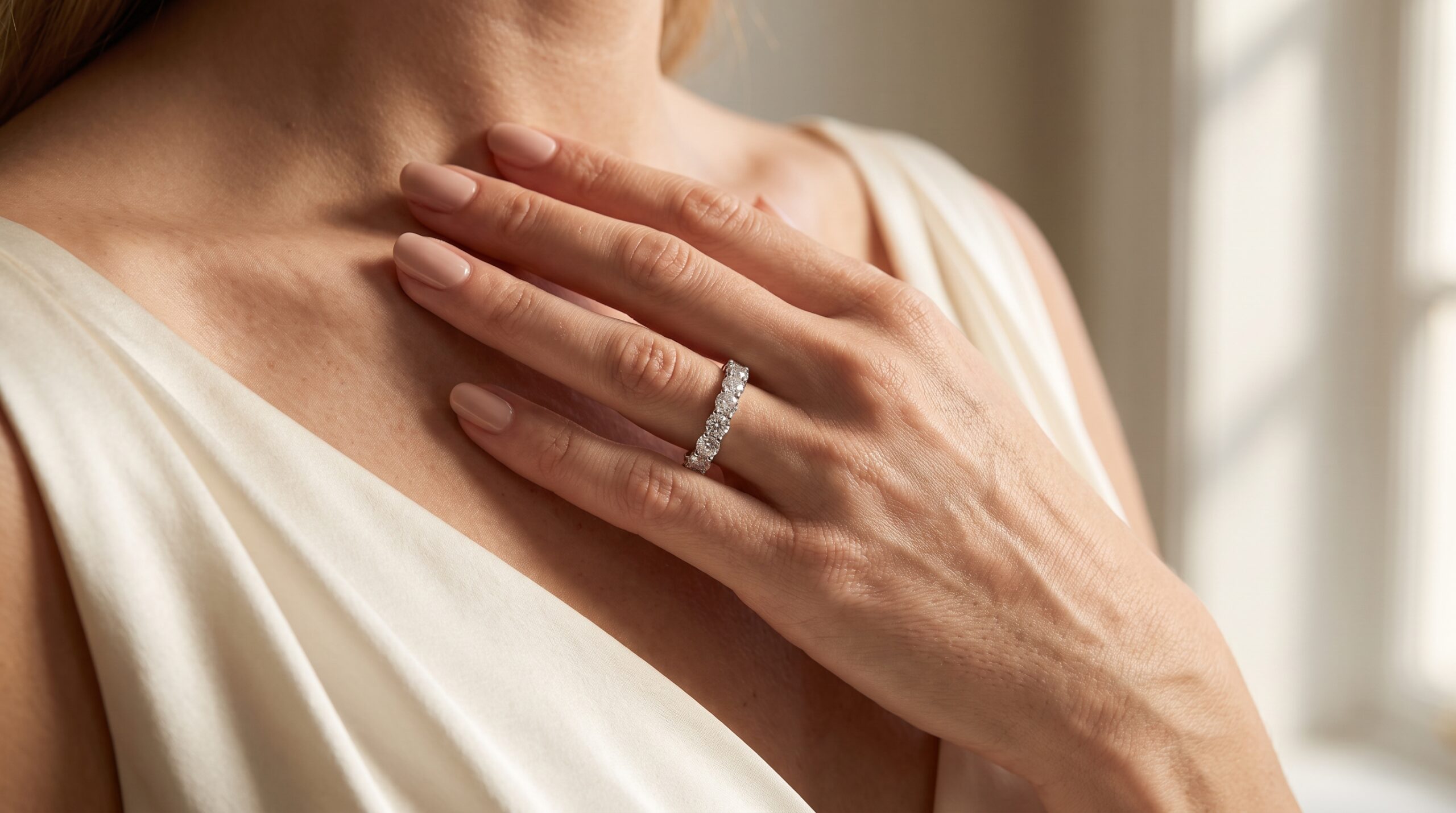
Choosing a diamond wedding band comes down to a handful of real decisions: how much of the band should carry diamonds, how those diamonds are held in place, whether the ring can be resized later, and how it will sit next to an engagement ring. The band with the most sparkle isn’t automatically the right one. A full eternity design that can’t be resized might be a poor fit for someone whose ring size could change, while a channel-set band might suit someone who works with their hands more than a pavé design would.
This guide walks through the main styles, how the settings differ in durability and upkeep, and what to check before buying.
What Is a Diamond Wedding Band?
The Basic Definition
A diamond wedding band is a ring with diamonds set into the metal, either running around the entire circumference or across the portion that’s visible when worn. It’s typically worn alongside an engagement ring, though many people wear one on its own.
Why Diamond Bands Are Popular
The appeal is straightforward: diamonds catch light in a way plain metal doesn’t, and a diamond band adds visual weight to a bridal stack without competing with the engagement ring’s center stone. For couples who want a ring that reads as more than a simple metal loop, a diamond band delivers that without the size or cost of a larger center stone.
What to Consider Beyond Appearance
A diamond band is usually worn every day, which raises questions a plain band doesn’t. How secure is the setting during regular activity like typing, gardening, or washing dishes? Can the ring be resized if a finger changes size over time? How often does it need to go to a jeweler for a checkup? These questions matter as much as which style looks best in a photo.
Main Types of Diamond Wedding Bands
Full Eternity Bands
Diamonds run continuously around the entire band, so the ring sparkles from every angle, including the portion that sits against the palm. This uses more diamonds than any other style and gives the most consistent brilliance.
Half Eternity Bands
Diamonds cover the top, visible portion of the ring, while the underside remains plain metal. From the front, a half eternity band can look nearly identical to a full eternity band, but it uses fewer stones.
Pavé Bands
Small diamonds are set closely together with tiny shared prongs, creating a fine, continuous shimmer rather than the look of individual stones. The word comes from the French for “paved,” which describes the effect: the metal surface appears almost fully covered in small points of light.
Channel-Set Bands
Diamonds sit in a row between two parallel metal rails, with no prongs above the stones. The rails hold the diamonds by their girdle (the widest part of the stone), which keeps the top surface of the ring smooth.
Contour Diamond Bands
These bands are curved or notched to follow the outline of a specific engagement ring, usually one with a raised setting or an unusual silhouette. Instead of sitting flat next to the engagement ring, a contour band bends around it.
| Style | How diamonds are set | Sparkle profile | Typical tradeoff |
| Full eternity | Diamonds continuous around the whole band | Sparkles from every angle | Very limited resizing |
| Half eternity | Diamonds across the visible top | Sparkles from the front and sides | Underside stays plain metal |
| Pavé | Small stones, shared tiny prongs | Fine, dense shimmer | Prongs need regular checking |
| Channel | Stones between metal rails | Smooth, protected sparkle | Slightly less light exposure per stone |
| Contour | Curved to match an engagement ring | Depends on base style | Only fits the ring it was shaped for |
Full Eternity vs Half Eternity Bands
Appearance Differences
A full eternity band sparkles all the way around, which matters if the ring is ever seen from underneath, such as when a hand is raised or the ring is examined up close. A half eternity band concentrates the same visual effect on the front and sides, which is what’s actually visible during normal wear.
Comfort and Practicality
Because a full eternity band has metal prongs or channels running the entire way around, the underside can feel less smooth against the skin than a half eternity band, where the inner portion is often a plain, polished metal surface.
Resizing Considerations
This is the tradeoff that catches the most buyers off guard. A full eternity band has diamonds set into the metal around its entire circumference, so cutting and resizing the shank means cutting through a section that’s set with stones. Many jewelers won’t attempt it, and those that do often can only adjust the size by a fraction before the stone spacing becomes uneven. A half eternity band, with plain metal on the underside, can usually be resized through that plain section the way an ordinary ring would be. Anyone whose ring size might change, including during pregnancy or with weight fluctuation, should treat resizing limitations as a real factor in the decision, not a minor detail.
Budget Considerations
A full eternity band uses roughly twice the number of diamonds as a half eternity band of the same width and quality, which is reflected in the price. This isn’t a reason to default to half eternity. It’s a tradeoff between total sparkle and total cost, and either choice is reasonable depending on what matters more to the buyer.
| Full Eternity | Half Eternity | |
| Sparkle coverage | Entire band | Visible top portion |
| Underside comfort | Diamonds or prongs may be felt | Often smooth metal |
| Resizing | Very difficult or not possible | Usually possible through the plain section |
| Relative cost | Higher, more diamonds used | Lower for a similar look from the front |
Pavé vs Channel Diamond Bands
Pavé Settings
Pavé diamonds are held by small metal beads or prongs shared between neighboring stones, which is what allows the diamonds to sit so close together. Because the metal holding each stone is minimal by design, pavé settings are more vulnerable to snagging and wear than settings with larger prongs. This doesn’t make pavé impractical, but it does mean the prongs deserve regular attention.
Channel Settings
In a channel setting, diamonds sit inside a groove between two metal walls, with no prongs sitting above the stone surface. This protects the edges of each diamond and gives the ring a smoother profile overall.
Which Is Better for Daily Wear
Neither setting is objectively better. Pavé gives a lighter, more delicate look and slightly more brilliance because more of each stone is exposed to light. Channel setting gives more physical protection to the stones and a flatter surface that’s less likely to catch on fabric or hair. Someone who works with their hands frequently, or who wants a lower-maintenance ring, may prefer a channel-set band. Someone prioritizing maximum sparkle and willing to have the ring inspected regularly may prefer pavé.
| Pavé | Channel | |
| Look | Dense, delicate shimmer | Smooth row of stones |
| Stone protection | Lower, small prongs | Higher, stones sit within rails |
| Surface profile | Slightly raised prongs | Flush and smooth |
| Maintenance | Regular prong checks recommended | Lower maintenance, still needs inspection |
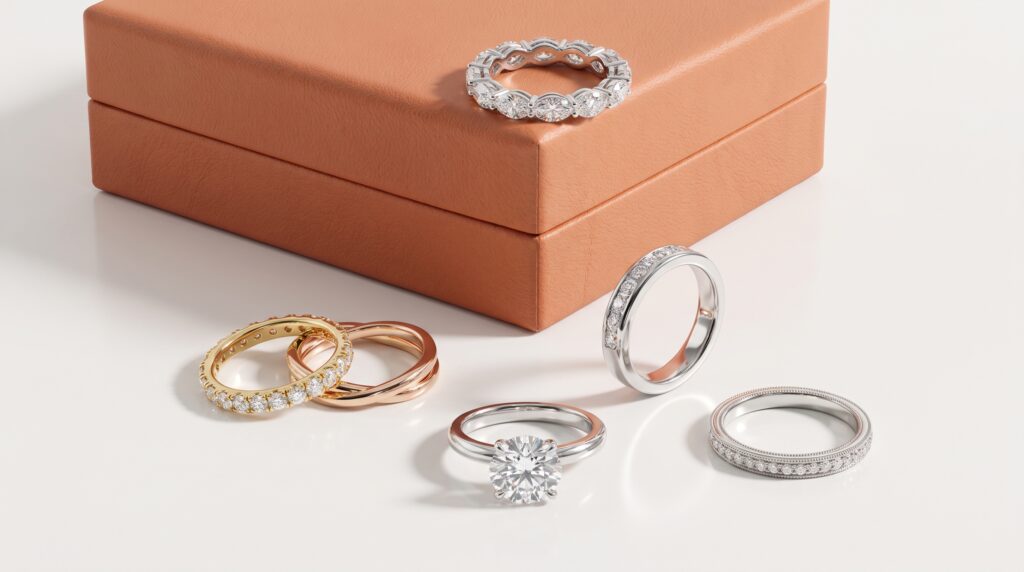
Matching a Diamond Wedding Band to an Engagement Ring
Consider Ring Height and Shape
An engagement ring with a high setting, such as a raised solitaire, sits above the finger differently than a ring with a low-profile halo. A wedding band that fits comfortably against a low-set engagement ring may leave a visible gap next to a high-set one.
Avoiding Gaps
This is what contour bands solve. A curved or notched band follows the shape of a specific engagement ring so the two rings sit flush against each other rather than leaving a triangle of space between them. Buyers considering a contour band should check whether it’s designed for their exact engagement ring style, since a contour shaped for one setting won’t necessarily match a different one.
Matching Diamond Size and Style
The diamonds in a wedding band don’t need to match the engagement ring’s center stone in size, but extreme mismatches, such as very large band diamonds next to a small center stone, can throw off the visual balance of the stack. A band with smaller, closely set diamonds usually reads as a complement to the center stone rather than competition for attention.
Matching Metal and Finish
Mixing metal colors, such as yellow gold and white gold, has become a common styling choice and isn’t a mistake. What tends to look unintentional is a mismatch in finish, such as a highly polished engagement ring paired with a band in a noticeably different karat or a duller finish. Checking the metal type and finish before buying helps avoid a stack that looks accidental rather than deliberate.
Diamond Quality in Wedding Bands
What Total Carat Weight Means
Total carat weight, often written as cttw, is the combined weight of every diamond in the piece, not the size of any single stone. A band listed at 1.00 cttw might contain dozens of small diamonds that together weigh one carat, which is very different from a ring with one one-carat stone. The 4Cs of diamond quality, developed by GIA, are the standard used to describe an individual diamond’s color, clarity, cut, and carat weight, and the same framework applies to the small stones used in wedding bands.
Understanding Melee Diamonds
The small diamonds used in pavé and channel settings are commonly called melee. Because grading dozens of tiny stones individually isn’t practical for most retailers, melee diamonds are typically assessed and sold as a batch that meets a stated quality range, rather than certified one by one.
Cut, Colour, and Clarity Basics
For melee diamonds, cut affects how much a stone sparkles under normal light, color affects how white or yellow-tinted it appears, and clarity affects whether inclusions are visible to the eye. At this small size, differences that would matter in a large center stone are often not visible without magnification, so buyers don’t need to apply the same scrutiny they would to an engagement ring’s center diamond.
Documentation and Certification
Individual grading reports from GIA or AGS are standard for larger center diamonds but aren’t always available for the small stones in a wedding band, since melee is frequently sold and graded in batches rather than stone by stone. What buyers can reasonably expect is a stated total carat weight, a general quality range for the diamonds used, and a metal purity mark, sometimes called a hallmark, indicating karat or fineness. The FTC’s guidance on buying gold, silver, and platinum jewelry explains what these metal markings are supposed to represent and what sellers are required to disclose.
Comfort, Width, and Fit
Band Width and Stability
A wider band spreads the metal over more surface area, which can make a ring feel steadier on the finger and can also make a set of diamonds look more substantial. A narrower band feels lighter and more delicate but has less structural material, which matters more for full eternity settings than for channel or half eternity styles.
Petite Hands and Narrow Bands
Bands in the 2 to 3mm range are common for pavé styles and tend to suit smaller hands or a more delicate stacking look. A narrow band isn’t inherently less durable, but it does concentrate the same number of prongs or channel walls into less metal, so the construction quality matters more at narrow widths than at wider ones.
Sizing for Stacking
Wearing a diamond band next to an engagement ring changes how snug the fit needs to be. Two rings on one finger take up more space than one, and a size that felt comfortable alone can feel tight once stacked. Trying on both rings together, rather than sizing each one separately, gives a more accurate read on the final fit.
Resizing Limitations
As covered earlier, full eternity bands carry the most resizing risk. Anyone choosing that style should confirm with the seller, before buying, what resizing is realistically possible and what it would involve.
Care and Maintenance
Cleaning Diamond Bands
A mild, ammonia-free soap and warm water, applied with a soft brush, is generally suitable for cleaning diamonds in secure settings. Weekly cleaning helps prevent the buildup of soap residue, lotion, and skin oils that dull a diamond’s sparkle over time.
Prong and Setting Checks
Pavé and eternity bands, which rely on small prongs to hold many stones, benefit from periodic professional inspection to catch loose or worn prongs before a stone is lost. The American Gem Society’s guide to buying jewelry covers what to look for when evaluating a piece and why working with a credentialed jeweler for ongoing care matters.
Storage Guidance
Storing stacked rings in separate compartments, rather than piled together in one dish or pouch, reduces the chance that one ring’s metal or stones will scratch another.
What to Avoid
Harsh chemicals, including chlorine and some household cleaners, can damage metal settings over time. A loose stone or a prong that feels rough or bent is worth addressing immediately rather than waiting for a scheduled inspection.
Diamond Band Care Checklist:
- Clean weekly with mild, ammonia-free soap and a soft brush
- Have prongs and settings professionally checked on a regular schedule, especially for pavé and eternity styles
- Store stacked rings in separate compartments
- Remove rings before contact with chlorine or harsh chemicals
- Address any loose stone or rough prong right away rather than waiting
Buying a Diamond Wedding Band Online
Product Details to Look For
Before buying, a listing should clearly state the total carat weight, the general diamond quality range, the metal type and karat, the band width, the setting type, whether it’s full or half eternity, any resizing limits, and, for contour styles, which engagement ring shapes it’s designed to fit.
Helpful Visuals
Photos of the ring on a hand, magnified images of the setting, and side-profile shots showing how the band sits all give a more accurate sense of the ring than a single front-facing product photo.
Red Flags
A listing that describes the diamonds only in vague terms, without stating carat weight or quality, makes it hard to know what’s being purchased. The same is true for a seller who claims a full eternity band can be resized without limitation, since that claim runs against how these settings are physically constructed. A listing missing clear information on setting type or carat weight is worth asking about directly before purchase.
Buying a Diamond Wedding Band: A Practical Summary
The right diamond wedding band depends on how it will be worn day to day, not just how it looks in a single photo. Full eternity offers the most complete sparkle but the least flexibility if a ring size needs to change later. Half eternity gives a similar front-facing look with more room to adjust sizing down the road. Pavé creates a fine, continuous shimmer but asks for more regular prong checks. Channel setting trades a bit of open sparkle for stones that are better protected during daily activity. Contour bands solve the specific problem of an engagement ring and wedding band that don’t sit flush together.
None of these is a universal best choice. The right one is the style whose tradeoffs match how the ring will actually be worn.
Frequently Asked Questions
What is a diamond wedding band?
A diamond wedding band is a ring set with diamonds, either continuously around the full circumference or across the visible top portion, typically worn alongside an engagement ring as part of a bridal set, though it can also be worn on its own.
What is the difference between full and half eternity?
A full eternity band has diamonds set all the way around the ring, including the underside, while a half eternity band has diamonds only across the top, visible portion, with plain metal underneath. From the front, the two can look very similar, but they differ in comfort, resizing flexibility, and typically in cost, since a full eternity band uses more diamonds.
Can eternity bands be resized?
Half eternity bands can usually be resized through their plain metal underside using standard jewelry techniques. Full eternity bands are much harder to resize because diamonds are set into the metal around the entire ring, leaving no plain section for a jeweler to cut and adjust. Some jewelers can make very small adjustments, but significant resizing is often not possible without disrupting the stone spacing. Anyone considering a full eternity band should ask the seller directly about resizing limitations before purchasing.
Is pavé good for everyday wear?
Pavé bands can be worn daily, but the small shared prongs that hold the stones in place are more delicate than larger prongs or channel walls, which means they benefit from more frequent professional inspection. For someone who wants a low-maintenance ring for physically demanding daily activity, a channel-set band may hold up with less upkeep, though pavé remains a practical choice for most everyday situations as long as it’s checked periodically.
Are channel-set bands more durable?
Channel settings protect the edges of each diamond by holding the stones between metal rails rather than exposed prongs, which generally makes them more resistant to snagging and chipping during daily wear. This added protection comes with a slight tradeoff in how much light reaches each stone compared to a more open setting like pavé.
What does total carat weight mean?
Total carat weight, written as cttw, is the combined weight of all the diamonds in a piece of jewelry, not the weight of a single stone. A band described as 1.00 cttw might contain many small diamonds whose combined weight equals one carat, which is different from a ring featuring one diamond that weighs a full carat on its own.
How often should diamond bands be inspected?
There’s no single fixed schedule that applies to every ring, since it depends on the setting type and how often the ring is worn. Pavé and eternity bands, which rely on numerous small prongs, generally warrant more frequent checks than channel-set bands. A jeweler can recommend an inspection interval based on the specific setting and how the ring is worn day to day.
Should my diamond wedding band match my engagement ring?
The band doesn’t need to match the engagement ring exactly, but the two should be evaluated together rather than separately. Ring height, metal color and finish, and diamond proportions all affect how well the two rings sit together as a stack. A contour band, shaped to follow the outline of a specific engagement ring, is one way to avoid a visible gap between the two.