
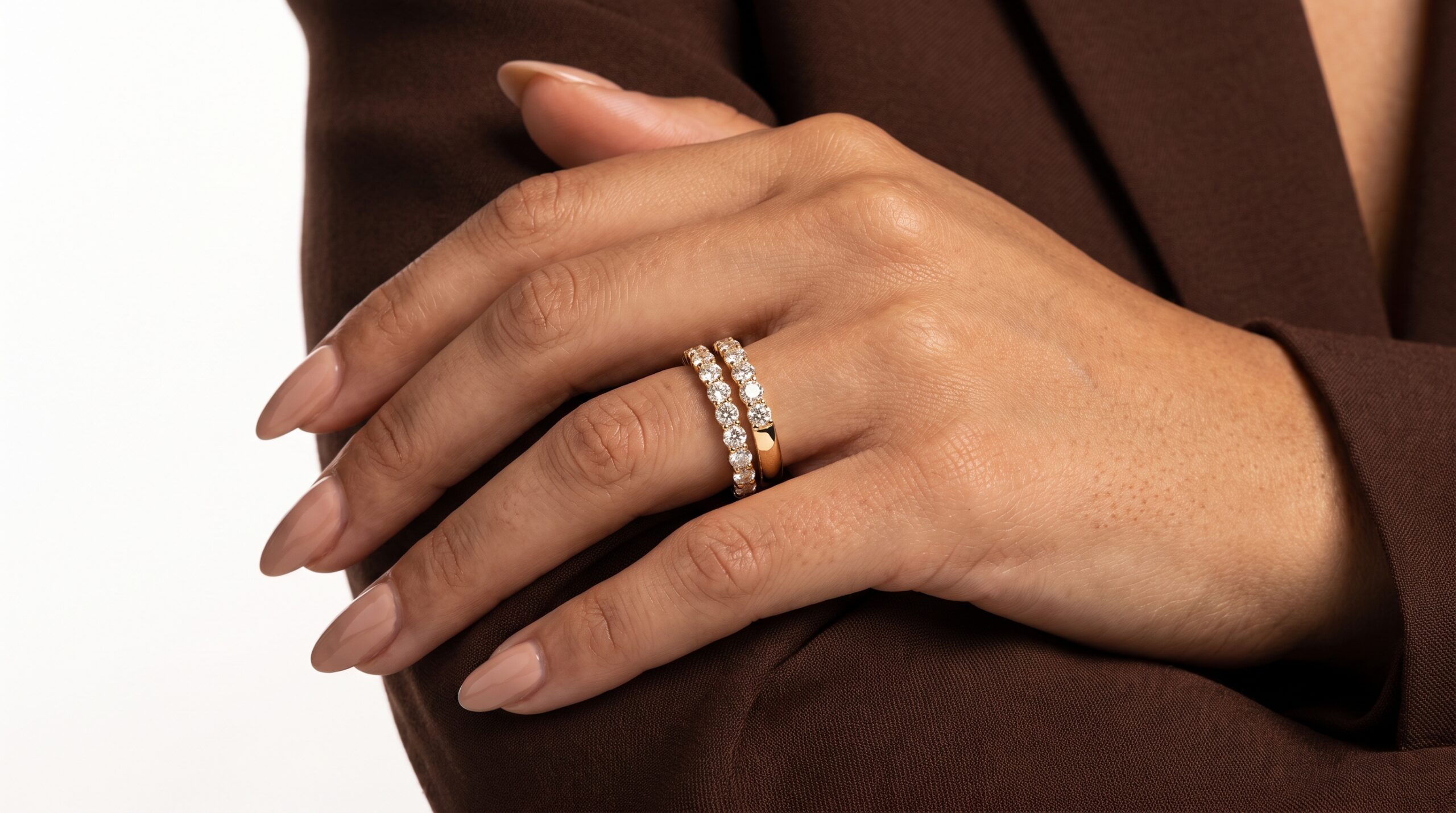
Full eternity and half eternity describe how much of a wedding band is set with diamonds. Full eternity means the diamonds run all the way around the ring. Half eternity means they cover only the front, visible portion, with plain metal underneath. The visual difference from the front can be almost nothing. The practical difference, in comfort, resizing, cost, and upkeep, is where the two styles actually diverge.
This comparison walks through those differences so the choice comes down to what matters for how the ring will be worn, not just which one looks more complete in a product photo.
What Is an Eternity Band?
Full Eternity Band Definition
A full eternity band has diamonds set continuously around the entire circumference of the ring, including the section that sits against the palm and between the fingers. Every part of the band carries a stone.
Half Eternity Band Definition
A half eternity band has diamonds across roughly the top half of the ring, the part that faces outward when the hand is held normally. The underside is plain metal, without diamonds or the settings that hold them.
Why Buyers Compare Them
The two styles can look nearly identical from a standing distance and a front-facing angle, which is why the comparison usually isn’t about appearance alone. It’s about sparkle from all sides, how the ring feels on the hand over a full day, whether it can be resized later, the price difference for the added diamonds, and how much upkeep each style needs.
Full Eternity vs Half Eternity: Main Differences
| Full Eternity | Half Eternity | |
| Diamond coverage | Entire band, 360 degrees | Visible top portion only |
| Comfort | Stones or settings felt around the full circumference | Plain metal underside, generally smoother |
| Resizing | Requires precise initial sizing; later adjustment is limited | More flexibility for future resizing |
| Cost | Typically higher | Typically lower for a similar look from the front |
| Maintenance | More stones to monitor | Fewer stones, generally less to check |
| Best for | Buyers prioritizing complete sparkle and unlikely to need resizing | Buyers who want the look with more room for sizing changes |
Diamond Coverage
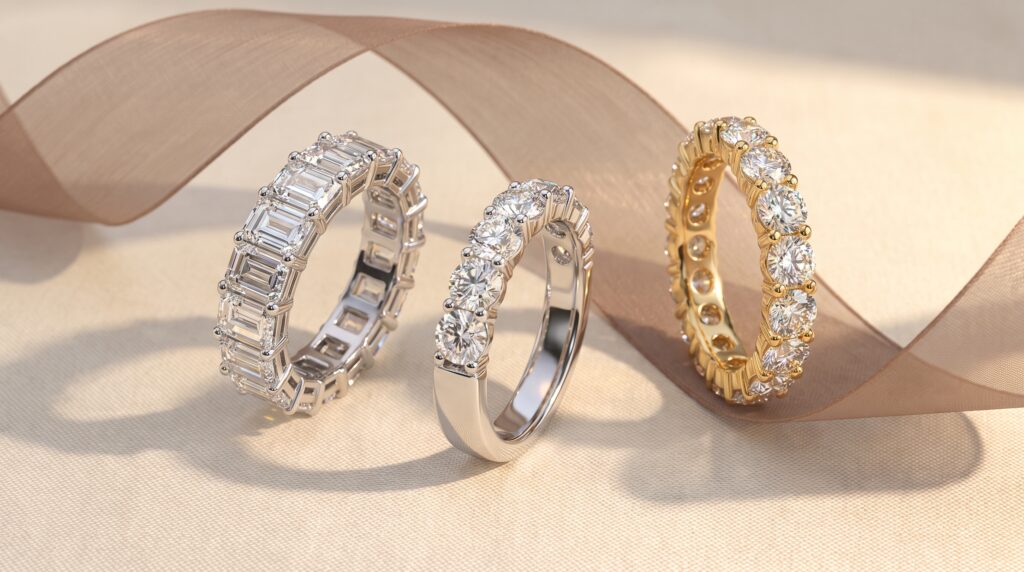
A full eternity band puts diamonds where they’ll never be seen in normal wear as well as where they will, which is part of the appeal for some buyers: the ring is finished the same way from every angle, not just the front. A half eternity band concentrates the diamonds on the part of the ring that’s actually visible when a hand is resting, gesturing, or photographed, which is most of what anyone sees day to day.
Comfort
The underside of a full eternity band has metal prongs, channel walls, or bezel edges running its entire length, since that’s where the diamonds are held. Depending on the setting style, this can be felt against the adjacent finger, particularly during activities that involve gripping. A half eternity band has a plain, usually polished metal underside, which tends to feel smoother in the same situations.
Resizing
This is the difference most likely to affect a buyer months or years after purchase. A full eternity band has no plain section of metal for a jeweler to cut and adjust: the diamonds are set into the metal the entire way around, so resizing means working through a stone-set section. Many jewelers decline to resize a true full eternity band beyond a very small amount, since cutting through set stones risks loosening neighboring diamonds or leaving uneven spacing once the ring is rejoined. A half eternity band keeps its plain underside specifically so a jeweler has room to work, and modest resizing is usually possible there the way it would be on any plain band. This is why getting the initial size right matters more for full eternity purchases than for almost any other ring style. Buyers whose size might change, including with pregnancy, weight changes, or seasonal swelling, should weigh this before choosing full eternity.
Cost
A full eternity band uses roughly twice the diamonds of a half eternity band at the same width and quality, and the setting work involved in securing stones around a full circle, including the underside where wear is highest, adds labor cost beyond the stones themselves. This doesn’t mean half eternity is the more sensible default. It means the extra cost of full eternity buys something specific (complete coverage), and whether that’s worth it depends on whether the buyer values sparkle that shows even when the ring isn’t facing outward.
Pros and Cons of Full Eternity Bands
| Pros | Cons |
| Sparkles from every angle, including the underside | Difficult or often impossible to resize later |
| Reads as a complete, finished design | More stones to inspect and maintain |
| Suited to statement pieces or ones meant to be passed down | Underside may feel less smooth during activity |
| No visible “gap” if the ring rotates on the finger | Higher cost for the same width and quality level |
Pros and Cons of Half Eternity Bands
| Pros | Cons |
| Smoother underside, generally more comfortable for daily wear | Diamonds don’t extend around the full band |
| More flexibility if resizing is needed later | If the ring rotates, the plain underside can become visible from the front |
| Lower cost than full eternity at a similar look and quality | Slightly less continuous sparkle than full eternity |
| Practical for everyday stacking with other rings |
Which Style Is Better for Daily Wear?
Consider Your Lifestyle
Someone who uses their hands frequently through the day, for manual work, frequent handwashing, or sports, may notice the underside of a full eternity band more than someone whose hands are less active. Half eternity’s smooth underside tends to go unnoticed in the same conditions. Neither style is unsuitable for daily wear; the difference is in how much the underside construction is likely to register during regular use.
Consider Finger-Size Changes
Ring size isn’t always fixed for life. Pregnancy, weight changes, and even temperature and humidity can shift finger size enough to affect fit. Because full eternity bands are hard to resize after the fact, buyers who anticipate any of these changes have more to lose by choosing a style that locks in the current size. A half eternity band offers a practical safety margin here that a full eternity band doesn’t.
Consider Stacking
When a diamond band sits next to an engagement ring, part of what’s being evaluated is how the two rings interact as the hand moves and the bands rotate slightly during the day. A full eternity band keeps its sparkle consistent no matter how it rotates, since there’s no plain section to end up facing outward. A half eternity band depends on staying reasonably aligned, since rotation can bring the plain underside around to the visible side, similar to how a bracelet clasp can work its way into view if it shifts out of place. In practice this is usually minor and easy to adjust by hand, but it’s a real difference in how the two styles behave once worn rather than just displayed.
Setting Styles: Pavé vs Channel
Pavé Eternity Bands
Pavé settings hold diamonds close together using small shared prongs or beads, producing a dense, continuous shimmer rather than the look of individually mounted stones. Because the metal holding each stone is minimal, pavé settings benefit from more frequent prong checks than settings with larger, more substantial metal contact points.
Channel-Set Eternity Bands
Channel settings hold diamonds between two parallel metal walls, with no prongs above the stone surface. This gives the diamonds more physical protection and a smoother top surface, at a slight cost to how much light reaches each stone compared with an open pavé setting.
Which Setting Supports Your Lifestyle
A buyer who wants the lowest-maintenance option, particularly for a full eternity band where more stones are involved overall, may prefer channel setting for the added protection. A buyer prioritizing maximum sparkle and comfortable with periodic professional inspection may prefer pavé. This holds for both full and half eternity styles: the setting type and the coverage type are separate decisions that combine to produce the final ring.
Quality Factors to Look For
Diamond Consistency
In an eternity band, dozens of small diamonds sit next to each other, which makes consistency more noticeable than it would be in a ring with a single center stone. Diamonds that vary visibly in size or color break up the continuous look that’s the main appeal of an eternity design. GIA’s 4Cs framework for color, clarity, cut, and carat weight is the standard used to describe diamond quality, and applying it evenly across all the stones in a band, rather than judging a single large stone, is what determines whether the finished ring reads as uniform.
Metal and Hallmarks
A karat or fineness mark, known as a hallmark, indicates the purity of the metal used in the band. Checking this mark, and comparing it against the engagement ring it will be worn with, helps confirm the two pieces are made from comparable metal rather than mismatched alloys that could wear or tarnish differently over time. The FTC’s guidance on jewelry metal marking explains what these markings are required to represent.
Professional Fit
Because full eternity bands offer so little room for later adjustment, an in-person or carefully guided sizing process before purchase matters more for this style than for almost any other ring. A half eternity band still benefits from accurate sizing, but the consequences of being slightly off are less severe given the resizing flexibility built into the design.
Documentation
Individual grading reports are standard practice for a large center diamond but aren’t typical for the small, uniform stones used in eternity bands, which are usually sold and quality-graded as a matched parcel rather than stone by stone. What’s reasonable to expect from a seller is a stated total carat weight, a general quality range for the diamonds used, and a clear metal hallmark, rather than a certificate for every individual stone.
Care and Maintenance
Cleaning
Regular cleaning with a mild, ammonia-free soap and a soft brush removes the buildup of lotion, soap residue, and skin oils that dull a diamond’s brilliance. Periodic professional cleaning, using equipment not typically available at home, can reach areas that a home cleaning routine misses.
Prong and Setting Checks
Full eternity and pavé styles, which rely on the greatest number of small prongs, benefit from the most frequent professional inspection. Catching a loose or worn prong during a routine check is far less costly than losing a stone that goes unnoticed.
What to Avoid
Ultrasonic cleaners are common in jewelry stores, but the vibration they produce can loosen stones in delicate, prong-heavy settings like pavé eternity bands. It’s worth asking a jeweler whether ultrasonic cleaning is appropriate for a specific ring before using one, rather than assuming it’s safe for every setting.
Storage Guidance
Storing an eternity band separately, in its own compartment or a soft pouch rather than tossed in with other rings, reduces the chance that adjacent pieces will scratch each other or catch on exposed prongs.
Buying Eternity Bands Online
Product Details to Look For
A complete listing should state the stone count, total carat weight, setting type, whether coverage is full or half, any resizing limitations, the metal type and hallmark, and general specifications for the melee diamonds used.
Helpful Visuals
A 360-degree video is particularly useful for eternity bands, since it’s the only way to confirm from a photo alone whether coverage genuinely extends around the entire ring or only appears to from a single angle. Close-up images of individual stones, a side profile showing the underside construction, and photos of the ring stacked with another band all add information a single front-facing shot doesn’t.
Red Flags
A listing that claims a full eternity band can be resized without meaningful limitation is worth treating with skepticism, since that claim runs against how these bands are physically constructed. The same caution applies to listings that don’t state a stone count or carat weight, since there’s no way to evaluate what’s actually being purchased without that information. A listing with no close-up or 360-degree visuals makes it harder to confirm the coverage claimed in the description.
A Practical Way to Decide
The comfort, resizing, and cost differences between full and half eternity bands are consistent enough to use as a starting point. If finger size is likely to stay stable and complete coverage matters more than cost or resizing flexibility, full eternity delivers what it promises: sparkle from every angle, with no visible gap regardless of how the ring rotates. If comfort during daily activity, a lower price for a similar front-facing look, or the option to resize later matter more, half eternity is built for exactly that. Neither answer is more correct than the other. What matters is being honest about which of those priorities actually applies.
Frequently Asked Questions
What is the difference between full eternity and half eternity?
A full eternity band has diamonds set around the entire ring, including the underside, while a half eternity band has diamonds only across the visible top portion, with plain metal underneath. From the front, the two can look very similar, but they differ in comfort, cost, and how much room a jeweler has to resize the ring later.
Can full eternity bands be resized?
Resizing a full eternity band is difficult because the diamonds are set into the metal the entire way around, leaving no plain section to cut and adjust. Some jewelers can make very small changes, but larger adjustments risk disturbing the spacing of the stones or loosening neighboring diamonds. Anyone considering a full eternity band should ask the seller directly what resizing is realistically possible before buying, rather than assuming it can be handled later.
Are half eternity bands more comfortable?
Half eternity bands generally have a plain, smooth metal underside, which tends to feel less pronounced against an adjacent finger than the prongs or settings running the full circumference of a full eternity band. Whether this difference is noticeable in daily wear depends on the specific setting style and how active the wearer’s hands are.
Do half eternity bands spin?
Any ring can rotate slightly on the finger during normal wear, and a half eternity band is no more prone to this than other styles. What differs is the consequence: if a half eternity band rotates far enough, the plain underside can briefly face outward, whereas a full eternity band looks the same regardless of how it turns since diamonds cover the entire circumference. In most cases, rotation is minor and easy to correct by hand.
Is full eternity worth the extra cost?
That depends on what the buyer values. Full eternity costs more because it uses roughly twice the diamonds of a half eternity band at a similar width and quality, along with more complex setting work around the full circle. That additional cost buys complete coverage and a design that looks finished from any angle, including the underside. For a buyer who won’t often see or care about the underside, or who prioritizes resizing flexibility, that added cost may not reflect a meaningful difference in daily experience.
Which style is better for everyday wear?
Neither style is better in every case. Half eternity tends to be more practical for buyers who anticipate finger-size changes or who want a smoother underside during hands-on activity. Full eternity tends to suit buyers who won’t need to resize and who want consistent sparkle regardless of how the ring sits or rotates. The right choice depends on those individual circumstances rather than a fixed rule.
Is pavé or channel better for eternity bands?
Pavé settings create a denser, more continuous shimmer because more of each stone’s surface is exposed to light, but the small shared prongs that hold the diamonds need more frequent checking. Channel settings protect the stones between metal rails, giving a smoother, more durable surface at a slight cost to how much light reaches each diamond. Someone who wants maximum sparkle and is comfortable with regular inspections may prefer pavé; someone who wants lower maintenance may prefer channel.
How often should eternity bands be inspected?
There’s no single interval that applies to every ring, since it depends on the setting type and how frequently the band is worn. Full eternity and pavé styles, which involve the most prongs relative to the size of the ring, generally warrant more frequent inspection than channel-set or half eternity designs. A jeweler can recommend a specific schedule based on the ring’s construction and how it’s worn.