
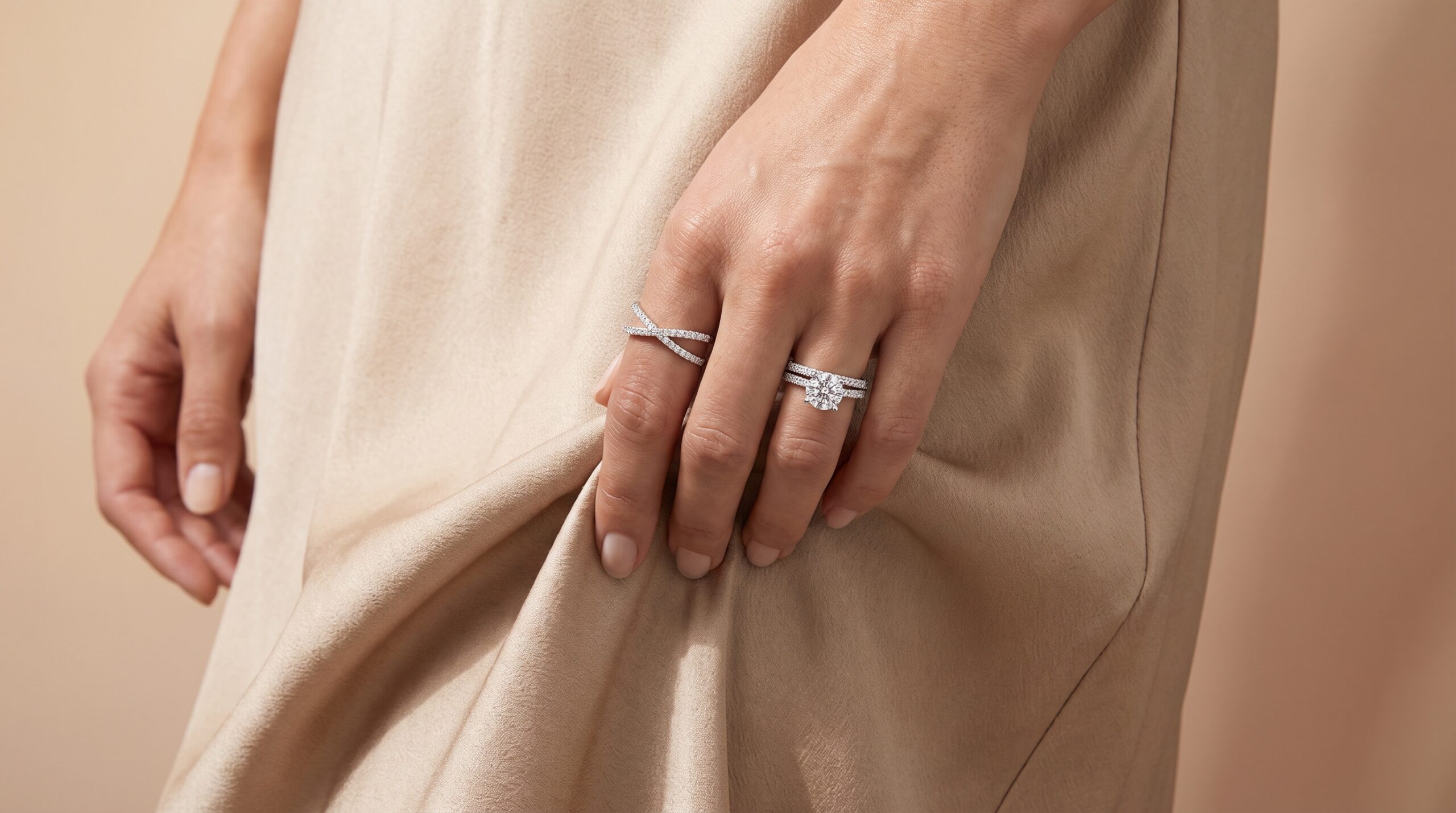
A stack of wedding bands is not one purchase. It’s a series of decisions, each one affecting how the rings before and after it will sit, fit, and wear. Buyers often start by picking a band they like the look of, then discover later that it spins against the engagement ring, catches on sweaters, or feels tighter than expected once a third ring joins the other two. None of that is inevitable. It comes down to width, metal, setting, and profile, chosen with the rest of the stack in mind rather than one ring at a time.
This guide walks through what stackable wedding bands are, how they differ from a fixed bridal set, and the practical choices that determine whether a stack looks intentional and wears comfortably for years, or ends up shoved in a drawer after the first scratch.
What Are Stackable Wedding Bands?
How Stackable Bands Work
Stackable bands are slim rings meant to be worn together on the same finger, usually alongside an engagement ring. Unlike a ring that’s soldered into a set, each band in a stack stays independent. That means the arrangement can change: a band can be added for an anniversary, swapped for a different metal, or worn on its own on days when a simpler look makes more sense.
Stackable Bands vs Fixed Bridal Sets
A fixed bridal set, sometimes soldered or fused, is designed once and worn as a single unit from that point forward. A stack is the opposite premise: each ring stays separate, which allows the arrangement to change, grow, or shrink over time. The tradeoff is that a stack requires more thought at the point of purchase, because the buyer is responsible for making sure new bands actually work with what’s already on the finger. A fixed set removes that decision but also removes the option to change the look later.
Why Buyers Choose Stackable Bands
The appeal is usually one of three things: the ability to add rings over time rather than buying everything at once, the option to mix textures or metals for a more personal look, or the flexibility to wear fewer rings on some days and more on others. None of these require an elaborate collection. Many people wear just an engagement ring and one band for years before adding anything else.
Popular Stackable Wedding Band Styles
Enclosure Stacks
These are bands designed with a slight interlock or contour that grips the neighboring ring, keeping the stack aligned rather than letting each ring rotate independently. They tend to hold up better under daily wear because there’s less friction between loose, independently spinning rings.
Nested Bands
A nested band is shaped, usually curved or notched, to sit flush against the profile of an engagement ring rather than lying flat against it. This works well when the engagement ring has an asymmetrical setting, such as a solitaire with a raised head, since a flat band would otherwise leave a visible gap.
Eclectic Stacks
This is the loosest category: mixed metals, mixed textures, gemstone accents, or symbolic pieces added over time. It gives the most personal result but also carries the most risk of looking cluttered if widths and finishes aren’t coordinated.
Glam Wall Stacks
Multiple diamond or gemstone bands worn together to create continuous sparkle across the finger. This style draws the most attention and also requires the most maintenance, since more stones mean more settings to inspect and more surfaces prone to catching on fabric.
Stackable Wedding Band Style Comparison
| Style | Look | Pros | Cons | Best For |
| Enclosure | Fitted, cohesive | Resists spinning, holds alignment | Less flexible if styles change | Daily wear, active lifestyles |
| Nested | Curved, flush | Fills gaps around asymmetrical settings | Usually matched to one specific ring | Solitaire or raised-head engagement rings |
| Eclectic | Mixed, personal | Reflects individual style, grows over time | Requires planning to avoid a cluttered look | Buyers building a stack gradually |
| Glam wall | Continuous sparkle | Maximum visual impact | Higher maintenance, more settings to inspect | Special-occasion or lower-friction wear |
How to Choose the Right Width for Stackable Bands
Why Thin Profiles Matter
A single band at 4mm or 5mm reads as normal on its own. Three bands at that width stacked together add up to over a centimeter of metal across the finger, which changes both the look and the comfort. Thinner profiles let multiple rings sit together without the stack becoming bulky or physically restrictive at the knuckle.
Common Width Range
Most stackable bands fall between 1.5mm and 3mm. That range isn’t a strict rule, but it’s a useful starting point for anyone assembling a stack of three or more rings. A single accent band can go narrower, sometimes under 1.5mm, while an anchor piece might sit closer to 3mm without overwhelming thinner bands around it.
How Width Affects Comfort
Width is cumulative. A stack that measures comfortable at two bands can feel noticeably tighter once a third is added, even if each individual band is the same size that was previously comfortable alone. This is why sizing needs to account for the finished stack rather than each ring measured in isolation.
Stack Width Guide
| Width | Visual Effect | Comfort Note | Best Use |
| Under 1.5mm | Delicate, subtle | Adds minimal bulk, easy to layer | Accent or milestone bands |
| 1.5mm to 2mm | Balanced, versatile | Comfortable in stacks of three or more | Everyday stacking bands |
| 2mm to 3mm | More visible presence | Works well as an anchor piece | Anchor band or standalone wear |
| Over 3mm | Bold, statement | Can crowd a multi-ring stack | Single band or two-ring stack only |
How Stacking Affects Ring Size and Fit
Why Multiple Bands Can Feel Tighter
Each additional band takes up more circumference around the finger, and the knuckle, not the base of the finger, is usually what determines whether a ring can go on and off comfortably. A stack that slides on easily over a wide knuckle can still feel snug once resting at the base if too many bands are combined without adjusting for total width.
Sizing for the Full Stack
The most reliable approach is to try on the actual bands intended for the stack together, not each one against a bare finger. Some jewelers offer sizing that accounts for a specific combination of rings. If that isn’t available, err toward slightly looser individual sizing when three or more bands are planned, since the combined width will naturally tighten the fit.
How to Reduce Spinning
Rings with mismatched profiles, one rounded, one flat, one with a raised setting, tend to rotate independently and can end up misaligned throughout the day. Matching profiles, or choosing enclosure or nested styles designed to interlock, keeps the stack visually consistent without constant readjustment.
Fit Questions Before Buying a Stackable Band
- Does this band’s profile match the shape of the rings it will sit next to?
- Has the stack been tried on together, not just individually?
- Is there room to add one more band later without resizing everything?
- Does the width work with a full stack, not just this single ring?
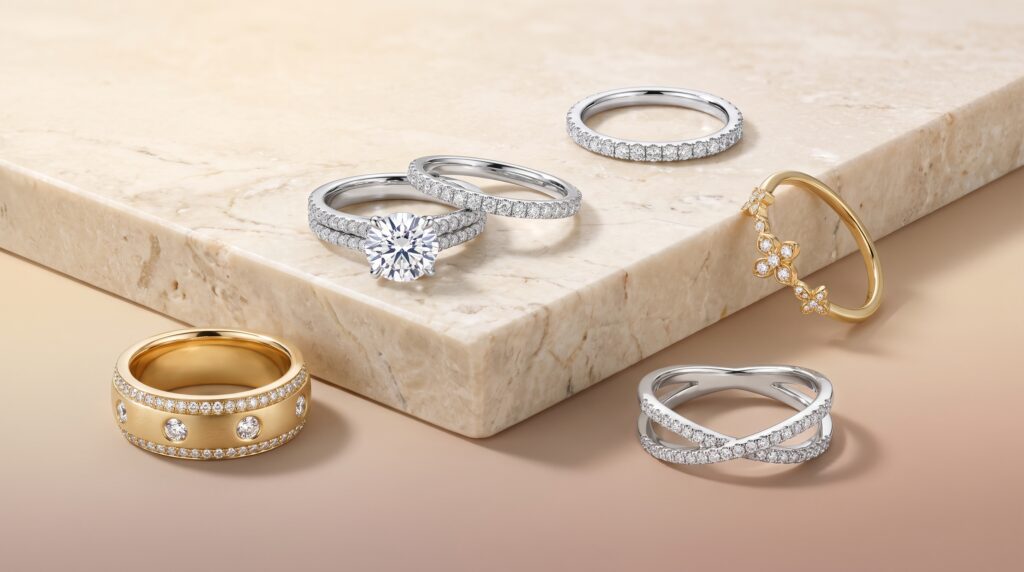
Mixing Metals in a Wedding Band Stack
Can You Mix Metals?
Yes, and it’s one of the more common ways buyers personalize a stack. But mixing metals isn’t risk-free. Different metals wear at different rates, and combinations that look identical in a photo can behave differently after a year of daily contact.
Metal Compatibility Considerations
Karat gold alloys vary in hardness depending on what they’re mixed with, and softer alloys mark more easily against harder ones when rings rub together throughout the day. Pure 24-karat gold is soft, which is why it’s alloyed with other metals to increase hardness in jewelry, and the FTC’s guidance on gold and silver jewelry explains how the karat mark on a piece indicates how much of that alloy is pure gold. That means a lower-karat band and a higher-karat band in the same stack may wear noticeably differently over time, even if they look the same color side by side. Finish is a separate issue: a matte band next to a polished one will show wear unevenly, since the polished surface picks up fine scratches that read differently against a brushed texture.
How to Mix Metals Elegantly
A few approaches tend to hold up better than random combinations:
- Repeat one metal at least twice in the stack so it reads as a deliberate choice rather than an accident.
- Let one metal dominate, with the others used as accents rather than equal partners.
- Add a two-tone band as a bridge between two different metals, which softens the transition instead of placing them directly against each other.
- Keep widths consistent across mixed-metal bands so the color variation is the only variable, rather than color and proportion both shifting at once.
Metal Mixing Guide
| Metal Combination | Visual Effect | Wear Consideration | Styling Tip |
| Yellow gold + white gold | Classic contrast | White gold may need periodic rhodium replating | Repeat one metal to anchor the pairing |
| Rose gold + yellow gold | Warm, tonal | Similar wear if karats are close | Keep widths matched for a cohesive line |
| Platinum + gold | High contrast, durable | Platinum is denser and shows different wear patterns than gold | Use platinum as the anchor piece |
| Mixed karats of the same color | Subtle variation | Lower-karat bands may show wear sooner | Position higher-karat bands where contact is greatest |
Stone Settings for Stackable Wedding Bands
Bezel Settings
A bezel wraps metal fully or partly around a stone, keeping it flush with the band’s surface. That low profile means less snagging on fabric and fewer edges for a neighboring ring to catch on, which makes bezel settings a practical choice for bands that will see daily, high-contact wear.
Prong Settings
Prongs hold a stone higher off the band, which shows more of the stone but also exposes the prongs themselves to more contact from adjacent rings. Repeated rubbing against a bezel or plain band can gradually wear down prong tips. The GIA recommends having jewelry checked periodically by a professional, roughly every six months, which is worth treating as closer to a minimum than a maximum for prong-set stacking bands, where the prongs are doing more work than they would in a ring worn alone.
Oversized Stones and Nesting
A large stone or raised setting can prevent bands from sitting close together, leaving visible gaps in the stack or forcing an awkward angle. This is one of the more common regrets buyers have after assembling a stack around a statement piece: the stack looks less cohesive than intended because the setting itself won’t let the rings sit flush.
Setting Comparison for Stacks
| Setting Type | Appearance | Durability | Maintenance | Best For |
| Bezel | Sleek, low profile | High, minimal snagging | Low | Daily wear, high-contact stacks |
| Prong | Stone sits higher, more visible | Moderate, prongs can wear | Requires periodic inspection | Accent bands, lower-friction placement |
| Pavé | Continuous sparkle | Moderate, small stones can loosen | Requires periodic inspection | Glam wall stacks, special occasion |
Building a Stack Around an Engagement Ring
Start With the Engagement Ring Profile
The engagement ring usually sets the terms for everything added around it. A high-set solitaire calls for a curved or nested band that follows the setting’s shape. A flatter, low-profile ring gives more flexibility, since a straight band can sit against it without leaving a gap.
Choose a Visual Anchor
Every stack tends to read better with one clear anchor, whether that’s the engagement ring itself, a plain gold band, or a diamond eternity band. The anchor doesn’t need to be the most expensive piece. It just needs to be the ring the eye lands on first, with the rest of the stack supporting it rather than competing with it.
Balance Symmetry and Personality
Bands can sit above the engagement ring, below it, or both. A symmetrical stack, matching bands on either side, tends to look more formal. An asymmetrical arrangement, more bands on one side or a mix of widths, tends to look more collected over time, which fits buyers who plan to add milestone bands gradually rather than all at once.
Cost Considerations for Stackable Wedding Bands
Why Costs Accumulate
Each band in a stack carries its own material cost, labor, and, if it includes stones, setting work. A three-band stack isn’t three times the cost of one band in a simple sense, since anchor pieces and accent pieces are typically priced differently, but the total does add up faster than buyers sometimes expect when pricing bands individually rather than as a group.
Budget-Friendly Stack Strategies
- Start with one or two bands and treat the rest of the stack as a longer-term plan rather than a single purchase.
- Add milestone bands, for anniversaries or other occasions, as they come up rather than buying everything upfront.
- Mix plain metal bands with diamond bands so the stack has visual interest without every ring carrying stone costs.
- Choose consistent widths early on, since this makes it easier to add compatible bands later without redesigning the stack.
Stack Budget Planning
| Stack Type | Number of Bands | Cost Drivers | Buyer Consideration |
| Minimal | 1 to 2 | Metal type, karat | Lower upfront cost, easy to expand later |
| Moderate | 3 to 4 | Metal, one or two stone bands | Balance of visual impact and cost |
| Full milestone stack | 5 or more | Multiple stone bands, setting labor | Best built gradually rather than all at once |
Care and Maintenance for Stackable Wedding Bands
Clean Rings Separately
Cleaning a stack as a single unit can leave residue trapped between bands, particularly around prong settings. Taking rings apart for cleaning, even occasionally, gets to surfaces that stay hidden when the stack is worn together.
Store Bands Separately
Bands left tangled together in a dish or a single compartment scratch each other, especially when harder metals or exposed stones are involved. Separate compartments or soft pouches reduce that contact when the rings aren’t being worn. The GIA advises against tossing jewelry loose into a drawer for exactly this reason, recommending individually padded slots or pouches instead.
Inspect Settings Regularly
Prong-set bands in a stack take more contact than a prong-set ring worn alone. A quarterly check, looking for loose stones or worn prong tips, catches problems before a stone is lost rather than after.
Watch for Uneven Wear
Constant contact between bands can dull a polished finish faster than expected, particularly where two rings rub against each other in the same spot day after day. This isn’t a defect. It’s a predictable result of stacking, and it’s one of the tradeoffs worth knowing about before assembling a stack, not after noticing the wear.
How to Choose Stackable Wedding Bands Online
Buying stackable bands without trying them on in person adds a layer of uncertainty, so the listing itself needs to answer questions a physical try-on normally would. Look for millimeter widths stated explicitly, photos showing the band stacked with other rings rather than alone, multiple angles, clear metal and karat details, setting height information, and sizing guidance specific to stacking.
Red flags include vague use of the word “stackable” without any supporting detail, listings with only a single isolated photo, no stated width, no mention of how the band pairs with other metals, and no explanation of how high or low the setting sits.
Online Buying Checklist
| What to Check | Why It Matters | Red Flag |
| Stated width in millimeters | Determines fit within a stack | No measurement given |
| Stacked photos, multiple angles | Shows how the band actually sits next to others | Only single-ring photos |
| Metal and karat details | Affects compatibility and long-term wear | Vague metal descriptions |
| Setting height | Determines whether bands will sit flush | No mention of profile or height |
| Sizing guidance for stacks | Prevents a stack that fits too tight | Generic sizing chart only |
Conclusion
A wedding band stack works best when it’s built the way most collections are, one considered addition at a time, rather than assembled all at once and hoped into place. Start with the engagement ring’s profile, pick an anchor, and check width, metal, and setting compatibility before adding each new band. The stack doesn’t need to be finished on day one. It needs each piece to hold up on its own and work with what’s already there.
Frequently Asked Questions
What are stackable wedding bands?
Stackable wedding bands are slim rings designed to be worn together on one finger, typically alongside an engagement ring, rather than fused into a single permanent piece. Because each band stays independent, the arrangement can be changed, added to, or reduced over time, which is the main distinction between a stack and a fixed bridal set.
How many wedding bands can you stack?
There’s no fixed number. Many people wear just an engagement ring and one band for years, while others build a stack of four or five bands over time as milestones come up. The practical limit tends to be comfort and width rather than a styling rule: once total width starts crowding the knuckle or restricting movement, that’s usually the point to stop adding bands or switch to thinner profiles.
Do stackable rings need to be the same metal?
No, metals can be mixed, but it’s worth doing deliberately rather than at random. Different metals and karats wear at different rates, and combinations that look uniform when new can show wear unevenly after regular contact. Repeating one metal at least twice in the stack, or using a two-tone band to bridge two different metals, tends to produce a more cohesive result than combining several unrelated metals with no connecting element.
Should stackable bands be resized differently?
Sizing should account for the full stack rather than each band measured on its own. A combination of rings that fits comfortably at two bands can feel tighter once a third is added, since width is cumulative around the finger. Trying on the actual bands together, rather than sizing each ring individually, gives a more accurate sense of how the finished stack will fit.
Can I wear stackable bands every day?
Yes, though the setting style matters more for daily wear than it does for occasional wear. Bezel settings sit low and resist snagging, which makes them a practical choice for rings that will see constant contact with clothing, tools, or other surfaces. Prong-set bands can be worn daily too, but they benefit from more frequent inspection, since the prongs take on more contact when rubbing against neighboring rings in a stack.
Are prong settings safe for stacks?
Prong settings aren’t unsafe, but they do require more attention in a stack than a single prong-set ring worn alone would. Constant contact with an adjacent band can gradually wear down prong tips over time. Regular inspection, roughly every few months for a high-contact stack, helps catch a loosening stone before it becomes a bigger problem.
What is the best width for stackable bands?
Most stackable bands fall between 1.5mm and 3mm, which keeps a multi-ring stack from becoming bulky or uncomfortable. That said, the right width depends on how many bands are planned and how they’re arranged: a single accent band can go narrower, while an anchor piece can sit a bit wider without overwhelming the rest of the stack.
How do I stop stacked rings from spinning?
Spinning usually happens when bands have mismatched profiles, one flat, one rounded, one raised, that don’t sit flush against each other. Choosing bands with matched profiles, or opting for enclosure or nested styles designed to interlock with the ring next to them, keeps the stack aligned without constant readjustment throughout the day.
Can I add anniversary bands later?
Yes, and this is one of the main reasons buyers choose a stackable approach over a fixed set in the first place. Adding a band for an anniversary, a child’s birth, or another milestone works best when the new band’s width and metal are chosen with the existing stack in mind, rather than picked in isolation. Keeping widths reasonably consistent across the stack from the start makes it easier to add compatible bands later without needing to redesign the whole arrangement.